Yes, if your monitor or dock is designed to manage video, data, and power through one USB-C connection. The reliable setup is a USB-C monitor with a built-in hub and Power Delivery, or a powered USB-C dock, not a cheap passive splitter.
Is your desk down to one USB-C port while your monitor needs video and your cell phone is nearly dead? A well-matched USB-C monitor or powered dock can turn that single laptop connection into a cleaner display, charging, and peripheral station without sacrificing the external screen. Here is how to tell whether your setup can do it, what to buy, and where the failure points usually hide.
The Short Answer: It Depends on the Port, Monitor, Cable, and Power Path
A USB-C connector is only the shape of the port, not a guarantee that every feature is available. A laptop USB-C port may support charging, data, video, high-speed expansion, or only a subset of those features, which is why identical-looking ports can behave very differently; not all USB-C ports have the same speed, charging, video, or expansion capability.
For a USB-C monitor to work from the same laptop port that also helps charge a phone, the connection needs a video-capable path, usually DisplayPort Alternate Mode or a high-bandwidth USB-C protocol. The monitor or dock then needs downstream USB ports that can provide power to the phone. In practical terms, your laptop sends video to the monitor over USB-C, while the monitor’s hub or a powered dock supplies phone charging from its own power input or allocated USB power budget.
What usually does not work well is a cheap passive splitter that tries to turn one USB-C laptop port into “monitor plus charger” without proper USB-C negotiation. USB-C Power Delivery is negotiated between devices, and video lanes must also be assigned correctly. When that negotiation is missing or poorly implemented, you get flicker, no display signal, slow phone charging, or a laptop that stops charging.
The Cleanest Setup: Laptop to USB-C Monitor, Phone to Monitor

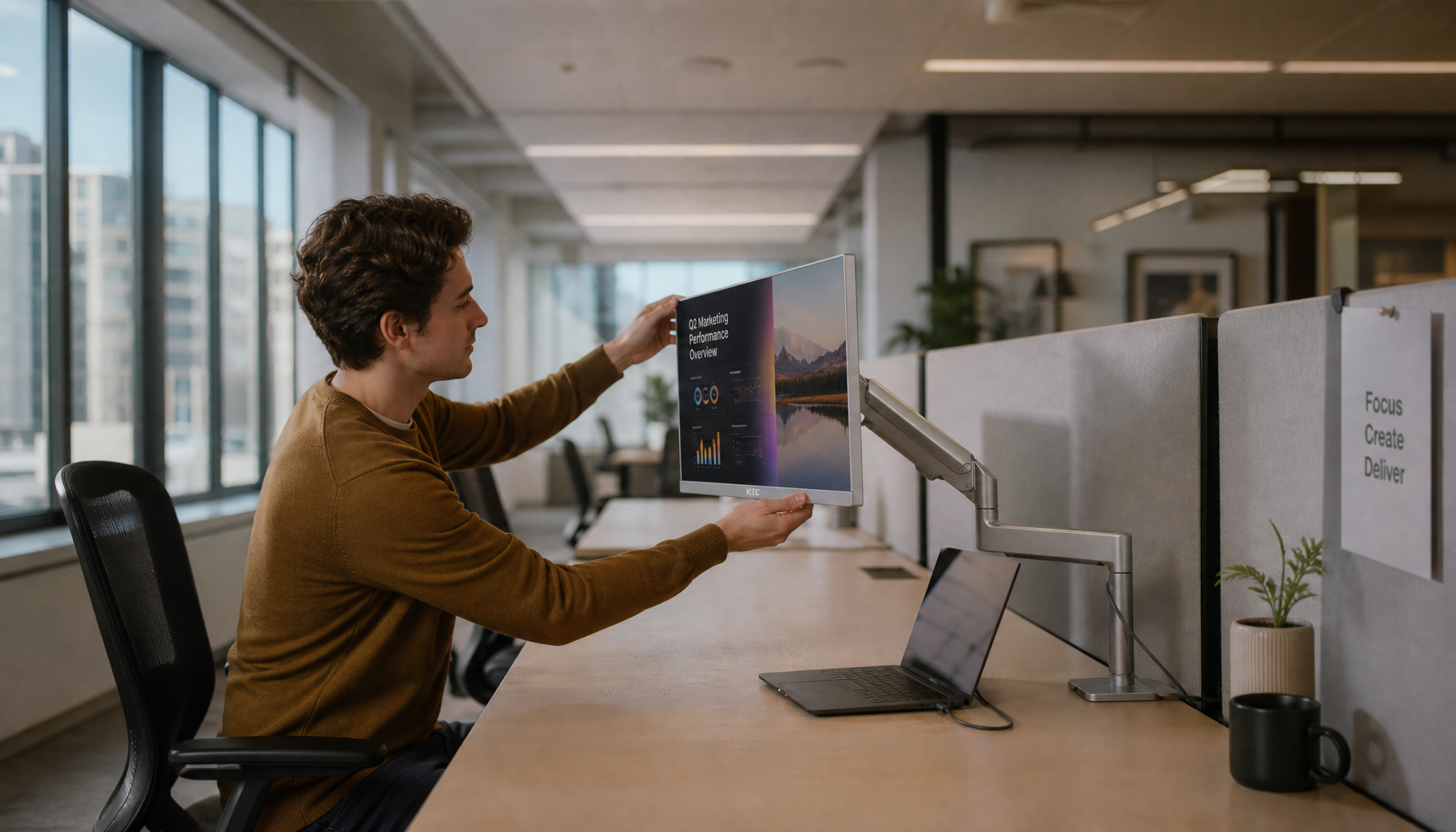
The strongest everyday configuration is a laptop connected to a USB-C monitor by one full-featured USB-C cable, with the cell phone plugged into a USB port on the monitor. A true USB-C monitor can carry video, audio, data, and sometimes power through one cable, making it act like a small docking station; one cable carrying video is the core productivity benefit of this class of display.
Here is the real-world flow. Your laptop uses its USB-C port to send the display signal to the monitor. The monitor, if it has Power Delivery, may also charge the laptop. The phone plugs into the monitor’s USB-A or USB-C downstream port and receives charging power from the monitor’s internal hub. This keeps the laptop’s single USB-C port doing one high-value job: feeding the whole workstation.
The key is that the monitor must have hub functionality, not just a USB-C video input. Some USB-C monitors only accept video and data, while others include Power Delivery and downstream ports for keyboards, mice, storage, Ethernet, and device charging; USB-C docking monitors are built for exactly this kind of one-cable desk.
The Powered Dock Option: Better for Multi-Display and Heavy Charging

If your monitor lacks downstream charging ports, a powered USB-C dock is the safer answer. The laptop connects to the dock through one USB-C cable, the monitor connects to the dock through USB-C, DisplayPort, or HDMI, and the phone plugs into the dock’s USB charging port. This design is more reliable because the dock has its own power supply and is built to divide video, data, and charging across several outputs.
A dock is especially useful when you run a high-resolution monitor, an external webcam, Ethernet, a keyboard, a mouse, and a phone charger at the same time. USB-C docks can expand a single laptop port into display outputs, USB peripherals, wired networking, and power delivery; USB-C docks are the more flexible route when your workstation is more than one screen and one accessory.
For example, a laptop connected to a 27-inch 4K monitor at 60Hz already needs a capable video path. Add a phone charging at meaningful speed and a few USB devices, and the quality of the dock, cable, and laptop port matters. A powered dock with 100W pass-through gives you more margin than an unpowered mini hub, especially if your laptop normally needs 65W to 100W.
Why the Cable Matters More Than It Looks

A USB-C cable can be charge-only, USB 2.0 data-only, full-featured with video support, or capable of higher-bandwidth USB-C protocols. That difference is invisible unless you check markings, packaging, or specs. DisplayPort Alternate Mode uses the USB-C connector’s high-speed lanes for video, and a basic charging cable may not have the wiring needed for a monitor signal; DisplayPort Alt-Mode is one of the advanced functions enabled only by full-featured USB-C designs.
For desk setups, a short, certified cable is the performance-driven choice. Passive USB-C cable length limits shrink as speed rises, with higher-bandwidth USB4 40Gbps runs listed much shorter than basic USB 2.0 cables. In plain English, the 6 ft cable from a random charger drawer may be fine for topping up a phone but wrong for a monitor, dock, and data hub.
If the monitor blinks, the phone charges slowly, or the laptop does not detect the display, test with the cable that came with the monitor or dock first. For high-refresh-rate gaming displays, 4K productivity monitors, or portable smart screens, cable quality is not an accessory detail; it is part of the display pipeline.
Power Budget: The Part That Decides Whether It Feels Reliable

Power Delivery is where many setups fail quietly. A USB-C monitor may provide 15W, 65W, 90W, or 100W depending on the model. A thin office laptop may be satisfied with about 65W, while a performance laptop may need closer to 90W or 100W to avoid battery drain under load. Some USB-C monitors can provide up to 100W of charging power, and USB Power Delivery is the feature that lets compatible monitors charge phones, tablets, or laptops while in use.
Now add the phone. If the monitor is giving most of its power budget to the laptop, its downstream USB port may only provide basic charging to the phone. That can still be useful during a workday, but it may not fast-charge like a wall charger. If you expect laptop charging, monitor output, and fast phone charging from one compact hub, choose a powered dock or monitor with clearly stated downstream charging specs.
The practical calculation is simple: match the monitor or dock’s laptop Power Delivery rating to the laptop first, then treat phone charging as a separate requirement. A 90W USB-C monitor paired with a laptop that needs 65W has more breathing room than a 65W monitor paired with a laptop that can draw 65W under load. If your laptop battery falls while connected, the setup is underpowered even if the display works.
Pros and Cons of Sharing One Laptop Port
Setup |
Best For |
Advantages |
Trade-Offs |
USB-C monitor with built-in hub |
Clean office desk, hybrid work, simple peripherals |
One cable to laptop, fewer desk cables, phone can charge from monitor hub |
Requires monitor with hub and enough Power Delivery |
Powered USB-C dock |
Multi-display workstations, Ethernet, heavier accessories |
More ports, stronger power management, better expansion |
Extra box and power brick on the desk |
Passive USB-C splitter |
Very limited low-power use |
Cheap and compact when it works |
Often unreliable for video plus charging, weak compatibility |
Portable USB-C monitor |
Travel, second screen from laptop |
Minimal gear, fast setup, compact |
May draw power from laptop and reduce battery life |
The benefit is obvious when it is done correctly: one laptop port can become the center of a high-performance, low-clutter workstation. The downside is that USB-C naming is not consumer-friendly, and the connector alone tells you almost nothing about video support, wattage, or charging behavior.
Compatibility Checklist Without the Guesswork
Start with the laptop. Confirm the USB-C port supports DisplayPort Alt Mode, USB4 with display output, or another compatible high-bandwidth display protocol. If the laptop’s USB-C port only handles charging and data, it will not drive a monitor; USB-C display output works only when the device port, cable, and display support the required video features.
Next, check the monitor. Look for USB-C video input, Power Delivery wattage, and downstream USB ports. If the product page only says “USB-C” but does not mention Power Delivery or hub ports, assume less until the manual proves otherwise.
Then check the cable. For monitor use, use a full-featured USB-C cable rated for video, preferably the cable included with the monitor or dock. For high-bandwidth displays and docks, use a cable rated for the required protocol.
Finally, check how the phone charges. Plug the phone into the monitor or dock, not into a passive splitter. If the phone reports slow charging, that may be normal for the downstream port. If fast charging is essential, use a powered dock with a dedicated high-output USB-C charging port or keep a separate wall charger.
Troubleshooting When the Monitor Works but the Phone Does Not
If the monitor is stable but the phone will not charge, the monitor’s downstream port may be data-only or low-power. Try a different USB port on the monitor, because some displays reserve stronger charging for a specific marked port. Also confirm the monitor’s external power supply is connected; some hub features are limited when the display is running from bus power.
If the phone charges but the monitor flickers, suspect bandwidth or cable quality. Poor cables, adapters, and docks can cause flickering, color distortion, input lag, or unstable video output, and display performance depends on the port capability, cable, adapter, dock, resolution, and refresh rate.
If nothing works, simplify the chain. Connect the laptop directly to the monitor with the known-good USB-C cable. Then add the phone. Then add the dock or extra peripherals. This isolates whether the problem is the laptop port, the cable, the monitor hub, or the power budget.
FAQ
Can one USB-C laptop port power a monitor and charge a phone directly?
Usually no, not directly through a simple splitter. The dependable method is to connect the laptop to a USB-C monitor or powered dock, then charge the phone from that monitor or dock.
Will charging my phone reduce monitor quality?
Not if the monitor or dock has enough power and bandwidth. If the device is underpowered or the cable is weak, you may see flicker, disconnects, or slower charging rather than reduced image sharpness.
Do I need a high-bandwidth USB-C protocol?
Not always. A single USB-C monitor can work with DisplayPort Alt Mode. Higher-bandwidth protocols become more valuable for advanced docks, multiple displays, fast storage, and premium workstation setups.
Can a portable USB-C monitor charge my phone too?
Sometimes, but portable monitors are often designed to draw power from the laptop, not distribute extra power to other devices. For travel, expect simpler behavior unless the portable screen clearly lists hub and charging features.
Final Word
You can run a USB-C monitor and charge a phone from the same laptop port when the monitor or dock is designed to manage video, data, and power together. Choose a video-capable laptop port, a full-featured cable, and a powered monitor hub or dock with enough wattage, and that single port becomes a clean, reliable command center instead of a bottleneck.