You cannot force a USB-C monitor past its rated Power Delivery limit, but you can help the monitor, cable, and laptop negotiate the highest wattage they are all designed to support. Verify PD wattage, use a full-featured USB-C cable, connect directly, reduce power conflicts, and confirm that the laptop’s USB-C port supports charging and display at the same time.
Is your laptop still draining battery while plugged into a USB-C monitor that promised one-cable power? In practical setups, a 4K portable display drawing about 12 watts plus a laptop needing about 40 watts already asks for roughly 52 watts, so a weak 30-watt chain can flicker, disconnect, or fail to charge. Here is how to push your USB-C monitor setup to its real maximum without wasting money on the wrong cable, dock, or display.
USB-C Wattage Is Negotiated, Not Forced
A USB-C monitor does not behave like an old barrel-plug charger that simply dumps power into a laptop. USB-C Power Delivery is a negotiation between the power source, the cable, and the laptop. If one part of that chain tops out at 60 watts, your 90-watt monitor will not deliver 90 watts through it.

The practical ceiling is the lowest supported wattage among the monitor’s USB-C PD output, the USB-C cable rating, and the laptop’s accepted charging profile. A monitor advertised with 65-watt PD may be excellent for an ultrabook, but it may only slow battery drain on a workstation-class laptop under gaming, rendering, or heavy multitasking loads. Many office-focused USB-C monitors land around 65 to 90 watts, while gaming-focused USB-C displays often prioritize refresh rate and response time over charging output, sometimes offering only 15 to 18 watts through USB-C.
The key is to stop treating the USB-C shape as the specification. USB-C ports and cables can support different data speeds and power capabilities, so the connector alone tells you very little about the real charging result.
Step One: Confirm the Monitor’s USB-C PD Output

Start with the monitor, because it is the power source in this setup. Look for the exact “USB-C Power Delivery,” “PD out,” or “upstream USB-C charging” wattage in the spec sheet. Do not rely on vague phrases like “USB-C charging” or “single-cable solution.”
USB-C monitor charging can range from 15 watts to 90 watts depending on the model, which is a useful reminder that two monitors from the same manufacturer can behave very differently. A conferencing or creator-focused productivity model may provide enough power for a serious laptop, while a high-refresh gaming model may provide just enough to keep a phone or tablet alive. USB-C monitor categories also show why use case matters: creator and office displays tend to value docking and charging, while gaming displays often reserve engineering budget for speed.
Monitor USB-C PD rating |
Real-world expectation |
Best fit |
15W to 18W |
Maintains small devices, rarely enough for a laptop |
Gaming monitor convenience port |
60W to 65W |
Good for thin productivity laptops |
Office and hybrid work setups |
80W to 90W |
Better for larger laptops under moderate load |
Creator, business, and premium productivity displays |
Up to 100W |
Strongest common USB-C monitor charging class |
Power-hungry laptops that support it |
If your laptop originally shipped with a 130-watt, 180-watt, or larger power adapter, even a 90-watt monitor may not fully sustain peak performance. That does not make the monitor defective. It means the laptop can consume more than the monitor is designed to supply.
Step Two: Use a Cable That Carries Power and Video

The cable is the most common weak link because many USB-C cables are charge-only, data-only, or built for low-speed use. For a USB-C monitor, you want a cable explicitly rated for video plus high-wattage charging. Search for wording such as 100W charging, 4K at 60 Hz video, USB 3.1 Gen 2, 10 Gbps, DisplayPort Alt Mode, or full-featured USB-C.
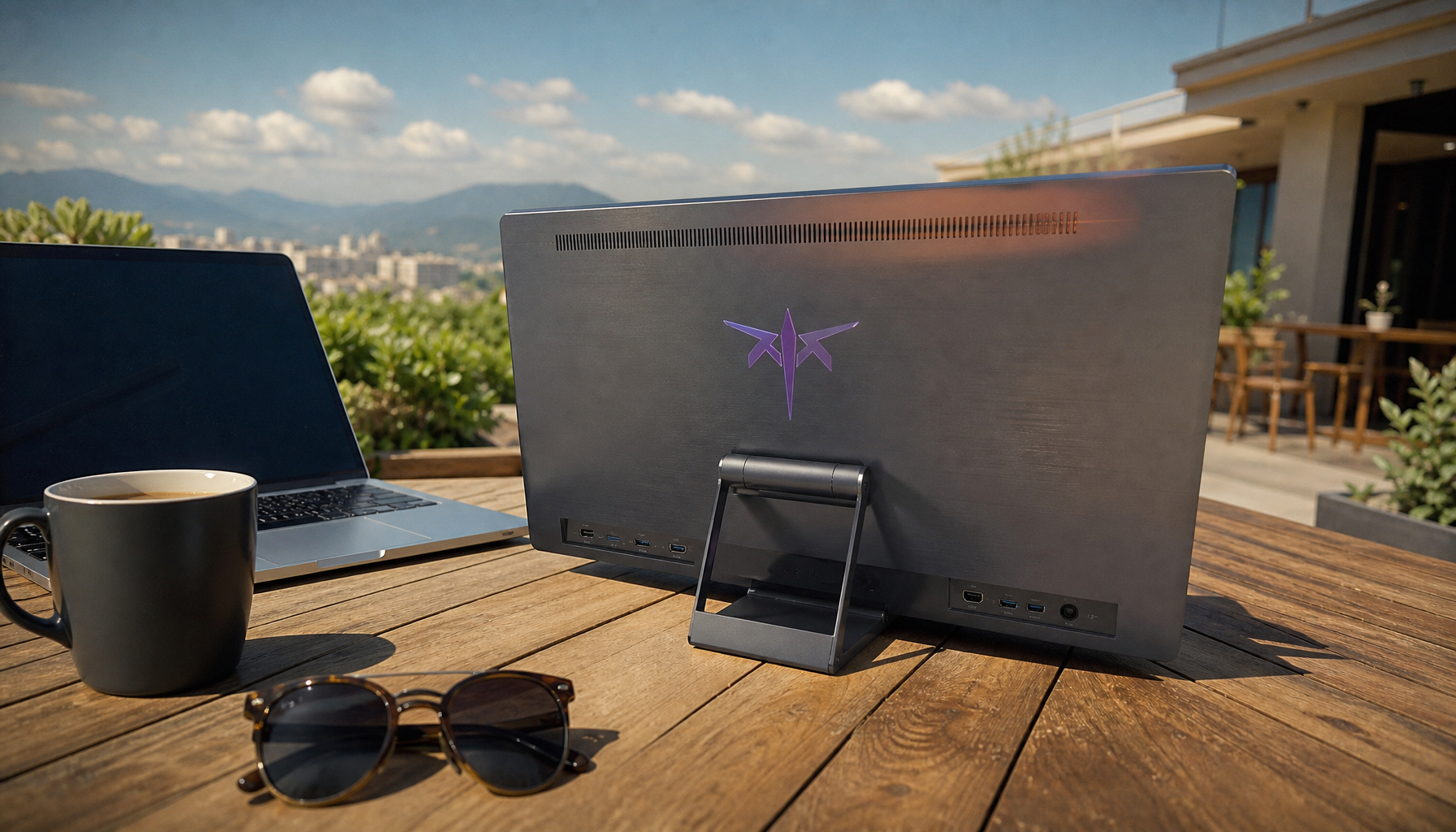
A product listing for a portable external monitor cable, for example, claims 10 Gbps data, 100W charging, and 4K at 60 Hz video support, which are exactly the kinds of specs worth checking before you blame the monitor. A portable external monitor cable still cannot raise a 65-watt monitor to 100 watts, but it can prevent the cable from becoming the bottleneck.
In real use, a suspicious cable often creates mixed symptoms. The laptop charges, but the screen says no signal. The display works, but charging drops in and out. The monitor disconnects when brightness rises or when a USB drive is attached to the monitor hub. Replace the cable with a known full-featured USB-C cable before changing docks, drivers, or monitors.
Step Three: Connect Directly Before Adding a Hub or Dock

To get maximum wattage, remove negotiation complexity. Connect the laptop directly to the monitor’s correct upstream USB-C port with the best cable you have. Avoid a hub, USB-C extension, adapter, KVM, or dock during testing.
Hubs are convenient, but they can split power, introduce display compatibility limits, or require their own PD input to stabilize the chain. Power instability is a frequent reason a USB-C hub fails to detect monitors, especially when external displays, SSDs, Ethernet, keyboards, and mice are all connected at once.
A clean test looks like this in practice: the laptop connects directly to the monitor through one USB-C cable, the monitor is plugged into its wall power, and no extra bus-powered devices are attached to the monitor hub. If wattage improves in that state, the problem is not the laptop or monitor alone. It is the total load on the USB-C chain.
Step Four: Verify the Laptop’s USB-C Port Supports What You Need
Charging through USB-C does not prove that the same port supports video. Video through USB-C does not prove that the port accepts high-wattage charging. You need both capabilities active on the exact port you are using.
For a one-cable monitor setup, the laptop’s USB-C port generally needs USB-C charging support and video support through DisplayPort Alt Mode, USB4, or another display-capable USB-C mode. USB-C is only a connector type, so a port can support charging and data while still failing to output display video.
This matters when a dock or monitor powers your keyboard and mouse but the screen stays black. The data lanes may be working while video support is missing. It also matters when a laptop accepts a small maintenance charge but refuses to draw the monitor’s full available wattage because that model’s USB-C charging profile is limited.
Step Five: Reduce the Monitor’s Own Power Load
A USB-C monitor plugged into wall power should still provide its rated PD output, but portable screens and hub-style monitors can become sensitive when total draw rises. Brightness, HDR, refresh rate, touchscreen layers, speakers, and connected USB devices all increase demand.
Portable monitor research gives a useful baseline: a 1080p USB-C portable monitor often uses about 5 to 8 watts, a QHD model about 8 to 12 watts, and a 4K model about 12 to 15 watts. Power usage increases with higher brightness, higher resolution, faster refresh rates such as 144 Hz, touchscreen support, HDR, and less efficient connections.
For a power-hungry laptop, set monitor brightness around 60% to 70%, turn off HDR when you do not need it, disconnect idle USB devices from the monitor hub, and use the laptop’s own charger during gaming or heavy GPU work. Those changes do not increase the monitor’s PD rating, but they reduce instability and keep the available power focused where it matters.
Step Six: Check Monitor Settings That Affect USB-C Behavior

Some USB-C monitors include settings for USB-C priority, charging mode, power saving, hub speed, or input selection. If the monitor is set to prioritize high USB data bandwidth, it may limit display bandwidth or behave differently with charging and peripherals. If input is not set to USB-C, the laptop may charge while the display remains blank.
This is where the fix becomes less glamorous but highly effective. Open the monitor’s on-screen display, select USB-C as the active input, disable aggressive eco modes during testing, and look for any USB-C charging or compatibility mode. USB-C displays are designed to reduce cable clutter by carrying video, audio, data, and charging through one connection, and some models add hub-style features such as Ethernet and USB peripherals. That convenience works best when the monitor is configured as the center of the desk, not just treated as a passive screen. USB-C display features can provide up to 100 watts on select models, but the exact model setting and port still matter.
Why the Laptop Still Drains Under Load
A laptop can show “charging” and still lose battery during demanding use. That usually means the monitor is delivering power, but the laptop is consuming more than the monitor supplies. A 90-watt USB-C monitor can feel excellent for spreadsheets, coding, meetings, and browsing, then fall behind during gaming, GPU rendering, or large exports.
This is especially common with performance laptops. The CPU and GPU may boost higher when the original power brick is connected, while USB-C charging may be treated as a lower-power mode. In that case, the maximum USB-C monitor wattage is useful for desk cleanliness and battery maintenance, not for replacing the factory charger in every workload.
Pros and Cons of One-Cable USB-C Charging
Approach |
Pros |
Cons |
Direct USB-C monitor connection |
Clean desk, fewer adapters, can carry display and power together |
Limited by monitor PD rating and laptop USB-C support |
USB-C monitor plus hub devices |
Efficient docking-style workflow |
Peripherals can add power and compatibility stress |
Separate laptop charger plus USB-C display |
Best stability for high-performance laptops |
More cables on the desk |
Higher-wattage USB-C monitor |
Better chance of sustaining larger laptops |
Usually costs more and still may not match factory chargers |
Quick FAQ
Can a 65W USB-C monitor charge a laptop that came with a 100W charger?
It can charge many laptops, but it may charge slowly or lose battery under heavy load. The laptop will usually negotiate a supported lower power level rather than forcing the monitor beyond 65 watts.
Will a 100W cable make my monitor deliver 100W?
No. A 100W cable only means the cable can carry up to that amount when the source and device also support it. A 60W monitor remains a 60W source.
Why does my monitor charge the laptop but show no video?
The laptop port, cable, or monitor may not support USB-C video through DisplayPort Alt Mode, USB4, or another display-capable USB-C mode. The USB-C shape alone does not guarantee display output.
Final Word
Maximum USB-C monitor wattage comes from matching the whole chain: monitor PD rating, full-featured cable, laptop port capability, direct connection, and stable settings. Treat the monitor like a performance component, not just a screen, and your one-cable desk becomes cleaner, faster to dock, and far more reliable.