Yes, but only if the USB-C connection carries DisplayPort video and the first monitor supports DisplayPort MST with a DisplayPort Out port. A plain USB-C data or charging port will not daisy-chain monitors, no matter how premium the cable looks.
Staring at two dark monitors after plugging one sleek USB-C cable into your laptop is a familiar desk-upgrade letdown. The practical win is real when the hardware matches: one laptop cable can handle video, charging, and peripherals while a short DisplayPort cable links the second screen. You will know exactly what to check, what to buy, and when to use a dock instead.
The Short Answer: Thunderbolt Is Helpful, Not Mandatory
Thunderbolt is not required for monitor daisy chaining. It is one strong way to do it because Thunderbolt carries high-bandwidth video, data, and power over a USB-C-shaped connector. But USB-C can also support daisy chaining through DisplayPort Alternate Mode and DisplayPort Multi-Stream Transport, often shortened to DP Alt Mode and MST.
The catch is that “USB-C” describes the connector shape, not the full feature set. A laptop USB-C port can be data-only, charge-only, video-capable, or Thunderbolt-capable depending on how the manufacturer wired it. A USB-C port can drive a monitor only when the device, cable, and display support the needed video path.
Think of it like a gaming monitor’s refresh-rate claim. A 240Hz panel still needs the right GPU output, cable bandwidth, and display setting. Daisy chaining works the same way: the chain is only as capable as the laptop port, first monitor, cable, GPU, and OS support behind it.
What “Daisy-Chaining USB-C Monitors” Actually Means
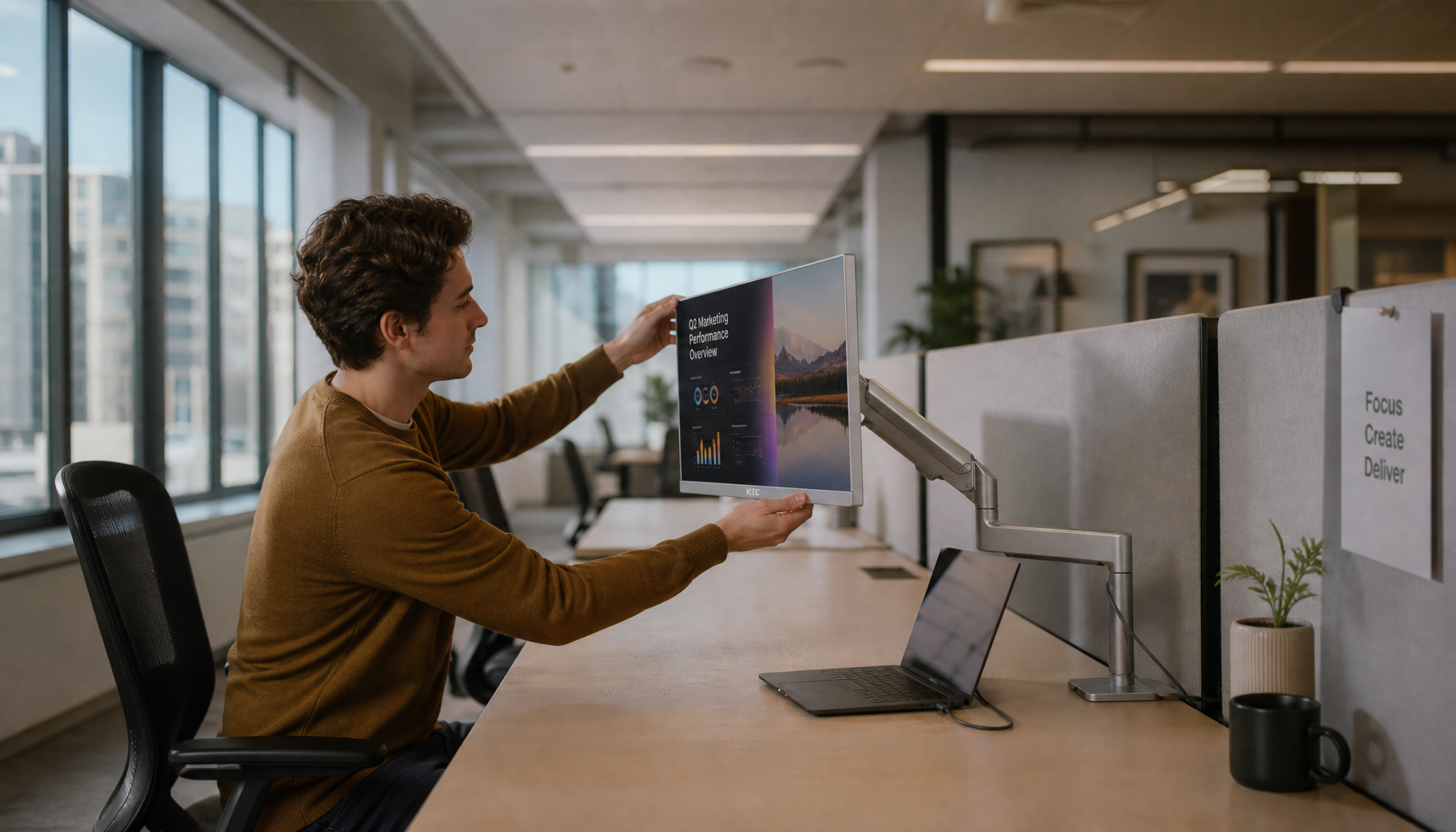
A daisy chain connects displays in sequence. Your laptop connects to Monitor 1, then Monitor 1 passes a video signal to Monitor 2. In a non-Thunderbolt USB-C setup, the most common path is USB-C from the laptop to the first monitor, then DisplayPort Out from the first monitor to DisplayPort In on the second monitor.

The first monitor is the critical hub in the chain. It needs a USB-C input that accepts DisplayPort video and a DisplayPort Out port that can pass MST to the next screen. The second monitor usually only needs a compatible video input, typically DisplayPort In. A campus support workflow for DisplayPort multistreaming describes this exact path: the laptop connects to the primary monitor through USB-C, while the second display connects from the primary monitor’s DisplayPort Out to the secondary monitor’s DisplayPort In using a DisplayPort cable, making DisplayPort Out the deciding connector on the first display.
This is why many USB-C monitors can power a clean desk but still fail at true chaining. A monitor may accept USB-C video and charge your laptop, yet lack DisplayPort Out. That monitor is still useful as a single-cable display, but it cannot pass the image onward.
The Hardware Checklist That Decides Everything
Before buying anything, check the laptop first. The USB-C port must support DisplayPort Alt Mode or Thunderbolt. Since this article focuses on non-Thunderbolt setups, look for “USB-C with DisplayPort,” “DP Alt Mode,” or a small DisplayPort icon near the port. If the spec only says USB 3.x, SuperSpeed USB, charging, or data transfer, it may not output video at all.
The cable also matters. Charge-only USB-C cables are common around desks and bags, and they can power a device while carrying no display signal. For reliable display use, pick a full-featured USB-C cable rated for video and power delivery. Technical laptop-monitor guidance is blunt about USB-C variability: USB-C can carry power, accessories, DisplayPort, and HDMI signals, but USB-C cable and port capabilities vary significantly.
The first monitor must support MST and provide DisplayPort Out. The second monitor should support DisplayPort In. For a typical productivity setup, two 27-inch 1440p displays at 60Hz are a realistic target when the laptop GPU and monitor chain support it. If you try to chain two 4K displays while also running high-speed USB devices through the same monitor hub, you may hit bandwidth limits sooner than expected.

Component |
Must Support |
Why It Matters |
Laptop USB-C port |
DisplayPort Alt Mode |
Sends native video over USB-C without Thunderbolt |
First monitor |
USB-C video input, MST, DisplayPort Out |
Receives the signal and passes it to the next display |
Second monitor |
DisplayPort In |
Accepts the downstream signal |
USB-C cable |
Video-capable, not charge-only |
Prevents blank screens and refresh-rate failures |
Operating system/GPU |
Multiple external displays |
Determines whether screens extend, mirror, or fail |
When It Will Not Work
The most common failure is a USB-C port that does not carry video. A support case involving a laptop with a 5Gbps USB-C port showed the practical limitation: without DisplayPort Alt Mode, the port could not directly connect to an external monitor through a standard USB-C hub, dock, or adapter. That same pattern applies to daisy chaining. If the first monitor never receives native video, it has nothing useful to pass downstream.

Another failure point is HDMI. HDMI is excellent for a direct monitor connection, but it does not support true monitor daisy chaining in the same DisplayPort MST sense. If your laptop has HDMI only, you can still run multiple monitors with the right dock, adapter, or DisplayLink solution, but that is not a native USB-C monitor chain.
Some desktop operating systems deserve special attention. Many setups do not support MST extended displays the same way typical Windows laptops do, even when the monitor hardware has the right ports. A USB-C dock setup may still work for one external display, but one external display by default is common depending on the computer model and dock type. Verify the exact model’s external-display limits before spending money on a chained pair.
USB-C Daisy Chain vs Thunderbolt vs Dock
USB-C MST is the value-oriented route when your goal is a clean dual-monitor desk. Thunderbolt is the performance route when you want more bandwidth, higher display ceilings, fast external storage, and premium docks. A USB-C dock is the practical route when your monitors lack DisplayPort Out or your laptop needs Ethernet, more USB-A ports, SD card readers, or mixed HDMI and DisplayPort outputs.
Setup Type |
Best For |
Main Limitation |
USB-C with DP Alt Mode and MST |
Clean dual-monitor office or productivity desk |
Needs a first monitor with DisplayPort Out |
Thunderbolt chain |
Higher-bandwidth creative, gaming, and power-user setups |
Higher cost and stricter hardware matching |
USB-C dock |
Mixed monitors, Ethernet, accessories, fixed workstations |
Dock specs decide resolution and refresh rate |
DisplayLink adapter |
Laptops without native USB-C video |
Requires drivers and may add latency |
For home office buyers, a USB-C monitor can replace a separate display cable, laptop charger, and USB hub when it includes power delivery and downstream ports. A practical buying target is a 27-inch 1440p IPS USB-C monitor with enough charging wattage for your laptop, since one USB-C cable can reduce desk clutter while keeping text sharp and ergonomics manageable.
A Practical Setup Example
Suppose you have a mainstream ultrabook, two 27-inch 1440p monitors, and you want one-cable docking at your desk. The best configuration is a USB-C cable from the laptop to Monitor 1, then a DisplayPort cable from Monitor 1’s DisplayPort Out to Monitor 2’s DisplayPort In. Monitor 1 should provide enough Power Delivery for the laptop, often 65W for ultrabooks and closer to 90W or 100W for more demanding machines.

Once connected, open your display settings, choose Extend, and drag the display boxes to match your physical layout. If both monitors mirror the same image, look for an MST setting in the first monitor’s on-screen menu and enable it. If the second monitor stays black, lower the resolution or refresh rate temporarily, swap the DisplayPort cable, then confirm the laptop’s USB-C port actually supports DP Alt Mode.
A real-world office detail matters here: cable management becomes easier when the monitors do not require external power bricks and when the first display keeps monitor identity stable during input switching. Community testing around USB-C office displays highlights active EDID as useful because it helps preserve screen layout when inputs change, although active EDID behavior can vary by GPU and connection path.
Pros and Cons of Non-Thunderbolt USB-C Daisy Chaining
The biggest advantage is efficiency. You save laptop ports, reduce cable clutter, and create a cleaner workstation that is easy to dock and undock. For analysts, developers, creators, and competitive players who also work from the same desk, keeping chat, references, timelines, dashboards, or browser windows on a second panel reduces constant window shuffling.
The value case is strong because you do not need to pay for Thunderbolt monitors if your workload is mostly office productivity, coding, research, trading dashboards, or 1440p creative review. It also fits refresh planning well. Enterprise procurement policies often treat monitors as lifecycle peripherals, and university IT procurement practice places peripherals such as monitors on a 3-year refresh cycle, which is a useful reminder to buy for compatibility and supportability, not just the lowest sticker price.
The downside is bandwidth and compatibility. USB-C MST can be less forgiving than Thunderbolt when you push higher resolutions, higher refresh rates, monitor USB hubs, webcams, Ethernet, and storage through the same upstream cable. For gaming, a direct DisplayPort connection from the GPU to the primary high-refresh monitor is still usually the cleaner performance choice, while the chained display can handle chat, streaming controls, browser stats, or productivity windows.
Buying Advice: What to Look For on the Spec Sheet
Do not buy based on “USB-C monitor” alone. Look for USB-C with DisplayPort Alt Mode, Power Delivery wattage, DisplayPort Out, MST support, and the maximum supported resolution and refresh rate in a chained configuration. If the spec sheet only lists USB-C input and HDMI input, assume it is not a daisy-chain monitor unless the manufacturer clearly says otherwise.
For an office-first setup, prioritize 27 inches, 1440p or 4K resolution, height adjustment, tilt, swivel, strong text clarity, and at least 65W Power Delivery. For gaming-adjacent workstations, decide which screen needs the highest refresh rate and connect that one directly when possible. For portable smart screens, daisy chaining is less common; the better goal is single-cable USB-C video and power from a laptop, then use the laptop or dock for the second display path.
FAQ
Can I daisy-chain two USB-C monitors without Thunderbolt?
Yes, if the laptop USB-C port supports DisplayPort Alt Mode and the first monitor supports MST with DisplayPort Out. The second monitor must accept the downstream DisplayPort signal.
Can I daisy-chain through HDMI?
Not as true monitor daisy chaining. HDMI-only setups usually need a dock, splitter with limited mirroring behavior, or another adapter path.
Why does one monitor work but the second one stays black?
The likely causes are MST disabled in the first monitor, no DisplayPort Out on the first monitor, a charge-only USB-C cable, insufficient bandwidth for the selected resolution and refresh rate, or a laptop USB-C port that lacks DP Alt Mode.
Is Thunderbolt better?
Thunderbolt is better for bandwidth-heavy setups, especially multiple 4K displays, fast storage, and premium docking. For a clean dual-monitor productivity desk, USB-C with DP Alt Mode and MST can be the smarter value.
Final Word
You can daisy-chain USB-C monitors without Thunderbolt, but the winning setup is specific: DP Alt Mode from the laptop, MST and DisplayPort Out on the first monitor, and a proper video-capable cable. Match those pieces before you buy, and the result is the kind of clean, fast, reliable desk that makes multiple screens feel like an upgrade instead of a troubleshooting project.