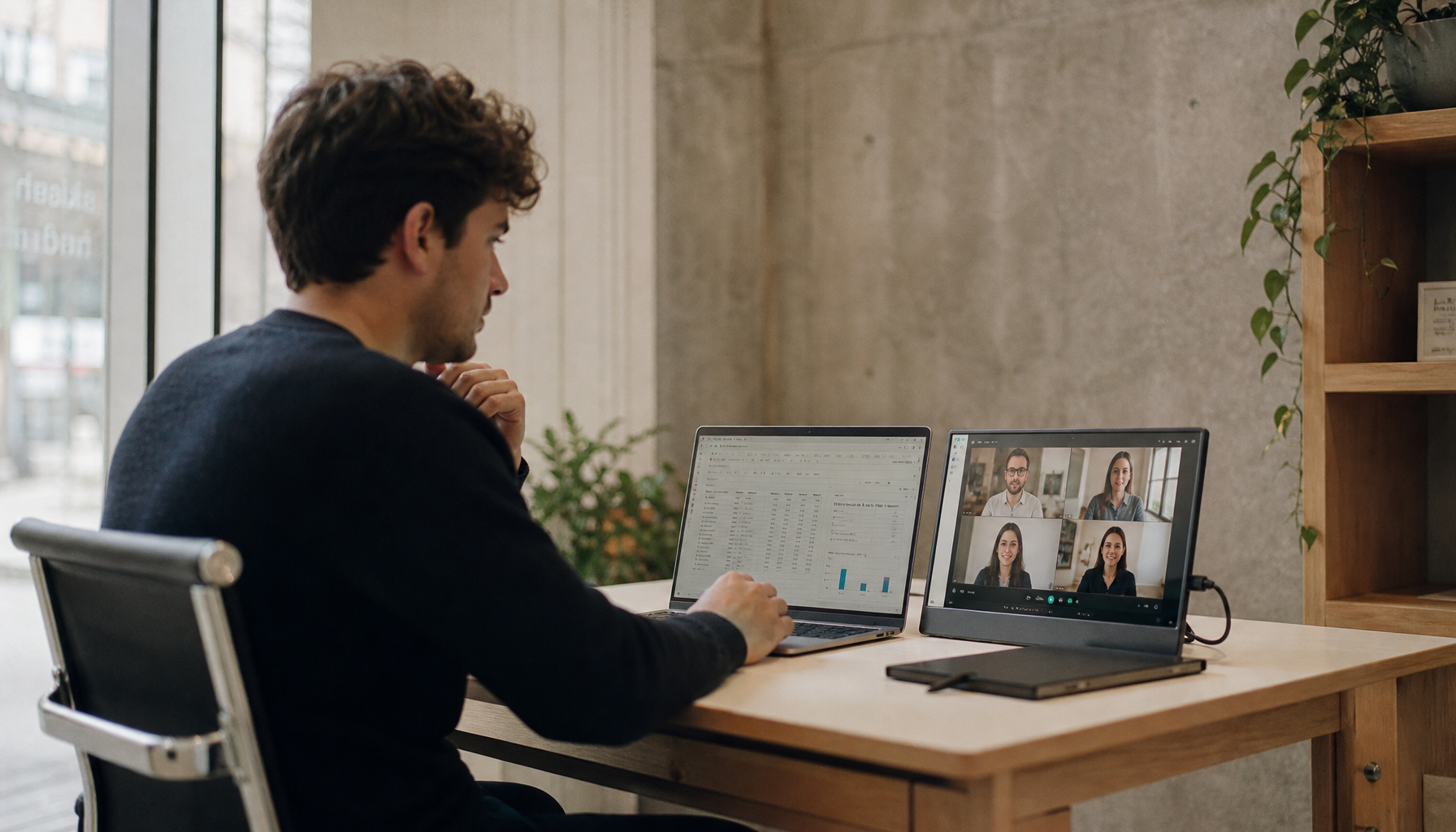
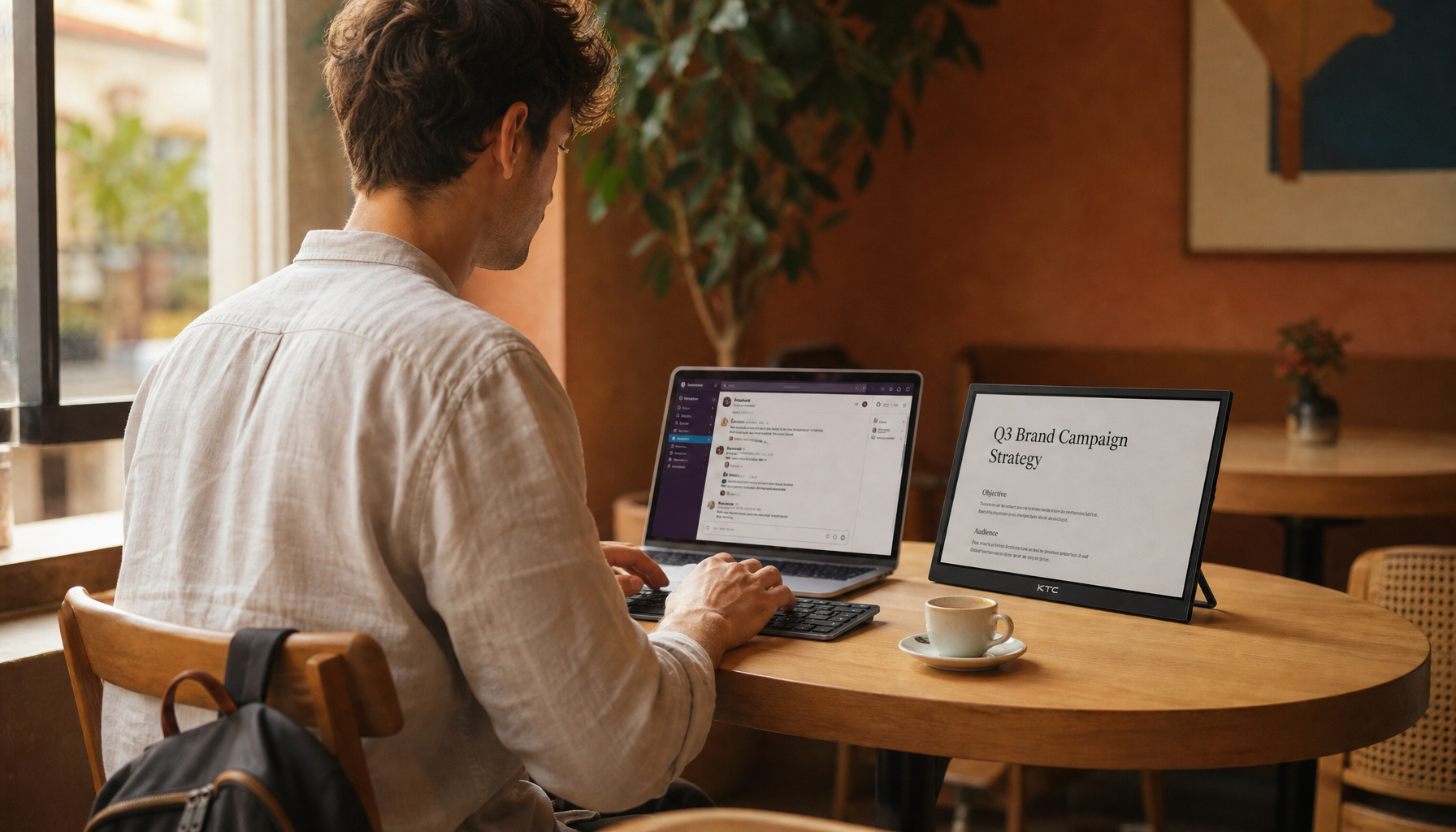
Put your most-used screen directly in front of your chair and keyboard, then angle the second monitor inward so your eyes move more than your neck. If both screens are used equally, center yourself between them and form a shallow V.
Do you finish the day with one side of your neck feeling tighter because your second screen keeps pulling your head sideways? A 10-minute monitor reset can make your work feel more stable by reducing repeated head turns, matching screen height, and keeping your hands aligned with your main task. This setup preserves dual-screen productivity without turning your desk into a neck workout.
Why Second-Monitor Placement Causes Neck Rotation
A second monitor becomes a problem when it turns into a permanent side glance. The risk is not simply having two displays; it is making your neck repeat the same rotation hundreds of times a day while your shoulders, keyboard, and chair stay pointed somewhere else. Poor monitor setup can increase neck flexion, extension, and twisting, especially when the most-used screen is off-center.
Neck rotation means turning your head left or right from a neutral forward position. Neutral posture means your ears sit over your shoulders, your shoulders stay relaxed, and your torso is not twisted toward the screen. In real desk checks, the easiest warning sign is simple: if your chest points to the keyboard but your nose points to the second monitor for long stretches, the monitor is not secondary anymore.
Dual displays are still useful for the right workflow. They reduce window switching, keep reference material visible, and improve control in coding, spreadsheets, design, trading, and communication-heavy work. The ergonomic tradeoff is that screen space must be organized by priority, not by symmetry alone.
The Core Rule: Center the Screen You Use Most
If one monitor carries your main work, place that monitor directly in front of your chair, keyboard, and mouse. For multiple monitors with one primary screen, the most-used display should be centered, with secondary screens beside it rather than forcing you to twist toward the primary task.

For example, a product manager reviewing a dashboard while writing in a document should center the writing screen. The dashboard can sit to the left or right, angled inward, because it is glanced at rather than stared at. A developer who writes code all day should center the IDE and place documentation, logs, or preview windows on the side display.
The biggest mistake is centering the gap between two monitors when one of them clearly gets 70% or 80% of your attention. That looks tidy, but it makes every primary task slightly off-axis. Over a full workday, small rotations can accumulate into stiffness, shoulder elevation, and the familiar end-of-day neck pull.
If You Use Both Screens Equally, Build a Shallow V
Equal-use setups need a different layout. Dual monitors used equally should sit side by side, angled inward, with the user centered between them. This creates a shallow concave shape so your eyes and chair rotation share the movement instead of asking your neck to do all the work.

A practical setup is to bring the inner bezels close together, pull both monitors to a similar distance, then angle each screen inward about 10 to 20 degrees. Dual-screen ergonomic guidance also supports a slight V shape and a viewing angle range that limits excessive twisting.
Think of a financial analyst comparing two spreadsheets or a video editor moving between timeline and preview. If both displays are truly active, the centerline should run through the join between the screens. If one screen gradually becomes the real work display, reset the layout and center that one instead.
Workflow |
Best Position |
Main Benefit |
Tradeoff |
One dominant screen |
Primary centered, secondary angled inward |
Least neck rotation for focused work |
Secondary content is less central |
Equal screen use |
User centered between two angled screens |
Balanced scanning across both displays |
More eye movement and chair swiveling |
Laptop plus monitor |
External monitor centered, laptop raised beside it |
Better posture than looking down |
Laptop screen may be best for reference only |
Wide or large displays |
Farther viewing distance, stronger inward angle |
Less edge-to-edge head movement |
Requires deeper desk space |
Height and Distance Matter as Much as Angle
Second-monitor angle solves rotation, but height solves neck tilt. Monitor height recommendations commonly place the upper viewing area near the forehead or top third of the screen so the head can stay stacked over the shoulders. Other ergonomic guidance frames it as the top of the screen at or slightly below eye level, with the gaze falling slightly downward toward the center.
The practical target is this: sit back in your chair, relax your shoulders, and look straight ahead. The top third of your main screen should meet that relaxed line of sight. If the display is too high, you extend your neck. If it is too low, you tend to drop your chin or hunch forward.

Distance should start around arm’s length. A monitor should generally be about arm’s length away, close to your fingertips when seated upright with your back supported. Larger monitors need more distance because the outer edges sit farther from your centerline. A 27-inch screen often feels better around 3 to 4 ft away, while a 32-inch screen may need roughly 5 ft depending on text size, resolution, and eyesight.
Do not solve unreadable text by leaning forward. Increase scaling, raise font size, or choose a sharper display. For gaming and productivity screens, pixel density and panel size matter: crisp text lets you sit farther back without squinting, and that extra distance reduces the amount your neck must rotate to see the corners.
Angle the Second Monitor Toward Your Face, Not Your Wall
The secondary display should face your seated position. A secondary monitor should be angled inward, especially when one monitor is used most often and the second sits off to the side. A flat, side-by-side wall of screens looks clean in photos, but it often makes the outside monitor harder to read and encourages head rotation.
Use a simple test. Open a dense page of text on the second monitor, sit normally, and read a few lines without leaning. If the far edge feels farther away or dimmer, rotate the monitor inward. If you need to move your whole head before your eyes can land on the content, bring the monitor closer to the primary display or reduce its angle from your body.
For a 24-inch or 27-inch secondary screen, a modest inward angle is usually enough. For a larger secondary display, especially 32 inches or ultrawide, you may need more distance and a stronger curve around your seated position. Larger ultrawide displays can improve multitasking, but shallow desks may make them feel overwhelming or require more head movement.
Use Chair Swivel for Glances, Not Neck Twisting for Work
A strong dual-monitor setup lets your chair participate. If the second screen needs more than a quick glance, swivel your chair slightly so your chest follows your eyes. This is especially important for laptop-plus-monitor setups, where the laptop often sits lower and off to the side.

For two monitors plus a laptop, the better pattern is to establish a primary screen, keep displays close together, and swivel rather than twisting the neck or torso. In practice, that means the external monitor usually becomes the main display, while the laptop becomes a reference, chat, or call screen raised near the same height.
Input devices must match the same logic. If your keyboard stays centered to the desk but your main monitor sits left, your body is split between two directions. A neutral workstation starts with the chair and monitor positioned so the head is not tilted forward, turned sideways, or held in a strained position while working.
Match Screen Roles to Real Work
The cleanest dual-monitor setups assign each screen a job. Keep active creation, decision-making, or high-precision control on the centered display. Put reference material, chat, music, dashboards, previews, or documentation on the secondary screen. Multiple-monitor setups improve efficiency when they reduce clutter and let people view documents, apps, and communications side by side.
For gaming, keep the game centered and use the second screen for stream controls, chat, hardware monitoring, or a build reference. For office productivity, keep the document, spreadsheet, or customer record centered while email or calendar sits off to the side. For portable smart screens, use the portable panel as a light secondary display rather than forcing your main laptop screen into a low, off-center posture.
There is one exception: if the second monitor becomes the focus for a long session, promote it. Move the window to the centered screen, or rotate your chair and input devices so your body faces it. Ergonomics is not a one-time cable-management project; it is a performance layout that should follow the task.
When a Monitor Arm Is Worth It
Factory stands often fall short for dual-screen ergonomics because they offer limited height, depth, and rotation. A monitor arm can help create enough viewing distance on shallow desks and make it easier to align two screens at the same height.
The value is highest when your desk is shallow, your monitors are different sizes, or you switch between sitting and standing. Arms also help with portrait orientation, which can be useful for code, long documents, chat, and reference feeds. The downside is compatibility: you need to confirm mounting support, weight capacity, desk clamp clearance, and cable reach before buying.
A reliable adjustment sequence is chair first, main monitor second, secondary monitor third, and input devices fourth. Set your feet flat, knees near 90 degrees, and back supported. Then center the primary screen, match the secondary screen height, angle it inward, and bring the mouse close enough that your shoulder does not reach forward.

Quick Self-Check Before You Call It Done
A good second-monitor position passes three practical tests. Your most-used screen is directly in front of your nose, keyboard, and chair. Your second screen can be read with mostly eye movement and a small chair swivel. Your shoulders stay relaxed while your mouse and keyboard remain close to your body.
If glare forces you to turn or lean, fix the light source too. Glare can be checked by turning the screen off while seated normally and looking for reflections on the dark panel. Position screens at a right angle to windows where possible, or control natural light with blinds or curtains.
Breaks still matter. Even a well-positioned display cannot make static posture disappear. Short pauses every 30 to 40 minutes, a few shoulder rolls, and a distant gaze reset keep the setup working after the first hour.
FAQ
Should my second monitor be on the left or right?
Place it on the side that matches your workflow and visual comfort, but do not let preference override posture. If you constantly drag work to that side and stay there, make that monitor the primary display or move the main task back to the centered screen.
Is a vertical second monitor better for neck pain?
A vertical second monitor can reduce horizontal footprint and make documents, code, and chat easier to scan. It is not automatically more ergonomic, though. The top should still stay near eye level, the screen should remain close to the primary monitor, and the panel should angle inward.
Should both monitors be the same size?
Matching size and resolution makes alignment easier and reduces scaling friction. Mixed monitors can work well, especially a sharp primary display with a smaller reference screen, but viewing height and distance need more careful adjustment.
The best second-monitor position is the one that respects attention. Center what you use most, angle what you reference, and let your chair move before your neck has to. That is how a dual-display setup stays fast, immersive, and comfortable through a full workday.