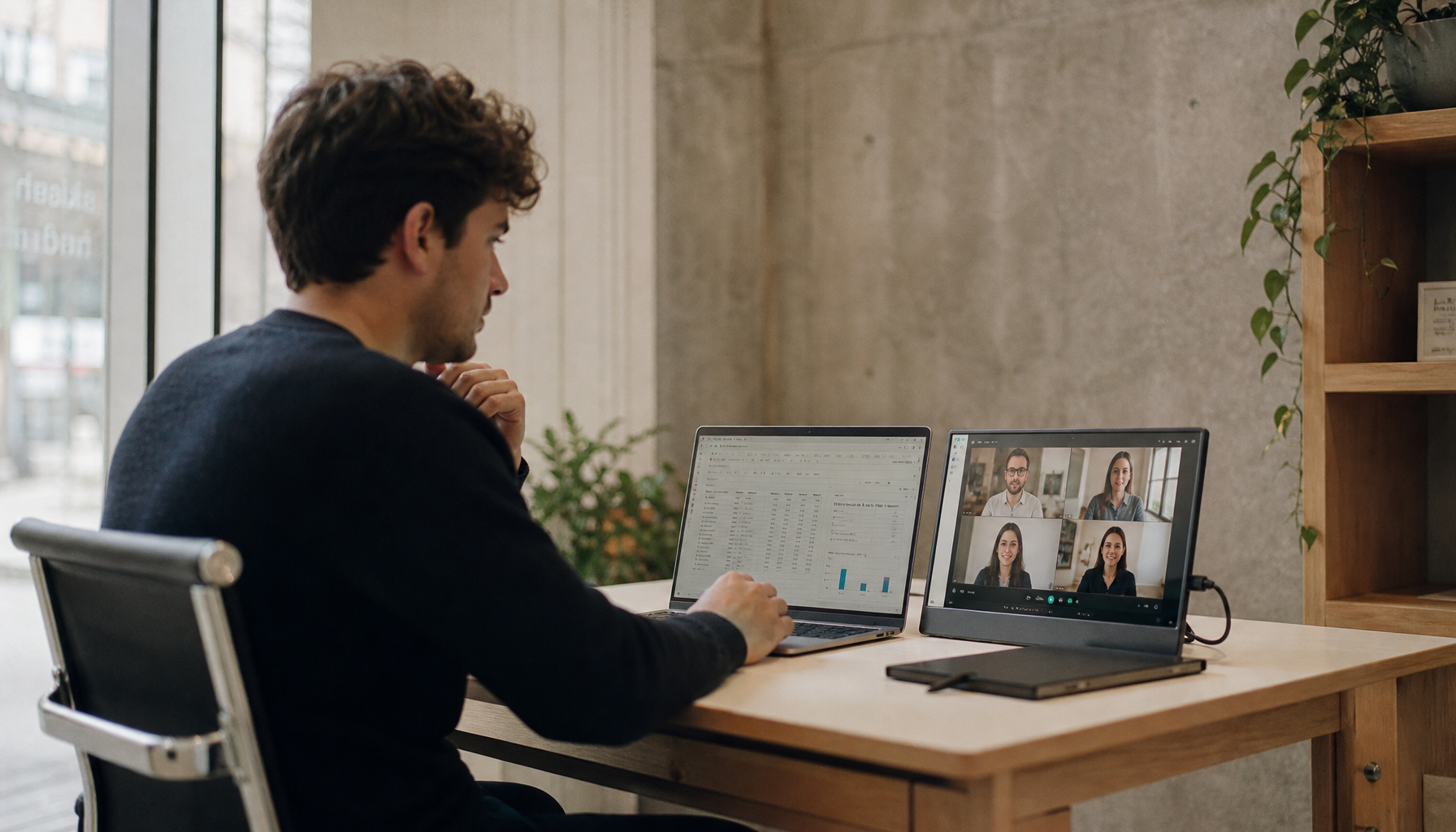
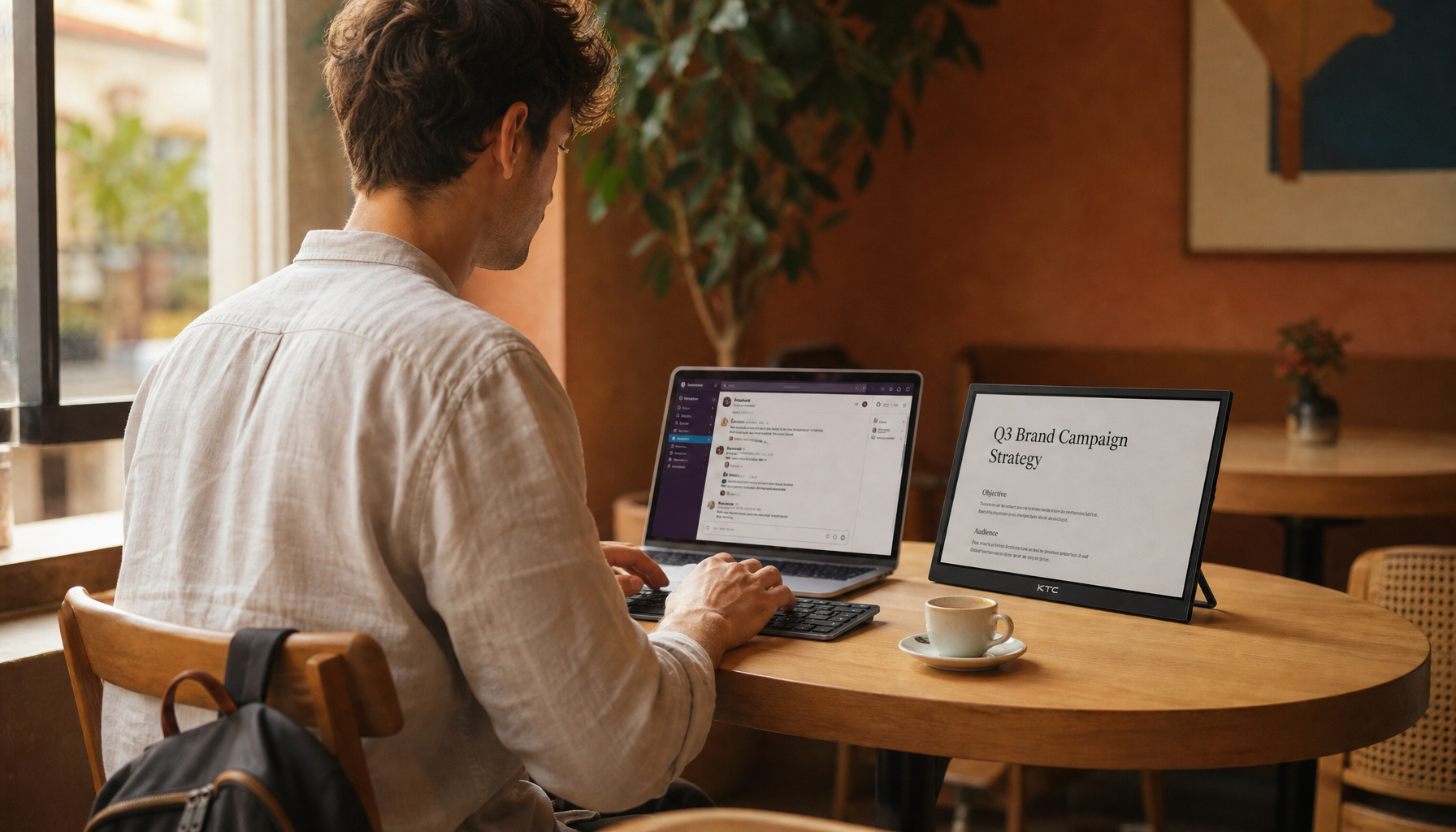
A comfortable brightness setting does not prevent headaches if your screen forces your head, neck, and eyes into a strained position. Looking down too far can combine neck muscle load, dry-eye strain, focusing effort, and posture fatigue into one headache trigger.
Do you finish a focused work block or ranked match with pressure behind your eyes, tight shoulders, and a dull forehead ache, even though the screen does not feel too bright? A simple height, distance, and tilt reset can make the main content land in a relaxed gaze zone instead of making your neck and eyes carry the session. You will leave with a practical monitor setup you can test at your desk today.
The Real Problem Is Usually Angle, Not Brightness
Brightness is only one part of screen comfort. A monitor that sits too low makes you bend your neck forward and down, which can load the muscles around the upper back, shoulders, and base of the skull. That tension can feel like a screen headache even when the panel brightness is dialed in.
Digital eye strain can include headaches, blurred vision, dry or irritated eyes, neck pain, and shoulder discomfort after prolonged screen use, and digital eye strain is not caused by brightness alone. In real desk setups, the pattern is usually mixed: your eyes are focusing at a near distance, your blink rate drops, your shoulders creep upward, and your head drifts forward as you chase text on a poorly placed screen.
The key definition is simple. An ergonomic monitor position is a screen location that lets you sit upright, keep your ears roughly over your shoulders, view the main content with a gentle downward gaze, and read without leaning, squinting, or craning.
Why Looking Down Can Trigger Headaches
Neck Flexion Loads the System
When your monitor is too low, your head tends to move forward and downward. That position asks the neck and upper back muscles to hold a static load for minutes or hours. It may not hurt immediately, but during long editing, coding, spreadsheet, gaming, or video-call sessions, that load accumulates.

A good posture target is not military-stiff. It is stable and relaxed: back supported, shoulders down, elbows near a right angle, feet planted, and screen directly in front. Monitor placement should keep the top of the screen around eye level and the display about an arm’s length away, with lower placement sometimes needed for progressive lenses.
A real-world check is fast. Sit back in your chair, close your eyes, breathe out, and open your eyes. If your gaze lands on the desk, keyboard, bottom bezel, or lower third of the screen, your display is probably asking your neck to work harder than it should.
Your Eyes Work Harder When Posture Collapses
Looking down too much often pairs with leaning forward. That shortens viewing distance and increases focusing demand. If the screen is too close, your eyes must converge inward and maintain near focus for long periods. If the screen is too far, you may squint or crane forward. Both patterns can contribute to eye fatigue and headache.
The practical target for most 24-inch to 27-inch desktop monitors is roughly 20 to 30 inches from your eyes. For larger 32-inch displays and ultrawides, more distance usually feels better because you need to see the whole canvas without constant head scanning. If text becomes hard to read at that distance, increase operating system scaling, browser zoom, app interface size, or in-game HUD size before pulling the screen closer.
Dryness Can Masquerade as a Brightness Problem
During intense screen use, people blink less often. That can destabilize the tear film and create burning, gritty eyes, blurred focus, and forehead pressure. This is why reducing brightness may help a little but not solve the headache: the eyes still need movement, refocusing breaks, and a monitor angle that does not force a wide-eyed stare.
The 20-20-20 rule is a useful baseline: every 20 minutes, look at something at least 20 ft away for 20 seconds. For productivity displays, set a quiet timer or use natural task breaks. For gaming, use loading screens, matchmaking queues, or round resets as recovery points.

The Best Monitor Height for Headache Prevention
For most users with single-vision lenses or no corrective lenses, place the top edge of the monitor at or slightly below eye level. Your main working area should sit a little below your straight-ahead line of sight, so your eyes look slightly downward while your head stays neutral.

Many ergonomic recommendations converge around a mild downward gaze, often around 10 to 20 degrees for general work. Screen posture advice also notes that users with bifocal or progressive lenses may need the monitor lower and tilted slightly back so they are not tipping the head backward to see through the lower lens area.
Setup Type |
Better Starting Point |
Why It Helps |
24-inch to 27-inch office monitor |
Top edge at or slightly below eye level, 20 to 30 inches away |
Keeps text readable without neck flexion or leaning |
32-inch display |
Slightly farther back, main content below eye level |
Reduces head movement across a larger panel |
Ultrawide or curved monitor |
Align the active center content, not just the top edge |
Keeps the primary work zone in the relaxed gaze path |
Raise the laptop and use a separate keyboard and mouse |
Avoids the classic downward laptop hunch |
|
Progressive lenses |
Lower screen slightly and tilt back |
Reduces neck craning through the lower lens area |
The strongest setup move for laptop users during long sessions is to separate viewing from typing. Raise the laptop screen to viewing height, then use an external keyboard and mouse. A laptop is compact and portable, but its screen and keyboard are physically tied together, which usually means either your hands or your head loses.
Brightness Can Be Comfortable While Lighting Still Fails
A screen can feel comfortable in isolation but still fight the room. If the wall behind the monitor is dark and the display is bright, your eyes keep adapting between high-contrast zones. If a window reflects off the panel, your eyes work harder to resolve text through glare.
Balanced lighting matters because room lighting and monitor brightness should work together to reduce eyestrain. Put windows to the side when possible, not directly in front of or behind the screen. A simple glare test works well: sit normally, turn the monitor off, and look for reflections on the dark panel. If you see a window, lamp, or bright ceiling patch, reposition the screen, adjust blinds, or change the light angle.
For evening gaming or deep-focus work, soft bias lighting behind the monitor can reduce the contrast between the display and the wall. This does not need dramatic colored effects. A neutral, low-glare backlight is often enough to make blacks feel cleaner and reduce visual adaptation fatigue.

Pros and Cons of Common Fixes
A monitor arm is the cleanest performance upgrade for many desks because it lets you tune height, distance, depth, and tilt without stacking books under the stand. The downside is cost, installation effort, and the need for a desk that can handle a clamp or grommet mount.
A riser is cheaper and stable, but it usually fixes only height. If the screen ends up too close, too far, or poorly tilted, the riser can solve one problem while leaving another in place.
A larger monitor can reduce squinting and improve productivity, especially for spreadsheets, timelines, coding, or multitasking. The tradeoff is that a larger display often needs more desk depth. Put a 32-inch screen at the same distance as a small laptop panel, and you may create more head movement and visual scanning than comfort.
Blue-light filters can help some people feel better in the evening, especially if sleep disruption is part of the headache pattern. Still, immediate screen headaches are often more strongly tied to glare, contrast, posture, flicker, dryness, and viewing distance. For migraine-prone users, screen exposure can be one of several triggers, so reducing total uninterrupted screen time may matter as much as changing the color temperature.
A Fast Desk Reset You Can Test Today
Start with your chair, not the monitor. Sit back with your lower back supported, feet flat, shoulders relaxed, and elbows near a right angle. Then place the monitor directly in front of your torso and keyboard.
Set the screen about an arm’s length away. If your fingertips can barely reach the panel while your back stays against the chair, you are in the right range. Raise or lower the display so the top edge is at or slightly below eye level. Tilt the monitor back slightly, just enough that the surface faces your eyes without making you lift your chin.
Now test with real work for five minutes. Open the document, dashboard, game HUD, or editing timeline you actually use. If your chin drops, raise the monitor a little. If your chin lifts, lower it. If you lean forward, increase scaling or font size before moving closer. If your shoulders tighten, check keyboard and mouse position; screen headaches often start below the screen.
When to Treat It as More Than Ergonomics
If headaches are frequent, severe, sudden, or paired with double vision, persistent blurry vision, weakness, confusion, nausea, vomiting, flashes of light, or speech trouble, do not treat the monitor as the whole answer. Medical evaluation is the right move.
For recurring but non-urgent symptoms, an eye exam is also practical. Uncorrected vision, outdated prescriptions, contact lens dryness, and progressive-lens mismatch can all make a technically good monitor setup feel wrong. Frequent headaches during or after screen use may point to digital eye strain, but vision correction and workstation setup should be checked together.
Build the Screen Around Your Body
Comfortable brightness is a good start, not the finish line. A high-performance display should meet your natural posture: centered, arm’s length away, slightly below straight-ahead gaze, glare-controlled, and readable without leaning. When the screen stops pulling your head down, your eyes and neck can stop paying the hidden cost of every work session.