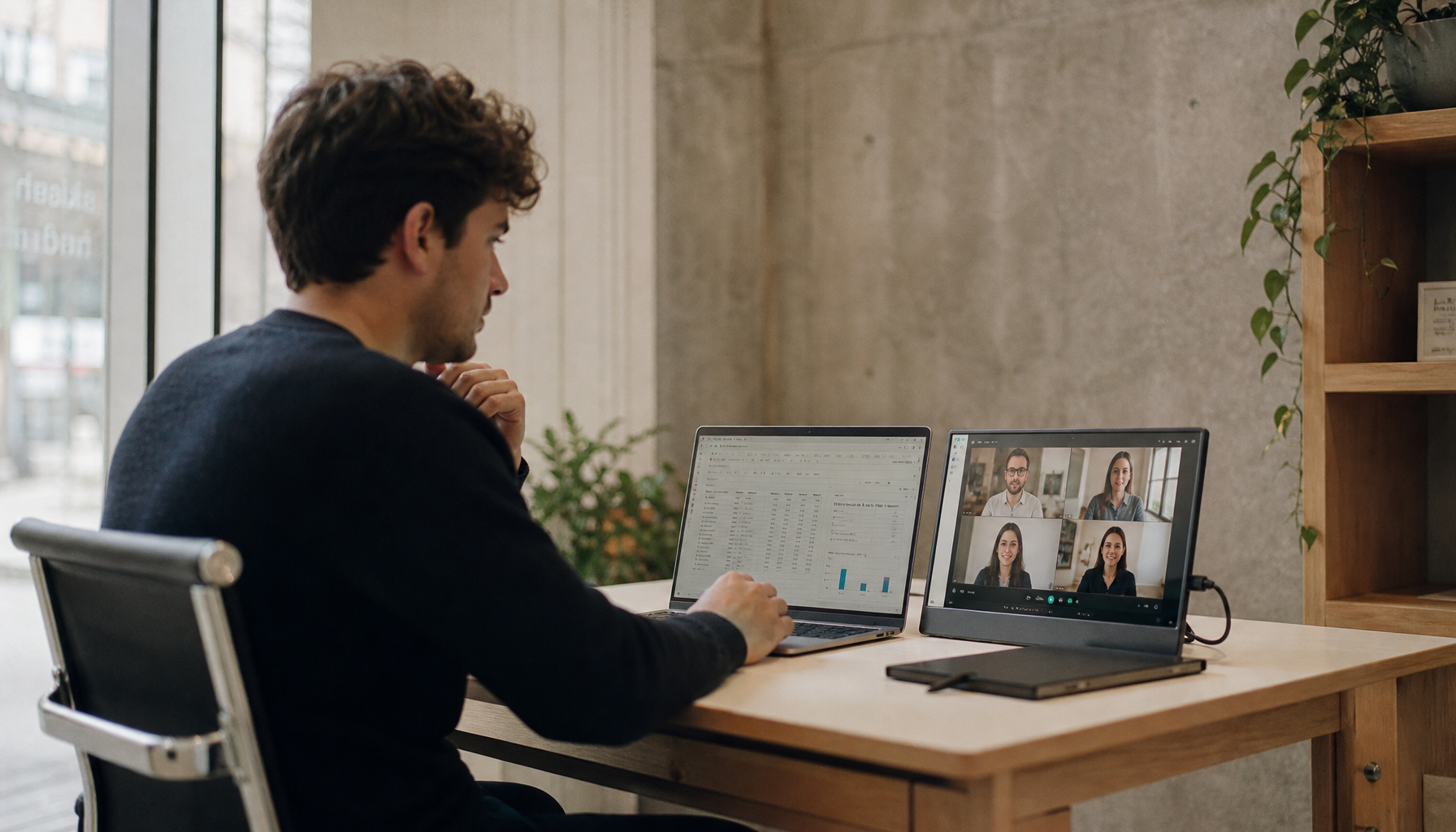
Digital nomads are switching because portable monitors offer desktop-like focus, easier multitasking, and better posture without tying them to a fixed office.
Ever lose your place while jumping between a client brief, team chat, a spreadsheet, and a video call on one 13-inch laptop screen? A well-matched portable monitor keeps active work and reference material visible at the same time, making the benefit practical from the first setup. Here is how to decide whether the extra screen is worth the space in your bag.
The Laptop-Only Workflow Is Hitting a Ceiling
Laptop-only work is clean, light, and simple, but it becomes fragile when the job needs context. Writing while referencing research, coding while previewing a build, editing a deck while reviewing client comments, or running a meeting while reading notes all force the same behavior: constant window switching.
That switching is the real productivity tax. A portable monitor extends or mirrors your laptop screen through USB-C or HDMI, giving remote workers more room for documents, dashboards, calls, and creative tools without carrying a desktop monitor.
The difference is easy to feel in a cafe. Put the draft or spreadsheet on the laptop, place reference material or chat on the second screen, and the workspace stops collapsing every time a notification or browser tab gets involved. For nomads billing by output, not by desk time, that matters.

What a Portable Monitor Setup Actually Means
A portable monitor is a slim external display designed to travel with a laptop, tablet, phone, or handheld device. Most useful travel models sit around 13 to 17 inches, with many mainstream recommendations clustering around 14 to 15.6 inches because that size still fits in a backpack while adding meaningful workspace.
A travel monitor is not just a smaller desktop screen. The travel version has to survive movement, set up quickly, and connect reliably in imperfect spaces like hotel desks, airport lounges, coworking booths, and kitchen tables.
The strongest setups usually pair the monitor with a compact stand, a separate keyboard, and a mouse. That lets the laptop sit higher, the monitor align beside it, and the keyboard stay at a comfortable typing height. Without that ergonomic layer, you get more pixels but may still end up hunched over the machine.
Why the Switch Is Happening Now
The shift is happening because the trade-off has improved. Portable monitors used to feel like specialist gear; now there are lighter, cheaper, sharper models with USB-C, protective covers, kickstands, touchscreen options, and high-refresh panels.
For most remote workers, the practical win is not a dramatic spec sheet. It is a calmer layout. A second screen reduces tab switching, keeps reference material visible, and helps recreate the productivity rhythm of a home multi-monitor desk while traveling.
A consultant can keep a video call on one screen and a proposal on the other. A writer can keep notes beside the draft. A designer can preview output while keeping tools open. A trader or operations lead can watch dashboards without burying the main task. These are normal modern work patterns that laptop screens compress badly.
The Productivity Case: More Room, Fewer Mistakes
The best reason to switch is not more screen space. It is less cognitive friction. When the tools you need stay visible, you spend less time remembering where something was and more time acting on it.
A portable travel monitor supports work from different destinations by adding lightweight screen space that can be packed and deployed quickly. That flexibility is why digital nomads are adopting them: the setup moves with the workday instead of forcing the workday to shrink around the laptop.
A simple calculation shows the value. If switching between windows costs only a few seconds each time, and you do it hundreds of times during research, production, or client communication, the lost attention stacks up fast. The monitor does not make you faster by magic; it removes repeated interruptions from the physical layout of your work.
The Ergonomics Case: Your Neck Knows the Difference
A laptop screen is usually too low for long sessions. The keyboard and screen are attached, so if the keyboard is comfortable, the screen is often below eye level. If the screen is raised, the keyboard becomes awkward. A portable monitor setup lets you separate those decisions.

The comfort benefit is especially clear during multi-hour work blocks. A second screen to a laptop can provide a larger viewing area than a laptop or phone, which may reduce eye strain and support better posture during travel work.
The best field setup is practical: raise the laptop or monitor so your gaze is closer to level, keep the keyboard and mouse on the table, and avoid twisting your neck toward a side screen for hours. If the portable monitor is your main reading surface, place it directly in front of you and use the laptop as the secondary screen.
The Buying Decision: Size, Resolution, Power, and Ports

Digital nomads should buy around workflow, not around the most dramatic spec. A 15.6-inch 1080p screen is often the best value for general productivity because it is large enough for documents and calls but still bag-friendly. A 14-inch model is better for minimalist travel. A 17-inch model feels more immersive, but the extra space and weight matter on every airport walk.
A USB-C port with DisplayPort Alternate Mode can carry video, data, and power through one cable, while ordinary USB-C or USB-A ports may not support video output. This is the compatibility detail that prevents many failed setups.
Use case |
Best-fit portable monitor style |
Practical reason |
Writing, research, admin |
14- to 15.6-inch 1080p USB-C |
Fast setup, good text space, reasonable weight |
Spreadsheets and coding |
15.6- to 17-inch, preferably 16:10 |
More vertical room for rows, logs, and documents |
Photo, video, design |
Higher resolution with strong color accuracy |
Better detail and more reliable creative review |
Gaming after work |
1080p or 1440p with high refresh rate |
Smoother motion and lower blur |
Presentations and annotation |
Touchscreen with stable stand |
Easier markup and client-facing interaction |
Resolution should match screen size and task. Full HD is acceptable for typical office productivity on smaller screens. QHD or 4K can help with creative work and sharper text, but higher resolution often costs more and can increase power demand. Brightness also matters; a dim panel that looks fine at night may struggle beside a sunny hotel window.
Power Is the Part Many Buyers Underestimate
Portable does not mean powerless. Every monitor needs electricity, and the source affects how reliable your setup feels on the road.
Small, efficient portable monitors often run from a laptop through USB-C Power Delivery, while larger, brighter, touch-enabled, high-resolution, or high-refresh models may require separate power. That is why two monitors with the same screen size can behave very differently in a cafe.
For a practical nomad kit, assume your monitor may drain your laptop faster. Carry a capable USB-C charger, a spare video-capable USB-C cable, and a compact power bank if you often work away from outlets. If your laptop has HDMI but not full-featured USB-C, expect one cable for video and another for monitor power.
Pros and Cons Before You Pack One
The upside is clear: a portable monitor can make a temporary workspace feel organized, focused, and closer to a real desk. It improves side-by-side work, supports calls with notes, helps creative review, and can double as an entertainment display after hours.
The downside is also real. You add weight, cable management, setup time, and another fragile surface to protect. Budget models may have weak stands, limited brightness, washed-out contrast, or unreliable accessories. Premium models solve some of those issues but can cost enough that the value depends heavily on your work.
A portable monitor for laptop search can show how broad the category has become, but search pages alone are not enough for a decision because product-level specs, included cables, brightness, warranty, and verified reviews change the real value.
A Practical Setup That Works for Most Nomads

For a dependable first setup, choose a 14- to 15.6-inch IPS portable monitor with 1080p resolution, USB-C plus HDMI, a protective case, and a stand that does not collapse under light table movement. Add a compact keyboard and mouse if you plan to raise your laptop screen. Keep one short USB-C cable for everyday use and one HDMI cable for older machines or shared devices.
Some portable monitors show the category split clearly, with models aimed at mobile productivity, creative color work, touch input, gaming, and entertainment. That segmentation is useful: the best display for spreadsheets is not automatically the best display for editing video or playing at high refresh rates.
Before buying, check your laptop’s exact ports, whether USB-C supports video, whether the monitor includes the right cable, and whether it can stand in portrait mode if you read long documents or code. Also check the return policy, because portable monitor quality varies sharply at the low end.
When Laptop-Only Still Makes Sense
Laptop-only is still the right choice for ultra-light trips, short work sessions, or roles that mostly involve email, messaging, and simple browser tasks. If you work from cramped airplane trays or move every hour, the second screen may stay in the bag.
A portable monitor earns its place when your daily work involves comparison, monitoring, creation, review, or communication across multiple windows. If your income depends on deep work from changing locations, the extra pound or two can pay back in fewer mistakes and less mental drag.
FAQ
Do portable monitors work with every laptop?
No. Many work easily with modern USB-C laptops, but the USB-C port must support video output for one-cable display use. If it does not, HDMI plus separate power is usually the fallback.
Is 1080p enough for digital nomad work?
Yes, for most writing, admin, calls, coding, and spreadsheet work on 14- to 15.6-inch screens. Creative professionals who need finer detail or color-critical review should consider higher resolution and better panel quality.
Will a portable monitor drain my laptop battery?
Often, yes. USB-C-powered models can draw from the laptop, especially at higher brightness. For long sessions away from outlets, plan around a USB-C charger, power bank, or lower brightness setting.
Final Word
Digital nomads are not abandoning laptop-only workflows because laptops failed. They are upgrading because modern work needs visible context, better posture, and faster setup wherever the day lands. Choose the monitor that matches your actual workload, and the second screen becomes less of an accessory and more of a portable command center.