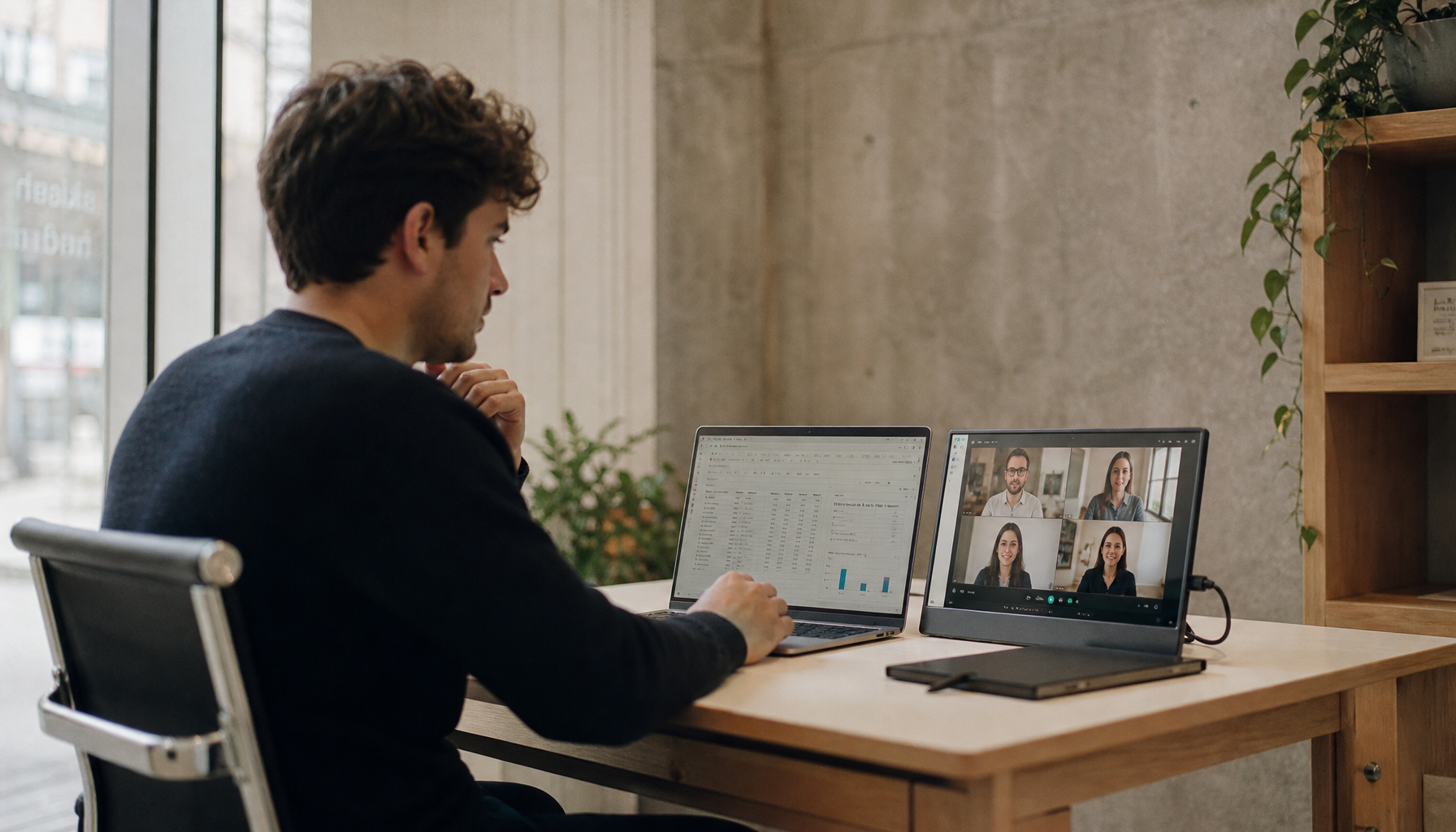
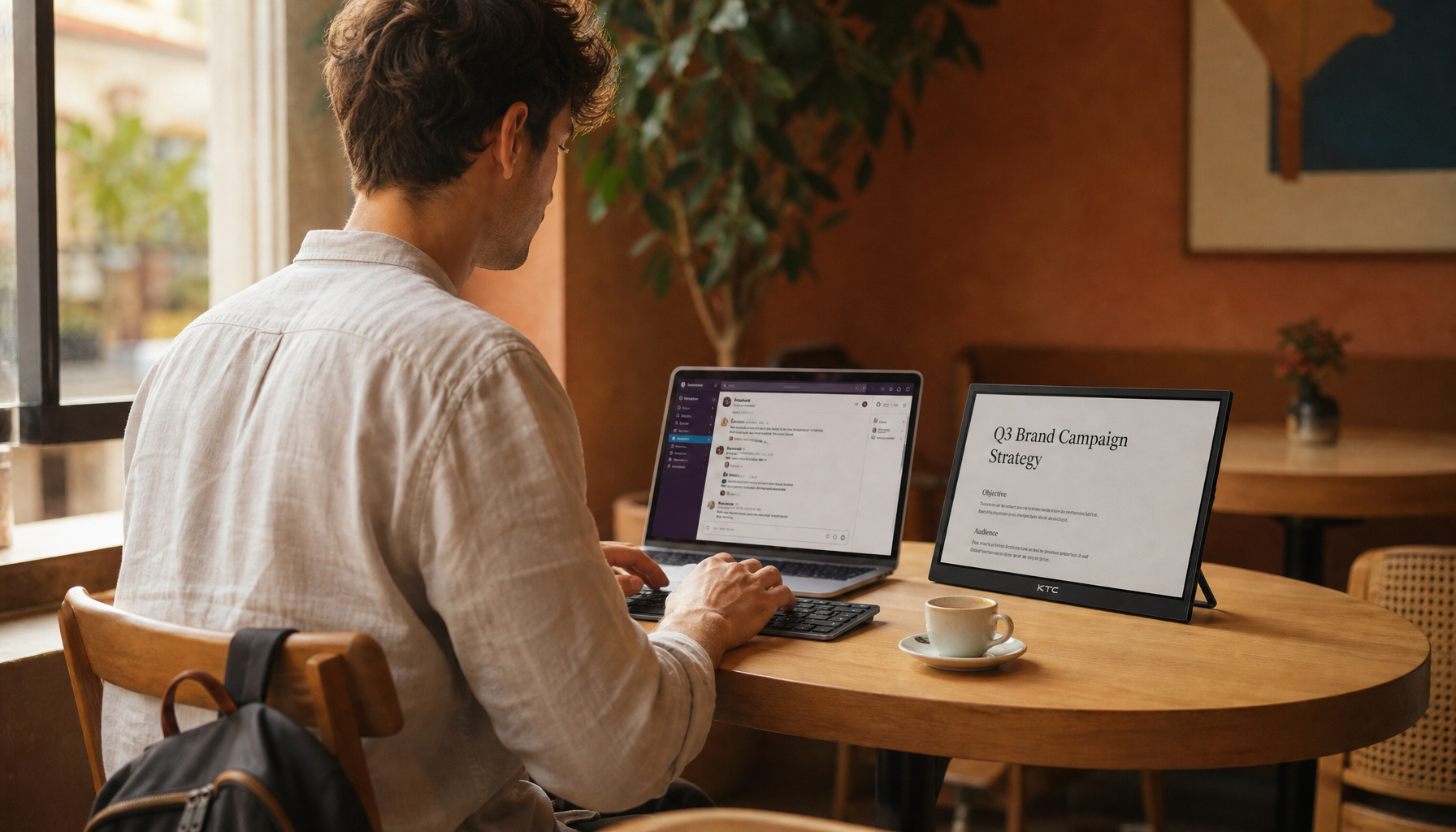
A larger monitor can make your lower back hurt more when it changes how you sit: leaning forward, twisting, looking too high, reaching farther, or staying still longer. A practical workstation reset can often reduce strain by restoring screen distance, eye height, chair support, and movement breaks.
Does your back feel tighter after a few hours on that new 32-inch display or ultrawide, even though the upgrade was supposed to make work and gaming easier? Here is how to diagnose the real cause and tune the setup without giving up the performance benefits of a bigger screen.
The Larger Monitor Is Not the Problem by Itself
A larger monitor can improve visibility, multitasking, timeline editing, spreadsheet work, and immersive gaming. The problem starts when the bigger panel lands on the same shallow desk, at the same old height, with the same chair position. Your body then adapts to the screen instead of the screen adapting to your body.
Office ergonomics is the process of arranging your chair, desk, keyboard, mouse, monitor, laptop, phone, and frequently used objects so your body works with less strain, and office ergonomics guidance places the monitor straight in front of you at about arm’s length. When a larger display breaks that relationship, the lower back often becomes the compensation zone. You may crane your neck, but your lumbar spine pays for the fixed sitting, forward lean, and subtle rotation.
In real setups, the pattern is easy to spot. A 24-inch office monitor may have worked fine at about 20 to 24 inches away. Swap in a 34-inch ultrawide on the same 24-inch-deep desk, and the outer edges now sit much farther into your side vision. If you keep windows pinned at the far left and far right, your head and torso start rotating all day. That repeated rotation can tighten the muscles around the low back and hips even if the pain shows up nowhere near the screen.
Why Your Lower Back Reacts After the Upgrade
You Sit Closer Than the Screen Size Allows
Bigger screens need more viewing distance because your eyes and head must cover a wider field. If the display is too close, you may not notice the full-screen sweep at first; you just begin leaning back, leaning forward, or locking your pelvis in place to scan the panel.

Workstation guidance notes that a monitor positioned too high can force the user to tilt the head back, potentially straining back muscles, and computer workstations should be arranged to support neutral postures. For a large display, neutral posture means you can see the main work area without pushing your chin forward, lifting your chest, or peeling your lower back away from the chair.
A useful field test is simple. Sit fully back in your chair with your back supported, extend your arm, and check whether your fingertips nearly reach the screen. For many large monitors and ultrawides, you may need closer to 30 to 36 inches of viewing distance, especially if you use the full width all day. If your desk cannot provide that depth, a monitor arm is often a higher-value fix than buying a different chair.
The Screen Is Too High
A big monitor mounted like a small monitor often ends up too tall. If the top edge sits well above eye level, you lift your chin and subtly arch through the spine. That can make the low back feel compressed, especially during long sessions.

The monitor should generally sit with the top of the screen at or slightly below eye level, and the top of the screen should be about an arm’s length away. For taller panels, this does not mean the center of the screen must be at eye level. In most productive desk setups, your relaxed gaze should land slightly downward into the upper third of the display.
There is one important exception. If you wear bifocals, trifocals, or progressive lenses, a lower monitor with a slight backward tilt may be more comfortable because it reduces the urge to tip your head back to see through the lower lens area.
The Main Work Zone Is Off Center
Large monitors encourage dramatic layouts: chat on the left, dashboard on the right, document in the middle, game map in the corner. That is useful, but it can quietly move your actual task off center. If your spreadsheet, coding window, or video timeline lives on one side for hours, your torso may rotate slightly toward it.
A single monitor should be directly in front of your seated position and keyboard, while dual setups work best when the primary display is centered and the secondary screen is angled inward. This same principle applies to ultrawides. Put your highest-focus window in the center third, then use the side zones for reference material, chat, tools, scopes, playlists, or dashboards.
The quick calculation is whether your chin has to leave center to do your main work. If the answer is yes for more than a few minutes at a time, the layout is driving posture instead of supporting it.
Pros and Cons of Larger Displays for Back Comfort
A larger display can be excellent for posture when it reduces squinting, tab switching, and laptop hunching. It can also be worse when it pushes the user into static posture, wider head turns, or a desk arrangement that crowds the keyboard and mouse.
Setup Choice |
Back-Friendly Advantage |
Common Back-Pain Risk |
27-inch monitor |
Strong productivity gain without overwhelming most desks |
Still needs proper height and arm’s-length distance |
32-inch monitor |
Better visibility for spreadsheets, creative tools, and 4K scaling |
Often too close on shallow desks |
34-inch ultrawide |
Less bezel interruption and strong multitasking flow |
Main window may drift off center |
Dual monitors |
Dedicated spaces for apps and references |
Repeated twisting if both screens are not angled correctly |
Laptop plus monitor |
Big improvement over laptop-only work |
Pain returns if keyboard and mouse are not external |
Dual displays can improve workflow, and dual screen ergonomics research reports productivity gains in multi-screen work when the setup is used correctly. The performance case is real. The ergonomic case depends on whether the display geometry matches your body and task flow.
How to Fix the Setup Before Replacing Gear
Start With the Chair, Not the Monitor
Set your chair first because monitor height depends on your seated eye height. Your feet should rest flat on the floor or on a footrest, thighs roughly parallel to the floor, and lower back supported. If your chair lacks lumbar support, a small lumbar cushion can help you keep contact with the backrest instead of sliding forward.
Ergonomics guidance recommends choosing a chair that supports the spine and adjusting the chair so the feet rest flat, while the monitor sits directly behind the keyboard. That order matters. If you raise or lower your body to match the screen, you may fix your eyes while creating a worse hip, knee, or lumbar position.
Move the Monitor Back

For a 24-inch display, arm’s length may be enough. For a 32-inch or ultrawide, arm’s length is still the starting point, but many users need more distance so the whole panel fits comfortably into view. If the screen feels visually huge, do not solve it by leaning back with your low spine unsupported. Move the monitor back, use a deeper desk, or add an arm that lets the panel float behind the desk edge.
Text should stay readable at the new distance. If you catch yourself leaning forward to read, increase display scaling or font size before pulling the monitor closer. A larger monitor should reduce strain, not create a contest between readability and posture.
Lower the Screen and Tilt It Slightly
The top edge should be at or slightly below eye level for most users. A slight backward tilt, often around 10 to 20 degrees, can reduce glare and support a natural downward gaze. Avoid using tilt to compensate for a screen that is simply too high; lower the display first.
Glare matters because reflections make you move your body into awkward viewing positions. Place the screen at a right angle to windows when possible, and use blinds or curtains if sunlight hits the panel. You can test glare by turning the monitor off while sitting normally; reflections become obvious on the dark screen.
Rebuild Your Window Layout
Put the active task in the center. On an ultrawide, treat the middle third as the cockpit and the outer thirds as support zones. On dual monitors, center the primary display in front of your keyboard if one screen gets most of your attention. If both screens are used equally, place them side by side in a shallow V shape with your body centered between them.
This is where display discipline pays off. A large productivity or gaming screen gives you more canvas, but your lumbar spine should not become the mount that holds your whole workflow together.
Movement Is Part of the Display Setup
Even a perfect workstation cannot make eight still hours healthy. Prolonged sitting is associated with lower back discomfort, and computer-induced pain guidance emphasizes movement, posture changes, and regular breaks. A larger monitor can make this worse because immersive screens reduce natural interruptions; you stay locked in because everything is visible.
Use a simple rhythm. Every 30 to 60 minutes, stand, walk, refill water, or do a brief hip-opening stretch. For eyes and neck, the 20-20-20 rule is still practical: every 20 minutes, look at something 20 ft away for 20 seconds. This does not replace a correct setup, but it reduces the static load that builds in the lower back.
If your pain includes numbness, tingling, leg weakness, sharp pain, or symptoms that persist despite setup changes, bring in a clinician or physical therapist. Monitor ergonomics can reduce a common trigger, but it is not a diagnosis.
FAQ
Should I return my larger monitor if my back started hurting?
Not immediately. First move the display farther back, lower the top edge to eye level or slightly below, center your main work, and restore lumbar support. If your desk cannot create enough distance, a monitor arm or deeper work surface may solve the issue for less than replacing the screen.
Is a curved monitor better for lower back pain?
A curve can help keep the edges visually closer on ultrawide screens, but it is not a cure. Distance, height, centering, chair support, and movement breaks still matter more.
Can monitor brightness cause lower back pain?
Brightness does not directly strain the lower back, but glare or poor contrast can make you lean, squint, or twist to see clearly. Match brightness to the room and control reflections so your posture stays stable.
A Better Screen Should Make You Feel More Capable
A larger monitor should expand your command of the workspace, not make your back absorb the upgrade. Set the chair first, place the screen at the right height and distance, center the real work, then move often enough that performance does not depend on staying frozen.