In 2026, high-zone Mini-LED monitors deliver the most practical balance of brightness, color accuracy, and long-term reliability for 4K HDR video editing. For freelancers and small-studio creators spending hours daily in tools like DaVinci Resolve or Premiere Pro, these displays meet the 1000-nits-plus, wide-gamut threshold needed for professional-grade grading while avoiding the static-UI burn-in risks that plague OLED panels in timeline-heavy workflows.

Why HDR 1400 is the New Benchmark for 4K Video Editing
HDR 1400 certification requires roughly a 40% increase in peak luminance over the HDR 1000 standard, along with tighter black-level control. This jump matters for video editors because it lets you master bright HDR highlights without clipping while maintaining detail in shadows during sustained grading sessions.
As the VESA DisplayHDR standard update explains, the performance tier was designed for demanding professional content creation where consistent high brightness prevents the aggressive automatic brightness limiting (ABL) often seen on OLED panels. In real editing rooms, this stability reduces the need to constantly adjust exposure or fight unexpected dimming when bright UI elements appear alongside your footage.
For most prosumer setups, hitting 1400 nits peak in HDR mode translates to more headroom for accurate color decisions across the full dynamic range of modern cameras. Lower-brightness monitors force compromises that show up as crushed blacks or lost highlight detail once the project moves to final delivery.
Solving the 'Timeline Burn-in' Risk for Long Editing Sessions
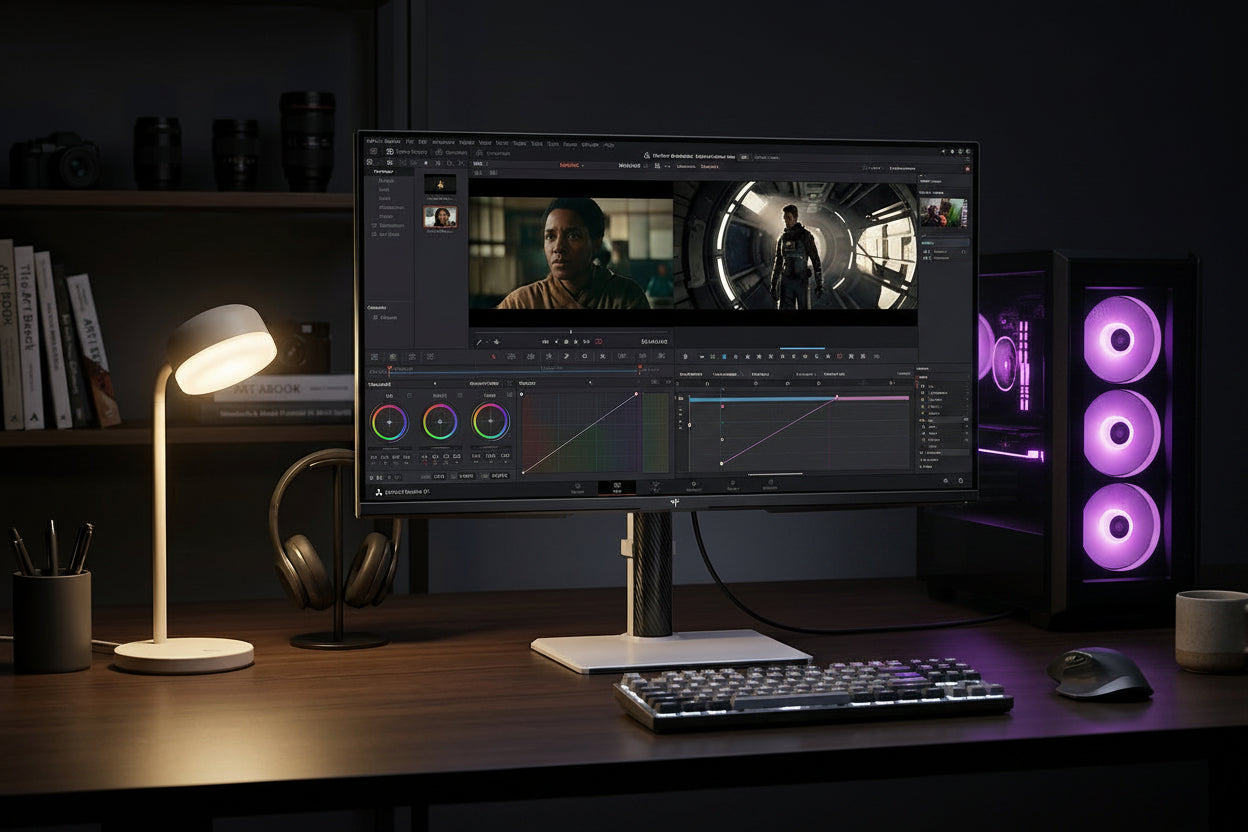
Static user-interface elements such as timelines, tool palettes, and menu bars in DaVinci Resolve or Premiere Pro create the primary burn-in risk for OLED displays. These fixed high-contrast areas remain on screen for hours, accelerating organic LED degradation over months of professional use.
Mini-LED backlights, built from inorganic LEDs, eliminate this concern entirely. You can run 8- to 10-hour daily sessions with the full interface visible and no need for pixel-refresher routines, hidden taskbars, or scheduled screen savers. This “zero babysitting” reliability is the main reason many freelance editors now prefer Mini-LED for day-to-day timeline grinding.
Community reports and reliability comparisons consistently flag OLED burn-in as a real workflow tax for editors who keep the same UI layout visible for weeks at a time. Mini-LED removes that anxiety, letting you focus on creative decisions instead of monitor maintenance.
When Does Mini-LED Offer Better Value Than OLED for Creators?
Mini-LED becomes the stronger everyday value once a monitor meets the practical 1000/1000/100 rule—roughly 1000 local-dimming zones, 1000+ nits peak, and 100% class DCI-P3 coverage. In the $400–$600 price band common for prosumer 27-inch 4K models, this combination delivers enough shadow detail and highlight headroom for HDR grading without the burn-in maintenance that OLED panels require in static-UI environments.
Mini-LED Value Zones for Creator Monitors
This chart highlights the likely value zones for creator monitors under typical use, with emphasis on price, zone count, and HDR tier rather than exact ranking.
View chart data
| Scenario | Under $400 | $400-$499 | $500-$599 | $600+ |
|---|---|---|---|---|
| Low zone count | 1.0 | 1.0 | 0.0 | 0.0 |
| Mid zone count | 0.0 | 2.0 | 2.0 | 1.0 |
| High zone count | 0.0 | 2.0 | 3.0 | 2.0 |
| HDR 1400 tier | 0.0 | 1.0 | 2.0 | 3.0 |
The heatmap above visualizes where higher zone counts and HDR 1400 capability tend to align with better overall value for creators. In the $400–$500 tier, models with around 1152 zones and HDR 1400 certification typically offer the strongest combination of brightness stability and shadow control for daily editing.
KTC’s M27P6 27" 4K HDR1400 Mini-LED monitor sits squarely in this sweet spot. Its 1152-zone Fast IPS panel, 98% DCI-P3 coverage, and factory Delta E < 2 calibration deliver the performance editors need at a price that leaves budget for calibration tools or storage rather than premium display upkeep.
OLED remains preferable for short “final polish” sessions conducted exclusively in dark rooms where absolute black levels matter most and burn-in risk is minimized by limited exposure. For the majority of freelance and small-studio timelines that run all day in mixed lighting, the Mini-LED reliability advantage outweighs the theoretical contrast edge.

How to Handle Mini-LED Local Dimming Artifacts in Your Workflow
Even with 1152 zones, some blooming or haloing can appear around bright UI elements against dark backgrounds, especially in completely unlit rooms. This is a manageable workflow friction rather than a deal-breaker for color-critical work.
Professional editors rely on waveform, vectorscope, and parade scopes for technical black-level accuracy; these tools remain unaffected by local-dimming behavior. Adding bias lighting at 6500 K behind the monitor reduces the visual prominence of any remaining halos without altering the calibrated image.
For non-grading tasks such as timeline scrubbing or UI navigation in SDR mode, simply toggling local dimming off in the monitor’s OSD removes the effect entirely. Many users map this to a quick keyboard shortcut or OSD hotkey so the change takes only a second when switching between grading and general desktop use. The guide on local dimming zones offers more detail on how zone count influences these real-world trade-offs.
A 2026 Buyer’s Checklist for Color-Accurate Mini-LED
Before purchasing, verify these specs against your room, software, and budget:
- Local-dimming zones: 1000+ zones are the practical minimum to control shadow detail and minimize blooming in typical editing environments.
- Peak brightness: HDR 1400 or equivalent sustained 1000-nit capability ensures headroom for modern HDR deliverables without ABL surprises.
- Color gamut: 98%+ DCI-P3 coverage aligns with professional production standards for HDR video, as outlined in EBU Tech 3320 requirements for video monitors.
- Panel type: IPS (or Fast IPS) is required for consistent color and gamma when viewing off-axis; VA panels introduce shifts that undermine grading accuracy.
- Factory calibration: Delta E < 2 out of the box provides a trustworthy starting point; plan to verify with your own probe using the steps in our calibration verification guide.
- Connectivity: HDMI 2.1 and DisplayPort 1.4 support full 4K 160 Hz with HDR metadata passthrough for modern editing PCs and consoles.
The M27P6 meets every item on this list while staying under $500, making it a strong candidate for freelancers upgrading from standard IPS displays.
Choosing the Right Mini-LED Setup for Your Editing Workflow
Match the monitor to your dominant daily pattern. If you spend most of your time on long timeline sessions with static interfaces visible, prioritize a high-zone Mini-LED such as the M27P6 for its brightness stability and burn-in immunity. Reserve OLED only for short, dark-room final-color passes where you can control session length and UI exposure.
Check your room lighting first: moderate ambient light favors Mini-LED, while a completely blacked-out suite may still benefit from OLED’s perfect blacks if burn-in protocols are followed rigorously. Confirm the monitor’s firmware receives ongoing local-dimming updates, and budget for a colorimeter if you grade client deliverables.
By focusing on the 1000/1000/100 threshold instead of chasing reference-monitor pricing, most creators can achieve reliable 4K HDR accuracy without the maintenance overhead or replacement risk that often accompanies OLED in professional settings. The result is more time spent on creative work and less time worrying about the display itself.
Is Mini-LED Good Enough for Professional Video Editing?
Yes, when the monitor meets or exceeds 1000 local-dimming zones, HDR 1400 brightness, and 98% DCI-P3 coverage. For most freelance and small-studio workflows in 2026, this level of Mini-LED performance exceeds typical client-delivery requirements while eliminating the burn-in maintenance that comes with OLED timeline use. True reference monitors remain necessary only for final delivery approval in elite post houses.
How Does Mini-LED Compare to OLED for DaVinci Resolve Users?
Mini-LED is generally the safer daily driver because it avoids burn-in from Resolve’s persistent UI elements and maintains consistent brightness without aggressive ABL. OLED can still be preferable for short, dark-room color-finishing passes where absolute black levels are the only priority and the interface can be minimized. Most users find the workflow reliability of Mini-LED outweighs OLED’s contrast advantage once sessions exceed four hours.
What Brightness Level Is Needed for Accurate HDR Grading?
Industry guidance points to at least 1000 nits sustained peak for reliable HDR grading, with 1400 nits providing comfortable headroom for modern deliverables. This prevents clipping of specular highlights and allows accurate judgment of both bright and dark scene elements. Lower-brightness panels force constant exposure compensation that reduces grading precision.
Can Local Dimming Blooming Affect Color Accuracy?
Blooming does not change the technical values measured by waveform or parade scopes, so it has no direct impact on color decisions. It remains a perceptual issue best managed with bias lighting and selective toggling of the dimming feature during non-critical tasks. Scopes remain the source of truth for technical grading.
Should I Choose IPS or VA Mini-LED for Video Editing?
IPS panels are required for color-accurate editing. They maintain consistent gamma and hue across typical viewing angles on a desk, whereas VA panels exhibit noticeable shifts that make side-by-side client reviews or multi-monitor setups unreliable. All professional Mini-LED recommendations for creators therefore use IPS or Fast IPS technology.