

Savvy buyers know that a factory calibration report is more than just marketing paper—it's a unit-specific snapshot that can reveal whether a monitor truly delivers on its color accuracy claims or simply rides on brand reputation. For value-conscious creators and gamers in 2026, learning to read these reports helps separate genuine performance from the 'brand tax,' showing that options like KTC often match the raw accuracy of legacy names at a fraction of the price, provided you understand the fine print and your specific workflow needs.

Beyond the Hype: What Is a Factory Calibration Report Actually Proving?
A factory calibration report serves as a personalized 'birth certificate' for your monitor, documenting that technicians measured and adjusted that specific panel against industry standards like sRGB or DCI-P3 before it left the production line. Unlike generic office displays that ship with broad presets, professional and high-end gaming monitors include these reports to prove they cleared measurable thresholds for color accuracy, white balance, and gamma tracking.
This document helps informed skeptics guard against the panel lottery—the natural manufacturing variations that mean two identical model numbers can perform differently. It gives you concrete data points rather than trusting marketing headlines alone. However, the report is only as useful as your ability to interpret it correctly and match it to your actual usage mode.
For most buyers evaluating monitors on product pages or after unboxing, the report is the first filter: it separates displays engineered for color-critical work from those optimized purely for brightness or speed. Yet it never guarantees long-term performance, as all monitors experience some drift over time.
Decoding the Data: A Step-by-Step Guide to Reading Your Monitor’s Report
Start with the target gamut listed at the top. Professional reports typically specify whether measurements were taken in sRGB (for web and general content), DCI-P3 (for cinema and video), or Adobe RGB (for print photography). Mismatching your workflow to the wrong gamut renders the numbers less relevant—for instance, a strong DCI-P3 result means little if you edit exclusively in sRGB color spaces.

Next, examine the white point and gamma values. The industry standard targets 6500K (D65) for white point, delivering neutral whites without visible tint, and a gamma of 2.2 for Windows and web content. This curve controls shadow detail and highlights: as EIZO's guide to reading factory reports explains, a measured gamma curve that closely tracks the 2.2 target prevents crushed blacks or washed-out images. Deviations here often matter more than headline color specs for everyday editing.
The Delta E (ΔE) section is where most buyers focus, but it requires nuance. Delta E quantifies the difference between requested and displayed colors, with an average below 2.0 widely considered the pro standard for work where differences are indistinguishable to the human eye. An average below 3.0 suits high-end gaming or general creation. However, always check the maximum Delta E alongside the average, as a low overall score can mask spikes in critical hues like skin tones or brand reds. This is the 'Average ΔE Illusion': a reported average of 1.2 might still show a maximum error of 4.0 in oranges, causing unnatural skin rendering in portraits.
Look for a Color Checker or saturation sweep chart in the report. These reveal where errors concentrate. For most creative professionals, prioritize reports showing both average ΔE < 2.0 and maximum < 3.0 for reliable skin tones and primary colors.
Internal resources like our guide on What Delta E Values Actually Mean for Your Creative Work expand on interpreting these metrics in real workflows.
The 'Brand Tax' vs. The Data: How KTC Compares to Legacy Labels
Many buyers assume legacy brands like Dell UltraSharp or ASUS ProArt deliver objectively superior factory calibration. In raw panel performance, however, value-focused options often match them closely while skipping the premium for extensive software suites or uniformity compensation.
KTC models such as the H27P3 5K professional monitor frequently achieve ΔE < 2 and 99% DCI-P3 coverage out of the box using high-grade IPS panels. This raw accuracy aligns with the guarantees on many UltraSharp or ProArt units, yet at significantly lower price points. The difference emerges in supporting features: premium lines often include hardware LUTs (lookup tables) that store calibration data directly in monitor memory, plus advanced uniformity compensation that adjusts edge-to-center variations across the entire screen.
This chart helps visualize the trade-off: KTC prioritizes center-point accuracy and wide gamut at competitive pricing, making it suitable for many creators who own a colorimeter for fine-tuning. Legacy brands justify their higher cost with built-in tools for large-format or print work where edge uniformity prevents visible shifts. As secondary analysis from sources like digit.in notes, these differences often reflect added processing rather than fundamentally superior panel data.
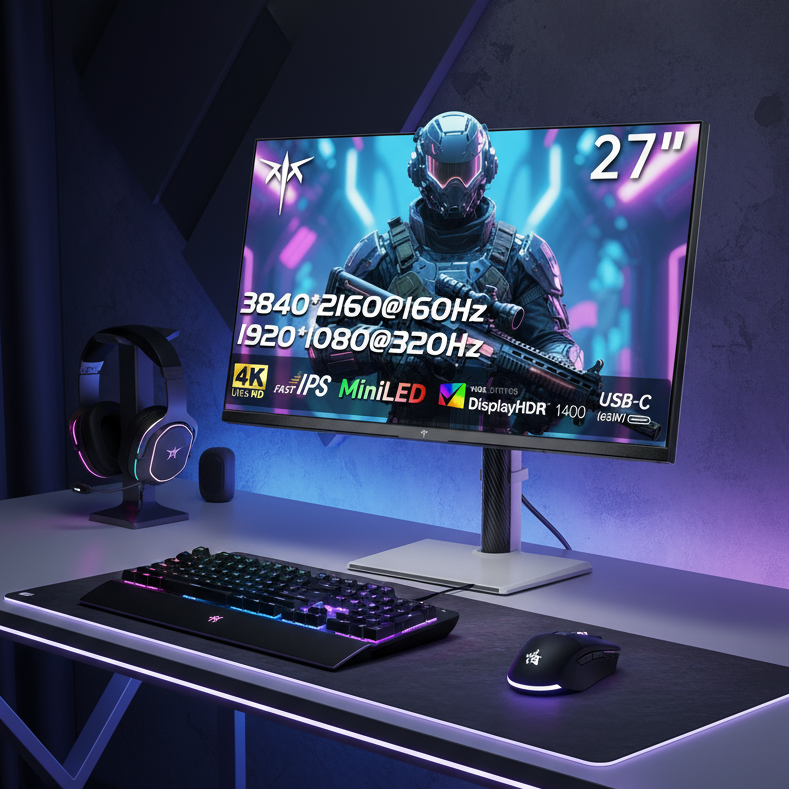
For gamers seeking balanced performance, the H27P6 dual-mode 4K gaming monitor or Mini-LED options like the M27P6 bring similar factory accuracy with gaming-focused refresh rates. Check our roundup of best factory calibrated monitors when comparing across use cases.
The Fine Print: Why Your Calibration Might Be Meaningless in 'Vivid' Mode
Factory reports carry an important limitation: they are mode-specific. The measurements typically apply only to the exact OSD preset (often labeled 'sRGB,' 'Standard,' or 'Calibration') used during testing. Switching to 'Vivid,' 'Gaming,' or 'Movie' modes usually bypasses the factory lookup table entirely, producing Delta E values far higher than reported.
Brightness adjustments pose another common trap. Many calibrated sRGB modes lock brightness around 100-120 nits for accuracy. Raising it for a bright room or HDR content can shift the white point and gamma, invalidating the report. On Mini-LED models, enabling local dimming for HDR introduces further variables that standard SDR factory reports do not address.
Reviews such as TFT Central's analysis of the Dell UltraSharp U3223QE confirm that real-world accuracy depends heavily on staying within the verified preset. This makes the report a useful starting point but not a universal guarantee. Our support article on how to verify your display calibration is actually working offers practical tests you can run after setup.
The Informed Skeptic’s Checklist: Evaluating Your Next Display
Use this framework to turn any calibration report into an actionable buying decision:
-
Verify the measured mode first. Confirm the report matches the OSD preset you will actually use. If it only covers 'Standard' but you work in a custom profile, the data is less reliable.
-
Scrutinize both average and maximum Delta E. Accept average < 2.0 for most pro work, but reject units where maximum exceeds 3.0 in skin-tone or primary-color ranges.
-
Assess uniformity data if provided. Budget reports often omit full-screen grids. For large creative canvases or print matching, prioritize models from brands offering explicit uniformity compensation.
-
Plan for drift. Factory calibration is a strong baseline, but backlights age and colors shift. As detailed in KTC's guide on when to use monitor hardware calibration, serious creators should invest in a colorimeter for recalibration every few months.
-
Match features to workflow. Choose KTC-style value monitors when you prioritize raw panel quality and plan to manage profiles in software. Opt for legacy premium lines only when you need hardware LUTs, built-in uniformity engines, or vendor-specific ecosystem support.
This checklist positions factory-calibrated KTC monitors as strong contenders for creators who understand the data, offering professional-grade accuracy without the full brand premium. Cross-reference with our calibrate your gaming monitor guide for post-purchase optimization.
FAQs
What Does an Average Delta E Below 2 Actually Mean in Practice?
It indicates colors are generally indistinguishable from the reference under controlled conditions for most viewers. However, always verify the maximum Delta E, as averages can hide problematic spikes in specific hues critical to photography or branding work. For professional grading, combine it with strong gamma tracking.
Can I Trust a Factory Calibration Report for HDR or Gaming Modes?
Usually not. Most reports test in SDR presets like sRGB. HDR or gaming modes often activate different processing that invalidates the measured values. Test in your intended mode with calibration software or visual test patterns to confirm real-world accuracy.
How Often Should I Recalibrate Even With a Good Factory Report?
Factory calibration provides an excellent starting point but degrades as the backlight ages. For color-critical work, recalibrate with a colorimeter every 1-6 months depending on usage hours and environmental stability. Casual users can extend this to yearly checks.
Does Paying More for a Brand Guarantee Better Uniformity?
Not always for raw center accuracy, but premium lines more consistently include hardware uniformity compensation that reduces edge-to-center variation. Value monitors like certain KTC models excel at center-point Delta E but may require software corrections for perfect large-canvas work.
Is a Physical Calibration Report Better Than Software-Only Claims?
A physical, unit-specific report offers verifiable proof for that individual panel, reducing reliance on batch-level marketing. It remains a snapshot, however—pair it with your own validation tools for long-term confidence in creative or gaming setups.
When Is Factory Calibration Sufficient Versus Professional Calibration?
Factory calibration suffices for most content creators, gamers, and semi-pro users who stay within the tested mode. Professional hardware calibration becomes necessary for commercial print work, color grading studios, or when maximum consistency across multiple displays is required.
How Do I Spot a Misleading Calibration Report?
Watch for vague target specifications, missing maximum Delta E values, or reports that only test at maximum brightness. High-quality reports clearly state the measured preset, test conditions, and provide both average and peak error data across a wide color set.