

AI eye-tracking needs per-user calibration because the system has to learn how your specific eyes, face, and seating position map to pixels on your monitor.
If you have ever watched a gaze cursor drift off a button or noticed tracking feel solid in the middle of a gaming monitor but shaky near the edges, you have already seen the problem calibration is meant to solve. Real-world setups can work well, but the difference between a useful feature and a frustrating one often comes down to a 10- to 30-second setup that matches the tracker to your eyes and display. What follows is a practical guide to why that happens, which monitor variables matter most, and what to check before you pay extra for eye-tracking on a desktop display.

What Calibration Actually Does on a Monitor
It turns raw eye images into screen coordinates
Calibration maps an eye tracker’s raw output to your actual gaze point on the screen rather than assuming the camera can infer that perfectly on its own. In practice, the system shows known targets on the display, records how your eyes look at each target, and builds a correction model so future gaze estimates land in the right place on the panel.
That mapping step matters because eye images do not translate directly into screen pixels. A standard explanation from video-oculography calibration is that pupil position alone is not enough; the software often relies on a pupil-to-corneal-reflection relationship and then fits a 2D non-linear mapping to the monitor space. On a gaming or productivity display, that is the difference between “looking near the minimap” and “looking at this exact icon.”
Accuracy and precision are not the same thing
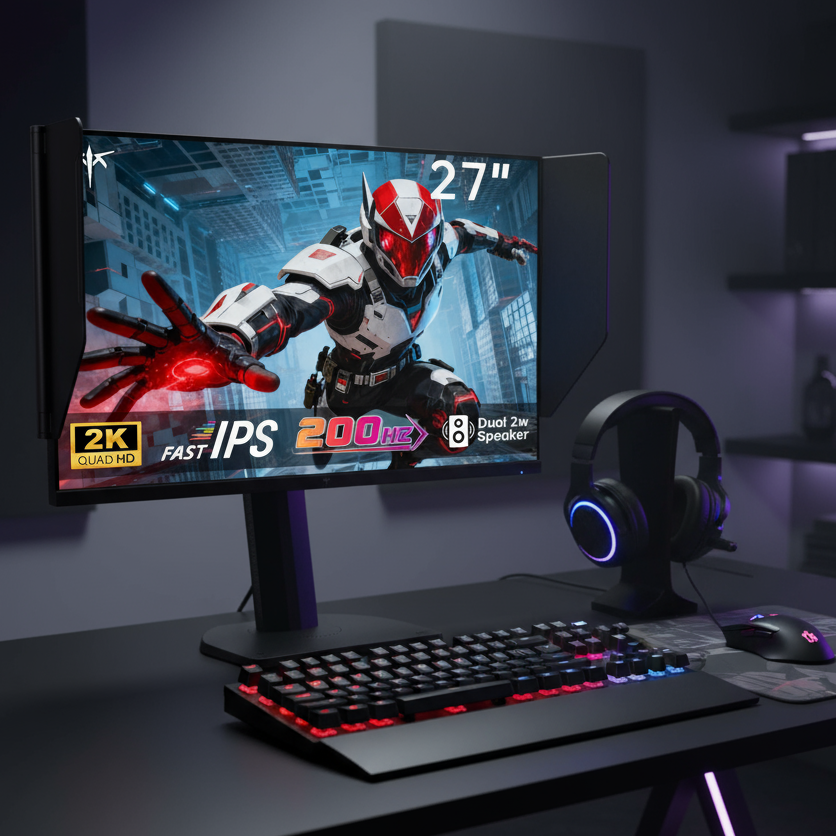
Accuracy is the average gap between recorded gaze and true gaze, while precision is how stable the measurement stays from sample to sample. On a monitor viewed from about 27 inches away, 1 degree of visual angle is roughly 0.5 inch, which is large enough to miss a small UI element, a browser tab, or a compact HUD item on a 27-inch or 34-inch display.
That distinction is important for display buyers because a tracker can look smooth while still being wrong. Calibration can compensate systematic bias and improve accuracy, but it does not automatically improve precision. If your use case is cursor control, accessibility input, or gaze-driven game interaction, small accuracy errors matter more than a marketing claim that sounds fast or fluid.
Why One Calibration Cannot Fit Every User
Eye geometry differs from person to person
Corneal-reflection eye tracking needs per-user calibration because eye shape and eye size vary between individuals. Another reason is that the visual axis and optical axis of the eye are not perfectly aligned; that offset, often described as angle kappa, means two people can look at the same point on the same monitor while producing measurably different raw eye signals.
That is why “AI” does not eliminate setup by itself. A webcam or dedicated sensor may detect your face and pupils in real time, but it still has to learn how your anatomy maps to the panel in front of you. Even systems marketed as simple browser-based tools still use a short setup phase; one webcam platform uses about 40 dots and takes roughly 30 seconds before the participant continues.

User conditions change the result even on the same display
Reported accuracy figures are usually measured under ideal conditions and can worsen with glasses, contact lenses, or movement after calibration. In day-to-day monitor use, that means the same eye-tracking feature may behave differently for two people sharing one desk, or for one person who changes chair height, leans closer during a match, or uses a different lighting setup at night.
Real products reflect that reality by exposing user-specific settings instead of treating everyone the same. Calibration options such as left eye, right eye, both eyes, target size, and 1, 2, 5, or 9 calibration points exist because different users need different tradeoffs between speed, attention demand, and final accuracy.
Which Monitor Factors Affect Calibration Quality
Screen size and layout change the difficulty
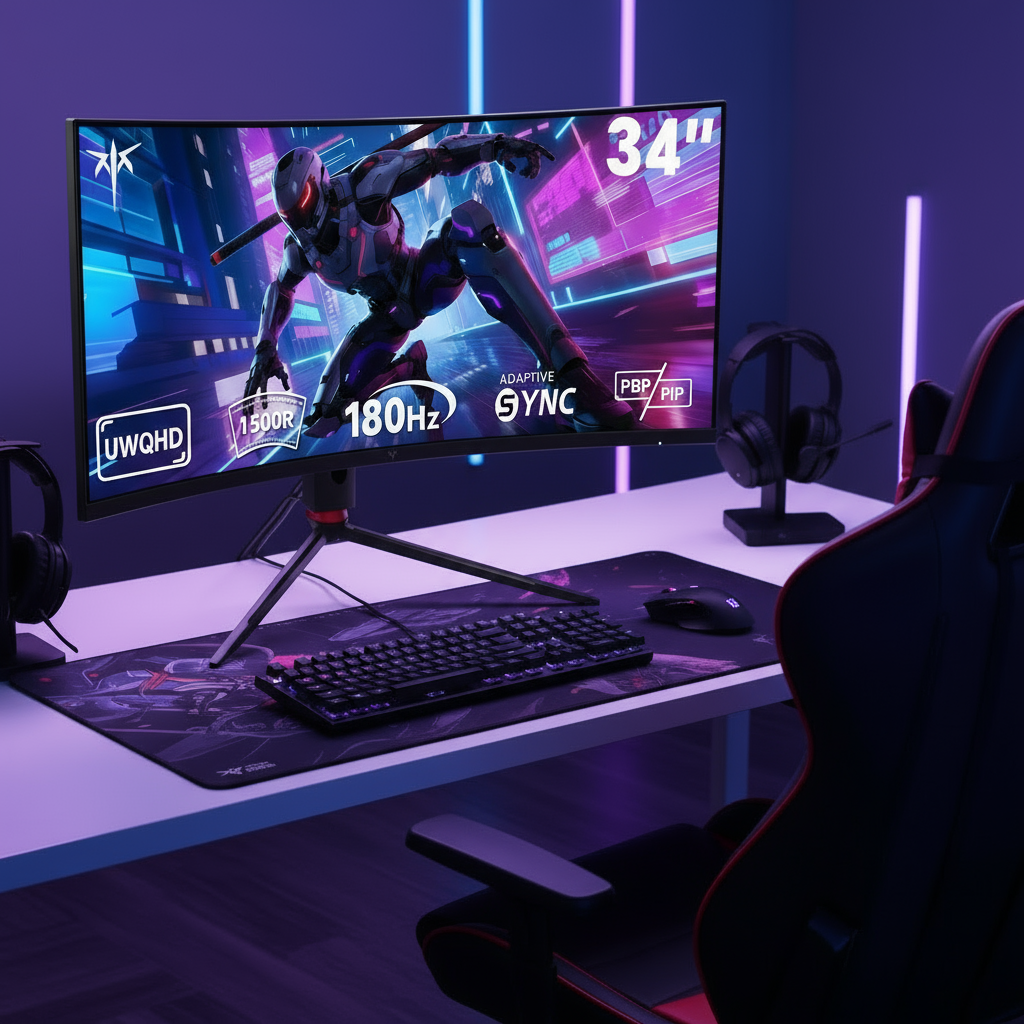
Super-ultrawide calibration can break down at the corners because users may need to move their heads to reach extreme targets with their eyes alone. A reported example on a 49-inch gaming monitor at 5120x1440 found tracking felt better near the center and worse farther out, which is exactly the kind of edge-case display buyers should expect on very wide panels.
On a standard 24-inch or 27-inch monitor, calibration points are clustered in a smaller physical area, so the mapping problem is easier. On a 34-inch ultrawide or 49-inch super-ultrawide, the corner targets sit farther from center, and that amplifies any mismatch between seating position, head pose, and display geometry. For gaze-heavy gaming or desktop control, that makes center-only performance less meaningful than full-screen consistency.

Distance, angle, and head position matter as much as the panel
Correct positioning is critical because the tracker needs a stable eye image. One practical eye-box example is about 12 inches high, 14 inches wide, and 14 inches deep, with a recommended viewing distance of roughly 18 to 32 inches and an optimal range around 22 to 26 inches. If your desk pushes you outside that zone, calibration quality usually suffers before refresh rate becomes relevant.
Monitor ergonomics also affect repeatability. An arm’s-length viewing distance of about 20 to 40 inches, a top bezel at or slightly below eye level, and a modest 10 to 20 degree backward tilt help keep head posture steady. For a 27-inch monitor, many users find 20 to 30 inches comfortable; that comfort is not just about neck strain, but about staying in the same place long enough for gaze mapping to remain valid.
A practical comparison for display buyers
The table below shows how common monitor traits affect calibration effort and likely eye-tracking behavior.
Monitor factor |
What changes |
Likely impact on calibration |
|
24-27 inch standard display |
Smaller target spread |
Easiest full-screen mapping |
Best starting point for accessibility or cursor control |
34 inch ultrawide |
Wider edge targets |
More edge error risk |
Check whether the tracker remains accurate near side UI panels |
49 inch super-ultrawide |
Extreme corners |
Highest chance of head movement during setup |
Expect more recalibration and test corner performance before buying |
Portable monitor |
Shorter desk depth, variable angle |
Position shifts happen more often |
A monitor arm or stable stand matters more than panel size alone |
High-refresh gaming monitor |
Faster motion on screen |
Does not remove mapping error by itself |
Refresh rate helps visuals, but calibration quality still drives gaze accuracy |
Curved monitor |
Different screen geometry |
Can help comfort, but not guarantee better tracking |
Verify support with the exact tracker and seating distance |
What Good Calibration Looks Like in Real Use
Setup should confirm detection before it asks for accuracy
Good eye-tracking setup checks whether both eyes are detected before calibration starts. In one common workflow, green indicators show proper positioning, red indicates poor detection, and the system only proceeds when placement is correct. That is a useful sign for monitor buyers because it tells you the product is validating input quality instead of pretending every webcam angle is fine.

You should also expect some recalibration. Standard calibration often uses 5 to 9 points and takes about 10 to 30 seconds, and repeating it is normal if lighting changes or drift appears. On a shared gaming setup, that means each new user should plan for a quick profile pass rather than assuming the previous person’s settings are close enough.
Quality checks matter more than marketing claims
Remote eye trackers can lose data or produce errors even when people stay inside the recommended tracking area, which is why internal quality checks are worth more than a headline accuracy number. A vendor may advertise strong lab performance, but the real test is whether the system stays reliable during your actual monitor use: sitting back in a chair, shifting a few inches, or wearing the glasses you normally use.
For browser-based AI tracking, expectations should stay realistic. Webcam eye tracking around 106 to 110 pixels of accuracy at 30 Hz can be enough for heatmaps, large interface zones, and ad-attention studies, but it is far less convincing for pixel-level interaction on dense desktop UIs. That is why per-user calibration is essential for precise monitor control, not just a box to check before data collection.
Should Buyers Trust “Calibration-Free” Eye Tracking?
It can reduce friction, but not erase the physics
Calibration-free eye tracking exists as a commercial goal, especially for surveys and attention research where setup time hurts completion rates. That is useful progress, but it targets a different tolerance for error than a gamer trying to trigger an action with gaze on a desktop monitor or a user relying on eye input for accessibility.
The key question is not whether calibration-free systems are real, but what level of accuracy they need to hit for your task. If the output is “the user looked at the left side of the screen,” that may be enough. If the output is “the user selected this exact button on a 34-inch ultrawide,” calibration is still the safer assumption.
Match the feature to the job
For monitor buyers, the most reliable rule is simple: the smaller the target and the more interactive the task, the more valuable per-user calibration becomes. Accessibility control, gaze-driven aiming aids, reading analysis, and desktop navigation all punish error more harshly than broad attention measurement.
That is also why recalibration shortcuts matter. On at least one ultrawide-related implementation, users were advised to quickly recalibrate when tracking feels inaccurate. If a display or eye-tracking bundle makes recalibration awkward, the feature may be technically impressive but practically underused.
FAQ
Q: Does a high-refresh-rate gaming monitor improve eye-tracking accuracy by itself?
A: No. A 144 Hz or 240 Hz panel can improve motion clarity for the game, but gaze accuracy still depends on calibration quality, head position, viewing distance, and the tracker’s own sampling and mapping.
Q: Are ultrawide monitors bad for eye tracking?
A: Not necessarily, but they are harder to calibrate well across the full screen. Edge and corner performance deserve extra testing on 34-inch ultrawide and especially 49-inch super-ultrawide displays.
Q: How often should one user recalibrate?
A: Recalibrate when lighting changes, seating position changes, drift appears, or another person uses the setup. For many systems, that is a short 10- to 30-second step rather than a major interruption.
Practical Next Steps
If you are comparing monitors with eye-tracking features, treat calibration as part of the product, not as an inconvenience outside the product. A good setup should let each user calibrate quickly, confirm eye detection clearly, and stay accurate at the distances and angles your desk actually allows.
For most buyers, the safest path is a standard-size monitor, stable seating, and a tracker that supports easy recalibration and user profiles. If you are shopping for an ultrawide, a portable monitor, or a gaze-based gaming setup, test the corners, test with your normal glasses, and test again from your real seating distance before paying extra for the feature.
References
- An Examination of Recording Accuracy and Precision From Eye Tracking Data From Toddlerhood to Adulthood
- Calibrate and Set Up Eye Tracking in a platform
- Webcam Eye Tracking: Heatmaps, Gaze Plots & AOIs
- How does Eye tracking calibration helps the gaze estimation?
- Eye Tracking Calibration: What is it and why do we need it
- Optimal Monitor Viewing Angle for Eye Comfort and Posture
- A company’s Breakthrough Calibration-Free Eye Tracking Feature
- Position the User and Eye Tracking System
- The Most Precise (or Most Accurate?) Eye Tracker
- The fundamentals of eye tracking part 3: How to choose an eye tracker