Motion blur reduction can make fast pans look sharper, but that sharpness exposes frame-by-frame sampling gaps, so fine textures shimmer, crawl, or break into strobing patterns instead of blending smoothly.
Ever sweep your view across brick walls, grass, mesh fences, or patterned floors and notice the image suddenly sparkles even though a “1 millisecond MPRT” mode is supposed to look cleaner? A practical test is simple: if the artifact gets worse when blur reduction is enabled and improves when frame rate exactly matches refresh rate, you are likely seeing a timing-and-sampling problem rather than a broken panel. Here is why it happens, when the tradeoff is worth it, and how to tune your monitor for clearer motion without turning detailed surfaces into visual noise.
The Short Answer: Blur Reduction Removes the Blur That Was Hiding Aliasing

Motion blur reduction works by shortening the time each frame is visible. On most LCD gaming monitors, that usually means backlight strobing: the panel updates while the backlight is dark, then flashes when the frame is ready. The result is lower perceived persistence blur, which is why branded strobing and “1 millisecond MPRT” modes are popular on high-refresh gaming displays. An explanation of motion blur reduction describes this same core idea: reduce how long the eye sees each frame so tracked motion looks sharper.
The catch is that blur is not always useless. During a fast camera pan, ordinary sample-and-hold blur acts like a soft temporal filter. It smears fine texture detail across time, which can hide undersampling. When you enable strobing, the monitor stops smearing as much. That creates more visible clarity, but it also makes each frame stand apart more aggressively. If the game, GPU, and display are not delivering enough unique samples for the amount of texture detail moving across the screen, the result is temporal aliasing.
What Temporal Aliasing Looks Like on a Monitor

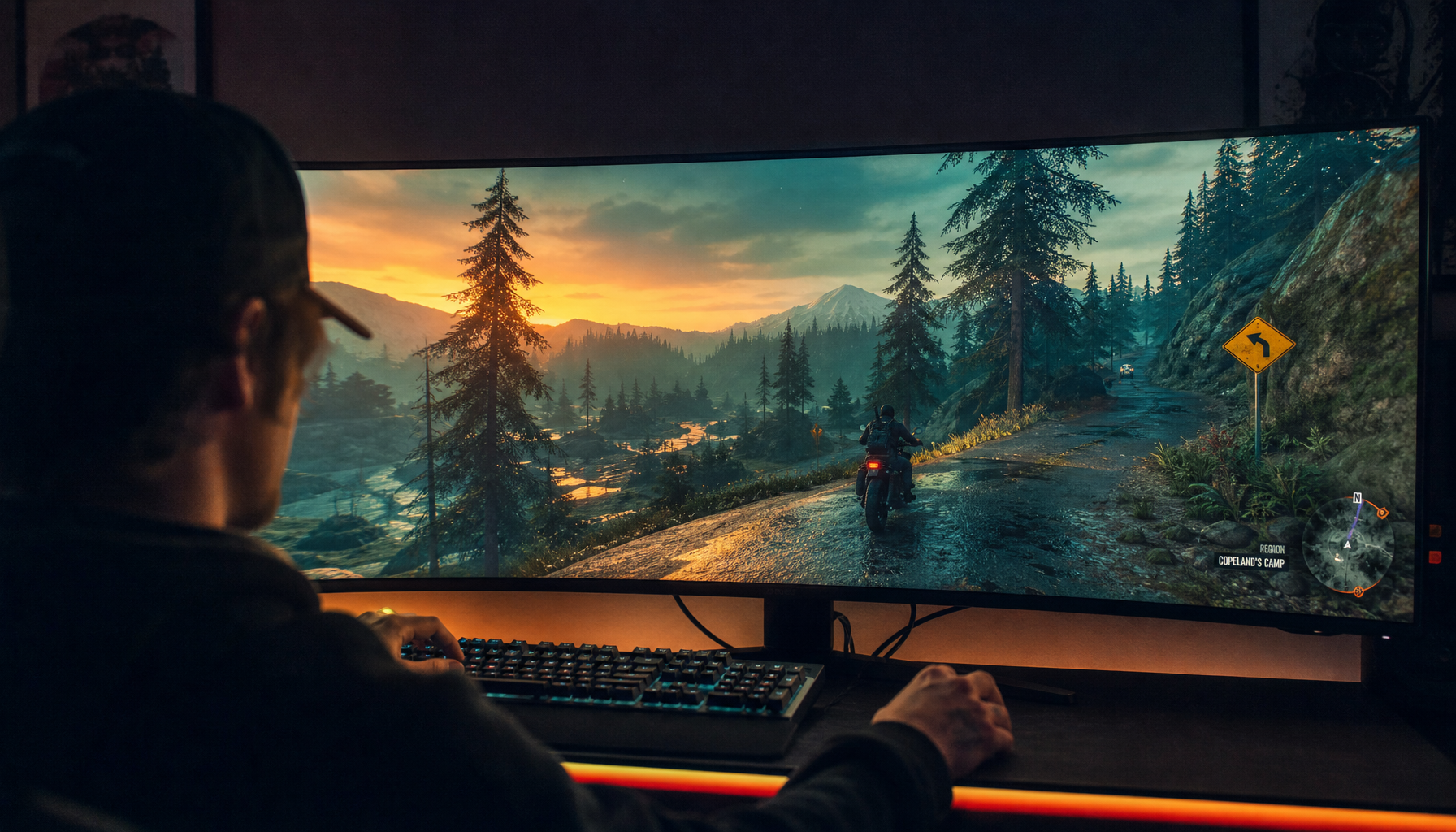
Temporal aliasing is the time-based equivalent of jagged edges. Instead of a diagonal line looking stair-stepped in space, a moving pattern looks unstable over time. On fast camera pans, it often appears as shimmering foliage, crawling brick texture, buzzing road surfaces, sparkling chain-link fences, or thin lines that pulse in and out of visibility.
The key difference from ghosting is that temporal aliasing is not a delayed trail from slow pixels. Ghosting is usually caused by pixel transitions failing to complete cleanly before the next refresh, while temporal aliasing comes from sampling motion too sparsely or too sharply. An overview of monitor ghosting separates trails and motion blur from other artifacts, which matters because the fix is different. Raising overdrive may help ghosting, but it can make aliasing look harsher if the underlying issue is frame sampling.
A real-world example is a 240Hz shooter with blur reduction enabled while panning across a grated catwalk. If the game is delivering 180 to 220 FPS unevenly, the catwalk may look sharper than before, but the lines can pulse because the monitor is flashing discrete, unevenly spaced snapshots. The panel may be doing exactly what you asked: showing motion with less blur. The content pipeline simply is not feeding it samples stable enough for that level of sharpness.
Why Fast Pans Across Textured Surfaces Are the Worst Case
Fine textures are high-frequency detail. Brick mortar lines, grass blades, fabric weave, tiled floors, roof shingles, wire fences, and asphalt grain all contain small alternating light-dark patterns. When the camera pans quickly, those patterns cross multiple pixels per frame. If the texture moves farther between flashes than the display and rendering pipeline can represent cleanly, the eye sees false motion patterns.
This is the same basic reason wagon wheels can appear to spin backward on video. The sampling rate is too low for the motion detail. In games, the “camera shutter” is your frame cadence, and a strobing monitor makes that cadence more visible. A primer on motion blur reduction frames blur reduction as a competitive clarity feature, but competitive clarity cuts both ways: it improves target edges while also revealing unstable high-frequency scenery.
A simple way to think about it is this: at 60Hz, a frame is held for about 16.7 milliseconds; at 120Hz, about 8.3 milliseconds; at 240Hz, about 4.2 milliseconds. Higher refresh gives more samples per second, which helps. But strobing shortens visible persistence even further, sometimes to around 1 millisecond MPRT or less. That makes motion look crisp, yet it also reduces the natural blending that would otherwise mask shimmer.
MPRT, GtG, and the Strobing Tradeoff
MPRT and GtG are often confused in monitor marketing. GtG describes how quickly a pixel changes from one shade to another. MPRT describes how long the image remains visible to your eye during motion. A monitor can have fast GtG and still show persistence blur if each frame remains illuminated for the whole refresh interval.
Motion blur reduction attacks MPRT, not the rest of the rendering pipeline. It does not add missing frames, stabilize texture sampling, fix a game’s anti-aliasing, or guarantee perfect frame pacing. A Purdue thesis on image artifacts treats motion-blur prevention as an artifact-prone display problem, which fits what users see: lowering blur can improve legibility while making temporal artifacts more visible.
Setting or Factor |
What It Improves |
What It Can Expose |
Backlight strobing |
Lower persistence blur and clearer tracked motion |
Shimmer, flicker, double images, frame pacing errors |
Higher refresh rate |
More temporal samples per second |
GPU limits and uneven frame delivery |
Strong overdrive |
Faster pixel transitions |
Inverse ghosting halos |
Temporal anti-aliasing in games |
Texture stability and reduced shimmer |
Softness, ghosting, and loss of fine detail |
Sharpening filters |
Perceived detail |
More visible crawling and sparkle |
Why Perfect Frame Matching Matters

Blur reduction works best when frame rate, refresh rate, and strobe rate are aligned. If your display is strobing at 120Hz, the cleanest result usually comes from a locked 120 FPS. If the game drops to 117 FPS or jumps irregularly between 100 and 140 FPS, the monitor still flashes on schedule, but the motion samples are no longer evenly spaced. That makes judder and shimmer easier to see.
This is why some players get better clarity by lowering the refresh target. A locked 100 FPS at 100Hz with strobing can look cleaner than unstable 120 FPS at 120Hz. It may feel counterintuitive if you bought a high-refresh monitor for maximum speed, but consistency is a performance feature. For aim tracking, readable movement beats a higher number that the GPU cannot hold.
There is also a double-image trap. If the game runs at 60 FPS while the monitor strobes at 120Hz, each rendered frame can be shown twice. That creates repeated-image motion, which some users mistake for strobe crosstalk or ghosting. True strobe crosstalk is a panel-timing issue where pixel transitions are caught by the flash, often worse near the top or bottom of the screen. Duplicate images from low FPS are a delivery mismatch.
The Role of Game Anti-Aliasing
Game anti-aliasing and monitor blur reduction are solving different sides of the same motion clarity problem. Spatial anti-aliasing handles jagged geometry. Temporal anti-aliasing uses information from previous frames to stabilize edges, specular highlights, and texture shimmer. The problem is that many players dislike heavy temporal anti-aliasing because it can soften the image, smear motion, or create ghost trails.
That tradeoff becomes sharper with blur reduction enabled. If you disable temporal anti-aliasing to regain crispness and then enable strobing, textured surfaces may become extremely unstable during pans. If you enable strong temporal anti-aliasing, the shimmer may calm down, but the monitor’s clarity advantage can be partly hidden by the game’s reconstruction blur.
A practical middle ground is to use the least smeary anti-aliasing mode that controls shimmer in the specific game you play. Subpixel morphological anti-aliasing, multisample anti-aliasing where available, restrained temporal anti-aliasing, quality upscaling modes, or a lower sharpening slider may all be better than simply turning everything off. The correct setting is not ideological; it is the one that keeps moving detail readable without burying targets in softness.
How to Tune Motion Blur Reduction for Fast Pans

Start with a motion test inside the actual game, not only a synthetic UFO pattern. Pick a textured wall, fence, field, or road surface, then pan at the same speed you use while playing. Toggle blur reduction off and on, and watch whether the artifact is smear, trails, double images, shimmer, or flicker. Naming the artifact correctly prevents wasting time on the wrong setting.
If shimmer is the main issue, lock your FPS to the strobe refresh rate. Use 120 FPS at 120Hz, 100 FPS at 100Hz, or 144 FPS at 144Hz only if the GPU can truly hold it. If your monitor supports strobe phase, pulse width, or duty controls, shorten the pulse for clearer motion only as far as brightness and comfort allow. A very short pulse can look impressively sharp but make temporal aliasing and flicker more obvious.
If trails or colored halos dominate, tune overdrive. Medium or normal overdrive is often the cleanest option with strobing because the most aggressive mode can overshoot. If the top or bottom of the screen has doubled edges while the center is clean, that points toward strobe crosstalk rather than game aliasing. In that case, a lower refresh-strobe mode may give the LCD more time to finish transitions before the flash.
For office productivity, coding, and document work, blur reduction is usually not the best default. Fast scrolling may look clearer, but flicker, reduced brightness, and harsher text shimmer can fatigue your eyes. Home office display advice often emphasizes comfort, lighting, and ergonomic consistency; a stable home office setup matters more than maximum motion aggression when you are reading text for hours.
When Motion Blur Reduction Is Worth It
Motion blur reduction is worth using when the content benefits from tracking clarity and the system can feed the display a stable cadence. Competitive shooters, rhythm games, retro scrolling games, and fast aim drills can feel dramatically more readable when the display flashes clean frames instead of holding each frame continuously.
It is less ideal for variable-frame cinematic games, high-dynamic-range-heavy scenes, large open-world pans, and textured environments where the GPU cannot maintain a locked frame rate. Portable smart screens and office monitors are also rarely the right place to prioritize strobing unless they are specifically built for high-refresh gaming, because brightness headroom and pixel response are usually more limited.
The value judgment is straightforward: use blur reduction when object tracking improves more than background stability worsens. Turn it off when the game becomes visually noisy, your frame rate cannot lock, or the brightness and flicker tradeoffs reduce comfort.
FAQ
Does motion blur reduction cause temporal aliasing by itself?
It does not create the underlying sampling problem alone. It makes the problem easier to see by reducing persistence blur. The texture, pan speed, frame rate, anti-aliasing, and frame pacing determine how much aliasing exists; strobing reveals it with more contrast.
Is a higher refresh rate always better for this issue?
Higher refresh usually helps because it provides more samples per second, but only if the GPU can keep up. A locked 120 FPS at 120Hz can look cleaner than unstable 165 FPS at 165Hz with blur reduction enabled.
Should I disable temporal anti-aliasing when using blur reduction?
Not automatically. Disabling temporal anti-aliasing can improve sharpness, but it can also unleash shimmer across textured surfaces. Try reducing sharpening first, then compare the game’s temporal anti-aliasing, subpixel morphological anti-aliasing, quality upscaling, or multisample anti-aliasing options if available.
Is this the same as ghosting?
No. Ghosting is a pixel response artifact that leaves trails. Temporal aliasing is a sampling artifact that makes moving detail shimmer, pulse, or crawl. Overdrive helps ghosting, while stable frame pacing and better anti-aliasing help temporal aliasing.
Final Calibration Thought
Motion blur reduction is a precision tool, not a universal “better” switch. When your frame rate is locked, your overdrive is controlled, and the game’s anti-aliasing is balanced, it can deliver the crisp motion clarity that performance-focused players chase. When those pieces are mismatched, the monitor simply shows the truth too sharply: fast textured motion needs enough clean samples to stay stable.