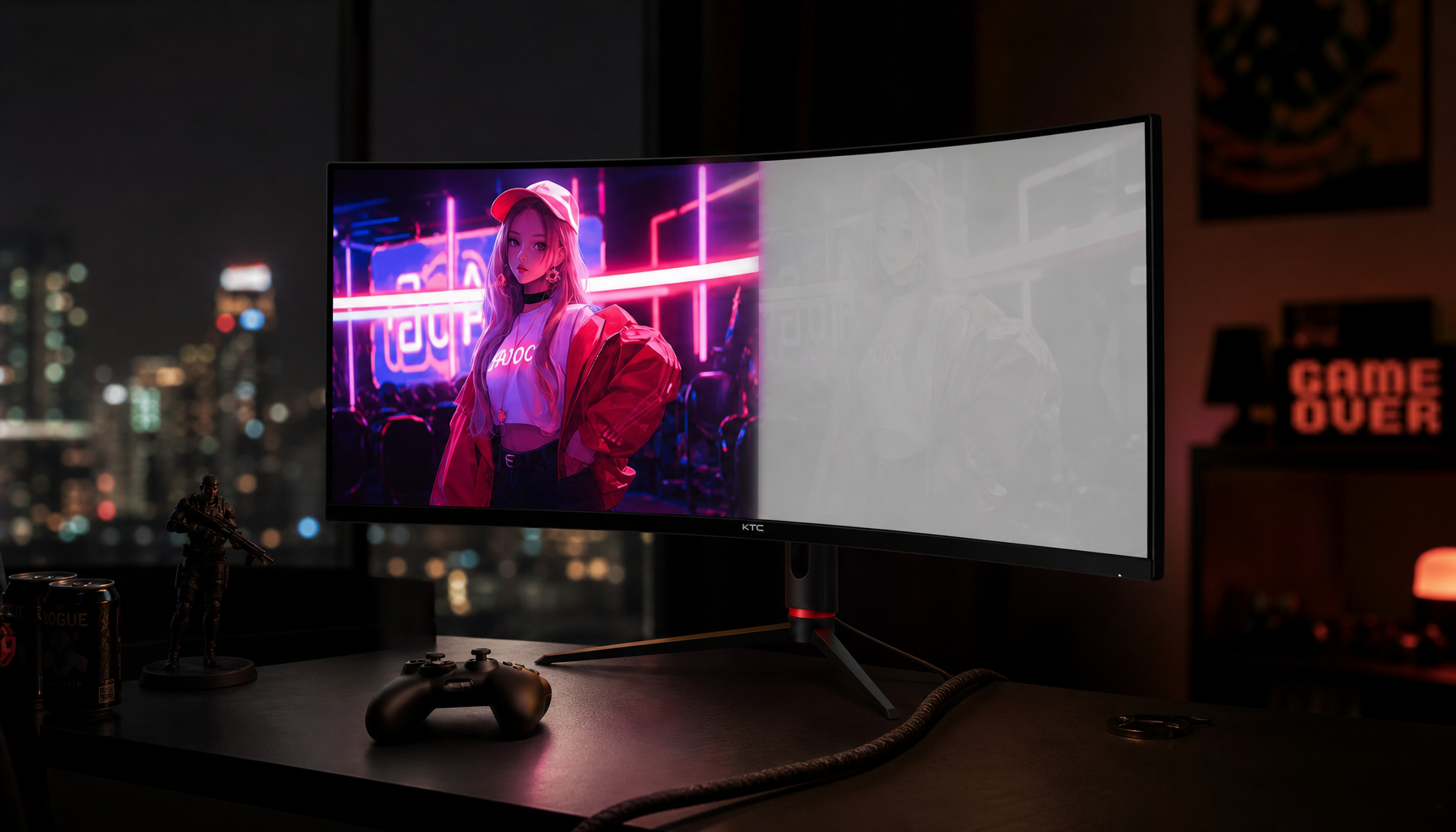
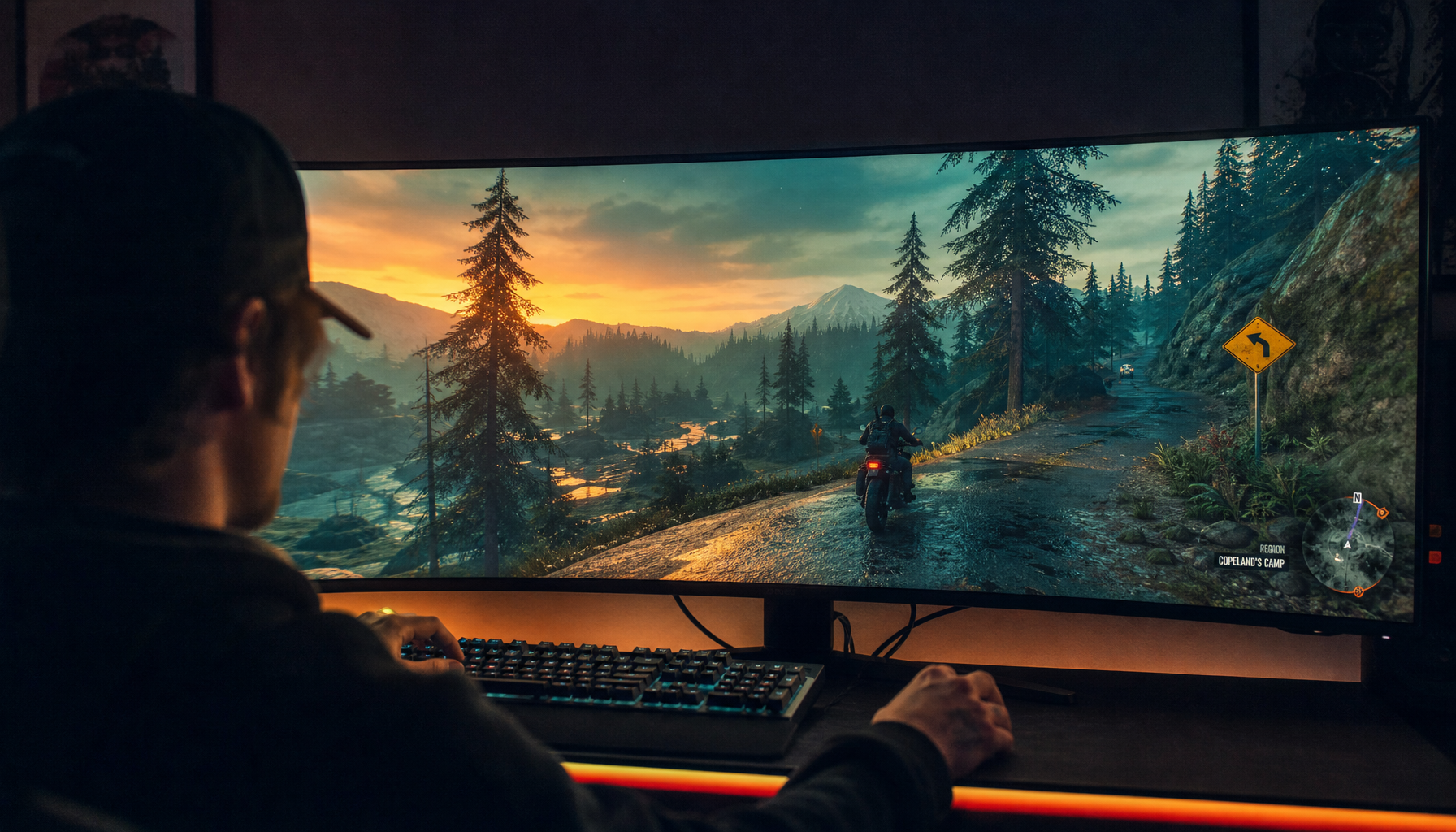
Black levels can appear to shift with VRR because the monitor is no longer refreshing at one fixed rhythm, so pixel response, overdrive, gamma handling, HDR behavior, and dimming logic may change as frame rate changes.
Does your game look rich and inky at 144 fps, then suddenly gray, lifted, or subtly pulsing during a dark cave scene? A controlled settings pass can usually separate real VRR behavior from a bad preset, cable limit, or room-light illusion in under 15 minutes. Here is how to diagnose it and tune your display without giving up smooth gameplay too quickly.
What VRR Changes in the Display Chain
Variable Refresh Rate, or VRR, lets the monitor match its refresh timing to the frame rate coming from the GPU. That is why adaptive-sync modes reduce tearing and improve motion feel; VRR technologies synchronize refresh behavior instead of forcing every frame into a fixed 60 Hz, 120 Hz, or 144 Hz cadence.
That timing flexibility is the win, but it also changes the operating conditions inside the panel. At a locked 144 Hz, each refresh cycle is predictable. With VRR active, the panel may be asked to display 141 Hz, then 96 Hz, then 58 Hz, then 118 Hz, depending on the scene, shader load, and GPU pacing. On some monitors, those shifts make near-black tones look like they breathe, lift, darken, or flicker.

This is most visible in dark games, HDR menus, loading screens, OLED gray ramps, VA shadow scenes, and cinematic titles where frame rate moves around instead of staying pinned. If you mostly write documents, browse, or work in spreadsheets, you may never notice it unless you enable a gaming preset and sit in a dark room.
Why Black Levels Are So Sensitive
Black level is the display’s handling of the darkest tones above full black. If it is set too high, blacks look washed out; if it is too low, shadow detail is crushed. Black-level controls are especially delicate because tiny changes near black are more visible than tiny changes in midtones during dark scenes.
Gamma adds another layer. A monitor can keep the same backlight brightness while changing how quickly tones rise from black to gray. A higher gamma curve makes shadows look deeper; a lower gamma curve makes them more open. When VRR is active, some displays hold this curve consistently, while others show small near-black instability as refresh timing changes.
Panel type matters too. IPS panels usually prioritize stable viewing angles and general balance, VA panels often deliver stronger native contrast but can struggle with dark transitions, and OLED or QD-OLED panels can shut off pixels for true black but may reveal near-black fluctuation more clearly. A practical buying resource frames this tradeoff well: IPS for balanced color and longevity, VA for deeper blacks with slower transitions, and OLED/QD-OLED for perfect blacks with higher cost and burn-in considerations.

The Main Causes of VRR Black-Level Shift
Frame Rate Swings Can Expose Near-Black Flicker
The most common real-world pattern is not that VRR makes black wrong all the time. It is that VRR exposes black instability when frame rate fluctuates in a sensitive range. A game that jumps between 48 fps and 90 fps in a dark scene can make the monitor change refresh timing rapidly, and the eye catches the near-black luminance change as a pulse.
For example, if a cutscene runs at 60 fps, gameplay runs at 110 fps, and a heavy combat effect drops to 52 fps, the monitor may move through multiple refresh intervals in a few seconds. On a well-tuned display, blacks remain visually steady. On a weaker VRR implementation, the same sequence can look like the shadow floor is rising and falling.
This is why a frame cap often works. If your GPU can deliver 100 to 140 fps in a title, capping at 117 fps on a 120 Hz or 144 Hz display may reduce frame-time swings enough to calm near-black pulsing while keeping VRR’s smoothness.
Overdrive May Not Track Refresh Rate Cleanly
Overdrive pushes LCD pixels harder so they transition faster. The problem is that the ideal overdrive strength at 144 Hz is not always ideal at 60 Hz. Overdrive can reduce blur, but stronger settings can also create overshoot or inverse ghosting.
In dark scenes, this can look like black-level shift even when the actual black floor is not changing. VA panels are the classic example: dark gray to near-black transitions are harder, so motion through shadow can smear, brighten, or trail. Response-time marketing does not always reveal this because GTG and MPRT measure different parts of motion performance, and advertised “1 ms” numbers may come from ideal conditions.
If your monitor has variable overdrive, it may adjust overdrive with frame rate. If it does not, the overdrive setting that looked clean at 165 Hz may be too aggressive or too weak when VRR drops into the 50 to 80 Hz range.
Display Modes Can Change More Than Color
A gaming preset is rarely just a color preset. Display modes can change brightness, contrast, scaling, color temperature, sharpness, refresh rate, and blue-light behavior, and many monitors also alter black level, gamma, HDR tone mapping, adaptive sync, and response processing behind the scenes.
That matters because users often enable VRR at the same time they switch into Game mode, HDR mode, or a low-latency preset. The visible black shift may be caused by the preset, not VRR alone. A useful test is simple: keep VRR off, switch between Standard and Game mode, and inspect the same dark test scene. Then keep the same picture mode and toggle VRR only. If the black floor changes in the first test, the preset is a major contributor.
HDR and Local Dimming Can Magnify the Effect
HDR can make the issue more obvious because it changes tone mapping and brightness behavior. A display that looks stable in SDR may show lifted blacks in HDR if its tone mapping is conservative, its local dimming has too few zones, or its OLED near-black handling is sensitive to variable frame pacing.
Full-array local dimming displays can look spectacular in bright HDR scenes, but their backlight zones may brighten or dim around UI elements and dark objects. OLED and QD-OLED displays avoid zone blooming because pixels control their own light, but near-black gray uniformity and VRR flicker can still be visible on some units. QD-OLED gaming monitors often emphasize high bandwidth and OLED care features; HDMI 2.1 full bandwidth is useful because high resolution, high refresh, and modern console or PC compatibility all depend on a stable signal path.
How to Diagnose the Problem Without Guessing
Start with one dark scene you can repeat. A game menu, cave checkpoint, night race, or near-black calibration screen works better than random gameplay. Set the monitor to native resolution, choose one refresh-rate ceiling, disable automatic brightness features, and use the same room lighting each time.

Then compare four conditions in order.
Test Condition |
What It Reveals |
Best Interpretation |
VRR off, fixed refresh |
Baseline black behavior |
If blacks shift here, VRR is not the main cause |
VRR on, same picture mode |
VRR-specific behavior |
If pulsing appears now, adaptive sync is involved |
VRR on, lower overdrive |
Response tuning |
If artifacts reduce, overdrive was too aggressive |
VRR on, frame capped |
Frame pacing sensitivity |
If blacks stabilize, frame-rate swings were the trigger |
Use the monitor’s black-level or shadow test pattern if available. Calibration guidance often recommends near-black gradients for setting black level because the darkest bars should remain barely visible, not disappear into one block or float as gray. That same idea works for troubleshooting: if the bars change visibility as frame rate changes, you are seeing a real near-black handling issue.
Practical Fixes That Preserve Smoothness
The best first move is to cap the frame rate slightly below the monitor’s maximum refresh rate. For a 144 Hz display, try 141 fps or 120 fps. For a 165 Hz display, try 160 fps or 144 fps. For a 240 Hz display, try 237 fps or 200 fps. The goal is not to slow the monitor; it is to stop the GPU from bouncing into unstable frame-time ranges.
Next, reduce overdrive one step. If the monitor is set to “Extreme,” try “Fast” or “Normal.” You may accept a little more blur in exchange for cleaner dark transitions. This tradeoff is especially worth making on VA gaming monitors, where aggressive overdrive can make dark motion look brighter, smeared, or haloed.
If HDR is active, test SDR. If SDR is clean and HDR is not, the issue may be tone mapping, local dimming, or HDR black handling rather than VRR alone. Use HDR only when the game has meaningful HDR output and your monitor has the hardware to support it. HDR labels by themselves do not guarantee strong HDR performance; monitor buying guidance often warns that weak HDR certification can overpromise the actual result, especially without effective dimming or strong peak brightness.
Finally, keep signal-level settings stable. A strong mixed-use setup is usually native resolution, one preferred high refresh rate, VRR enabled only for games that benefit from it, and separate brightness or gamma adjustments for work and night use. For a 27-inch QHD gaming and productivity monitor, that might mean 2560 x 1440 at 144 Hz or 165 Hz all day, with VRR enabled in the GPU panel, a moderate overdrive setting, and SDR as the default desktop mode.

Should You Turn VRR Off?
Turning VRR off is reasonable if the black shift is more distracting than tearing. Competitive players usually keep VRR or use a carefully chosen fixed refresh setup depending on latency preference, but single-player gamers may prefer stable blacks over perfectly synchronized frame delivery in dark cinematic titles.
For office work, coding, spreadsheets, design review, and video calls, VRR is usually not necessary. A steady 75 Hz, 100 Hz, or 120 Hz desktop can feel smooth without introducing adaptive-sync quirks. Many productivity-focused recommendations already point users toward resolution, ergonomics, USB-C docking, and color stability before extreme refresh rate; USB-C input with power delivery often matters more for a clean work setup than chasing every gaming feature.
For gaming, VRR remains valuable. It reduces tearing, smooths uneven frame delivery, and helps a monitor feel more connected to the GPU. The performance-driven answer is not to disable it everywhere. The better answer is to tune it by title and panel.
Buying Advice for Avoiding the Issue Next Time
If black stability matters, read real reviews that test VRR behavior, near-black performance, response time, and overdrive across refresh ranges. Do not buy from “1 ms” claims alone. A 27-inch QHD IPS monitor at 144 Hz to 180 Hz is still the value sweet spot for many mixed-use players, while OLED and QD-OLED are the immersion leaders when budget, burn-in habits, and panel care are acceptable.
Match the display to the job. Pixel density around 100 to 120 PPI is a practical target for sharp gaming and desktop use, which is why 27-inch QHD and 32-inch 4K remain strong picks. If you want the deepest blacks, OLED is compelling. If you want fewer longevity concerns and strong HDR brightness, full-array local dimming may fit better. If you want reliable workday comfort, IPS with good calibration and ergonomics is still hard to beat.
FAQ
Is VRR Black-Level Shift the Same as Ghosting?
No. Ghosting is a motion trail caused by pixel transitions that are too slow or poorly tuned. Black-level shift is a perceived change in dark luminance, often tied to VRR timing, gamma behavior, HDR tone mapping, or dimming. They can appear together, especially in dark moving scenes, but they are not the same defect.
Does a Better Cable Fix VRR Black Shift?
Sometimes, but only when the issue is signal instability. If you see random black screens, dropouts, or resolution limits, use a certified DisplayPort or HDMI cable that supports your target resolution and refresh rate. If the image is stable but shadows pulse only during changing frame rates, the issue is more likely panel processing or VRR behavior.
Is OLED Worse for VRR Flicker?
OLED can make near-black fluctuation easier to notice because its black floor is extremely low and pixel response is very fast. That does not mean every OLED has bad VRR behavior. It means dark-room players should check reviews and test their own games during the return window.
VRR is still one of the best display technologies for smooth gaming, but black-level stability depends on the whole chain: GPU pacing, refresh range, overdrive, HDR mode, panel type, and room conditions. Keep the signal stable, cap wild frame swings, tune overdrive conservatively, and use VRR where its smoothness earns its place.