Display cable type does not make a panel produce deeper blacks, but it can change signal range, bandwidth, refresh-rate support, and color handling. Checking the connection mode and output settings often fixes washed-out blacks before the monitor itself is to blame.
Does your expensive gaming monitor look gray in dark scenes after swapping from HDMI to DisplayPort? A quick cable-and-output-settings check can often restore the black depth you already paid for, especially when one input looks rich and another looks faded. You’ll learn how HDMI, DisplayPort, USB-C, and adapter setups affect contrast delivery, plus the settings to verify before blaming the screen.
Cable Type Matters, but It Is Not the Whole Contrast Story
A display cable is the delivery lane, not the engine. The panel technology still sets the true black ceiling: OLED can switch individual pixels off, VA commonly delivers stronger native contrast, IPS favors color and viewing angles, and newer IPS Black panels improve contrast without abandoning IPS strengths. Cable choice still matters because the wrong connection mode can prevent the monitor from receiving the full tonal range, refresh rate, resolution, or HDR metadata it needs.
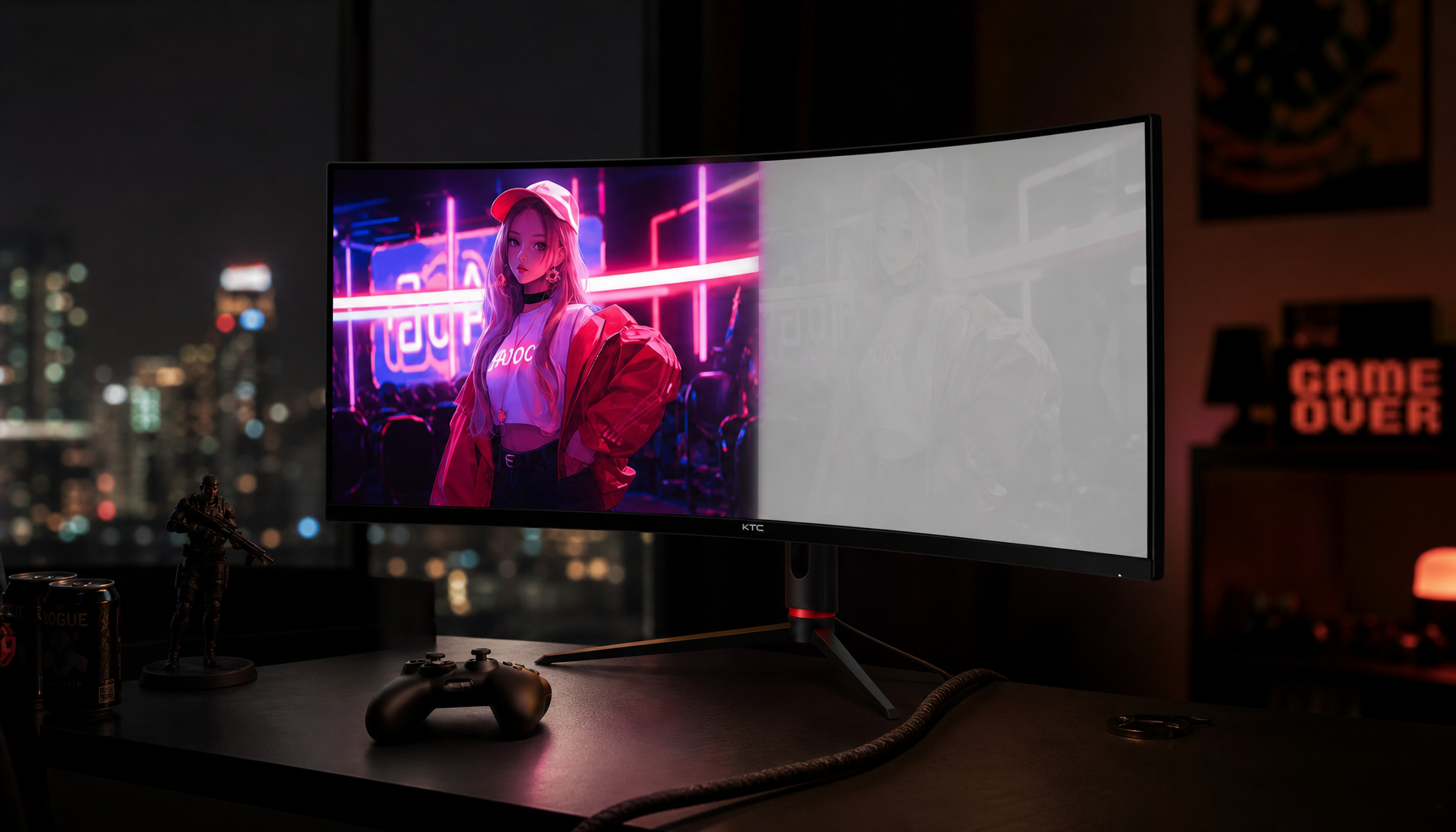
A real-world example is a two-monitor setup where the HDMI-connected screen shows deep blacks while the DisplayPort-connected screen looks washed out. In one support-thread case, the visible symptom appeared after switching one display from HDMI to DisplayPort, with the likely fix being GPU output settings such as RGB format and full dynamic range rather than the monitor’s physical contrast capability faded blacks and colors.

Black Level Accuracy Starts With Signal Range
Full Range vs. Limited Range
Black level accuracy depends on whether the graphics card and monitor agree on what “black” means. Full-range RGB maps the darkest value to true digital black, while limited-range output reserves the darkest and brightest ends for video-style signal handling. If a PC outputs limited range but the monitor expects full range, black can lift into dark gray and colors can lose punch.

This is one of the most common reasons a new cable appears to ruin contrast. The cable itself may be fine; the port change may have triggered a different output format. In graphics-driver display color settings, check that the exact monitor is set to RGB output and Full dynamic range. The same logic applies across GPU drivers, operating systems, and console menus: confirm that the source and display agree on range.
RGB vs. YCbCr
RGB is usually the cleanest choice for PC desktop use because it maps directly to how monitors handle text, UI edges, and color values. YCbCr can be useful for TVs, video playback, or bandwidth-limited modes, but it can also introduce chroma subsampling or unexpected color handling if selected automatically.
For office productivity, this matters more than people expect. A spreadsheet grid, dark-mode code editor, or photo-editing interface can look subtly lower contrast if the output format changes. For competitive gaming, a lifted black floor can make night maps look hazy, while crushed blacks can hide shadow detail.
Bandwidth Determines Whether Contrast Features Survive
Cable type also affects whether your chosen resolution, refresh rate, bit depth, and HDR mode can run together. A 4K monitor at 60 Hz is far easier to carry than 4K at 120 Hz or higher with high bit depth. Modern 4K gaming monitors can exceed older 60 Hz limits by using newer interfaces such as HDMI 2.1, DisplayPort 2.0, and DisplayPort 2.1, which makes the port standard part of the image-quality chain.
Here is the practical impact. If your monitor is set to 3,840 x 2,160 at 144 Hz and the connection cannot carry that cleanly, the system may reduce color depth, switch format, disable HDR, limit refresh rate, or depend on compression. Compression is not automatically bad, but automatic fallbacks can create confusing results when one cable preserves the desired mode and another silently changes it.
Connection Path |
Strength |
Black-Level Risk |
Best Use |
HDMI 2.0 |
Common and reliable |
May cap high-refresh 4K modes |
4K 60 Hz, consoles, office displays |
HDMI 2.1 |
High bandwidth for modern screens |
Device support varies |
4K 120 Hz gaming, HDR media |
DisplayPort 1.4 |
Strong PC monitor support |
Settings may change after input swap |
QHD/4K high refresh, desktop gaming |
DisplayPort 2.0/2.1 |
More headroom for demanding modes |
Requires matching GPU, cable, and monitor |
High-end gaming and creator displays |
USB-C DisplayPort Alt Mode |
Not every USB-C port supports video |
Laptops, portable monitors, and desk hubs |
Panel Contrast Still Sets the Limit
A cable can preserve contrast, but it cannot create contrast the panel cannot produce. OLED has the strongest black-level behavior because each pixel can turn off independently, while LCDs rely on a backlight that remains active behind the image. That is why OLED generally delivers deeper blacks and higher perceived contrast than LCD, while LCD remains attractive for brightness, durability, and price OLED and LCD differences.
VA panels are a high-value middle ground for dark-room gaming and media because they often provide stronger native contrast than standard IPS. The tradeoff is motion handling: some VA monitors can show smearing in dark transitions. IPS is usually better for color consistency and viewing angles, but conventional IPS can look lighter in dark scenes. IPS Black improves that weakness, and some productivity monitor lines position IPS Black as an upgrade for users who want sharper blacks without sacrificing desk-work clarity IPS Black productivity monitors.
For portable smart screens, the same principle applies at smaller sizes. IPS is often the balanced choice for travel, touch work, and laptop extension, while OLED is the premium choice for media and contrast-critical viewing. Brightness, contrast ratio, and connectivity still matter because a screen that looks great indoors may struggle in a bright workspace if brightness is too low.
HDMI, DisplayPort, and USB-C in Real Workflows
Gaming Monitors
For gaming, DisplayPort is often the safest PC-first route because many high-refresh monitors expose their best modes through DisplayPort. HDMI 2.1 is excellent when both the graphics card and monitor fully support it, especially for 4K 120 Hz gaming or console use. The critical move is not choosing one cable by habit; it is confirming the exact version, certified bandwidth, refresh rate, color format, and dynamic range after you plug it in.
A simple test is to launch a dark game scene, pause in a shadow-heavy area, and switch between Full RGB and any limited or YCbCr modes available. If black suddenly drops from charcoal gray to deeper black without losing shadow detail, the cable swap exposed a signal-setting issue rather than a defective monitor.
Office Productivity Displays
For work monitors, cable type can affect clarity and comfort as much as contrast. USB-C and similar single-cable connections can carry video, data, and laptop charging through one connection, which reduces desk clutter and makes multi-device setups easier. A 49-inch 32:9 ultrawide, roughly equivalent to two 27-inch 16:9 displays side by side, especially benefits from the right connection because high resolution, KVM switching, and hub features depend on proper bandwidth and compatibility 49-inch ultrawide setup.
The productivity trap is assuming USB-C always means video support. Some USB-C ports only handle data or charging. If a portable screen or hub monitor looks dim, capped, or unavailable, verify that the laptop port supports DisplayPort Alt Mode and enough power delivery. For touch portable monitors, USB-C with DisplayPort Alt Mode and Power Delivery is especially valuable because one cable can carry video, power, and touch input one cable can carry video.
Creative and Color Work
For design, cable type should preserve the monitor’s calibrated state. Resolution alone does not guarantee color accuracy, and 4K mainly gives you more detail and workspace. For graphic design, 4K is widely useful because it supports sharper UI elements and detailed image work, while higher pixel density can improve clarity for demanding creative workflows.
If you calibrate a monitor over HDMI and then move to DisplayPort, rerun a basic validation pass. Confirm native resolution, refresh rate, RGB Full range, HDR status, brightness, contrast, and color profile. The monitor did not become less accurate because the cable changed, but your operating system may now treat it as a different display path.
Practical Troubleshooting for Washed-Out Blacks
Start with the fastest checks. Confirm that the monitor is running at native resolution and the intended refresh rate. Then inspect GPU output settings for RGB, Full dynamic range, and the desired bit depth. Next, compare HDR on versus off because incorrect HDR handling can make SDR content look flat. Finally, test a certified cable that matches the target mode, especially for 4K high refresh or ultrawide resolutions.
Do not ignore the monitor’s own input settings. Some displays have separate black level, HDMI range, color space, or input mode controls for each port. A monitor may remember different settings for HDMI 1, HDMI 2, DisplayPort, and USB-C, which explains why one port can look correct while another looks wrong.
Cable quality matters most when the signal is near the bandwidth limit. A cheap or damaged cable may cause flicker, dropouts, handshake failures, or missing high-refresh options. It is less likely to create subtly poor blacks by itself; washed-out contrast usually points first to range, format, HDR, or panel mode.
Pros and Cons by Cable Choice
Cable Type |
Pros |
Cons |
HDMI |
Broad compatibility with PCs, consoles, TVs, and monitors |
Version confusion can limit 4K high refresh or HDR modes |
DisplayPort |
Strong choice for PC gaming, high refresh, and monitor daisy-chain workflows |
GPU settings may switch after input changes, causing range mismatch |
USB-C |
Clean one-cable setups for laptops, portable displays, hubs, and touch screens |
Port capabilities vary widely; cable may not support video or enough power |
Adapters and docks |
Useful when laptop ports are limited |
Can introduce bandwidth caps, format changes, or refresh-rate limits |
FAQ
Can a better cable improve black levels?
A better cable can help if the old cable prevents the correct signal mode, resolution, refresh rate, bit depth, or HDR mode. It will not turn a low-contrast panel into an OLED-like display.
Why does DisplayPort look washed out compared with HDMI?
The most likely causes are output dynamic range, color format, HDR state, or monitor input settings. Set the DisplayPort output to RGB Full first, then compare the same brightness, contrast, and refresh-rate settings.
Should I use HDMI or DisplayPort for gaming?
Use the connection that supports your monitor’s full target mode. For many PC gaming monitors that means DisplayPort, while HDMI 2.1 is excellent for 4K 120 Hz-capable monitors and consoles.
Does USB-C reduce contrast?
USB-C does not inherently reduce contrast. Problems appear when the laptop, cable, or monitor port lacks DisplayPort Alt Mode, enough bandwidth, or proper power support.
The Bottom Line
Choose the cable that lets your display run at native resolution, intended refresh rate, RGB Full range, and the right HDR mode. Then judge the panel on its real strengths: OLED for true blacks, VA for high-value contrast, IPS for consistency, and IPS Black when productivity clarity and stronger dark depth need to share the same desk.