Your screen can still feel too bright at night when the room is darker than the display’s lowest comfortable luminance. The best fix is usually a balanced setup: lower hardware brightness, controlled contrast, SDR when appropriate, and soft room lighting.
Does your monitor feel like a desk lamp at 10:30 PM, even with the brightness slider pinned to zero? A quick fix can be as simple as adding soft bias lighting behind the screen and matching the display to the room instead of chasing the lowest setting. Here’s how to make your gaming monitor, office display, or portable screen comfortable without ruining contrast or visibility.
The Real Problem Is Contrast With the Room
Evening discomfort usually starts with a mismatch between screen luminance and ambient light. In a bright office, a 300-nit screen can feel normal. In a dark room, even a much lower setting can feel piercing because your eyes have adapted to the darkness. Practical eye-comfort guidance consistently points to one rule: screen brightness should be adjusted to match the surrounding environment, not to a universal percentage on the monitor menu.
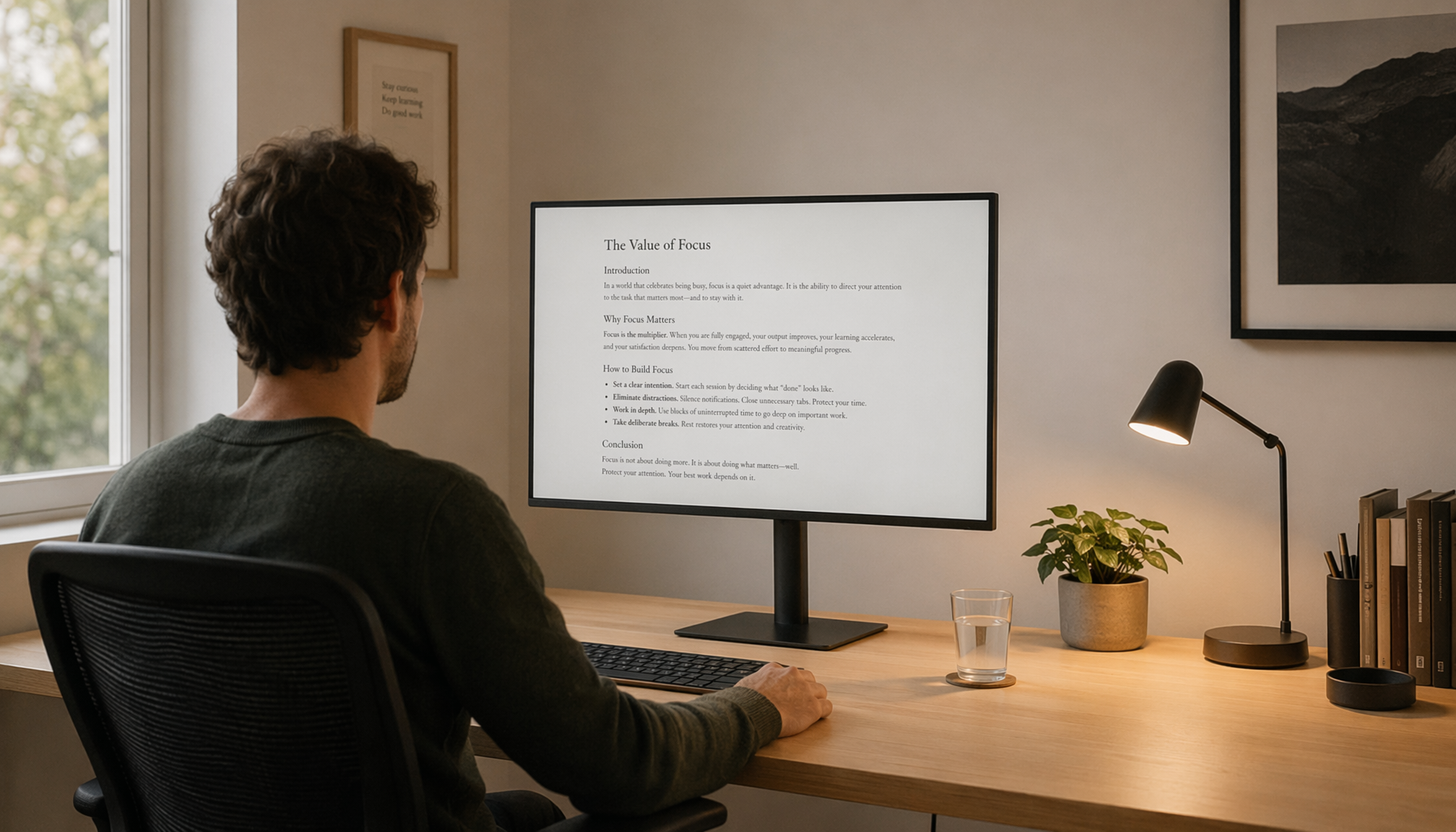
Think of it this way: if your room is nearly dark and your monitor shows a white document, your eyes compare that white page with the walls, desk, and keyboard around it. If the screen is the only bright object in view, it feels oversized and aggressive. This is why a spreadsheet at minimum brightness can feel worse than a movie scene with mixed dark and bright areas.
For a simple test, open a blank white document at night. If it looks like a glowing panel instead of a softly lit sheet of paper, the display is still too dominant for the room. The fix is not always to lower brightness further. Often, the better move is to raise the room’s soft background light and reduce harsh contrast between the screen and its surroundings.

Minimum Brightness Is Not the Same on Every Display
A monitor’s brightness rating is usually described in nits, which measure luminance. Higher nit ratings create stronger visibility in bright rooms, near windows, or outdoors, but perceived brightness does not scale in a simple straight line. A 1,000-nit portable monitor is already far brighter than a typical laptop display, while a 2,000-nit screen is mainly useful for direct sunlight or specialized outdoor work.
The important evening spec is not maximum brightness. It is minimum brightness. Some displays can drop very low; others remain visibly bright even at the lowest hardware setting. Independent monitor testing notes that minimum brightness below 65 nits is generally expected, while very light-sensitive users may prefer the 10- to 20-nit range for dark-room use. If your monitor bottoms out at a higher level, the slider can reach zero while your eyes still read the screen as too intense.
This matters for portable smart screens and high-brightness productivity monitors. A panel built to survive coffee-shop glare or window-side work may have a backlight system optimized for output, not candlelit comfort. That is a good tradeoff at 2:00 PM and a bad one at 11:00 PM.
Brightness, Contrast, and Black Level Are Different Controls
Many people lower brightness until the screen feels less painful, then wonder why dark scenes look muddy or text looks strange. That happens because brightness and contrast affect different parts of the image. On many LCD monitors, brightness mainly controls the backlight or black level, while contrast affects how bright whites and highlights appear.
Monitor communities often point out that brightness and contrast settings cannot be universal because display scales vary by model. Lowering brightness too far can crush dark grays into black, while incorrect contrast can erase highlight detail. For gaming, that means enemies in shadows disappear. For office work, it means dark UI themes become smeared and fatiguing.
The better sequence is to set brightness first until a white page stops feeling like a light source, then adjust contrast in small steps until dark gray remains visible next to black and light gray remains visible next to white. If your monitor has black equalizer, shadow boost, local dimming, or HDR tone mapping, check those settings after brightness and contrast. These features can make night use feel unstable because the screen may brighten small UI elements or shift luminance scene by scene.
Software Dimming May Not Reduce the Backlight
Operating system sliders, graphics controls, and dimming apps do not always control the same thing. Some reduce the physical backlight. Others darken the rendered image before it reaches the display. The second method can help, but the panel may still emit more light than you expect, especially on external monitors.
Built-in display controls can include brightness, night color, and color management options, and auto color management can help keep supported displays consistent across apps. But if your external monitor’s own backlight is too high, operating-system color changes may not fully solve evening glare. The image may become darker while blacks still look lifted and the display still illuminates the desk.
Some utilities can automate warmer color and signal-level brightness changes. A common setup uses warmer color at night and lower software brightness, but software brightness may affect only the image signal unless the hardware itself is also being adjusted. That distinction is critical: software dimming is useful, but it is not a replacement for a monitor with genuinely low minimum luminance.
Auto-Brightness Can Fight You
Adaptive brightness is helpful when it works well. It reads ambient light and adjusts the display automatically, raising brightness in bright spaces and lowering it in dark ones. But it can also misread the room, respond to a desk lamp at the wrong angle, or override your manual setting.
On laptops and supported displays, power plans and adaptive brightness settings can influence perceived brightness. If the screen seems inconsistent after sunset, check the active power mode, display settings, HDR setting, night light schedule, and any device utility. If the slider moves but the screen does not visibly change, the problem may involve a driver, firmware, or monitor control path rather than your eyes.
On portable setups, this is common when a laptop, USB-C display, graphics utility, and monitor on-screen menu all have their own brightness logic. Pick one primary control path for evening use. For example, set the monitor hardware brightness to a comfortable night baseline, then use Night Light or a graphics profile for small changes.
HDR and Local Dimming Can Make Night Use Feel Worse
HDR is valuable for games and movies because it allows brighter highlights and wider contrast. The problem is that the desktop, browser pages, and office apps are mostly SDR-style environments. A high-brightness HDR monitor can make white windows and UI elements feel aggressive in a dark room, especially if HDR mode lifts the overall image or if local dimming makes small bright elements pop too hard.
Mini-LED monitors can also show halos around bright UI elements on dark backgrounds. OLED displays have excellent black levels, but automatic brightness limiting can shift brightness when large white windows appear. For night productivity, SDR mode often feels calmer than HDR mode. For gaming, HDR may still be worth using, but it should be paired with in-game HDR calibration and a room light level that keeps highlights exciting rather than punishing.
A practical approach is to use SDR for writing, browsing, spreadsheets, and coding after dark. Switch to HDR only for games or movies that benefit from it, then lower in-game paper-white or UI brightness if available.
Add Bias Lighting Before You Buy a New Monitor
Bias lighting is one of the highest-value fixes for a screen that feels too bright at minimum. A small lamp behind the monitor or a soft LED strip aimed at the wall can make the display feel less harsh because your eyes no longer adapt to near-total darkness. The light should be gentle, indirect, and neutral enough that it does not tint your color perception.

For a desk about 4 to 5 ft wide, a small lamp behind the display or an LED strip along the rear edge of the monitor can be enough. Avoid pointing the lamp at the screen, which creates glare. The goal is to softly brighten the wall behind the display so the monitor is no longer the only strong light source.
This is especially useful for competitive gaming and long office sessions. You preserve visibility, reduce white-page shock, and avoid pushing the monitor so low that dark detail collapses.
A Practical Evening Calibration Routine
Start with the room, not the monitor. Turn on a soft background light behind or beside the display. Then set the monitor to SDR mode unless you are specifically watching HDR content or gaming in HDR. Open a white page and lower hardware brightness until it resembles paper under a desk lamp rather than a flashlight. Next, open a dark test image or a game scene with shadow detail and adjust contrast until near-black detail is still visible.
If the screen remains too bright, use software dimming as a second layer. Reduce graphics brightness or use a trusted dimming utility, but watch for crushed blacks and dull text. If text becomes gray and muddy, raise software brightness slightly and reduce contrast instead.
Finally, save separate profiles if your monitor supports them. A Day preset can prioritize glare resistance and clarity. A Night Work preset should use lower brightness, moderate contrast, SDR, and soft bias lighting. A Night Game preset can keep slightly higher contrast and tuned shadow visibility without forcing the whole panel into daylight mode.
When the Monitor Itself Is the Limitation
If you have tried bias lighting, SDR mode, hardware brightness, contrast tuning, and software dimming, the display may simply have a poor minimum brightness floor for night use. That does not make it a bad monitor. It means it was designed for brightness headroom, HDR impact, retail-floor punch, or outdoor readability rather than dark-room comfort.
For your next display, look beyond maximum nits. Check reviews for minimum brightness, flicker behavior, SDR brightness consistency, local dimming behavior, and whether brightness can be controlled cleanly over USB-C or DDC/CI. For portable monitors, be cautious with extreme brightness claims if your main use is indoor evening productivity. A balanced 1,000-nit class portable screen can be more practical than a 2,000-nit model because it usually offers better power, heat, comfort, and cost tradeoffs for indoor work.
FAQ
Should I use Dark Mode at night?
Dark Mode helps when your work is mostly text, chat, coding, or dashboards because it reduces large white areas. It is not a complete solution if the monitor backlight remains too high, and it can hide detail if contrast or black levels are poorly set.
Is warmer color temperature the same as lower brightness?
No. Warmer color reduces blue-heavy white light and can feel calmer at night, but it does not necessarily reduce the panel’s physical light output. Use warmth for comfort, then adjust brightness and contrast separately.
Is 0% brightness safe for image quality?
Sometimes, but not always. On some displays, 0% is still readable and clean. On others, it crushes dark detail or causes uncomfortable flicker behavior. Judge it with a white page, a dark scene, and real work content instead of trusting the number.
A display should adapt to your room, your workload, and your eyes. The best evening setup is usually not the dimmest possible screen; it is a balanced system of lower hardware brightness, controlled contrast, SDR when appropriate, and soft room lighting that lets the screen blend into the desk instead of dominating it.