A 27-inch 1080p monitor usually looks softer because its pixels are spread across a much larger panel, so text and fine edges have less density than they do on a smaller laptop display.

If you plugged in a new 27-inch gaming monitor and immediately thought your laptop screen looked cleaner, you are not imagining it. Users repeatedly report that text is where the difference shows up first, while games can still look acceptable. This guide will show you what is actually causing the softness, which fixes are worth trying, and when a higher-resolution monitor is the smarter buy.
The Main Reason: Pixel Density Drops Fast at 27 Inches
Why 1080p looks different on a bigger monitor
The biggest reason is pixel density. A 27-inch 1080p panel is about 82 pixels per inch, while a 24-inch 1080p monitor is about 92 PPI, and a 27-inch 1440p monitor jumps to about 109 PPI. That gap is large enough that text, icons, and thin UI lines often look less crisp at normal desk distance.
That is why a laptop screen can look sharper even when the external monitor has the same “1080p” label. The laptop panel is smaller, so the pixels are packed more tightly. In practical use, people describing 27-inch 1080p monitors often say the image is not truly out of focus, but that the screen looks more pixelated or coarse, especially in desktop apps and web pages.
Why text suffers more than games
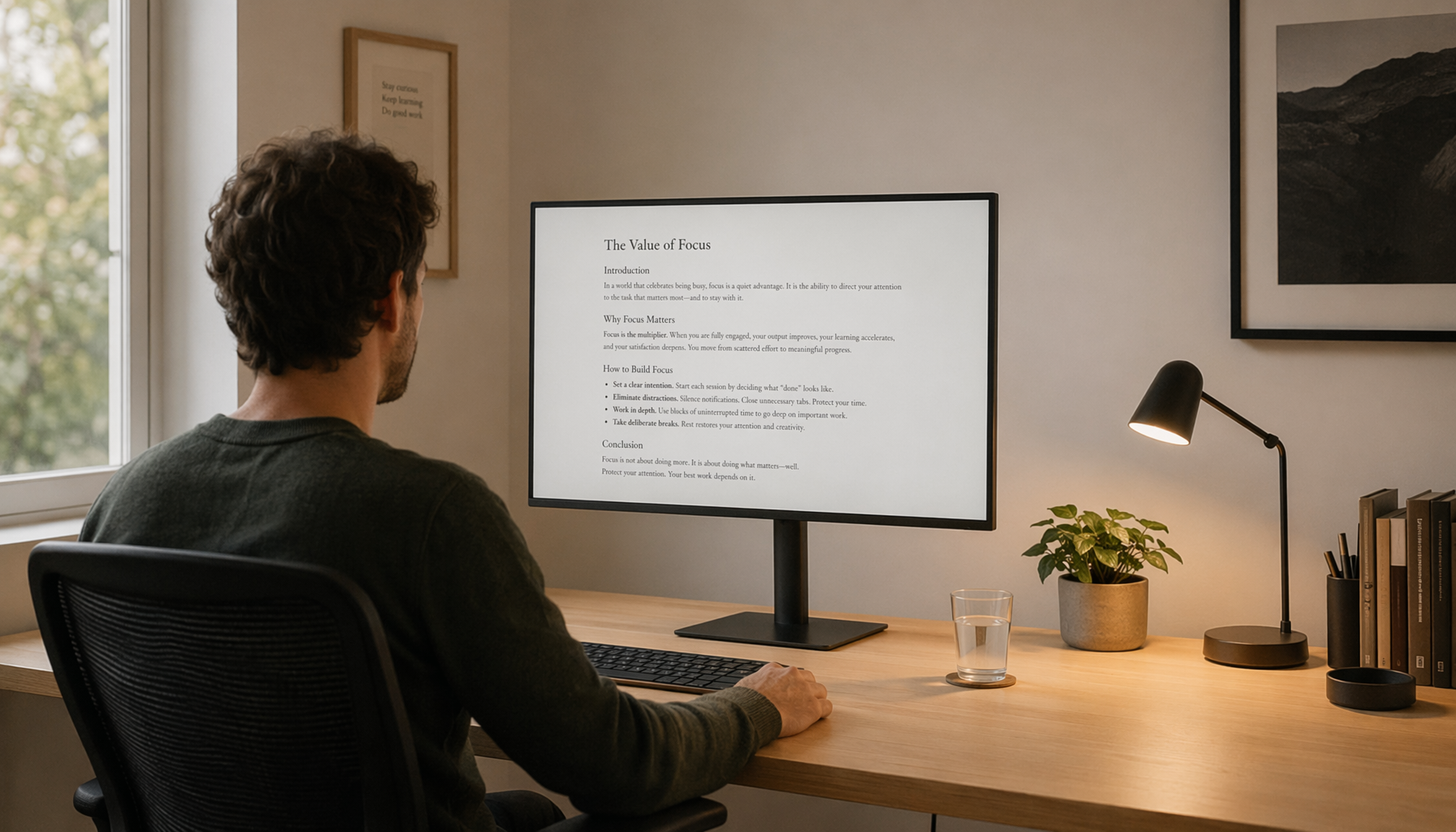
Multiple users in 27-inch 1080p discussions make the same distinction: desktop text usually looks worse first, while games are less bothered by the lower density. Motion, anti-aliasing, and normal viewing distance can hide some of the problem in games, but static text exposes it immediately.

That also explains why some buyers tolerate 1080p on a high-refresh-rate gaming monitor but regret it for mixed use. If your day includes reading, browsing, chat windows, spreadsheets, or long settings menus, 27-inch 1080p is much harder to ignore than it is in a fast shooter.
Blur, Pixelation, and “Something Looks Off” Are Not Always the Same Problem
Native resolution matters most
A fixed-pixel display looks best at its native resolution. Text blur on smart displays is often caused by a resolution mismatch, because the monitor has to scale the image instead of mapping each source pixel cleanly to the panel.
That is why one common reply in monitor threads is that “blur” often comes from non-native output, while low-density 1080p on a 27-inch panel is more about visible pixel structure. If your monitor is not actually receiving 1920 x 1080, or if a game is rendering below native and scaling up, the image can look soft in a different way than simple low PPI.
Refresh timing and overscan can also interfere
A forum case showed a 1080p monitor looking fuzzy at 1920 x 1080 with a 59.93 Hz mode, while other refresh options changed how the display handled sharpness and screen fit. That example is specific to one platform, but it shows a useful point: timing modes and display processing can change perceived clarity even when the listed resolution appears correct.
If your image looks slightly enlarged, cut off at the edges, or unusually soft, check more than just the resolution number. A monitor or TV-style display may be applying overscan, odd timing, or extra processing. That matters even more when you use HDMI on entry-level displays that blur video content more aggressively than desktop-oriented monitor modes.
Viewing Distance Changes the Verdict
Desk distance is why 27-inch 1080p gets criticized
Sharpness is not only about PPI. Pixels per degree is a better way to think about what your eyes actually see, because it combines density with distance. Sit farther back, and pixels become harder to notice.
That is why some users say 27-inch 1080p looks acceptable when the screen is pushed back, while others hate it at close desk range. One source notes a 27-inch 1080p screen reaches a point where pixels are hard to distinguish only at about 42 inches away, which is much farther than many people sit from a desktop monitor. If you usually work at about 24 to 30 inches, the softness is much easier to see.

Practical example for gaming setups
Forum users comparing 24-inch and 27-inch 1080p monitors often land on the same real-world result: if you sit close for competitive play, 24-inch to 25-inch 1080p tends to look cleaner, while 27-inch 1080p asks you to lean back more. That tradeoff matters if your desk depth is limited or if you keep the monitor on an arm pulled close.
For a gaming monitor, this becomes a buying question rather than a pure image-quality question. If your priority is 240 Hz or high frame rates on modest hardware, 1080p still makes sense. If you want cleaner text and better mixed-use clarity from the same 27-inch size, 1440p is usually the better fit.
Settings That Are Worth Trying Before You Replace the Monitor
Check the signal path first
Start with the basics: confirm the monitor is running at its native 1920 x 1080 resolution, use the correct refresh rate, disable overscan, and make sure the display is in a PC or game mode instead of a video-enhancement mode. In one tech site case, the desktop looked fine but games and a video platform looked noisy and foggy, which points to content path, scaling, or sharpening behavior rather than a single hardware failure.
On one desktop platform, text tuning can help. Users in platform threads specifically recommend running built-in display and text calibration tools to improve font rendering. This will not create more pixels, but it can reduce the “fuzzy text” feeling enough to make the monitor more tolerable.

Check scaling and mixed-display behavior
Mixed-display scaling issues can blur older apps when one screen uses 100% scaling and another uses a higher scale factor. If your laptop is the main display and the external monitor behaves oddly, try making the lower-DPI monitor the primary display, signing out and back in, and testing at 100% scaling.
Also remember that refresh rate alone does not fix text softness. A 180 Hz or 240 Hz gaming monitor can still look less sharp than a lower-refresh laptop panel if its pixel density is lower. Refresh rate improves motion clarity; it does not increase text detail.
When 1080p Is Still Fine, and When You Should Upgrade
1080p still has a place
1080p versus 1440p guidance makes the tradeoff clear: 1440p has about 78% more pixels than 1080p, so it shows more detail, but it also needs more graphics power. That is why low-end PCs and competitive players still benefit from 1080p, especially if high refresh rate matters more than text quality.
If you mostly play fast games, run a modest GPU, and do not spend hours reading or editing documents, a 27-inch 1080p monitor can still be workable. It is just not the cleanest choice for close-up desk use, and that mismatch is exactly why it often disappoints buyers coming from a sharper laptop screen.
The smarter upgrade path for most buyers
Across monitor forums, the most repeated rule of thumb is simple: 24-inch for 1080p, 27-inch for 1440p, and 32-inch for 4K. The platform discussion on 27-inch sizing and a separate 1080p vs 1440p thread both reinforce that 27-inch 1440p is the common sweet spot for mixed use.
If your monitor is for office work, content consumption, and gaming, 27-inch 1440p is usually the strongest value point. A 27-inch QHD option such as a 27-inch 2K 100Hz/120Hz home and office monitor fits that kind of upgrade, since it keeps the same screen size while improving sharpness over 1080p. If text quality is a top priority and your software handles scaling well, 27-inch 4K is sharper still, though it often needs scaling and costs more. For buyers considering ultrawide monitors, the same principle applies: panel size should rise with resolution, or text clarity suffers.
Quick Comparison for Desk Use
Monitor Size and Resolution |
Approx. PPI |
What It Usually Feels Like |
Best Fit |
24-inch 1080p |
92 |
Acceptable text, lighter GPU load |
Budget gaming, entry-level mixed use |
27-inch 1080p |
82 |
Softer text, visible pixel structure up close |
High-refresh gaming on a budget |
27-inch 1440p |
109 |
Noticeably crisper text and UI |
Best overall balance for mixed use |
27-inch 4K |
163 |
Very sharp text, may need scaling |
Premium productivity and media |
Practical Next Steps
If your 27-inch 1080p monitor looks blurry next to your laptop, first determine whether you are seeing true scaling blur or simply the limits of low pixel density. The difference matters, because settings can fix the first problem, but not the second.
Use this checklist:
- Confirm the monitor is set to its native 1920 x 1080 resolution.
- Check refresh rate options and test the standard PC mode your monitor handles best.
- Disable overscan and switch to a PC, Game, or Standard picture mode.
- Set scaling to 100% temporarily and sign out and back in if apps still look soft.
- Run your platform’s built-in text calibration or font smoothing tools.
- Move the monitor slightly farther back and reassess text clarity.
- If text still bothers you, target a 27-inch 1440p monitor for the next upgrade.
FAQ
Q: Is 27-inch 1080p actually blurry, or just less sharp?
A: Usually it is less sharp rather than truly blurry. At native resolution, the bigger issue is lower pixel density, which makes text edges and fine details look coarser at normal desk distance.
Q: Why do games sometimes look okay even when text looks bad?
A: Motion hides some of the low-density weakness, and anti-aliasing can smooth in-game edges. Static desktop text, browser tabs, and thin UI lines reveal the lack of pixel density much faster.
Q: Should I buy 1440p, 4K, or stay at 1080p?
A: Stay at 1080p if your priority is frame rate on weaker hardware. Move to 27-inch 1440p if you want the best balance for gaming and general use. Choose 27-inch 4K if text sharpness matters most and you are comfortable with scaling and a higher price.
References
- A platform community: 27-inch 1080p vs 1440p discussion
- A platform forum: External monitor fuzzy at native resolution
- A platform community: Does 1080p look blurry on a 27-inch screen?
- A website: Pixel density and PPI
- A forum: Is 1080p terrible for 27-inch displays?
- A platform community: Is 27 inch too big for 1080p?
- A brand article: Why text looks blurry on smart displays
- A forum: Basic question about pixel density
- A tech site: Why 1080p looks worse on a 27-inch monitor
- A tech site: How bad is 27-inch 1080p compared to 25-inch?
- A review site: 1080p vs 1440p