For most screen-heavy work, frequent short breaks are better for eye comfort than waiting for fewer long breaks. Use quick visual resets every 20 minutes, then add longer screen-free pauses every few hours to support focus, posture, and dryness control.
Do your eyes feel sharp at 9:00 AM but gritty, blurry, and slow to refocus by mid-afternoon? A 20-second distance-viewing reset can interrupt the screen habits that drive many symptoms: locked near focus, reduced blinking, glare tolerance, and leaning toward the display. Here is how to choose the right break rhythm for gaming monitors, office displays, laptops, and portable screens without sacrificing performance.
The Short Answer: Short Breaks Win, Long Breaks Still Matter
If the question is eye health during active screen use, short and frequent breaks are the stronger baseline. The widely recommended 20-20-20 habit means that every 20 minutes, you look at something about 20 ft away for at least 20 seconds. This is not a productivity gimmick; it gives your focusing system a quick change of distance and reminds you to blink before dryness builds.

Long breaks are still valuable, but they solve a slightly different problem. A 10- to 15-minute screen-free pause every few hours helps reset posture, circulation, attention, and overall fatigue. Clinical guidance notes that regular screen breaks should include time away from all screens, not just switching from a monitor to a phone. For a designer moving between a 27-inch 4K display and a cell phone, that distinction matters.
The best practical system is layered: short eye breaks often, longer body-and-mind breaks periodically. If you choose only one, pick short breaks, because eye strain usually develops during uninterrupted close focus rather than only after total daily screen time.
What Digital Eye Strain Actually Is
Digital eye strain, often called computer vision syndrome, describes temporary discomfort from prolonged screen or close-up work. Symptoms commonly include dry or watery eyes, blurred vision, trouble focusing, headaches, light sensitivity, and neck or shoulder tension. Medical guidance explains that digital eye strain is uncomfortable but is not the same as permanent screen damage to vision.
The core mechanism is simple. When you stare at a monitor, your eyes hold a near-focus position for a long time, and your blink rate drops. Eye-care guidance states that people normally blink about 15 times per minute, but screen use can reduce that to about 5 to 7 times per minute. That reduced blinking means the tear film is not refreshed as often, so dryness and burning creep in even if the display itself is high-end.
A premium monitor can reduce friction, but it cannot override biology. A 240 Hz gaming display may feel smoother in motion, and a matte productivity panel may reduce reflections, but neither replaces blinking, distance viewing, and a reasonable viewing distance.
Why Frequent Short Breaks Usually Beat Fewer Long Breaks
Short breaks work because they interrupt strain before it compounds. Clinical recommendations include regular eye breaks during close work, including the 20-20-20 method, because the eyes need chances to refocus at different distances. Waiting two hours for one long pause lets dryness, focusing fatigue, and compensating posture build up together.
Think of a competitive gaming session. If you play for three hours and only rest after the match block, your eyes may spend that entire window locked to the same depth, brightness, target distance, and reduced blink pattern. A 20-second glance across the room during queue time, respawn screens, loading screens, or round transitions costs almost nothing, but it gives the visual system a cleaner reset.

For office work, the math is even easier. In a four-hour desk block, the 20-20-20 rule creates about 12 microbreaks. That is only about four minutes total, yet it repeatedly changes focal demand. One 15-minute break after four hours gives more time away, but it arrives after symptoms may already be active.
Break Pattern |
Best Use |
Main Advantage |
Limitation |
20 seconds every 20 minutes |
Active screen work, gaming, spreadsheets, coding |
Prevents uninterrupted near focus |
Easy to forget without reminders |
5 minutes every hour |
Mixed desk work and meetings |
Helps posture and dryness |
May still allow long intense focus blocks |
10 to 15 minutes every few hours |
Recovery from long sessions |
Supports full screen-free reset |
Less effective if used as the only strategy |
When Longer Breaks Become the Better Tool
Longer breaks matter when discomfort is no longer just visual. If your neck is tight, your shoulders are rising, your back is stiff, or you are rereading the same line, you need more than a 20-second gaze shift. Ergonomics guidance emphasizes that lighting and visual ability can affect posture, because people often move awkwardly to see the screen better.
That means a long break should not be a passive scroll break. Stand up, step away from the desk, look outside or across a room, relax your shoulders, and avoid checking another device. A screen break that becomes 10 minutes on a cell phone is not a visual recovery break; it is just a smaller, closer display with tighter text.
A useful office rhythm is to pair microbreaks with task transitions. After a deep-work sprint, take a longer pause before moving into email, meetings, or dashboard review. For portable monitor users, this is especially important because compact screens are often lower, closer, and more likely to pull your head forward.
Set Up the Display So Breaks Actually Work
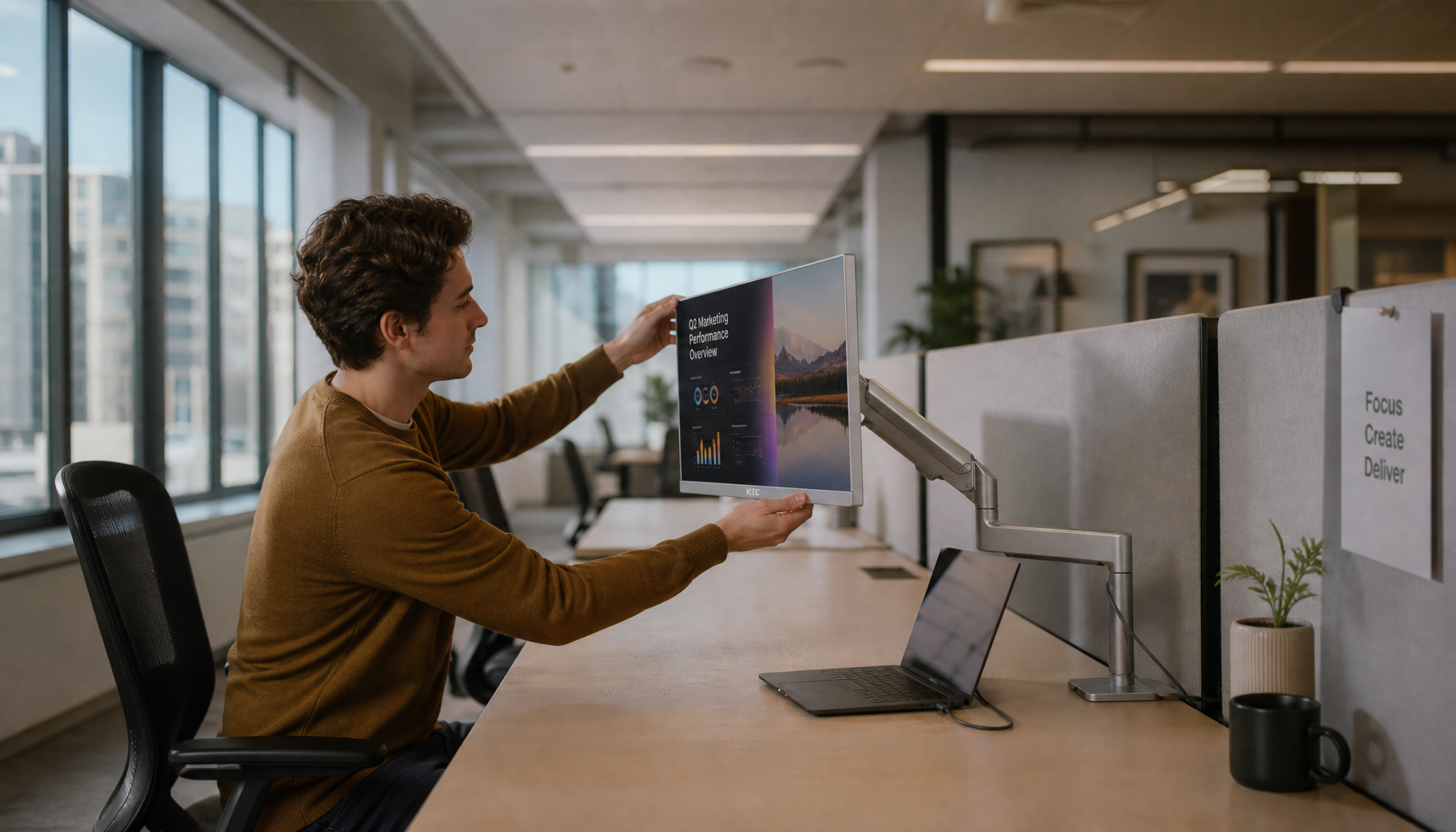
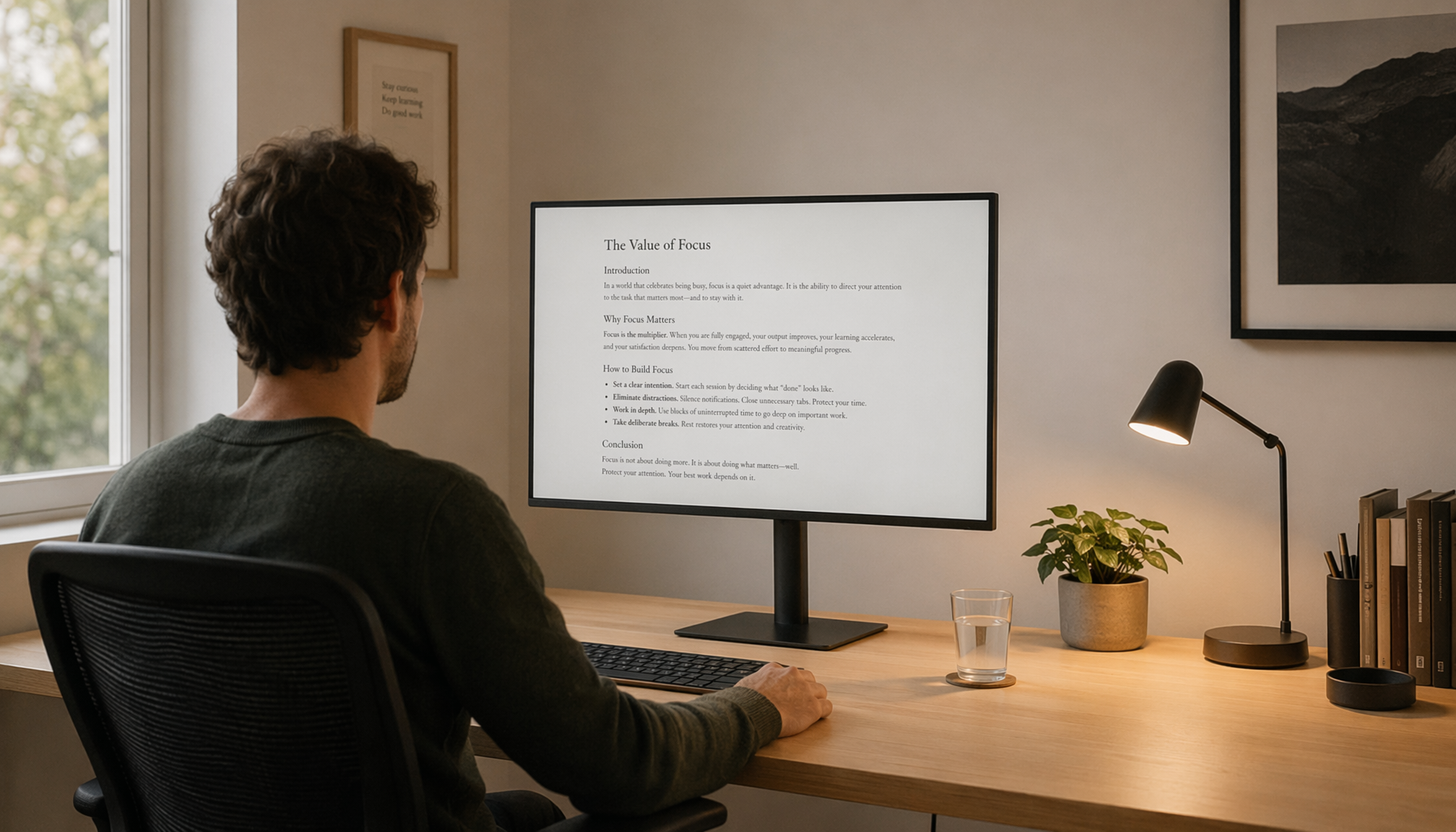
Breaks are more powerful when the screen is not fighting you. Eye-care guidance recommends positioning the computer about 25 inches away, roughly arm’s length, with your gaze slightly downward. For most desk setups, that means the top of the monitor should sit at or just below eye level, not towering above your line of sight.

Workstation guidance also warns that a monitor positioned too high can make users tilt the head back, adding neck and back strain. That is why monitor height adjustment is not just a nice-to-have feature. For a 27-inch productivity monitor, the stand should let you keep the panel centered, stable, and slightly below straight-ahead gaze. For a laptop or portable smart screen, use a stand and external keyboard when possible so the screen can rise without forcing your wrists into a bad position.
Brightness should match the room. A screen that glows like a light panel in a dim room forces the eyes to adapt constantly, while a dim display in a bright office encourages squinting. Increase text size before you lean forward. Improve contrast before you crank up brightness. Clean smudges and dust, because a dirty screen turns even a good matte panel into a glare source.
Blinking, Dryness, and Contact Lenses
For dry eyes, short breaks are only half the equation. Conscious blinking matters. Eye-care guidance identifies reduced blinking during screen use as a major reason screens cause dryness and recommends artificial tears when eyes feel dry. Clinical guidance also notes that artificial tears can help prevent and relieve dry eyes, while redness-removing drops may worsen dryness.

Contact lens users should be more aggressive about recovery. If your eyes feel gritty by the afternoon, use microbreaks to blink fully several times, avoid direct air from vents, and consider switching to glasses for long desktop sessions when appropriate. If you need drops often, preservative-free options may be better, especially when used more than a few times per day.
For a real-world display setup, airflow can be the hidden problem. A perfect 32-inch monitor placed at arm’s length will still feel harsh if an HVAC vent is blowing across your eyes for six hours. Move the fan, redirect the vent, add humidity when the room is dry, and treat the environment as part of the screen system.
What About Blue Light Glasses?
Blue light is often marketed as the center of eye strain, but the evidence is weaker than the marketing. Medical guidance states that blue light glasses are not recommended for preventing eye strain because strong evidence is lacking. University research summaries also describe support for blue-light-blocking lenses and filters as limited.
That does not mean evening display settings are useless. Warmer color temperature and reduced brightness can make nighttime viewing more comfortable and may help sleep routines. But for eye strain during work, the higher-value controls are break frequency, blink behavior, glare reduction, text size, viewing distance, and prescription accuracy.
If you are choosing a monitor, prioritize ergonomic adjustability, matte or low-glare surfaces, readable resolution and scaling, stable brightness controls, and flicker-reduced backlighting. A blue light mode can be useful, but it should not carry the whole eye-comfort strategy.
A Practical Break Plan for High-Performance Screen Users
Use the 20-20-20 rule as your default operating system. Every 20 minutes, look at a target across the room or out a window for 20 seconds. During that short reset, blink slowly and fully a few times. If you work in a small room, choose the farthest object available; the goal is distance change, not perfection.
Every hour, add a short physical reset if your work allows it. Stand, roll your shoulders, check whether you are leaning forward, and confirm that your monitor is still at arm’s length. Every few hours, take a true 10- to 15-minute screen-free break. Walk, get water, or look outside. Do not trade a desktop monitor for a phone.
For gaming, use natural downtime. Loading screens, queue times, intermissions, and match breaks are ideal moments to look away. For office productivity, attach the habit to calendar transitions, file exports, meeting endings, or completed work blocks. For portable smart screens, be stricter: smaller text and lower screen height make microbreaks and scaling more important.
When to Get an Eye Exam
If break habits, setup changes, and artificial tears do not improve symptoms, get an eye exam. Clinical eye-care guidance notes that computer vision symptoms may improve with an updated prescription, and people with symptoms during device use should consult an optometrist or ophthalmologist. Persistent redness, blurry vision, watery eyes, light sensitivity, or pain deserves professional evaluation rather than another accessory purchase.
Computer-specific glasses can help some people because normal prescriptions are not always optimized for the intermediate distance of a monitor. This is especially relevant for progressive lens wearers, bifocal users, and anyone who tilts the head to find a clear zone. Before an appointment, measure your normal viewing distance so the prescription can match how you actually work.
The Best Break Strategy
Take frequent short breaks for your eyes, then use fewer long breaks for full-system recovery. A 20-second distance reset every 20 minutes is the most reliable baseline for screen comfort, while longer screen-free pauses protect posture, attention, and dryness control across the day. The highest-performance display setup is not just a better panel; it is a smarter rhythm between your eyes, your environment, and the screen in front of you.