Shoulder pain from monitor height usually starts when your screen makes your neck bend, your shoulders lift, or your arms reach. Set your posture first, place the top third of the screen near eye level, keep the display about an arm’s length away, and keep your keyboard and mouse close enough for your shoulders to stay relaxed.
Does your shoulder feel tight after a long ranked session, a spreadsheet sprint, or a full day of video calls? A practical monitor reset can give you a testable win the same day: less chin lifting, less hunching, and fewer end-of-day shoulder knots. Here’s how to tune your screen height, desk, chair, and accessories so your display supports performance instead of stealing comfort.
Why Monitor Height Can Trigger Shoulder Pain
Shoulder pain is not always caused by the shoulder itself. In desk setups, it often starts with the neck, upper back, and arms working overtime because the screen is in the wrong place. When a monitor sits too low, you tend to drop the chin, round the upper back, and let the head drift forward. When it sits too high, you may tilt the chin up and tighten the upper trapezius muscles, the same area many users describe as a hard band from neck to shoulder.

A neutral monitor setup keeps the head stacked over the shoulders and avoids forcing the neck up or down. Proper monitor height is commonly described as a position that lets you look ahead comfortably while the main content sits slightly below your natural eye line. That matters because shoulder muscles stabilize the neck and arm position during typing, aiming, scrolling, and clicking. If your display placement is wrong, those muscles stay active for hours.
For high-refresh gaming monitors, ultrawides, dual displays, and portable smart screens, the risk is not the screen category itself. The problem is mismatch. A 27-inch QHD monitor on a proper arm can feel effortless. A laptop on a table, a 49-inch ultrawide too close, or a portable screen tilted low on a folio stand can push the same body into strain.
The Correct Monitor Height: A Practical Definition
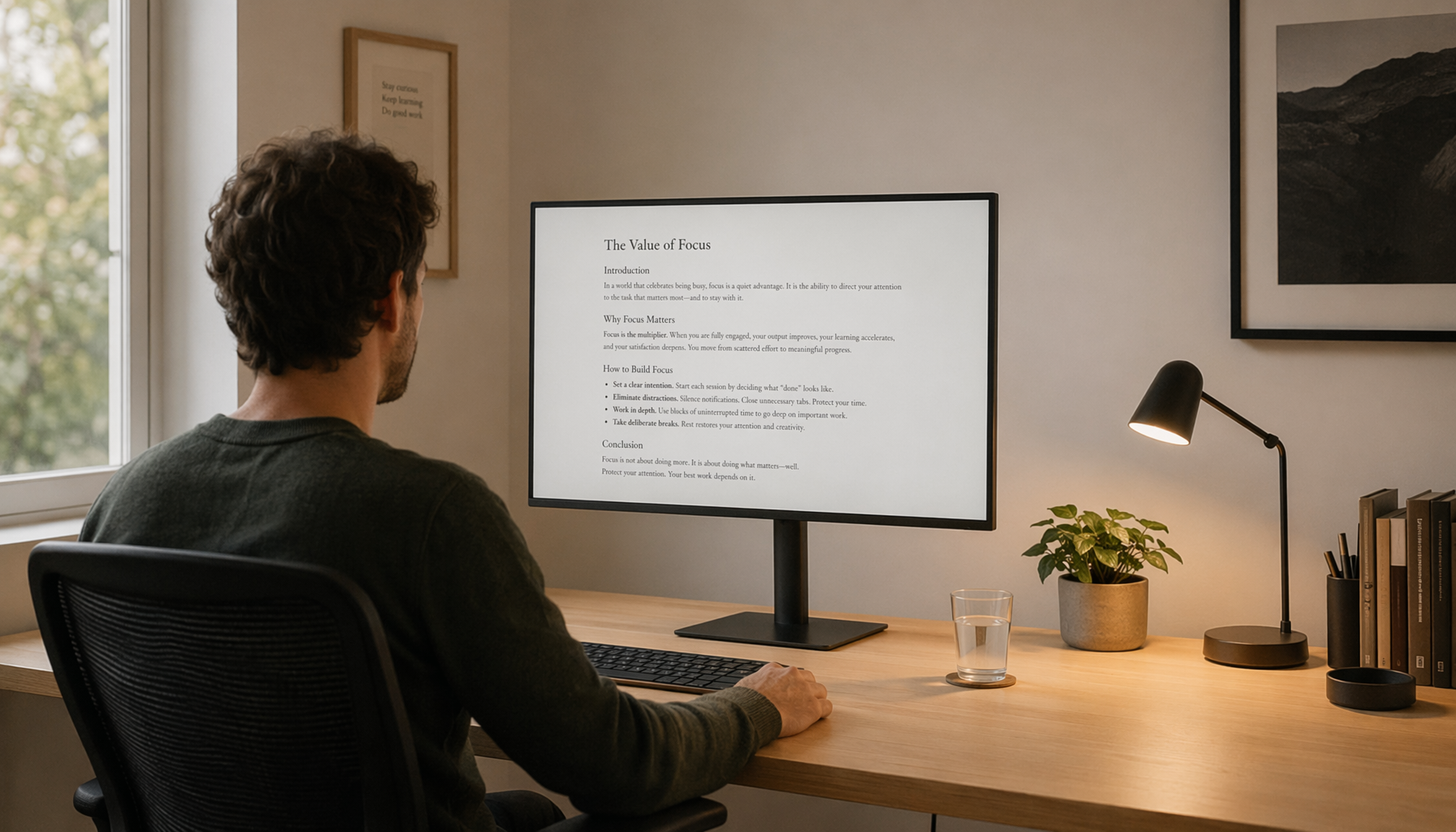
The best starting point is simple: sit in your normal working posture, relax your shoulders, and place the top third of the screen at or slightly below eye level. Your eyes should naturally land around the upper area of the display, while the center of the screen sits lower in your field of view.

A comfortable visual angle is usually slightly downward, not upward. Monitor placement should let the head stay upright without neck tilting. For a typical 24- to 27-inch office or gaming display, that often means the top bezel is near eye level and the middle of the panel is below it. If you use a taller 32-inch monitor or a portrait display, resist the instinct to align the center at eye level, because that can put the top of the screen too high.
A quick field test works better than guessing. Sit back with your pelvis supported, close your eyes for a few seconds, then open them. If your gaze lands near the upper third of the screen and your neck feels quiet, you are close. If you immediately look down into the lower half of the display, raise it. If you look up toward the top edge, lower it.
Too High vs. Too Low: What Your Body Tells You
Monitor problem |
Common body signal |
Likely cause |
First fix |
Too high |
Chin lifts, eyes feel dry, upper shoulders tense |
Screen top is above eye level |
Lower the monitor or raise the chair with foot support |
Too low |
Chin drops, upper back rounds, neck feels heavy |
Laptop or monitor sits below natural gaze |
Raise the screen and use separate input devices |
Too close |
Leaning back, eye fatigue, head turning on large screens |
Desk depth is too shallow |
Move the display back or increase text scaling |
Too far |
Leaning forward, squinting, rounded shoulders |
Text or UI is too small |
Increase font size before moving closer |
Off center |
One-sided neck or shoulder ache |
Main screen is angled or secondary screen dominates |
Center the primary display |
A low monitor often feels comfortable for the first few minutes because looking down is familiar. Over an eight-hour day, it can become a posture trap. A high monitor can feel refined on a tall stand, especially with a large gaming display, but if your chin is up even slightly, the neck extensors and shoulder stabilizers may never get a real break.
Set the Chair and Desk Before You Touch the Monitor
The fastest mistake is adjusting the screen while sitting in a compromised position. Start with the body, then tune the display. Your feet should be supported, your thighs roughly parallel to the floor, and your elbows near a right angle when your hands rest on the keyboard and mouse. Your shoulders should feel heavy and relaxed, not lifted toward your ears.
Desk height directly affects shoulder load. Neutral arm posture means relaxed shoulders, elbows near 90 degrees, and forearms roughly parallel to the floor. If the desk is too high, you may raise your shoulders to type. If it is too low, you may slump or reach forward. Either problem can make a correctly placed monitor feel wrong.
For example, if you raise your chair to make a fixed 30-inch desk usable, your feet may stop touching the floor. That can destabilize your posture, so add a footrest. If you lower your chair to get your feet flat but your elbows now sit below the desktop, consider a keyboard tray or a lower desk surface. Monitor height is only one part of the alignment chain.
Screen Distance, Tilt, and Size Matter
Monitor height gets most of the attention, but distance and tilt decide whether that height actually works. A common starting distance is about an arm’s length, often around 20 to 30 inches for standard desktop monitors. Larger screens need more room, especially 32-inch displays, 34-inch ultrawides, and 49-inch super-ultrawides.
For office displays, 24- to 27-inch monitors are often a practical comfort zone because they provide useful workspace without demanding excessive head movement. A 27-inch monitor may feel right at roughly 24 to 27 inches away, while ultrawide and dual-monitor setups often need closer to 30 inches or more so the whole visual field stays manageable.
Tilt the monitor slightly backward, roughly 10 to 20 degrees, especially if glare tempts you to crane your neck. Do not use tilt to compensate for bad height. If the screen is too low, tilting it back will not fix the forward-head posture. Raise the panel first, then fine-tune tilt for eye comfort.
Fixes for a Monitor That Is Too Low
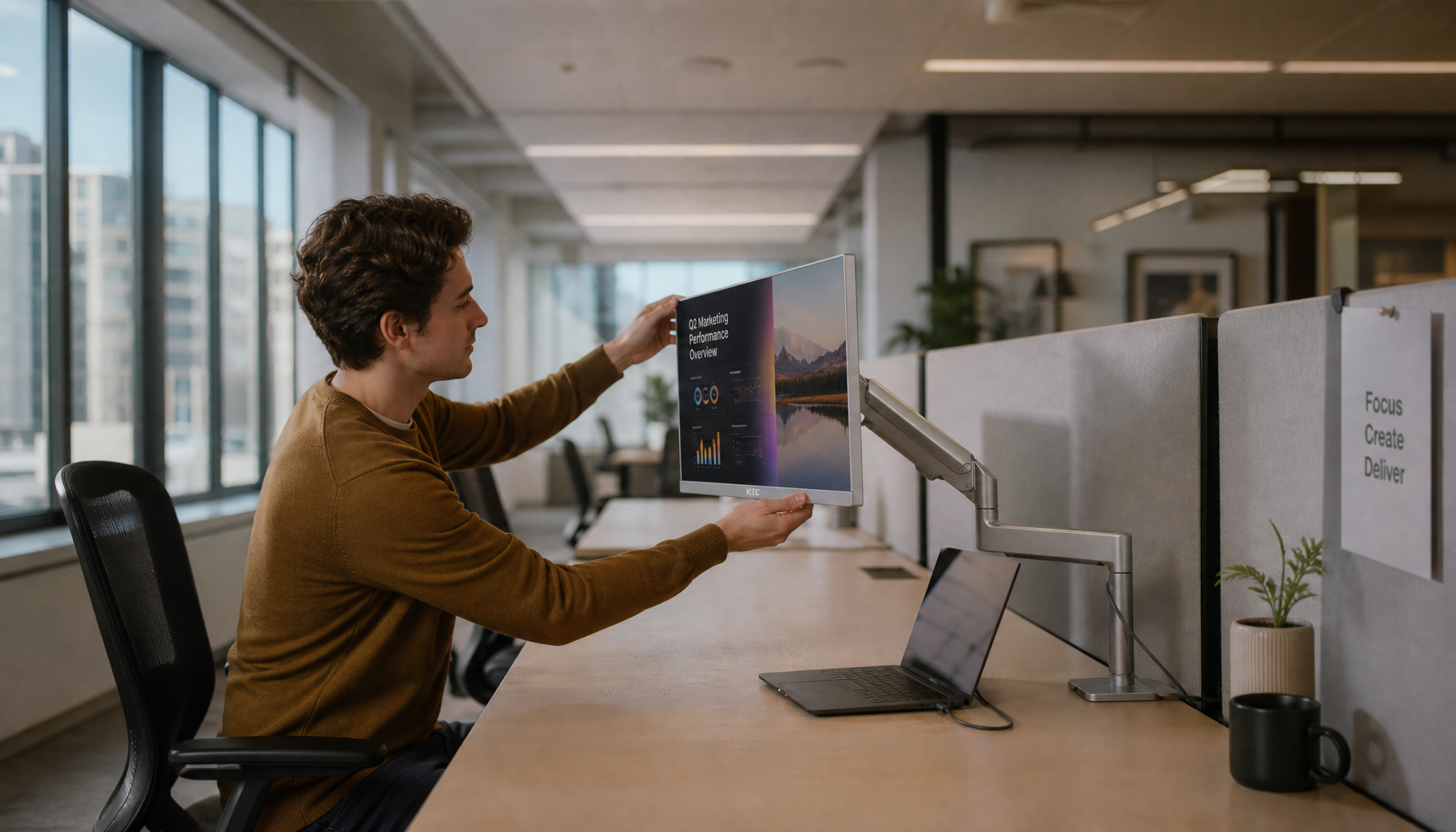
A low screen is common with laptops, portable monitors, compact stands, and budget display bases with limited height adjustment. The best fix is to raise the screen while keeping the keyboard and mouse at elbow height. That usually means a monitor arm, riser, stand, or stable stack of books for a temporary setup.

Laptop users need special discipline because the screen and keyboard are physically connected. If you raise the laptop to eye level and keep typing on it, your shoulders and arms will rise into a strained position. Use an external keyboard and mouse so the screen can be high enough while your hands stay low and close.
Portable smart screens need the same rule. A 15.6-inch portable display on a shallow hotel desk may sit too low and too close. Raise it with a compact folding stand, keep it nearly straight ahead if it is your primary display, and increase display scaling instead of pulling the screen toward your face.
Fixes for a Monitor That Is Too High
A monitor that is too high often appears in performance setups with tall factory stands, stacked monitor layouts, oversized screens, or aggressive monitor-arm positioning. The sign is simple: you lift your chin, your eyes feel exposed or dry, and the tops of your shoulders feel loaded.
Large displays are especially sensitive to height. Large monitor placement should keep the top at or slightly below eye level while the center of the screen sits below horizontal eye level. If you use a 32-inch or taller panel, lower it until the active work area feels comfortable, even if the top edge sits lower than you expected. Performance does not come from staring upward.
If the stand cannot go low enough, remove a riser, switch to a lower compatible arm, or adjust the chair only if your feet and arm position remain supported. For wall-mounted monitors, the fix may require remounting. A display that looks clean on a wall can still be ergonomically expensive if it forces neck extension all day.
Dual Monitors, Ultrawides, and Gaming Setups
Dual monitors boost workflow, but shoulder pain often appears when the main display is not truly centered. If you use one screen most of the time, put that screen directly in front of your nose and angle the secondary display inward. If you use both equally, place them like one wide display, with the center gap aligned to your body and both screens at the same height and distance.
Multi-screen setups can increase neck rotation when poorly placed. Dual-screen ergonomics favor matching screen heights, keeping displays about arm’s length away, and using a slight V shape when both screens get equal use. The mouse should also stay oriented toward the main screen. If your mouse lives far to the right because of a wide keyboard or second monitor, your dominant shoulder may carry the cost.
For gaming, the target is not just comfort but repeatable control. Keep the main monitor centered, the keyboard and mouse close, and the elbows near the body. A high-refresh 27-inch or 32-inch gaming monitor should not force a shrugged aim posture. If you play low-sensitivity FPS games with wide mouse sweeps, desk space and mouse placement become shoulder-health features, not accessories.
Pros and Cons of Common Monitor-Raising Tools
Tool |
Pros |
Cons |
Best use |
Monitor arm |
Precise height, depth, tilt, and swivel adjustment |
Needs a compatible desk and mount |
Shared desks, sit-stand desks, dual monitors |
Monitor riser |
Stable, simple, often affordable |
Fixed height can be imperfect |
Single-monitor office setups |
Laptop stand |
Raises screen quickly and travels well |
Requires external keyboard and mouse |
Remote work and portable setups |
Books or sturdy blocks |
Low cost and fast |
Can look messy or become unstable |
Temporary testing before buying gear |
Adjustable desk |
Helps sitting and standing posture |
Does not replace screen-height adjustment |
Users who alternate positions often |
The best accessory is the one that lets you change height without compromising your arms. A monitor arm is usually the most flexible solution for pro displays, ultrawides, and sit-stand routines. A riser is enough when your setup is stable and single-purpose.
Movement Prevents Static Shoulder Load
Even a perfectly tuned monitor cannot remove the cost of staying still. Muscles dislike static work. The goal is to interrupt tension before it turns into pain.

Long gaming and office sessions create risk through static posture, repetitive input, and awkward positions. Ergonomic gaming setups focus on neutral posture, supported feet, relaxed shoulders, and regular movement. A practical rhythm is to reset every 30 minutes: stand briefly, let the arms hang, roll the shoulders slowly, and check whether the screen has pulled you forward.
If pain keeps returning after two or three weeks of setup changes, or if you have numbness, weakness, sharp pain, or symptoms spreading down the arm, treat that as more than a monitor problem. Ergonomic changes can reduce strain, but persistent shoulder pain deserves medical or ergonomic evaluation.
FAQ
Should the top of my monitor be exactly at eye level?
Not always. Eye level is a starting point, not a law. For many users, the top third of the screen at or slightly below eye level works better because the main content lands in a natural downward gaze. Taller monitors, ultrawides, and progressive lenses may need a lower setup.
What if I wear bifocals or progressive lenses?
You may need the screen slightly lower and tilted upward so you can read without tipping your head back. The key test is whether your neck stays neutral while your eyes do the work.
Can shoulder pain come from the mouse instead of the monitor?
Yes. A monitor that is off-center can make you rotate, but a mouse that is too far away can also overload the shoulder. Keep the mouse close to the keyboard, at the same height, and avoid reaching around wide desk accessories.
Is a bigger monitor worse for shoulder pain?
No, but bigger screens demand better placement. A large monitor should sit farther back, lower than many users expect, and centered so your active work stays in the middle. If the edges require constant head turning, use window management to keep critical content near center.
A high-performance display should make work and play feel cleaner, faster, and more controlled. Set your body first, place the screen to match your natural gaze, and use adjustability as a performance feature. Your shoulders should not be the part of the setup doing the hardest work.