Sitting off-center makes one side of your neck and shoulder do more stabilizing work than the other. Over time, that repeated twist creates uneven muscle loading, posture drift, and fatigue that feels worse on one side.
Do you finish a long gaming session or spreadsheet-heavy workday with one shoulder tight, one side of your neck sore, or a headache that seems to start behind one ear? A centered monitor setup can give you a specific, testable win: less repeated head turning, less leaning, and a more consistent viewing angle across your whole session. Here’s how to identify the cause, correct the screen position, and tune your setup for work, play, and multi-monitor productivity.
The Real Reason Off-Center Viewing Feels Uneven
When your monitor sits to the left or right of your natural seated position, your body has to choose between two compromises. You either rotate your head and neck toward the screen while keeping your torso facing the keyboard, or you twist your torso slightly while your arms keep working straight ahead. Both options create asymmetrical load.

The practical ergonomic principle is simple: keep the monitor directly in front so your neck, head, shoulders, and trunk are not held in a rotated position for long stretches. Computer work rarely feels “heavy,” but localized force and sustained muscle tension can affect small muscle groups in the neck, shoulders, back, forearms, and hands. That is why a screen that is only a few inches off your body center can feel harmless for 10 minutes and punishing after three hours.
In display terms, “off-center” means the main visual target is not aligned with your nose, sternum, and chair position. It is not always the keyboard that should define center. For gamers, the keyboard may be shifted left for WASD comfort while the mouse gets more room on the right. In that case, the monitor should still face your head and torso, while the keyboard and mouse adapt to your arm position.
Why One Shoulder Gets Tired First
Your neck is not just turning your head; it is stabilizing the weight of your head while your eyes lock onto the screen. If the screen sits left of center, muscles on one side of the neck and upper shoulder help hold that rotation. The other side may counterbalance. This is why the discomfort often appears as a one-sided ache rather than a general tired feeling.
Forward head posture makes the problem worse. Clinical guidance notes that each inch the head shifts forward adds about 10 pounds of pressure to the neck muscles. Combine that forward drift with a side turn and you get a performance-killing posture: the head is no longer stacked over the shoulders, and one side is constantly working harder.
A simple example makes this obvious. If your 27-inch monitor is centered on the desk but your chair is parked 8 inches to the right because your mousepad, laptop, or drawer placement pushed you there, your eyes will still chase the display. Your neck quietly pays the bill. The fix is not to “sit up straighter” for the next month; the fix is to move the visual target back to your body’s centerline.
Screen Position Is a Viewing System, Not Just a Height Setting
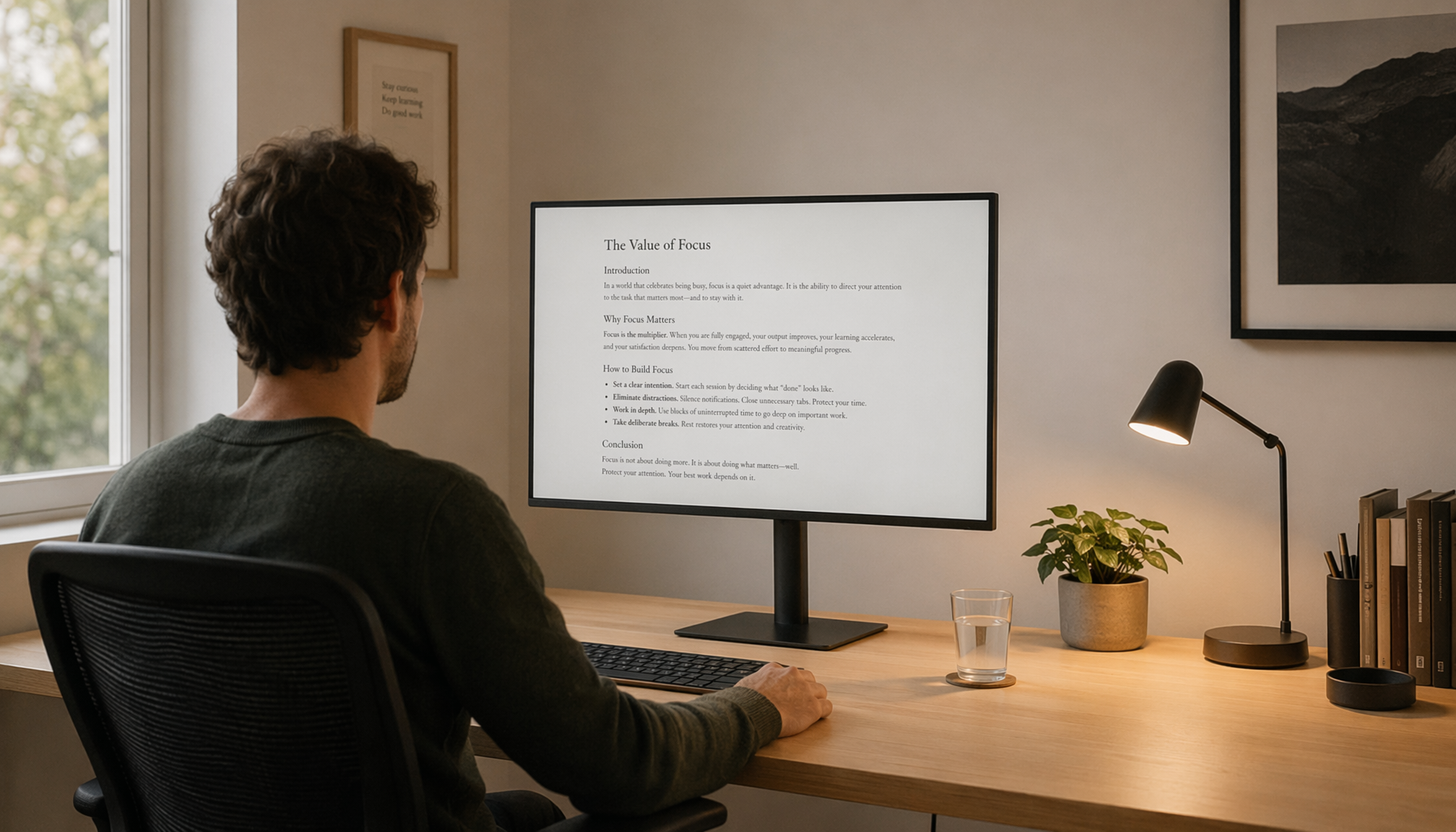
Most people adjust monitor height first, but side alignment, distance, glare, and text size all interact. Ergonomic guidance recommends placing the monitor directly behind the keyboard, about an arm’s length away, with the top of the screen at or slightly below eye level. That gives you a strong baseline for ordinary office work.

For performance setups, treat the center of the screen as the primary target. Your eyes should land slightly downward toward the screen center, not upward. A useful viewing zone puts the top line of the screen at eye level or slightly below, while the center of the display sits below horizontal eye level. In real desk terms, this often means the top edge is near your eye line and the middle of the panel is lower, so you are not lifting your chin.
Distance matters because sitting too close increases eye and neck movement, while sitting too far away encourages leaning. A practical starting point is arm’s length, then adjust font size, scaling, or game UI size before pulling your head forward. If you are using a 32-inch or ultrawide monitor, you may need to sit farther back than you would with a 24-inch display so you can scan the panel without constant head movement.
The Hidden Role of Glare and Small Text
Off-center fatigue is not always caused by the monitor’s physical location alone. Sometimes the body moves off-center because the eyes are trying to escape glare, reflections, or text that is too small. If a bright window is behind you, your eyes may squint and your head may drift to one side for a cleaner angle. If the screen is too dim compared with the room, you may lean forward and rotate without noticing.
Ergonomic guidance recommends reducing ambient lighting around the monitor to improve contrast and reduce eye strain. For a quick test, turn off the monitor and look at the dark screen. If you see a window, lamp, or bright ceiling reflection, your posture is probably adapting to the room instead of the other way around.
This is especially relevant for gaming monitors and high-refresh office displays because brightness and contrast are often set aggressively. A fast panel with poor viewing ergonomics still loses value if you compensate by craning your neck. Tune brightness to the room, place windows to the side where possible, and increase text or UI scale before you move your face closer.
Dual Monitors: When “Centered” Depends on Usage

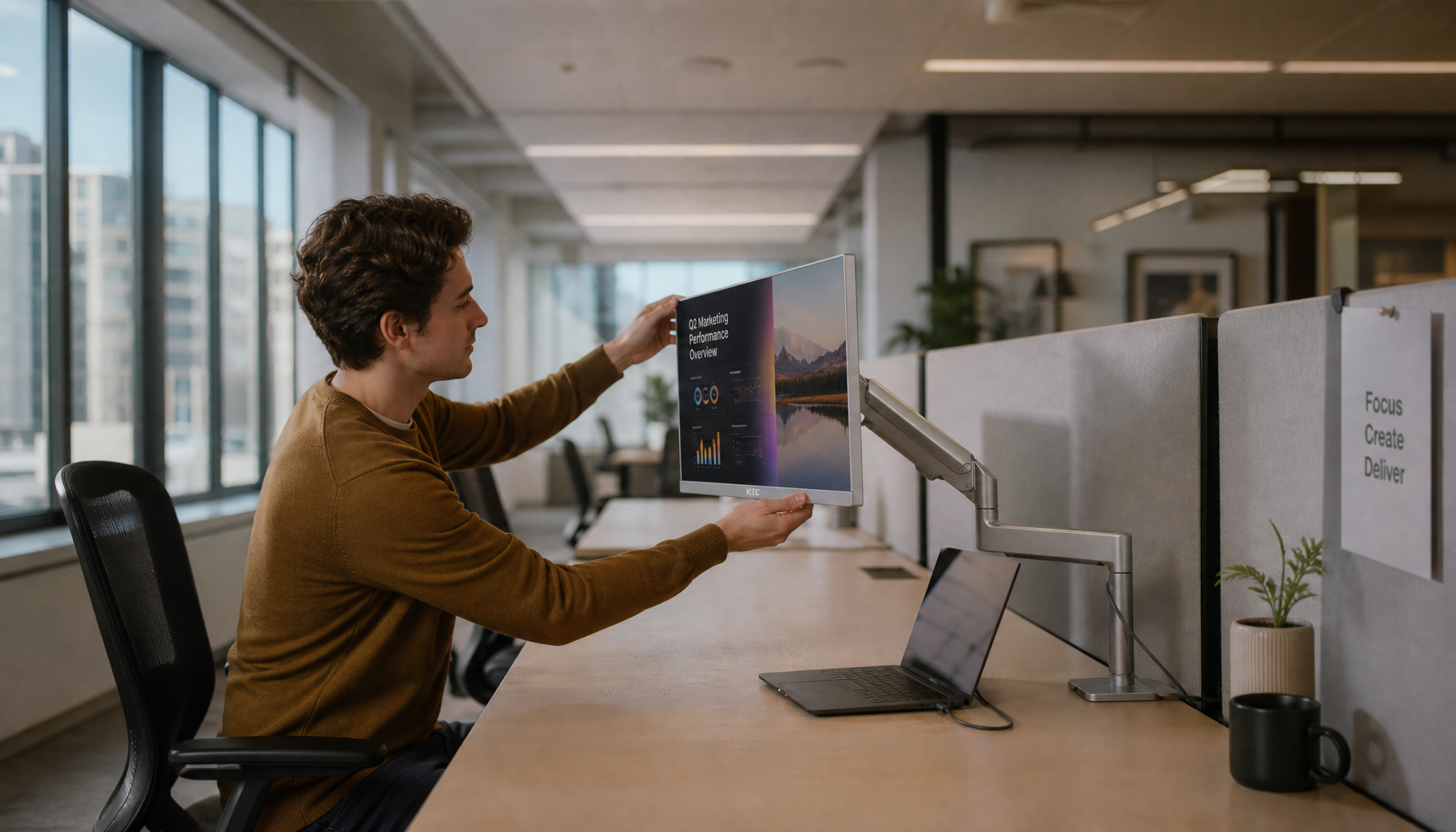
Dual monitors are where many smart setups go wrong. If you use one screen most of the time, the main display belongs directly in front of you. The second monitor should sit close beside it, angled inward, at the same height and similar distance. This prevents the secondary screen from becoming a repeated neck-turning station.
If you use two displays equally, the center split between them should sit directly in front of your body. That way, neither side dominates your neck rotation. Ergonomic monitor setup guidance makes the same distinction: the most-used screen directly in front, or the join centered when both screens are used equally.
For a streamer, designer, analyst, or competitive player, this distinction matters. A main gaming screen should be centered on your body, not sacrificed to make a chat, timeline, or reference screen look symmetrical on the desk. Symmetry on the desk is less important than symmetry in your muscles.
Setup Type |
Best Center Point |
Fatigue Risk If Wrong |
One main monitor |
Center of main screen |
One-sided neck and shoulder tension |
Two equal monitors |
Seam between screens |
Alternating but frequent head turns |
Gaming plus stream/chat screen |
Main gaming display |
Dominant-side shoulder tightness |
Laptop plus external monitor |
External main display |
Forward head posture and uneven reaching |
How to Fix an Off-Center Monitor Setup
Start by sitting the way you actually work or play. Place your feet flat, sit back into the chair, relax your shoulders, and let your hands fall naturally to the keyboard and mouse. Now look straight ahead without correcting your posture. The center of your main display should meet that line.
Next, move the monitor, not your body, until the panel is directly in front of your face and torso. Set the top edge around eye level or slightly below. Keep the screen about arm’s length away, then enlarge text, browser zoom, spreadsheet scale, or in-game HUD elements if you feel tempted to lean in. Health guidance notes that squinting at small screens can indirectly worsen neck and back strain because it pulls the body forward.
Then check your peripherals. Your mouse should be close enough that your upper arm stays near your body, because a mouse placed too far away keeps shoulder and neck muscles active. Your keyboard should support relaxed shoulders and straight wrists. For PC gaming, this may mean the keyboard is angled or shifted while the monitor remains centered on your vision.
Finally, reassess after 30 minutes of real use. If your head turns left to read chat, right to inspect a timeline, or down to check a laptop, your setup still has a repeated-motion problem. Move the most-used information closer to the center or reduce how often you need to look away.
Movement Still Matters
A perfect monitor position reduces strain, but it does not make stillness healthy. Health guidance describes tech neck as strain from prolonged screen use and recommends getting up and moving regularly to change neck position and improve circulation. That advice applies to both office productivity and long gaming sessions.

Use natural breaks in your workflow. After a match, stand up. After a long document section, look across the room. During a compile, render, or data refresh, roll your shoulders and reset your chair position. The goal is not rigid posture; it is a setup that keeps neutral alignment easy, then gives your muscles regular chances to recover.
When Discomfort Needs More Than Setup Changes
Uneven shoulder and neck fatigue that improves after repositioning your monitor is usually a strong sign that workstation geometry was involved. But persistent pain, numbness, tingling, weakness, pain radiating into the arm or hand, or symptoms that affect sleep should be evaluated by a qualified health professional. Ergonomics can reduce strain, but it is not a substitute for medical care when symptoms suggest nerve involvement or a more complex condition.
The Performance Takeaway
A monitor is not centered when it looks centered on the desk. It is centered when your eyes, head, shoulders, and main task all line up without twisting. Put the primary screen in front of your body, tune height and distance, control glare, and let secondary displays support the workflow instead of stealing your posture. A sharper setup does more than look clean; it helps you stay immersed, accurate, and comfortable for the full session.