MegPad for home fitness workouts works best when the screen follows your workout zone, not the other way around. If the display sits too high, too low, or in the wrong light, you end up with neck strain, glare, and more head movement than you want during class. Using MegPad for home fitness workouts means placement first, brightness second.

Why Placement Matters for Home Workouts
A rolling workout screen feels easy in one room and awkward in another because the body changes position constantly during training. Floor work, standing cardio, and quick transitions all change where your eyes land, so the screen should stay in your sightline without forcing you to crane your neck.
That is the main reason a Mobile Touch Screen collection setup can work well for a home gym: you can move the display closer to the workout zone instead of changing your workout around a fixed TV wall.
For a rolling smart display home gym, the key question is simple: can you see the instructor without repeatedly looking up or down? If not, the setup is fighting the workout.
The KTC MEGAPAD 27" FHD Android 14 Google EDLA Smart Touch Monitor with 9500mAh Battery is a useful reference point because it combines wheels, height adjustment, and tilt in one mobile package. The 31.5-inch KTC MEGAPAD 32" 4K model adds anti-glare treatment and the same room-to-room style of mobility, which matters more when the room is bright or the screen needs to serve as a larger follow-along display.
Set Height and Tilt for the Workout Type
For most buyers, height and tilt matter more than raw screen size. A slightly smaller screen that sits in the right line of sight is usually easier to use than a larger screen that needs constant correction.

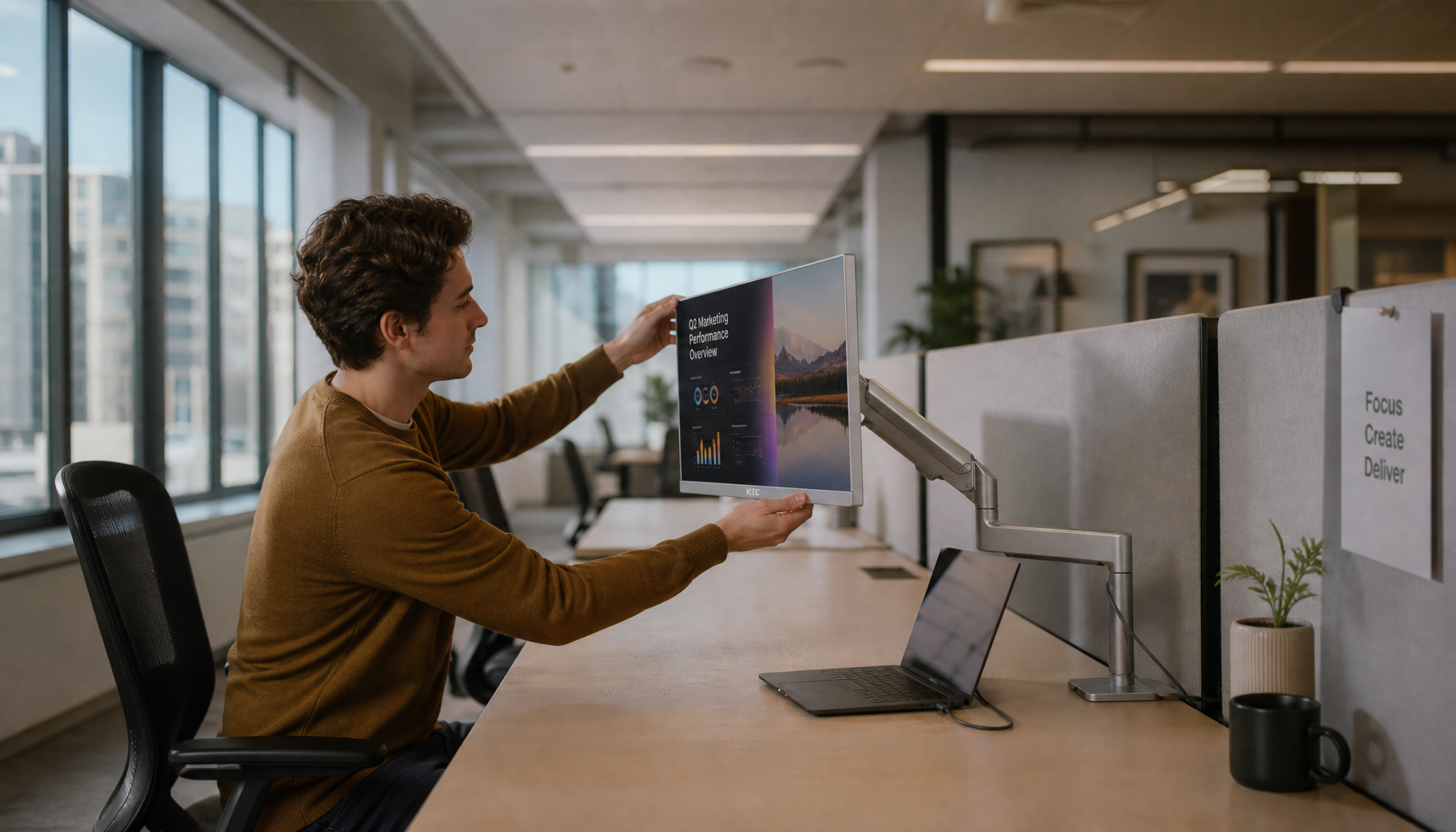
Standing sessions work best when the upper part of the display sits close to eye level, or just below it, so you can look forward instead of down. That keeps the neck neutral during cardio, dance, and standing strength work.
Mat sessions usually need the opposite approach. Lower the screen enough that the instructor stays visible while you are on the floor, then add a modest backward tilt so the image stays readable without lifting your chin.
The A27Q7 manual says the stand supports about 200 mm of height movement and about 20 degrees of tilt, which is enough to cover most home workout changes without constant repositioning. The A32Q7S manual gives the same broad range, while the A25Q5 uses a 45-degree portable bracket tilt. In practice, that means the best setup is the one that lets you switch quickly when a routine moves from standing to mat work.
A good decision sentence here is: if you do mixed routines, choose the model you can adjust in seconds, not the one that looks perfect from one pose. Slow adjustments are what turn a convenient screen into a daily annoyance.
Match the Screen to Your Room Layout
Room layout decides whether the screen feels flexible or in the way. The best placement is the one that leaves a clear roll path, keeps cords out of the workout lane, and still gives you a stable viewing line.
| Room setup | What usually works best | What to check first |
|---|---|---|
| Living room | Park the screen just outside traffic lanes and away from direct window glare | Make sure the roll path stays open and the mat area does not face a bright window head-on |
| Bedroom | Keep the screen closer to the mat and away from bed edges or tight corners | Check that the display can stop without blocking a closet, dresser, or door swing |
| Apartment corner | Use the shortest safe roll path and leave room for storage, not just viewing | Confirm the screen can move without hitting furniture, mirrors, or equipment |
The decision flips when the room gets tight. In a small apartment, a large screen is not automatically better if it makes parking harder or narrows the path from storage to mat. That is where the All Monitors browsing path can help you compare form factors before you commit to one size.
If you want a room that feels less crowded during workouts, choose the display size that leaves the most clearance around the mat. A smaller screen that moves cleanly often beats a bigger one that always needs readjustment.
Control Glare Before You Raise Brightness
Glare usually comes from the room, not just the screen. If a window sits directly behind you or behind the display, brightness alone often does less than moving the screen angle or changing where it parks.
The practical rule is to place the screen so windows are off to the side rather than directly in front of or behind the viewer. That matches common glare-reduction guidance from Ergotron's ergonomic viewing guidance, Onkron glare tips, Photodon's glare placement tips, and other display setup advice that starts with room direction before chasing more brightness.
In brighter daytime rooms, a model with anti-glare treatment can help. The KTC MEGAPAD 32" 4K Android 14 Google EDLA Smart Touch Monitor with 8550mAh Battery includes anti-glare coating, while the A25Q5 lists 400 nits typical brightness. Those details matter most when the room has unavoidable daylight and the workout screen needs to stay readable without becoming the brightest object in the room.
The clearest self-check is this: if the image still looks washed out, move competing lights and windows first, then raise brightness. If the room setup is the real problem, more brightness just creates a hotter, harsher screen without solving the reflection.
If you want a deeper background note on this issue, the linked guide on why a display looks dim in a bright room is a useful follow-up.
Map Features to the Exact Workout Problem
This is where the choice becomes less about general specs and more about the friction you are trying to remove. A built-in battery matters when you want to roll the screen between rooms or avoid running a power cord across the workout area. Touch control matters when you pause, scrub, or switch apps between sets.
The KTC MEGAPAD 25" FHD Google EDLA Portable Touch Monitor built in Camera is the lightest-feeling fit when the room is tight and the viewing distance is short. Its compact size makes it easier to place near a mat or in a bedroom corner, and the portable bracket gives you a wider tilt option than the larger stand-oriented models.
The 27-inch A27Q7 is the more balanced pick when you want a larger workout view without making the screen harder to park. It has wheels, a 9500mAh battery, and about 200 mm of height movement, so it is easier to shift between standing and floor sessions than a fixed display.
The KTC MEGAPAD 32" 4K Android 14 Google EDLA Smart Touch Monitor with 8550mAh Battery makes more sense when visibility is the bigger problem than footprint. The larger image can be easier to read from farther back, but only if the room still allows a stable roll path and a clear stopping point.
A useful decision sentence is: if you work out in a small bedroom, favor the screen that parks cleanly; if you work out in a larger living room, the bigger screen can be worth it when the viewing distance stays comfortable. The wrong screen size is the one that solves visibility but creates daily setup friction.
Final Setup Checklist Before Your Next Workout
Use this checklist before you start a workout with a rolling display:
- Park the screen where it will not block your walking path or your mat entry.
- Stand in your normal workout position and check whether the top of the image sits near a natural eye line.
- Lie down or kneel and confirm the instructor still stays visible without repeated chin lifting.
- Roll the display a short distance and make sure cords do not tug or cross the workout lane.
- Check whether a window or lamp creates a direct reflection before you raise brightness.
- Confirm the screen can move quickly enough for your usual routine change, especially if you switch between standing and floor work.
- Start one class without readjusting anything; if you keep changing the screen mid-session, the placement is not settled yet.
The Mobile Touch Screen collection is a practical place to compare portable touch models once you know whether your room favors compact parking, larger visibility, or better glare control. For home fitness, the right setup is the one that disappears into the routine instead of interrupting it.
How High Should a Workout Screen Be for Standing Routines?
For standing classes, the top of the usable screen should usually sit around eye level or slightly below it. That keeps your chin neutral during cardio or dance work. If the screen sits a little high, a mild downward tilt is better than raising the brightness again. Quick check: stand in position and confirm the instructor's face lands in the upper third without neck extension.
What Angle Works Best for Floor Exercises?
Floor workouts usually feel easiest when the screen tilts back enough that you can read the instructor without lifting your chin. A modest backward angle is usually enough; if you have to look up hard, the screen is still too high for mat work. Test by lying on the mat and adjusting until the full frame stays visible.
How Far Should the Screen Sit From Your Mat?
In smaller rooms, place it close enough that you can read cues without leaning forward, but not so close that the image feels cramped. A good practical check is whether you can see the full upper body of the instructor from your normal mat position without scooting forward every few minutes.
What Is the Most Common Placement Mistake?
The most common mistake is putting the screen too high or directly beside a bright window. Both make workouts harder to follow because they force extra head movement or create glare that you keep trying to fix with brightness alone. Avoid by testing sightlines in both standing and floor positions before the first class.
Which MegPad Setup Fits Your Workout Space?
If you want the short version, choose the setup that matches the room before you chase the biggest screen. The 25-inch model fits tighter spaces, the 27-inch model is the most balanced for mixed routines, and the 31.5-inch model is the better pick when larger visuals matter and the room can handle it. The best result is a screen you can roll, tilt, and start using without a fresh setup battle every day.
FAQs
Q1. How do I quickly test MegPad height for mixed standing and floor routines?
Stand in your normal position, then kneel or lie down to confirm the instructor remains visible without repeated neck adjustments.
Q2. Does anti-glare coating replace the need to move windows or lamps?
No. Move competing light sources first; anti-glare helps only after placement is optimized.
Q3. What distance works best between the screen and mat in small rooms?
Keep the screen close enough to read cues without leaning, yet far enough that the full frame stays comfortable from your normal mat spot.
Q4. Can the 25-inch model replace a larger screen for most home workouts?
Yes, when parking space is limited; the compact size reduces setup friction while still supporting clear viewing.
Q5. Should I raise brightness if glare persists after repositioning?
Only after confirming no direct reflections remain; extra brightness often creates harsher light without fixing the source.