A portable monitor stays stable on uneven surfaces when you control three things: surface contact, screen angle, and cable pull. Use a rigid stand, widen the contact points, damp vibration, and keep the display’s weight centered instead of relying on a thin magnetic cover alone.
Is your portable monitor slowly tipping backward on a park bench slat or bouncing every time the train table shakes? A quick tap-and-settle check can show whether your setup is stable enough before you start working: the screen should stop moving in about two seconds, not keep wobbling through every keystroke. Here is how to build a compact, reliable setup that holds steady in public spaces without overpacking your bag.
Why Portable Monitors Wobble Outdoors and in Transit
Portable monitors are light by design, which is excellent for commuting but unforgiving on imperfect surfaces. A 14- to 16-inch screen has enough height to act like a small sail: when the base is narrow, the table is uneven, or the cable pulls from one side, tiny forces become visible movement.
In display terms, wobble is mechanical oscillation: the screen moves because vibration travels through the surface, stand, hinge, or cable. Desk-stability guidance treats monitor shake as a system issue involving surface stability, fasteners, leveling, leverage, cable tension, and weight distribution, and that same logic applies even more strongly to a portable monitor on a train tray or outdoor bench.
Park benches add their own challenge. Public bench design varies by material, seating shape, back angle, and whether the bench is portable or permanently mounted; park benches may be wood, metal, recycled plastic, or concrete, and each surface changes grip and vibration differently. Wood slats can create gaps under your stand, metal can be slick, and curved seating can make a kickstand sit on only one edge.
Train tables are different but just as demanding. They are usually flatter than benches, yet they transmit vibration from braking, track movement, people leaning, and laptop typing. A setup that feels stable at home can become distracting when the base is small and the table is moving under it.
Start With the Stability Triangle
The simplest way to think about stability is the triangle formed by the monitor’s contact points with the surface. The wider and flatter that triangle is, the less likely the screen is to rock. The taller and more reclined the screen is, the more that triangle matters.
Use a Real Stand, Not Just a Thin Cover

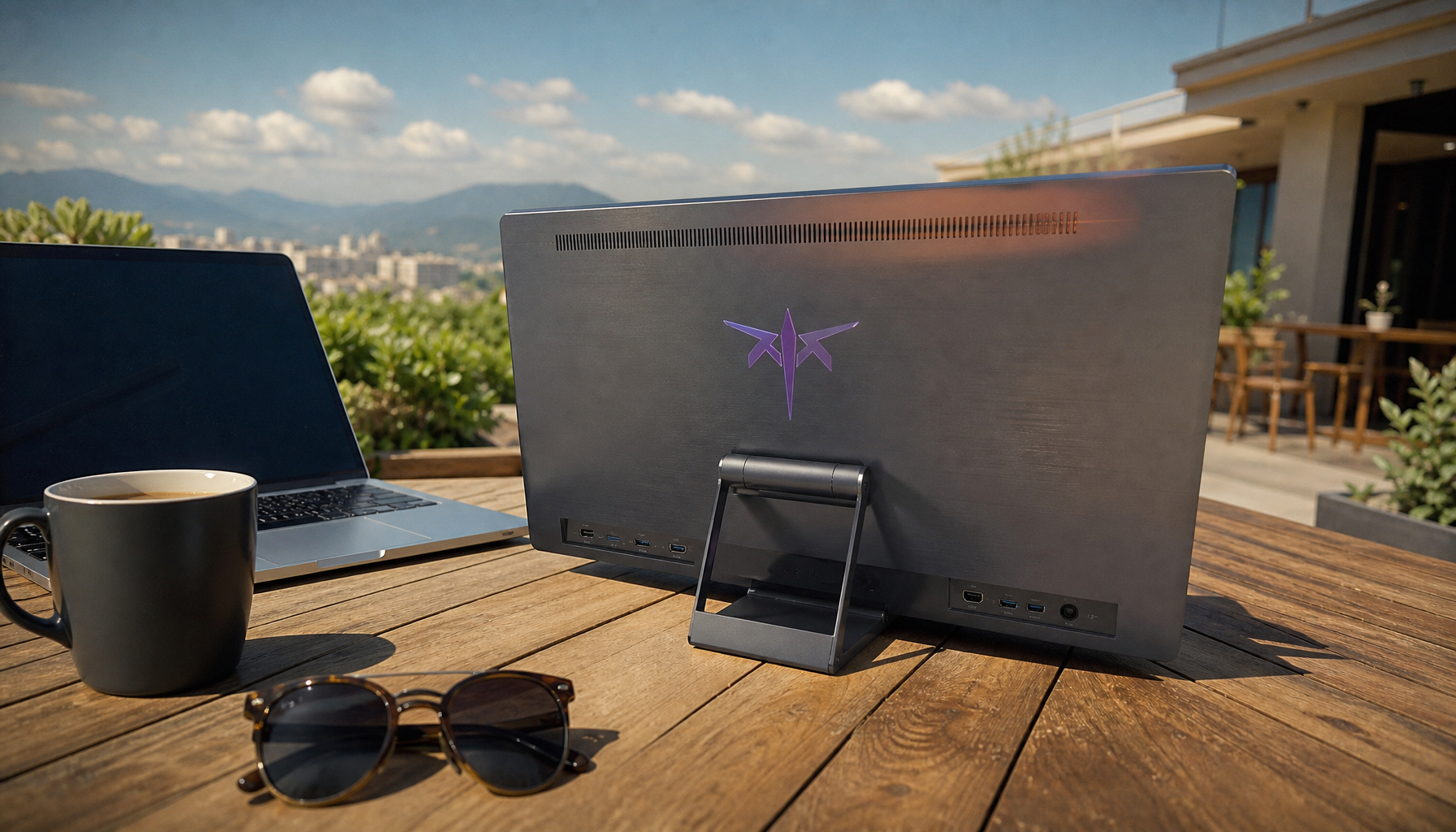
Many portable monitors ship with magnetic folding covers. They are convenient, but they often create a shallow footprint and limited angle control. KTC’s commuter setup guidance notes that stand quality strongly affects usability, with magnetic covers being more compact while hinged stands, rigid kickstands, or compact folding stands generally provide better stability and viewing angles.
For park benches, a separate folding tablet stand with rubber feet is usually the best value. Choose one that opens wide enough to support the lower back of the display and has a front lip tall enough to keep the monitor from sliding forward. For train tables, a low-profile rigid kickstand is often better because it fits shallow table depth without pushing the screen into the aisle.
A practical field test is simple. Set the monitor on the stand, place one finger on the upper corner, and tap gently. If it oscillates for more than about two seconds, lower the screen angle, move the base wider, or add damping under the contact points before plugging in.
Keep the Center of Mass Close to the Base
Monitor arms amplify movement because they act as levers, and the same physics applies to portable monitor stands. Moving a display several inches forward from its support point can noticeably increase leverage and wobble; on a portable monitor, leaning the panel too far back creates a similar effect.
On a park bench, avoid setting the display near the front edge of a slat. Move it back until the stand feet are fully supported, then tilt the screen only as far as needed for visibility. On a train table, place the monitor closer to the table hinge or wall side if that area feels more rigid, but do not wedge it where vibration from the wall panel transfers directly into the screen.
If the monitor is 16 inches and the stand footprint is only a few inches deep, small angle changes matter. A more upright display usually feels more stable than one reclined far backward, especially when the surface is narrow.
Build a Stable Base on Uneven Surfaces
Uneven surfaces are not all the same. A bench with slats needs bridging. A metal table needs grip. A vibrating train tray needs damping. The best portable kit handles all three without becoming bulky.
Bridge Gaps With a Thin Rigid Panel

On park benches, the biggest problem is often not slope but missing support under the stand feet. If one rubber foot sits over a gap between slats, the monitor twists. A thin rigid panel solves this better than soft padding alone.
A compact clipboard, thin cutting mat, rigid laptop sleeve insert, or flat carbon-fiber-style board can create a temporary tabletop. The goal is to spread weight across several slats, not to add cushion. KTC’s packing advice for portable monitors emphasizes that rigidity matters more than bulky padding when preventing bending and pressure points during travel; that same principle helps when turning a slatted bench into a usable work surface.
For a real-world setup, place the board across at least three bench slats, put a thin rubber pad on top, then set the stand on the pad. The board handles gaps, the pad adds grip, and the stand controls angle.
Add Friction Before Adding Weight
A heavy object can make a setup feel stable, but it also adds risk if the train jolts or the bench surface slopes. Friction is usually safer. A silicone mat, neoprene mouse pad, or thin rubber shelf liner under the stand increases grip and reduces vibration without turning your bag into a gear case.
Foam can help, but use it carefully. Too much soft foam lets the stand sink unevenly, which can make the monitor lean. A thin, dense rubber layer is better for most portable displays because it damps vibration while preserving a flat contact surface.
The same thinking appears in anti-wobble desk guidance: rubber pads and dampeners can reduce perceived vibration, but they do not replace structural fixes such as leveling, tightening, and better weight distribution. In portable use, the “structure” is your board, stand, angle, and cable layout.
Control Cables So They Do Not Pull the Screen

Cable tension is one of the most overlooked causes of portable monitor instability. A USB-C cable can tug the display sideways if it hangs off the table edge, catches on a backpack, or is too stiff for the port angle.
Portable monitor commuting advice recommends a full kit approach rather than thinking only about the panel, including the monitor, sleeve, stand, video cable, power fallback, and input devices. A reliable cable plan should include a full-featured USB-C video cable and a backup HDMI or Mini HDMI cable because HDMI carries video only and may require separate power.
On a train, leave a small service loop on the table so the cable can move without pulling the monitor. Route the cable toward the laptop, then back toward the monitor in a gentle curve instead of a tight straight line. If your monitor flickers, dims, or disconnects, reduce brightness first, then add external power rather than yanking the cable tighter.
For outdoor bench work, keep the power bank or charger on the same rigid board as the monitor when possible. If the battery sits in your bag below the bench, every movement of the bag can tug the screen.
Choose the Right Stand or Mount for the Situation
No single stand works everywhere. The best choice depends on surface depth, vibration, setup speed, and how much adjustability you need.
Stabilization option |
Best use case |
Pros |
Cons |
Built-in kickstand |
Train tables and compact cafe tables |
Fast, slim, fewer parts |
Limited angle range and narrow footprint |
Folding tablet stand |
Park benches and mixed surfaces |
Wider support, better angle control |
Extra item to carry |
Magnetic cover stand |
Light travel and quick setup |
Thin and protective |
Often less stable on uneven surfaces |
Clamp or VESA-style mount |
Fixed workstations, carts, long sessions |
Strongest positioning when compatible |
Usually impractical on public benches or train tables |
Anti-slip mat plus rigid board |
Slatted benches and slick tables |
Cheap, compact, adaptable |
Requires a flat board or sleeve insert |
VESA mounting can be excellent when the monitor supports it, but it is not always travel-friendly. Monitor arm guidance stresses that buyers should confirm weight capacity, desk thickness, clearance, VESA pattern, and cable length before ordering; VESA compliance commonly means standardized mounting holes such as about 3 x 3 inches or 4 x 4 inches on many desk monitors.
For portable monitors, VESA support is most useful if you regularly work from a cart, studio, RV desk, or semi-permanent hotel setup. For public transit and park benches, a compact folding stand plus rigid base is usually faster, lighter, and less intrusive.
Stabilize the Monitor Without Sacrificing Ergonomics
A stable screen that forces your neck down for two hours is not a win. Good portable display ergonomics still matter: the screen should sit roughly an arm’s length away, with the top near or slightly below eye level when the surface allows it.
The compromise is surface-specific. On a train table, do not use a tall riser if it makes the setup top-heavy. Keep the screen lower and closer to upright, then use the portable monitor for reference windows, chat, dashboards, previews, or documents while your laptop handles deep work. For a park bench, where the seating angle and table height may be awkward, prioritize a stable viewing angle over perfect desktop posture and take shorter work blocks.
Multi-monitor alignment guidance also applies when pairing a laptop with a portable screen. KTC recommends aligning physical placement first, then matching the virtual display layout so cursor movement feels natural; physical alignment includes screen edges, active image areas, tilt, height, and viewing distance. In practice, put the portable monitor on the side where its stand is least likely to be bumped, then adjust your operating system display layout to match.
Safety Checks Before You Start Working
Before opening a spreadsheet, game launcher, or editing timeline, run a quick stability check. Press lightly on the table or bench near the stand, tap the screen corner, and move the cable as if you were shifting your laptop. If the monitor creeps, rocks, or continues shaking, fix the base before trusting it.
Anti-tip products exist for larger tabletop monitors, including a monitor anti-tip fastener rated for monitors up to 50 lb using adhesive pads, a strap, and surface preparation. That kind of anchored restraint is not ideal for a public train table or park bench, but the principle is useful: clean contact surfaces, secure the display path, and prevent a tip before it starts.
For portable use, the safer equivalent is a non-marking setup: rubber mat, rigid board, controlled cable slack, and a stand with a real front lip. Avoid adhesives on public property, avoid clamps that can damage furniture, and do not place the screen where a passerby or train passenger can catch the cable.
A Field-Tested Setup That Works

For a 15.6- or 16-inch portable monitor, pack a rigid sleeve or thin board, a compact folding stand with rubber feet, a silicone mat, and a soft cable tie. Set the board across the uneven surface, place the silicone mat on top, open the stand to a moderate angle, and seat the monitor so the lower edge is fully captured by the stand lip. Route the USB-C cable in a relaxed curve toward the laptop and secure excess length with the tie so nothing hangs.
This setup is not glamorous, but it is fast. On a park bench, it turns slats into a usable platform. On a train table, it reduces sliding and cable-driven wobble. In a hotel lobby or airport gate, it gives you repeatable positioning without depending on whatever stand came in the box.
FAQ
Can I Use a Portable Monitor on My Lap?
You can, but it is usually less stable and worse for posture than using a small rigid board or table surface. If you must work from your lap, use a lap desk with a grippy surface and keep the monitor upright, low, and close to the laptop so the cable does not pull sideways.
Is a Heavier Portable Monitor More Stable?
Sometimes, but weight is not the whole answer. A heavier screen on a narrow stand can still wobble, while a lighter screen on a wide, grippy, rigid base can feel much more controlled. Stand geometry and surface contact matter more than weight alone.
Should I Buy a Portable Monitor With VESA Support?
Buy VESA support if you expect to mount the display on an arm, cart, tripod plate, or semi-permanent workstation. For benches and train tables, prioritize a rigid kickstand, strong hinge, anti-glare finish, USB-C compatibility, and a protective sleeve that can double as a flat support layer.
A stable portable monitor setup is not about carrying more gear; it is about removing the weak points. Flatten the surface, widen the base, reduce cable pull, and test the screen before you work. The result is a portable display that feels like a productivity tool instead of a balancing act.