Screen flex usually affects touch accuracy by letting the panel move, twist, or rebound while your finger is still making contact. The best fixes are simple: stabilize the monitor, reduce pressure, remove cable strain, and choose a portable touchscreen with a rigid chassis and reliable stand.
Does your portable monitor tap the wrong button when you press near the edge, sketch a wavy line when your hand feels steady, or miss gestures unless you hold the screen with your other hand? The most practical gains often come from setup changes you can test in minutes: a firmer stand angle, a flatter surface, a better data-and-power cable, and lighter touch pressure. This guide shows how to keep a lightweight portable touchscreen steady enough for accurate taps, swipes, drawing, and multi-touch gestures.
Why Screen Flex Can Make Touch Feel Inaccurate
Thin portable panels trade stiffness for weight
Lightweight portable monitors are designed to fit into a backpack, laptop sleeve, or travel desk setup, so their frames are often much thinner than desktop monitors. That portability is useful, but it leaves less material around the panel to resist bending when you tap, swipe, or rest part of your hand on the display. Portable touchscreen sizes commonly fall around 13 to 17 inches, with 15.6 inches often treated as a practical balance between workspace and easy carrying in a portable touchscreen monitor.
A capacitive touchscreen expects a stable contact point. If the panel bows inward, rocks backward, or twists slightly while your finger is on the glass, the input can feel offset even when the touch sensor itself is working. The problem is most noticeable near edges and corners because those areas often have less backing support and more leverage when the monitor is propped up on a folio stand.
Movement can be mistaken for poor touch technology
A responsive touch panel should register taps, swipes, and drawing input without obvious delay, and 10-point multi-touch can recognize up to ten simultaneous finger inputs for gestures such as pinch-to-zoom or two-finger rotation on a 10-point multi-touch screen. But even good touch hardware can feel inconsistent if the monitor shifts every time you touch it.
A useful distinction is repeatability. If the same icon misfires only when the screen is standing upright, flex or stand movement is likely involved. If touch is wrong in the same direction across the whole display, mapping or calibration may be the issue. If touch disappears entirely while video still works, the problem is more likely the touch data path than screen flex.
Set Up the Monitor So the Panel Does Not Move
Use the lowest stable angle that fits your workspace
The most reliable touch setup is usually a low, slightly reclined angle on a solid desk. A steeper laptop-like angle gives you a better viewing posture, but it also makes every tap push the monitor backward. A lower angle turns more of your touch force downward into the desk instead of backward into the stand.

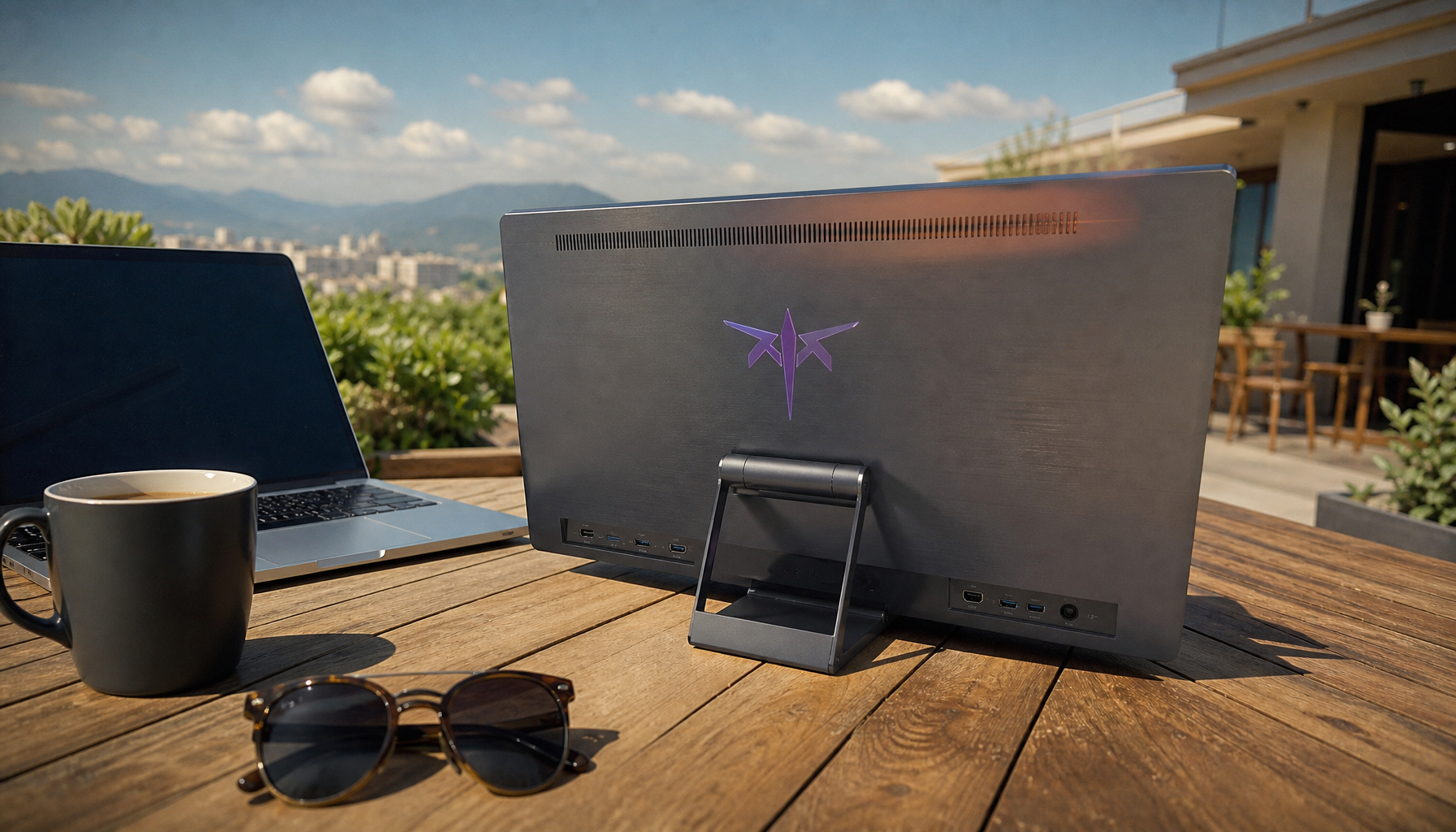
A flimsy or non-adjustable stand can make touch use frustrating, while a sturdy built-in kickstand with multiple viewing angles helps keep the panel steady during taps and swipes on a stable stand. For a 15.6-inch portable monitor, a good practical test is to open a drawing app, draw slow diagonal lines near all four corners, and watch whether the line wobbles when the monitor rocks.
Support the back, not just the bottom edge
Many portable monitors are supported mostly along the bottom edge. That can work for viewing, but touch input adds forward and backward force. If the stand only props up the lower third of the display, the upper corners may flex more than the center when tapped.

A magnetic folio cover can be useful when it protects the display in transit and also functions as an integrated stand for stable use. For frequent touch work, choose a folio or kickstand that creates a wide base, holds its angle firmly, and contacts enough of the back panel to reduce twisting.
Avoid soft, uneven, or slippery surfaces
A portable monitor may feel fine on a desk but misbehave on a couch arm, bed tray, airplane tray table, or uneven conference table. Soft surfaces let the bottom edge sink or slide, which can add panel twist during touch input.
For field use, place the monitor on a rigid base such as a laptop stand shelf, hard portfolio, lap desk, or firm tabletop. Rubber feet matter too: if one foot lifts slightly, the whole monitor can pivot when you tap an edge. Before blaming the touchscreen, press lightly on each corner of the frame and check whether the monitor rocks.
Reduce Touch Pressure, Cable Pull, and Edge Stress
Let the touchscreen detect your finger instead of pressing harder
Capacitive touch does not need the same force as a physical button. Pressing harder often makes flex worse without improving accuracy. Use a lighter touch for taps and a smoother, slower motion for swipes, especially when using the monitor as a second screen for photo editing, browser navigation, gaming launchers, or dashboard controls.

For drawing or annotation, rest your palm on the desk rather than on the screen when possible. If the app supports palm rejection, enable it, but do not rely on software to solve panel movement. A bent or bouncing surface can still make a straight stylus or finger path appear uneven.
Route cables so they do not tug the monitor sideways
Cable strain is easy to overlook because the screen may look stable until you touch it. A stiff video cable, a short data-and-power cable, or a cable hanging off the side of a desk can pull the monitor out of alignment. That side load can also make edge taps feel less reliable because the chassis is already under slight tension.

A full-featured single-cable connection can carry video, power, and touch data through one cable, reducing clutter and setup complexity in a one-cable setup. Dedicated video-cable setups usually require a separate data cable for power and touch, so secure both cables with enough slack that neither one lifts, twists, or drags the monitor when you move your laptop.
Keep hubs and adapters out of the first troubleshooting pass
If touch input is erratic, test the monitor directly with the host device before adding a dock, hub, extension cable, or adapter. Direct testing helps isolate whether the problem is mechanical flex, data instability, power delivery, or display/input mapping.
This matters because a portable monitor can show video while touch remains unavailable; touch uses a separate data path, and dedicated video-cable setups normally need an added data cable for touch input. If the display works but touch does not, do not assume the glass is defective until the data path has been checked.
Buying Features That Help Prevent Flex-Related Touch Problems
Prioritize chassis stiffness before shaving off every ounce
For touch use, the lightest monitor is not always the best monitor. A slightly heavier chassis can be worth it if it resists twisting and keeps the panel flat when you tap near the corners. Aluminum or metal chassis designs are generally more durable than plastic models, though often slightly heavier, which makes build quality a practical touch-accuracy feature rather than just a durability detail.

When comparing models, look beyond brightness, resolution, and refresh rate. Hold the monitor by opposite corners if you can inspect it in person, or read buyer feedback for words like “flex,” “wobble,” “stand,” “kickstand,” “folio,” and “touch offset.” A gaming-focused portable monitor may advertise refresh rate first, but touch accuracy still depends on mechanical stability.
Match the stand to how you actually touch the display
A portable monitor used mostly for viewing spreadsheets beside a laptop can tolerate a simpler stand. A portable touchscreen used for drawing, game streaming controls, music production, note markup, or kiosk-style input needs better support.
A built-in kickstand is often easier to stabilize than a loose folding case because it can provide firmer angle control. A magnetic folio can still work well if it grips securely and creates a wide base. If you plan to tap the screen dozens of times per hour, give stand design the same attention you would give screen size or panel type.
Consider standard mounting support for fixed desks
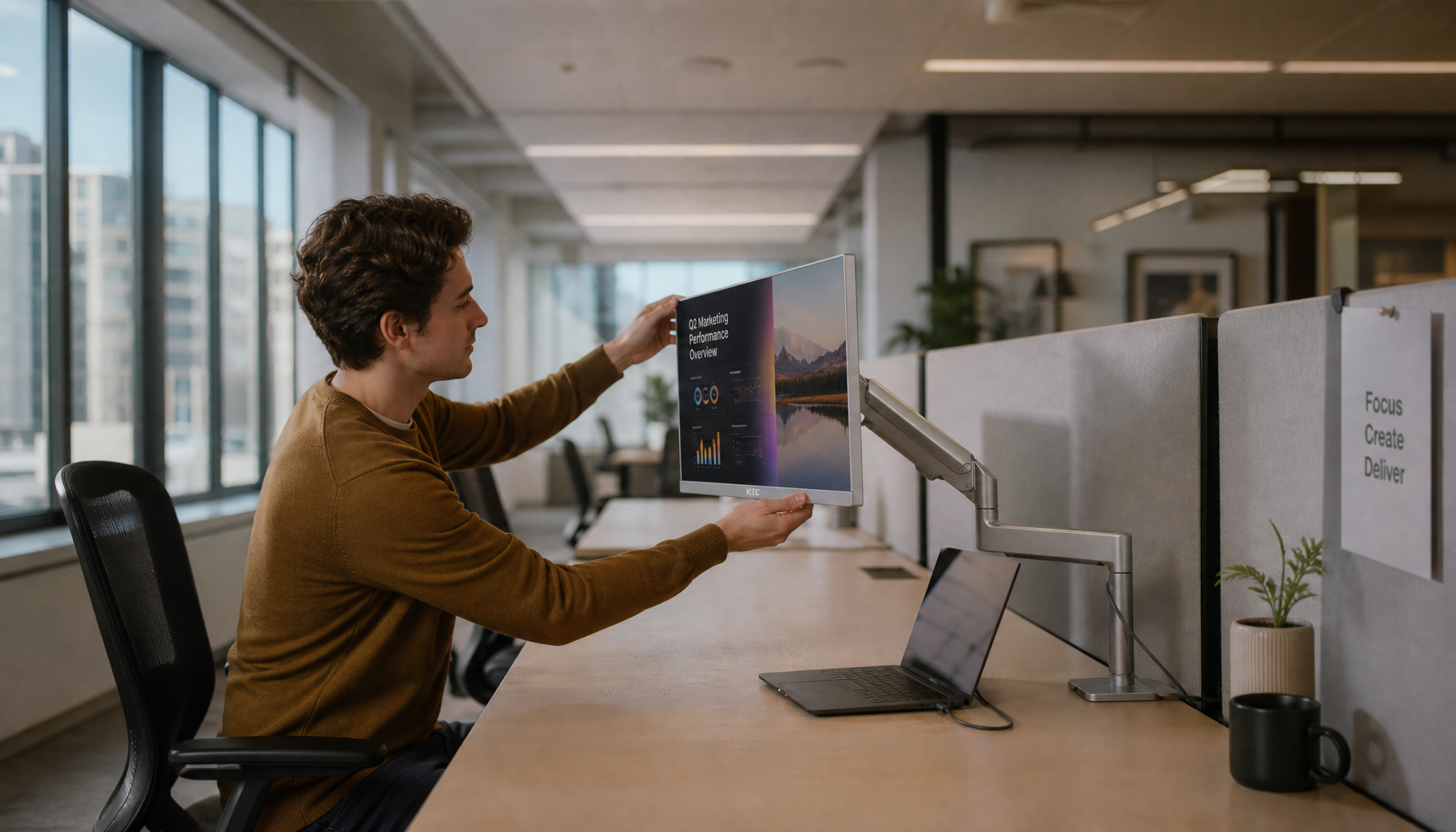
If the monitor will live on a desk most of the time, standard mounting support or a rigid clamp-style stand can reduce flex-related touch errors more effectively than a travel folio. A fixed arm keeps the panel from sliding, lets you set a repeatable angle, and removes the need to hold the screen with one hand while tapping with the other.
For hybrid use, a 15.6-inch portable touchscreen with a metal chassis, a firm kickstand, single-cable video/power/touch support, and protective cover is often the most practical middle ground. Larger 17-inch models give more room for multitasking or game dashboards, but they also create more leverage when touched near the edges, so stand quality becomes even more important.
Setup Options Compared
Option |
Best For |
Flex Control |
Touch Reliability Risk |
What to Check Before Buying or Using |
Magnetic folio stand |
Travel, laptop bag use, casual touch |
Medium |
Medium |
Confirm the magnets hold firmly and the base does not collapse during taps |
Built-in kickstand |
Daily touch use, desk work, presentations |
High |
Low to medium |
Look for multiple angles and a hinge that does not drift backward |
Standard or rigid clamp mount |
Fixed desk, kiosk-style input, heavy touch use |
Very high |
Low |
Confirm mounting support, arm stiffness, and cable slack |
Dedicated video cable plus data cable |
Older laptops, consoles, mixed devices |
Medium |
Medium to high |
Make sure the data cable carries touch data, not only power |
Full-featured single-cable connection |
Clean laptop setup, travel workstations |
Medium to high |
Low if compatible |
Confirm video, power, and data support on the cable and host port |
The table shows why touch accuracy is not only a panel specification. A strong touch controller still needs a stable frame, a reliable stand, and a clean data path. For gaming monitors and high-refresh portable displays, this is especially important because buyers often focus on refresh rate, response time, and resolution while underweighting the physical setup that affects real input accuracy.
If your monitor supports both a single-cable connection and a dedicated video connection, use the single-cable option first when your laptop supports video, power, and data through the same port. If you must use a dedicated video cable, add the correct data connection for touch and keep both cables slack. A charge-only cable may power a display but fail to carry touch data, so cable quality can decide whether touch works consistently in a portable monitor setup.
Troubleshooting Touch Errors Without Misdiagnosing Flex
Separate flex problems from connection problems
Flex-related issues usually appear when the monitor moves, bends, or rebounds under your finger. Connection issues often look different: touch disappears after sleep, works only after reconnecting, maps to the wrong screen, or fails while video continues normally.
A portable touchscreen has separate display and touch functions, and the touch side is often reported to the computer as a touch input device in a touch device path. If touch fails after sleep, unplugging and reconnecting can force the touch controller to enumerate again, which points toward a wake or detection issue rather than panel flex.
Test with a simple repeatable pattern
Use the same test every time so you can compare changes. Open a blank drawing canvas, note app, or browser-based paint tool. Draw a slow box around the screen edges, then draw diagonals from corner to corner. Repeat the test with the monitor upright, reclined, flat on the desk, and held firmly from behind.

If lines improve when the monitor is flat or better supported, flex or stand movement is probably involved. If lines remain offset in the same direction regardless of support, check touch mapping or calibration. In multi-monitor setups, touch may need to be mapped to the correct display output to avoid wrong-screen or offset taps in a multi-monitor setup.
Check power management when touch vanishes after sleep
If the monitor is physically stable but touch stops working after the laptop sleeps, screen flex is not the main suspect. Power management can turn off the touch input device, root hub, or controller to save battery, which can prevent touch from waking cleanly.
On a desktop operating system, inspect system device settings related to the touch input device, root hub, and controllers. If available, disable the option that lets the computer turn off the device to save power. Then test sleep and wake again with the monitor connected directly, using the shortest reliable full-featured cable you have.
Action Checklist for More Accurate Touch
- Place the monitor on a rigid, flat surface and confirm all feet contact the desk.
- Set the screen to the lowest comfortable angle so taps push downward more than backward.
- Support the back of the monitor with a firm kickstand, folio, standard mount, or rigid stand.
- Use light finger pressure, especially near corners and side edges.
- Route data-and-power, video, and data cables with slack so they do not pull on the chassis.
- Test touch directly without hubs or docks before troubleshooting software.
- Run an edge-and-diagonal drawing test before and after each setup change.
This checklist is most useful when applied in order. Start with the physical setup because it is fast to test and often fixes the “wrong tap near the edge” feeling. Then move to cable quality, touch mapping, and power management if the monitor remains inconsistent.
FAQ
Q: Why does my portable touchscreen miss taps only near the edges?
A: Edge misses often happen because the screen has less support near the perimeter and more leverage against the stand. Try a lower angle, a firmer stand, lighter pressure, and a drawing test around the border. If the same edge is always offset even when the monitor is flat, check touch mapping or calibration.
Q: Is a heavier portable monitor better for touch accuracy?
A: Not automatically, but a slightly heavier model with a stiffer metal or aluminum chassis can be better for frequent touch input than an ultra-light plastic design. Weight matters less than rigidity, stand stability, and whether the panel stays still when tapped.
Q: Can a cable cause touch problems that look like screen issues?
A: Yes. Video and touch do not always travel through the same path. Dedicated video cables usually need a separate data connection for touch, and some single-cable connections carry power but not stable data. If the screen displays an image but touch fails, test with a full-featured single-cable connection or the required data cable before assuming the panel is damaged.
Practical Next Steps
For an existing lightweight portable monitor, fix the setup first: lower the angle, stabilize the back, remove cable tension, and use lighter touch pressure. Then run the same edge-and-diagonal drawing test in each position so you can tell whether the improvement is mechanical or software-related.
For a new portable touchscreen purchase, treat stiffness and stand design as core specs alongside resolution, refresh rate, brightness, and color coverage. A 15.6-inch model with a rigid chassis, stable kickstand or strong folio, full-featured single-cable support, and reliable multi-touch behavior will usually feel more accurate in real use than a thinner monitor that looks good on paper but flexes every time you tap it.