Yes. A dirty, loose, worn, or oxidized display connector can interrupt the video link enough to cause brief black screens, flicker, “No Signal” messages, or forced drops to lower refresh rates.
Does your screen cut out for a second when you nudge the cable, move a monitor arm, or launch a game at full refresh? A solid swap test, a 15-minute retest with a known-good cable, and a lower-resolution baseline can usually separate connector trouble from power, bandwidth, and software faults.
Why a Connector Can Black Out a Screen
Loose or damaged cables are one of the most common reasons a monitor goes black intermittently because the panel is no longer receiving a stable input, even if the monitor itself still has power. In real setups, that unstable link may come from dust in the port, light oxidation on the metal contacts, strain from a tight bend, or a plug that is seated loosely enough to fail only when the desk moves or bandwidth demand rises.
A monitor connection is really two separate paths: power and data. That distinction matters. If your monitor stays powered but the image drops out, the failure is often in the data path. If a portable display goes black and then reconnects, the problem may be power delivery, data delivery, or both, especially on single-cable USB-C setups.

Digital display links depend on signal integrity. The signal has to arrive cleanly enough for the source and monitor to stay synchronized. Unlike older analog behavior that often degraded gradually, HDMI, DisplayPort, and USB-C video links tend to fail more abruptly. A momentary blank screen, flicker, audio cutout, or a fallback from 144 Hz to 60 Hz is more typical than a mild, steady decline in picture quality.
What “Dirty or Oxidized” Really Means in Practice
Checking for bent pins, loose seating, and cable damage is a core troubleshooting step because connector faults are often mechanical before they look electronic. “Dirty” usually means dust, lint, skin oil, or grime interfering with a firm metal-to-metal contact. “Oxidized” means the contact surface has developed corrosion or a dull film over time, which can raise resistance or make a connection unreliable when heat, movement, or high-bandwidth modes push the link harder.

Portable monitor drop symptoms make this easy to recognize in real use: if the image cuts out when the cable moves, a loose connector, damaged cable, or worn port is a likely cause. A common example is a USB-C portable screen that works fine for email at low brightness but blanks out during video playback or while the laptop battery is low. That does not always mean the panel is bad; it often means the connector, cable, or power headroom is marginal.
When It’s Probably the Connector, and When It’s Probably Something Else
Incorrect input selection, bad cables, unstable power, and outdated drivers can all produce a black screen, so the connector is only one candidate. The pattern matters more than the symptom name. If the blackout happens when you touch the cable, connector trouble moves to the top of the list. If it happens only at 4K or high refresh, bandwidth limits or adapter quality become more likely. If it happens only on a bus-powered portable monitor at full brightness, power delivery deserves immediate scrutiny.
USB-C display paths are especially easy to misread because a USB-C plug can fit physically while still failing functionally. Some ports charge but do not output video, some monitor ports are power-only, and some cables carry power but not full display data. That is why a connector that looks fine may still behave like a bad link under real workload.
Symptom pattern |
More likely cause |
Why it matters |
Screen blanks when the cable is bumped |
Dirty, loose, worn, or oxidized connector |
Mechanical movement changes contact quality |
Works at 1080p 60 Hz but fails at 4K or 144 Hz |
Cable bandwidth, adapter weakness, or a marginal connector |
High data rates expose weak links faster |
Portable monitor drops at high brightness |
Power delivery limit or USB-C cable limitation |
One cable may be carrying both power and video |
Black screen after updates, but cables test fine |
Driver or OS issue |
The physical link may be healthy |
A Reliable Way to Diagnose It Without Guesswork
Changing one variable at a time is the fastest way to avoid false conclusions. Start with the simplest version of the setup: one monitor, one direct cable, no dock, no splitter, and no adapter if you can avoid it. If a single monitor works directly but not through the usual chain, the weak point is often the connector path rather than the panel.
Testing with a known-good cable for at least 15 minutes is more useful than a quick visual inspection. This is where many gaming setups reveal the truth. A cable that can hold a desktop at idle may still fail during a 144 Hz session, HDR playback, or a GPU load spike. If the black screens vanish with a replacement cable, treat the original cable or connector as suspect even if the metal shell looks normal.

Lowering the display to a conservative baseline such as 1080p at 60 Hz helps show whether the issue is contact quality or raw link margin. If the monitor becomes stable at low settings and fails again when you restore 4K, VRR, or high refresh, the connector may still be part of the problem, but the root issue is usually a marginal path under bandwidth stress rather than dirt alone.
Windows multi-monitor troubleshooting adds an important reminder for office displays: one bad assumption can look like a hardware fault. If a dock, splitter, or single output is being asked to do more than it supports, you can chase cables for hours and never solve it. In productivity setups, especially hot-desk stations, the display chain itself is often more complicated than the monitor.
Should You Clean the Connector or Replace the Cable?
Reseating or replacing the cable is usually the highest-value first move because it is fast, low risk, and often resolves intermittent blackouts immediately. If you disconnect the cable and see obvious grime, debris, or discoloration on the plug, that supports the connector theory. If you see bent pins, looseness, or repeated failures across ports, replacement is usually smarter than trying to rescue a questionable cable.
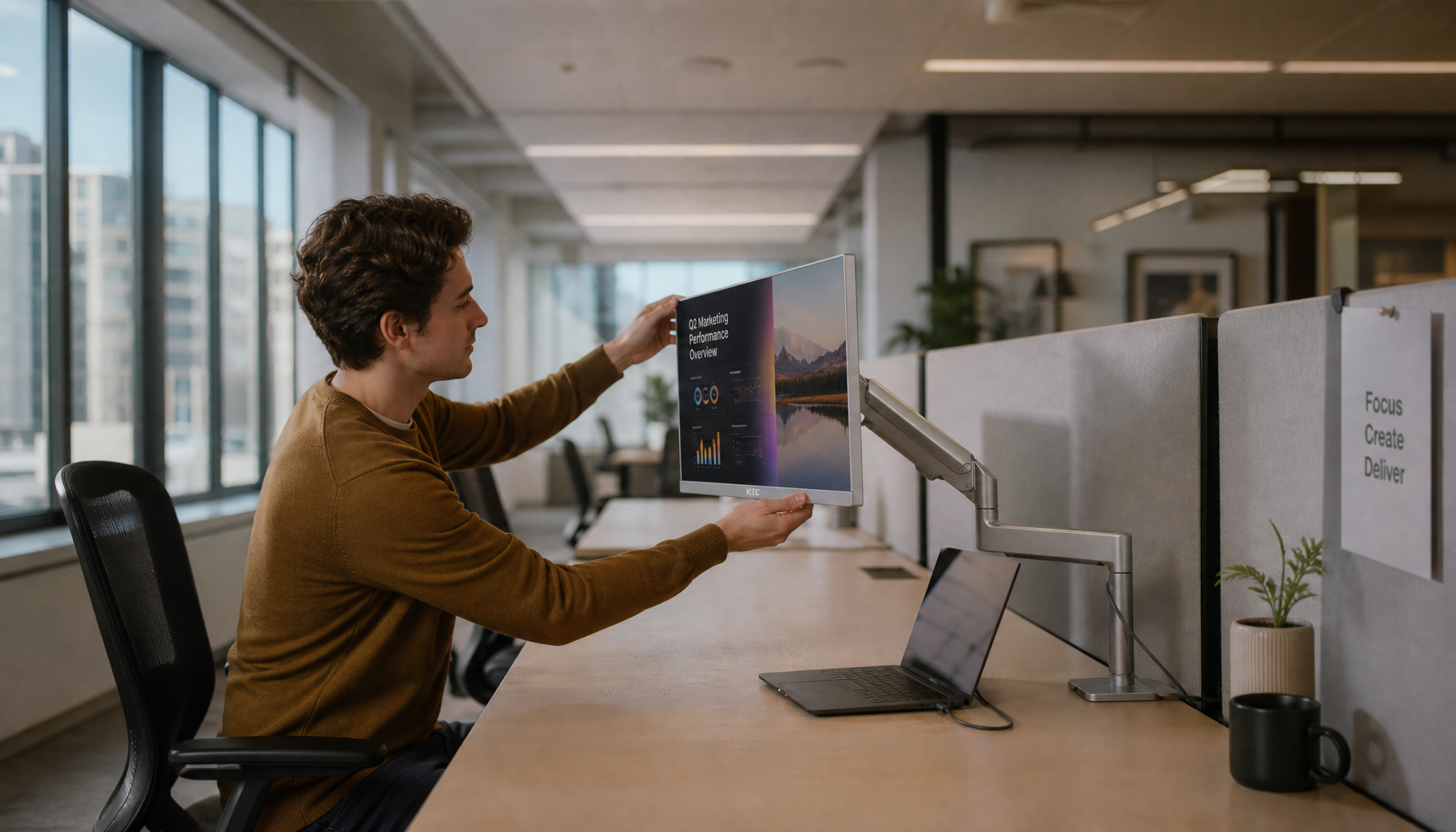
Cable strain and sharp bends often create the same symptoms as contamination, which is why cleaning alone may not help. A connector that has been tugged by a tight monitor-arm run can look acceptable and still lose contact internally. In practice, if a blackout disappears only when you reroute the cable with proper slack, the real fix is strain relief, not just a cleaner plug.
How to Prevent the Problem From Coming Back
Leaving slight slack near display ports protects the connector from being pulled every time you tilt, raise, or rotate the monitor. That matters more than most people think. On high-refresh gaming panels and movable office arms, repeated tension slowly turns a stable connection into an intermittent one.

Separating power and signal cable paths also makes troubleshooting faster and can reduce interference on cluttered desks. The practical upside is not just aesthetics. A clean routing path helps you spot the exact cable, swap it quickly, and avoid crushing the run behind furniture or under a monitor stand.
A black screen that comes and goes is often a performance-path problem, not a dead monitor. When the display cuts out only under motion, high refresh, or heavier load, treat the connector and cable path as the first suspect, then prove it with a clean swap test instead of guessing.