Yes, you can run different monitors with different color profiles, and a mixed photography-and-everyday setup often works best that way.
Does your edited photo look clean on your main display, then strangely warm, flat, or oversaturated when you drag it to the second monitor? A properly assigned profile can make each screen behave more predictably, while a calibrated photo display gives you a testable benefit: edits that are less likely to drift when exported, printed, or reviewed elsewhere. Here is how to set up a practical dual-monitor workflow without turning your desk into a color lab.
The Short Answer: Different Profiles Are Normal
A color profile is a file that describes how a device represents color. In photography, that usually means an ICC profile for your monitor, printer, or image file. A monitor profile tells color-managed software how that specific display behaves, so the software can compensate for its quirks.
Running two monitors with different profiles is not a hack. It is the correct approach when the monitors are physically different, such as a 27-inch wide-gamut editing monitor beside a standard office display. Even two units of the same model can vary, which is why monitor calibration is most reliable when it measures the exact display on your desk.

The practical rule is simple: profile the monitor, not the task. Your photography monitor gets its own ICC profile. Your general-use monitor gets its own ICC profile. Your image files keep their own embedded color spaces, such as sRGB or a wide-gamut RGB space, and your editing software translates between them.

Why One Profile for Two Screens Usually Fails
A profile is not a style preset. It is not “photo mode,” “movie mode,” or “vivid mode.” It is a device description. If you apply your premium photo monitor’s profile to a cheaper secondary display, you are giving the operating system the wrong map.
That mismatch can make skin tones swing too red, grays pick up a tint, and saturation become unreliable. In a real workflow, this shows up when a portrait is balanced on a calibrated main display, then the same file looks punchier on a side monitor used for email, chat, or browser preview. The second screen may be fine for office work, but it is not trustworthy for final color judgment.
Support guidance from calibration specialists is clear: two monitors can be made to look similar, but an exact match is not always possible because panel type, age, backlight, and brightness limits differ. The most useful target is consistency, and both are calibrated best toward the same white point, brightness, and gamma where the hardware allows.
Photography Profile vs General-Use Profile
For photography, your monitor profile should come from calibration hardware whenever accuracy matters. A colorimeter measures how your display actually renders color and tone, then software builds a custom ICC profile. That is different from choosing sRGB mode in the monitor menu, although sRGB mode can be useful when you are preparing web-only work.

For general use, you can be less strict. A factory profile, a reasonable sRGB preset, or an operating-system calibration may be enough for spreadsheets, video calls, web browsing, and gaming. The danger is using that looser screen for final photo decisions.
Use Case |
Best Display Setup |
Practical Target |
Photo editing for web |
Calibrated main monitor with embedded sRGB exports |
Stable brightness, neutral gray, predictable browser preview |
Photo editing for print |
Calibrated and profiled wide-gamut monitor |
Controlled room light, soft proofing, printer/paper profiles |
Office productivity |
Separate monitor profile or factory sRGB mode |
Comfortable brightness and readable text |
Gaming and media |
Monitor preset tuned for preference |
Good contrast, motion clarity, and low fatigue |
This is where value matters. You do not need every screen on your desk to be a reference monitor. You need one screen you can trust for color-critical decisions, and you need the other screens to stop interfering with that judgment.
How to Set Up Different Color Profiles Correctly
Start With the Editing Monitor
Set your best panel as the primary color-critical display. If you own a wide-gamut or factory-calibrated monitor, use that one for photo editing, RAW processing, or print soft proofing. Let the display warm up before calibration; calibration guidance recommends a warm-up period because brightness and color balance stabilize after the screen has been running for a while.

A strong starting target for photography is gamma 2.2 with moderate luminance, roughly 29 to 44 foot-lamberts, depending on room brightness. Since most consumer monitor menus do not label brightness that way, you need a calibration device to hit the target accurately. In practical terms, a bright office may need the upper end, while a dim editing room often needs less brightness so prints do not come back looking too dark.
Photo-editing guidance makes a useful workflow point: monitor behavior should stay stable while editing, so disable automatic brightness, eco dimming, night color modes, and graphics-card color tweaks. Its display settings advice also calls out full dynamic range output on Windows, which matters because a limited 16-235 signal can make images look washed out on a secondary display.
Give Each Monitor Its Own ICC Profile
On Windows, use Color Management to select each display and assign the correct profile to that display. The important step is choosing the actual monitor from the device dropdown before assigning the default ICC profile. If you calibrate with color-management software, it will usually create and install the profile for the selected screen.
On desktop systems with per-display profile controls, assign each physical screen its own measured or manufacturer-provided profile. The principle is the same: one screen, one accurate profile.
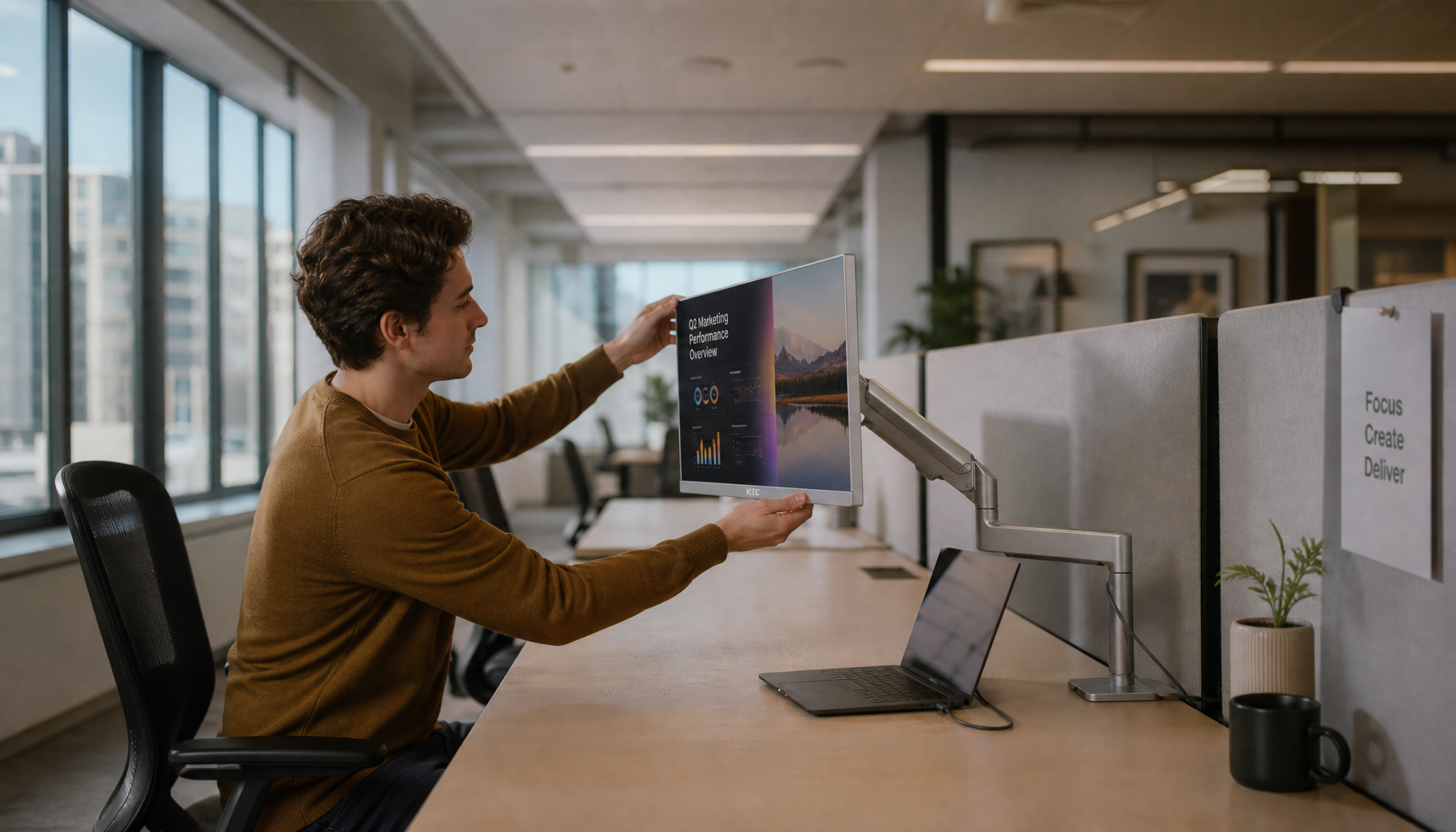
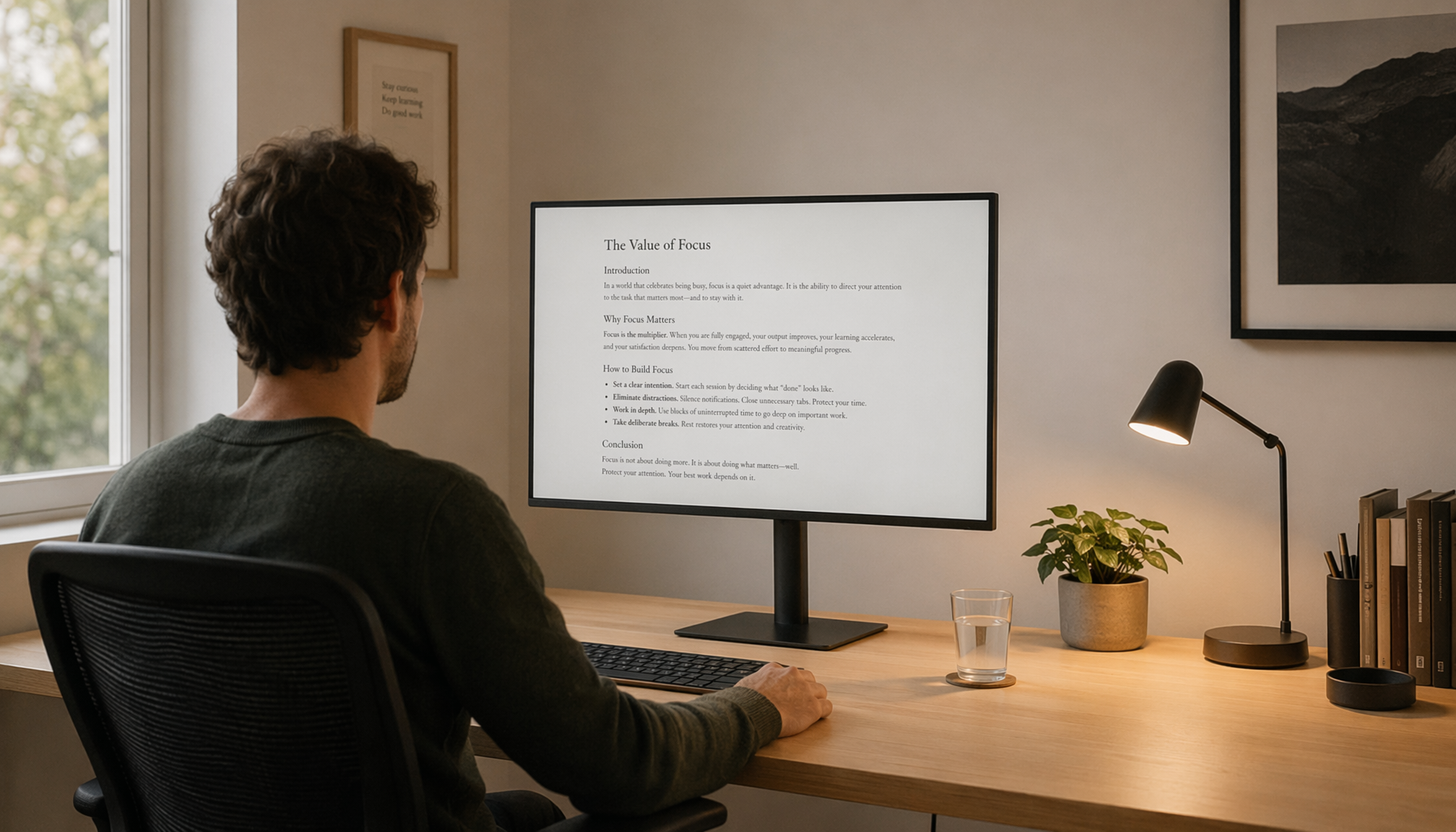
A clean desk example would be a 32-inch photo monitor calibrated to D65, gamma 2.2, and moderate luminance, plus a 24-inch office monitor using its own sRGB-like profile at a more comfortable brightness. You edit and soft proof on the 32-inch panel. You keep email, file browsers, client notes, and music apps on the 24-inch panel.
Keep Image Profiles Separate From Monitor Profiles
This is the mistake that derails many editing setups. Your monitor ICC profile is not the same thing as your image’s color space. An image can be tagged sRGB, a wide-gamut RGB space, or an even larger editing space, while the display has a separate profile describing the screen.
Professional color-management recommendations make this point clearly: do not set the RGB working space to Monitor RGB, because that effectively breaks normal color management. The safer workflow is to preserve embedded profiles and treat color-management profiles as translators between the file, the application, and the output device.
For a real-world example, edit a RAW file in a wide working space, export a duplicate JPEG in sRGB for web delivery, and let your calibrated monitor profile handle the display translation. Do not convert the original master file into your monitor profile. That profile belongs to the screen, not the photo.
Pros and Cons of Different Profiles
The main advantage is accuracy by display. Your photography monitor can be optimized for neutral edits, while your general monitor can stay bright and comfortable for everyday work. You also avoid forcing a single compromise profile across panels that cannot reproduce color the same way.
The second advantage is workflow clarity. When the calibrated screen is the only place where final color calls happen, you stop chasing every visual difference across the desk. That is especially useful for creators who also game, stream, code, or work in office apps on the same machine.
The downside is management overhead. Profiles can get reassigned after driver updates, dock changes, cable swaps, or operating-system display detection changes. HDR adds another wrinkle because HDR calibration profiles may behave differently from standard ICC profiles, especially when a TV and monitor are both connected.
Another limitation is physical hardware. If one monitor cannot reach the same brightness, white point, or gamut as the other, no profile can make it a perfect match. Matching down to the dimmer monitor is practical because a bright display can usually be lowered, while an older dim panel cannot exceed its hardware ceiling.
Should You Copy ICC Profiles From Review Sites?
Some monitor-review sites maintain an ICC profile database, and those shared settings can be useful as a starting point when you do not own calibration hardware. They are better than random guessing, especially when paired with a reputable review’s recommended monitor settings.
Still, shared profiles are not precision calibration. Panel variance means your unit may not behave exactly like the tested unit. Treat downloaded profiles as a temporary improvement for general use, not as a final reference workflow for paid photography, print sales, or brand-critical product images.
If your work earns money or goes to print, buy or borrow a calibrator. Updated calibration-device guidance points photographers toward modern colorimeter tools, and the practical value is that the software creates a monitor-specific profile from actual measurements. A good calibration device is cheaper than reprinting a stack of large photo orders or re-editing a client gallery because your display was too cool.
Best Practices for Photography Plus Everyday Use
Keep your editing environment boring in the best possible way. Use steady room lighting, avoid direct sunlight on the screen, and turn off display modes that change contrast, color temperature, or brightness automatically. A monitor that shifts under you is a weak foundation, even if its spec sheet looks excellent.
Use the calibrated display for final exposure, white balance, skin tone, product color, and print soft proofing. Use the secondary display for tools, timelines, messaging, browser tabs, and references. If you drag the image to the general-use screen, treat the result as a preview of how variable consumer displays can be, not as a reason to re-edit the file.
For exports, stay practical. sRGB remains the safest delivery space for web images viewed on unknown devices. Wide-gamut RGB spaces can be valuable for photography and print workflows when the whole chain supports them, but they should be used intentionally. Discussions around buying a color-calibrated monitor capture a common problem: buyers often get buried under terms before they understand the workflow. The reliable path is not the most expensive vocabulary; it is a calibrated display, correct profile assignment, embedded image profiles, and consistent viewing conditions.
Common Questions
Can I use one monitor in wide-gamut RGB and another in sRGB?
Yes, if each monitor has its own correct profile and your software is color-managed. The wide-gamut monitor is the better choice for editing wide-gamut photo work, while the sRGB monitor can serve as a practical web-preview or office screen. Just avoid using the sRGB screen for final color decisions if the main edit was made for print or wide-gamut output.
Why do colors change when I move an editing app between monitors?
Color-managed apps convert the image appearance through the profile assigned to each display. If both profiles are accurate, the image should remain broadly consistent, though not identical if the displays have different gamut, contrast, or uniformity. If the shift is dramatic, one profile may be wrong, missing, or assigned to the wrong monitor.
Do I need hardware calibration for a portable smart screen?
For serious photo judgment, yes, if the portable screen supports stable calibration and profiling. For tethering, travel review, client previews, or productivity, a good factory mode may be enough. Portable displays often have tighter brightness and gamut limits than desktop photo monitors, so use them as flexible workspace rather than your only reference unless you have verified them.
Final Verdict
Run different profiles for different monitors, but keep your decision chain disciplined. One calibrated screen should be your color authority; every other display can support speed, immersion, and productivity without being trusted for final photo color. That setup gives you the best mix of performance, value, and real-world reliability.