Yes, but only if your laptop, cable, and first portable monitor all support the right video pass-through path. In many real-world setups, a dock, Thunderbolt hub, or dual-screen portable monitor is more reliable than a true daisy chain.
Is your laptop down to one open USB-C port while two portable screens sit ready on the desk? A clean one-port setup can turn a cramped travel workstation into a usable command center for spreadsheets, timelines, chat, and reference windows. You’ll know what to check before buying, what usually fails, and which setup path gives you the best result.
What Daisy-Chaining Actually Means
Daisy-chaining means the laptop connects to the first display, then the first display passes video to the second display. That is different from plugging two monitors into a dock, and it is very different from using a cheap splitter that simply copies the same picture.

A proper monitor chain normally depends on DisplayPort Multi-Stream Transport, often called MST, or Thunderbolt. The key idea is that one upstream connection carries multiple display signals, then the first monitor separates or passes them along. Daisy chaining monitors is mainly valuable because it expands screen space while reducing cable clutter.
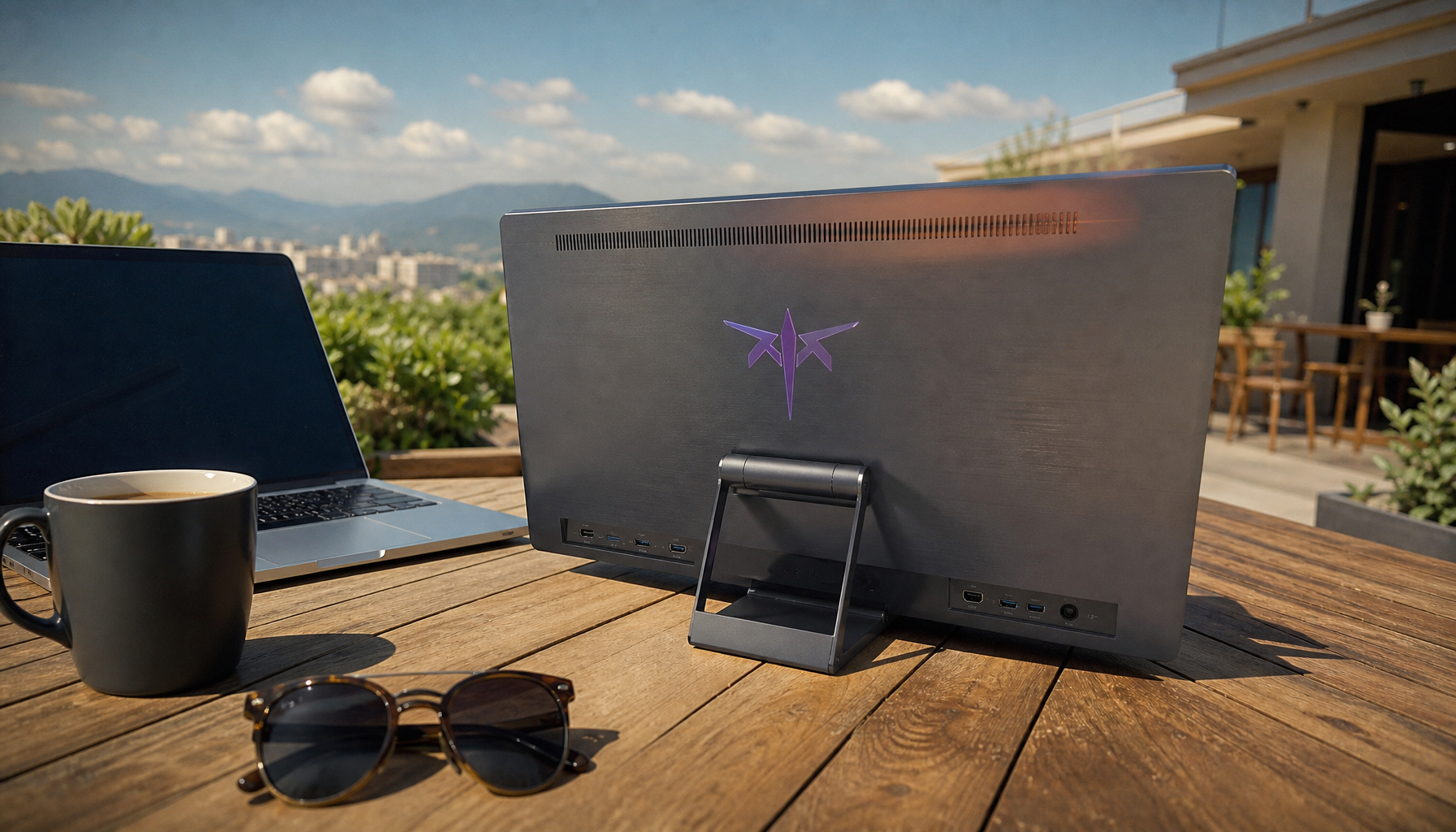
For portable monitors, the challenge is physical as much as technical. Many portable screens have USB-C input, but fewer include a real video output port. Two USB-C ports on a portable monitor do not automatically mean one is input and the other is output. One may be for power only.
The Short Answer for One USB-C Port
You can daisy-chain two portable monitors from one USB-C port when the laptop’s USB-C port supports video output, the connection standard supports multi-display output, the first monitor has a true video output, and the total bandwidth can handle both screens at the resolution and refresh rate you want.
If your laptop has Thunderbolt 3, Thunderbolt 4, USB4 with display support, or USB-C with DisplayPort Alt Mode plus MST support, you have a possible starting point. If the first portable monitor has only USB-C input and no DisplayPort Out, Thunderbolt Out, or verified pass-through, the chain stops there.
This is why many dual portable monitor setups that work from one port are not classic daisy chains. Some are purpose-built dual-screen units, some rely on docks, and some use USB graphics software. A dual-screen travel display, for example, ran two 15.6-inch Full HD panels from a single full-featured USB-C connection when the laptop could supply the required video and power, but that design is a packaged dual-display device rather than two ordinary portable monitors chained together. Two stacked 15.6-inch Full HD displays show the appeal: fast setup, less cable mess, and a desktop-like layout on the road.
Compatibility Checklist Before You Buy

The first question is whether your laptop’s USB-C port carries video. USB-C is only the connector shape; it does not guarantee display output. A laptop can charge through USB-C and still fail to send video to a monitor. Modern Thunderbolt ports are usually a strong sign, while ordinary USB-C ports need closer inspection.
The second question is whether your portable monitor can pass video onward. Look for explicit wording such as DisplayPort Out, Thunderbolt Out, MST, daisy-chain support, or video pass-through. If the spec sheet only says USB-C, mini-HDMI, or power delivery, assume it accepts a signal but does not pass one along.
The third question is whether your cable is built for video, not just charging. A monitor cable needs DisplayPort Alt Mode capability and enough power handling for the setup. For monitor use, DisplayPort Alt Mode is required, while charging-only USB-C cables are a common cause of blank screens, flicker, and confusing half-working behavior.
Here is the practical reality in plain terms.
Setup Type |
Extended Screens Possible? |
Best Use |
Main Risk |
True USB-C/DisplayPort MST chain |
Yes, if every device supports it |
Office work, coding, dashboards |
First portable monitor may lack video out |
Thunderbolt chain |
Yes, with compatible devices |
Premium laptops, creator workstations |
Higher cable and monitor cost |
HDMI splitter |
Usually no, mostly mirror only |
Presenting the same image |
Not independent desktops |
USB-C dock or Thunderbolt dock |
Yes, if dock supports dual displays |
Reliable desk and travel setups |
Adds another device |
USB graphics dock |
Yes, with drivers |
Laptops with limited native outputs |
Driver, lag, sleep/wake issues |
Why HDMI Splitters Usually Disappoint
HDMI splitters are tempting because they are inexpensive and easy to find. For productivity, they are usually the wrong tool. Most basic HDMI splitters duplicate one image across two screens, which is useful for a presentation or showroom feed but not for an extended desktop.
A true extended desktop lets your laptop treat each portable monitor as its own workspace. You can keep a video call on one display, a spreadsheet on another, and your main document on the laptop screen. Monitor guidance is clear that DisplayPort daisy chaining requires DisplayPort 1.2 or higher plus MST support on the graphics card and monitors.
For a road setup, that distinction matters. Mirroring two screens gives you more glass but not more workspace. Extending two screens gives you more usable control.
Bandwidth: The Hidden Limit
Even when the chain works, one USB-C port is still one pipe. Two portable monitors share the available display bandwidth, and that bandwidth is consumed by resolution, refresh rate, color depth, HDR, and sometimes USB data.

A simple example makes the trade-off clear. Two 1080p portable monitors at 60Hz are much easier to drive than two 4K portable monitors at 60Hz. A 120Hz gaming screen demands more from the connection than a 60Hz productivity screen. HDR and high color depth can also tighten the ceiling.
That is why 15.6-inch 1080p or 16-inch 1920 x 1200 portable monitors remain practical choices for mobile productivity. Many laptop-friendly portable monitors sit in the 12- to 17-inch range, with current mainstream resolutions commonly around Full HD or 1920 x 1200. USB-C is the key modern connection, but the port must support video, data, and power for the cleanest one-cable experience.
For gaming, direct connection wins. If you bought a 144Hz, 240Hz, or 300Hz portable gaming monitor, feed that display directly from the laptop or gaming handheld whenever possible. Portable gaming models can offer very high refresh rates, but those performance panels are not where daisy chaining delivers the best value. Gaming buyers should seek higher refresh rates when motion clarity matters, and a shared chain can become the bottleneck.
Windows, macOS, and Driver-Based Workarounds
Windows laptops are usually friendlier to DisplayPort MST extended displays. Once the hardware is connected, Windows Display settings let you extend the desktop, arrange the screens, choose a main display, and adjust scaling.
Mac setups need more caution. Many Mac users can run multiple external displays, but MST behavior for independent extended displays differs from Windows. Thunderbolt-based setups are often the cleaner route on Mac, while some base Apple Silicon models have external display limits that no cable can override.
USB graphics software is another workaround. It uses USB-connected docking hardware and software drivers to drive extra displays instead of relying only on native GPU display outputs. It can be useful, especially with laptops that have limited external display support, but it is not the same as native DisplayPort or Thunderbolt output. One forum user described stable single-display behavior but inconsistent results with three 1080p displays through USB-C docks, including stutter, lag, flicker-like behavior, and disconnects after sleep. Multi-monitor setups can work, but driver stability, power delivery, sleep/wake behavior, and resolution load all matter.
For managed work laptops, driver permission can decide the whole purchase. Some portable monitor systems require software for full functionality. Professional users should consider driver-free models when IT restrictions may block installation. Some monitor models may require a driver, so compatibility is not just about ports.
Best Setup Paths by Use Case
For a clean office productivity setup, start with direct USB-C from the laptop to one portable monitor and confirm video. Then test the second display through the first monitor only if the first unit has verified pass-through. If that fails, a compact USB-C or Thunderbolt dock with dual display outputs is usually the most reliable answer.
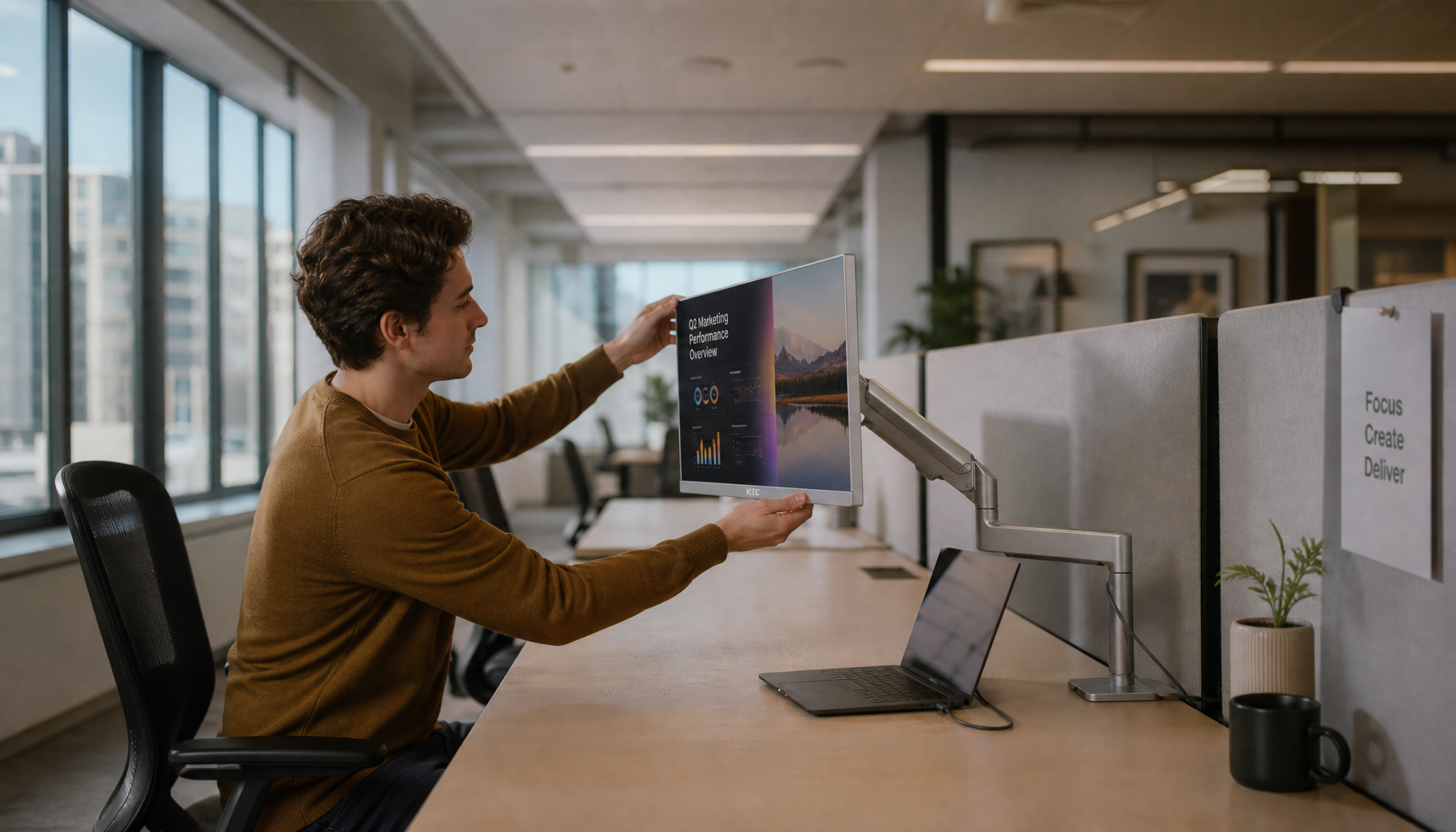
For remote work, a purpose-built dual portable monitor can be smarter than two separate screens. You get fewer loose parts, a matched panel layout, and less setup time. Portable monitors are practical remote-work tools because they add workspace for hybrid users moving between home, coworking spaces, and client locations. USB-C DisplayPort Alt Mode is the feature to look for when you want video over a simple USB-C connection.

For a desk where two computers share one monitor, a USB-C KVM monitor setup may be more useful than a portable daisy chain. A KVM path can combine display output, charging, and keyboard or mouse sharing, but every link still needs to support the right signal. A working one-cable setup requires a monitor with USB-C video support, a laptop with USB-C display output, and a cable capable of carrying video, power, and data.
Troubleshooting a One-Port Dual-Monitor Setup
Start by stripping the setup down. Connect one portable monitor directly to the laptop with the best full-featured USB-C cable you own. If it only charges or stays black, the problem is likely the port, cable, or monitor input mode.
Once the first display works, add the second display using the monitor’s actual output port, not a power-only USB-C jack. Open display settings and choose Extend instead of Duplicate. If the second screen mirrors the first, the chain is not being treated as independent displays.
If screens flicker or disconnect, shorten the cable path, avoid low-cost charging cables, reduce the refresh rate to 60Hz, lower the resolution, and disconnect extra USB devices. Portable monitors are power-sensitive; a laptop under load may not provide enough power for two screens through a thin travel cable. Practical portable monitor tips emphasize that correct power and connection behavior often decide whether an unstable setup works. USB-C portable displays need the full chain to cooperate.
Final Buying Advice
Buy for the workflow, not the fantasy of one cable. If your priority is spreadsheets, code, email, research, and travel productivity, dual 1080p or 1920 x 1200 portable screens are realistic with the right hardware. If your priority is high-refresh gaming, 4K editing, HDR, or color-critical work, connect the main display directly and use a dock only when it preserves the performance you paid for.
The reliable path is simple: verify USB-C video output on the laptop, verify true video output on the first portable monitor, use a full-featured cable, and respect bandwidth. Daisy-chaining two portable monitors from one USB-C port is possible, but the best setup is the one that gives you independent screens without turning every work session into cable diagnostics.