A monitor that is too dim is unlikely to permanently damage your eyes, but it can make them feel tired, dry, blurry, or strained. The safer goal is not maximum brightness; it is matching screen brightness, contrast, text size, and room lighting so your eyes are not constantly fighting the display.
Ever lower your gaming monitor at night, then notice yourself squinting through menus, spreadsheets, or small HUD text? Practical monitor tuning can reduce that strain quickly by matching brightness to the room, using readable contrast, and building in short focus breaks. This guide explains what dimness can and cannot do to your eyes, then gives specific settings for work monitors, gaming displays, ultrawides, and portable screens.
Dim Monitors Usually Cause Eye Strain, Not Eye Damage
A dim monitor does not usually injure the eye in the way that unsafe lasers, sunlight, or physical trauma can. The more common problem is digital eye strain: temporary discomfort from long screen sessions, poor lighting, glare, small text, low contrast, or awkward viewing position. A health organization notes that there is no scientific evidence that long-term computer screen viewing causes permanent eye damage, even though it can make eyes feel dry, tired, and irritated.

That distinction matters when choosing monitor settings. If your 27-inch gaming monitor is set to 10% brightness in a dark room and you are leaning forward to read chat, toolbars, or map labels, the risk is not that the panel is “burning out” your vision. The issue is that your eyes may be working harder to focus on low-contrast detail, especially during long uninterrupted sessions.
Digital eye strain can still be disruptive. A health organization describes computer vision syndrome as symptoms linked to using digital devices for several hours, including eye irritation, blurry vision, light sensitivity, headaches, and pain behind the eyes. For monitor users, that means a dim screen is less of a permanent-damage issue and more of a comfort, readability, and setup problem.
When to Take Symptoms Seriously
Most monitor-related eye strain improves after rest, better lighting, or display adjustments. A medical center notes that symptoms of digital eye strain are often temporary and may lessen after stopping device use, though they can last longer for some people. If blurry vision, double vision, headaches, eye pain, redness, or focusing problems continue after you change your setup, an eye exam is the practical next step.
This is especially relevant if you recently moved from a laptop to an external monitor, added a second display, bought an ultrawide, or switched to a high-refresh-rate gaming monitor. Those upgrades can change text size, viewing distance, brightness, panel coating, and glare all at once, making it easy to blame “dimness” when the real cause is a combination of settings.
Why a Too-Dim Monitor Can Feel So Uncomfortable
A dim screen can push you into squinting, leaning forward, or increasing mental effort while reading. That happens most often when brightness is low but the room is not equally dim, or when the monitor’s contrast, scaling, and text size make fine details harder to separate from the background.
Screen work is visually demanding because your eyes repeatedly focus on pixels and small edges. A health organization notes that screen viewing often involves low contrast between text and background, and people may blink only about 3 to 7 times per minute while looking at a screen. Less blinking means less tear film spread across the eye, so even a reasonable brightness setting can start to feel harsh or blurry after a long session.
Dimness can also interact with glare. A dark monitor in front of a bright window forces your eyes to adapt between the screen and the brighter background. A bright monitor in a dark room creates the opposite problem, where the display becomes the main light source. A health organization recommends adjusting screen contrast and brightness to a comfortable level and reducing bright lighting or glare that makes viewing harder.
Common Signs Your Monitor Is Too Dim
Your monitor may be set too low if you notice these patterns:
- You lean closer than usual to read text, especially on a 24-inch to 32-inch display.
- White pages look gray or muddy compared with a sheet of printer paper.
- You increase browser zoom or game UI scale just to read normal labels.
- Your eyes feel tired faster when reading than when watching video.
- You squint during dark game scenes, code editing, spreadsheets, or document work.
- The screen feels comfortable only when you turn off nearby lamps or close blinds.
A dim monitor is usually not the only cause. Low text scaling, an ultrawide positioned too far away, mismatched laptop and external monitor brightness, or aggressive dark mode can all create the same feeling.
How Bright Should Your Monitor Be?
The best monitor brightness is the one that visually matches the room. Many gaming monitors ship with bright retail-style presets, sometimes above 300 nits, because they are designed to look vivid in stores. In a normal home office or bedroom, that level can be uncomfortable, while a very low setting can make text dull and hard to read.
A brand’s monitor comfort guidance cites common ergonomic brightness ranges of 120 to 150 nits for typical office environments and 80 to 100 nits for darker rooms. You do not need a light meter to get close, but these ranges explain why 100% brightness is often too high for SDR desktop use.

Use Case |
Starting Brightness Target |
Contrast Target |
Practical Setup Tip |
Bright home office or desk near a window |
120-150 nits |
Around 60%-70% |
Reduce window glare before raising brightness aggressively |
Typical room with lamps or ceiling light |
100-120 nits |
Around 60%-70% |
Match the screen to the room, not to the monitor’s factory preset |
Dark room gaming or media |
80-100 nits for SDR |
Slightly lower if highlights feel harsh |
Add soft bias lighting behind or near the monitor |
Laptop plus external monitor |
Match by appearance, not percentage |
Keep both displays similar |
Open the same white page on both and adjust until they look equal |
HDR-capable gaming monitor in a desktop operating system desktop use |
Keep SDR desktop brightness moderate |
Avoid extreme contrast for reading |
Use HDR mainly for supported games and video, not all-day text work |
Use the White Paper Test
A quick real-world check is the white paper test. Open a blank white page on your monitor and hold a sheet of white printer paper beside it under the same room lighting. If the screen glows much brighter than the paper, lower brightness; if it looks dull gray and makes you squint, raise it.

This is useful because monitor brightness percentages are not standardized. A “30%” setting on one 27-inch IPS monitor may look brighter than “55%” on a portable USB-C display. Matching what your eyes see is more reliable than copying someone else’s on-screen display number.
Do Not Ignore Contrast
Brightness controls the display’s light output, while contrast affects separation between dark and light details. Higher contrast can make text easier to read, but excessive contrast in a dark room can create glare stress, halos, or uncomfortable highlight jumps, especially on Mini-LED and HDR monitors. A contrast setting around 60% to 70% is a reasonable starting point for many desktop monitors, then adjust only if text looks washed out or harsh.
For reading-heavy work, use a neutral preset such as Standard, sRGB, User, or Custom instead of Vivid, FPS, Racing, or Dynamic Contrast. Those gaming presets can be useful for visibility in specific games, but they often exaggerate brightness, sharpness, black levels, and color saturation for general desktop use.
Monitor Type Matters: Gaming, Ultrawide, Portable, and Multi-Monitor Setups
Different displays create different eye comfort problems. A high-refresh-rate gaming monitor may feel smooth but ship too bright. An ultrawide may place side content outside your comfortable viewing angle. A portable monitor may be too small or too dim when powered by a laptop. The right adjustment depends on the panel and how you use it.
For gaming monitors, start with SDR brightness around the room-based ranges above, then tune game-by-game. Competitive titles often tempt users to raise brightness and contrast so enemies stand out, but that can make menus, maps, and bright flashes more fatiguing during long sessions. For dark-room gaming, lowering hardware contrast by 5% to 10% can make shadows and HUD elements easier to tolerate without making the image unusably flat.

High refresh rate helps motion clarity, but it does not replace readable brightness and text scaling. A 144 Hz, 240 Hz, or 360 Hz panel can reduce motion blur and make camera movement feel smoother, yet your eyes can still strain if the display is too dim, too far away, or showing tiny UI elements. Treat refresh rate as one part of comfort, not a cure for poor setup.
Ultrawide Monitors
Ultrawide monitors are excellent for timelines, coding, spreadsheets, and immersive games, but their size can encourage bad positioning. Keep the center of the screen directly in front of you, then place frequently used windows near the center rather than at the far edges. If you use a 34-inch or 49-inch ultrawide, avoid pushing it so far back that text becomes small and dim; increase scaling or application zoom instead.
Curved ultrawides can help keep the edges visually closer, but brightness uniformity may still vary across the panel. If the edges look darker, do not keep lowering overall brightness to compensate. Instead, check viewing distance, angle, room reflections, and whether your monitor has uniformity compensation or a more neutral picture mode.
Portable Monitors
Portable monitors often run from USB-C power and may not reach the same brightness as a desktop monitor. If your portable display looks dim beside a laptop, match the laptop down slightly and raise text scaling on the portable screen rather than forcing yourself to read low-contrast detail. For travel work, a portable monitor is usually more comfortable with a small desk lamp or ambient light source than in a dark hotel room with only the screen lighting your face.
Also check power settings. Some laptops reduce external display brightness or USB-C power behavior on battery. If a portable monitor becomes noticeably dim when unplugged, the fix may be power delivery, not eye endurance.
Dual-Monitor and Laptop-Plus-Monitor Setups
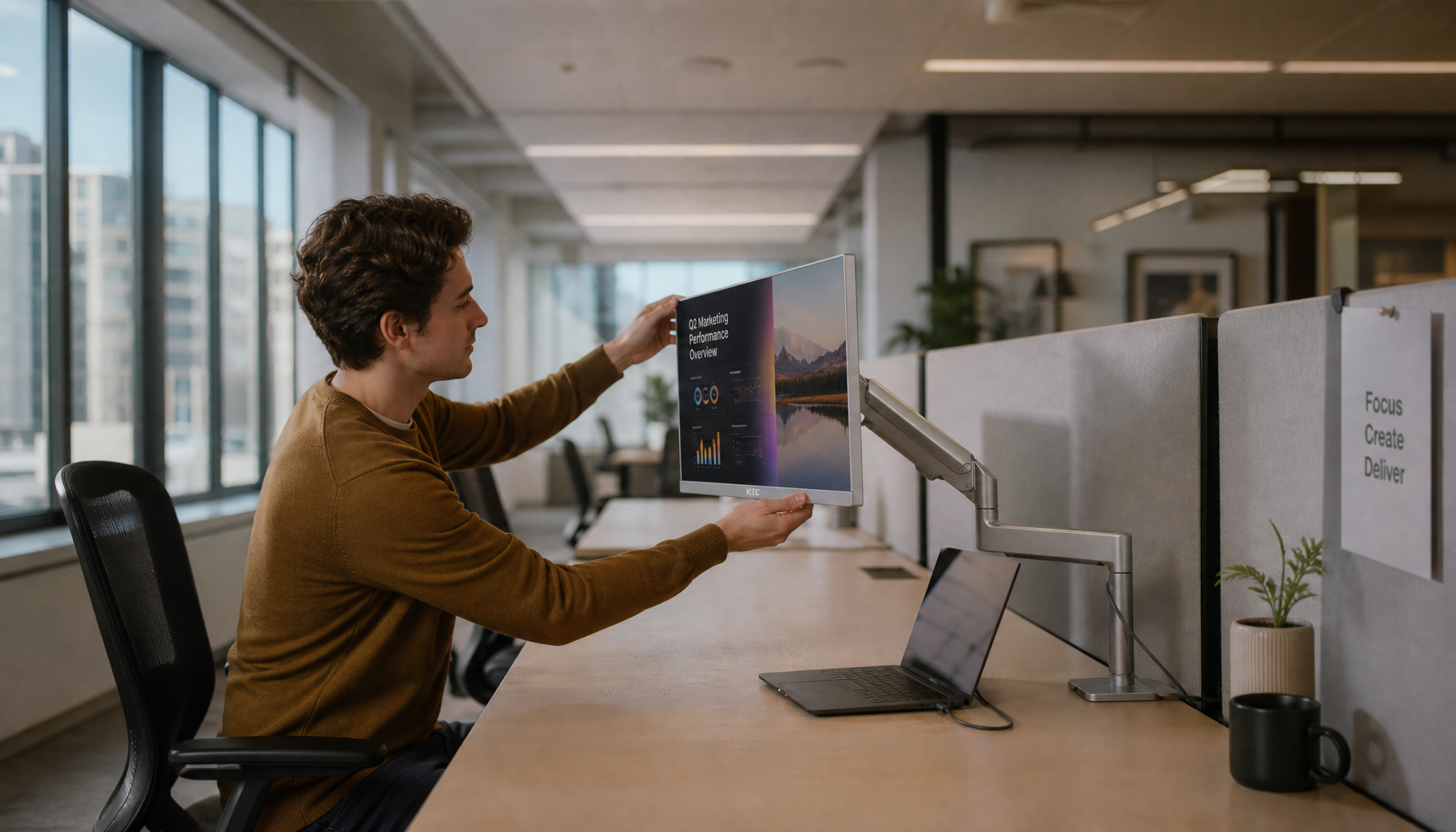
Mismatched brightness is a major cause of eye fatigue. If your laptop screen is bright and glossy while your external monitor is dim and matte, your eyes adapt every time you look from one to the other. A brand’s desk setup guidance notes that strain often comes from differences in brightness, contrast, glare, text rendering, and position rather than brightness alone.
Open the same white page on both screens and adjust until they appear similar from your normal seated position. Then match text size, not just brightness. A laptop at 150% scaling beside a 27-inch monitor at 100% scaling can make the larger display feel harder to read even when brightness is correct.
Build a More Comfortable Monitor Setup
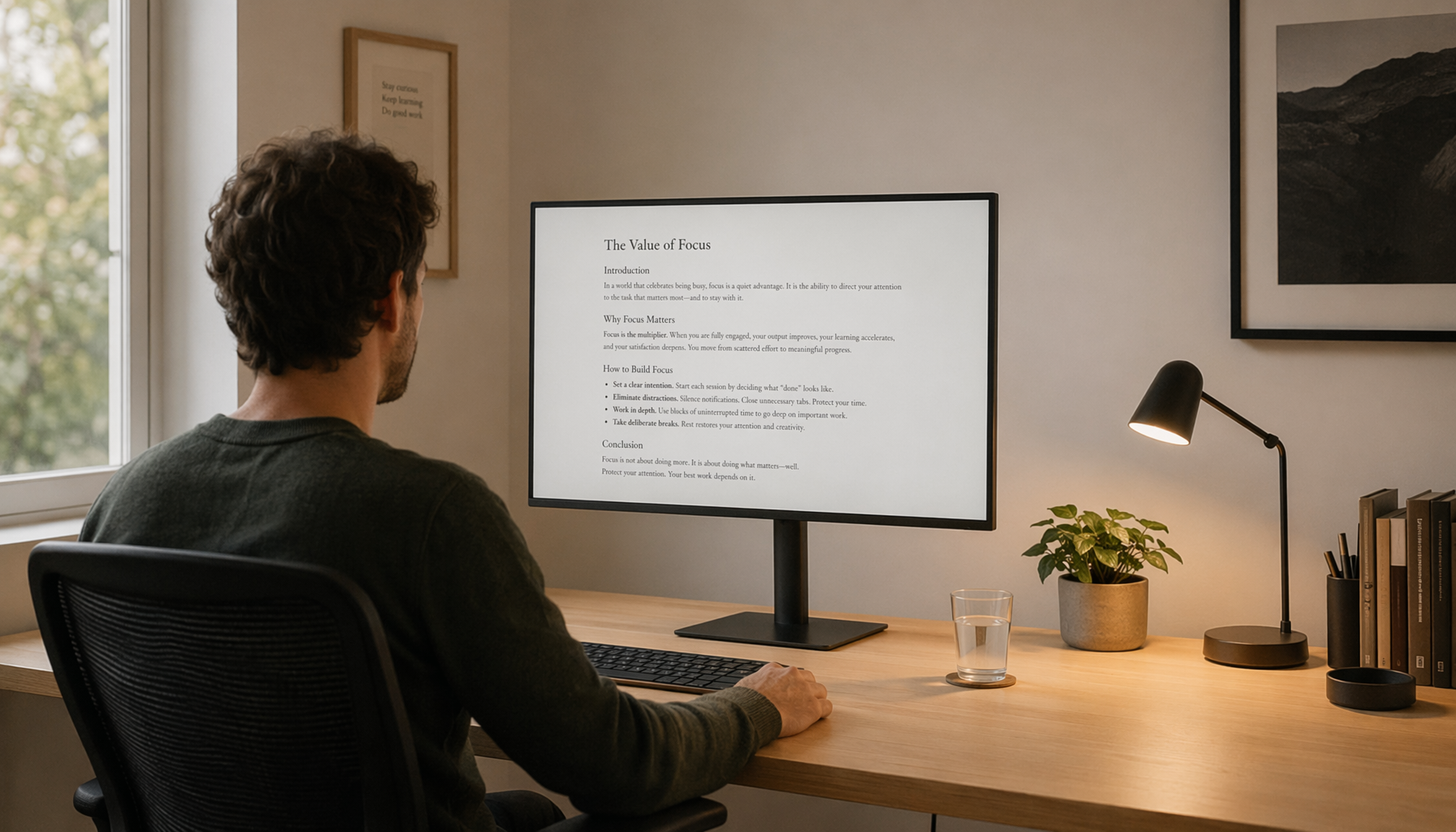
A comfortable monitor setup usually comes from several small fixes, not one perfect brightness number. A health organization recommends placing the monitor directly in front of you, about an arm’s length away, with the top of the screen at or just below eye level. For most desktop users, that means roughly 20 to 24 inches from the eyes, depending on screen size, resolution, and text scaling.

Height matters because it changes how much of your eye surface is exposed. If the monitor is too high, your eyes may open wider and feel drier. If it is too low or too far away, you may lean forward and create neck, shoulder, or back strain. A medical center lists poor posture, wrong viewing distance, glare, poor lighting, and uncorrected vision problems as possible contributors to digital eye strain.
Action Checklist for Safer Screen Use
- Set brightness to match the room: Use about 120-150 nits for a bright office, 100-120 nits for a normal room, and 80-100 nits for a dark room as starting points.
- Check with paper: Compare a white screen to a white sheet of paper; adjust until neither looks obviously brighter or duller.
- Keep contrast readable: Start around 60%-70%, then reduce harsh contrast for dark-room gaming or HDR-heavy content.
- Increase text size before leaning in: Use OS scaling, browser zoom, or in-game UI scale if labels or menus feel small.
- Position the monitor correctly: Keep it about an arm’s length away, with the top edge at or slightly below eye level.
- Reduce glare first: Move lamps, angle the monitor, close blinds, or use softer side lighting before pushing brightness higher.
- Take focus breaks: Every 20 minutes, look at something 20 ft away for at least 20 seconds.
Breaks Are Part of the Setup
Breaks are not a moral victory; they are a visual reset. A health organization notes that two hours of continuous digital screen time per day can increase the chance of computer vision syndrome, and recommends 15-minute breaks every two hours along with the 20-20-20 method. For a long workday or a weekend gaming session, these breaks are as practical as changing brightness.
If you often forget, use a timer, app reminder, or monitor software notification. During the break, look across the room or out a window, blink intentionally, and relax your shoulders. The goal is to change focus distance and reduce dry-eye buildup, not simply pause the game while still staring at the screen.
Settings to Check in a Desktop Operating System and Monitor Menus
Start with the monitor’s physical controls. Choose a neutral preset, disable dynamic contrast for desktop work, and avoid showroom-style modes unless you are testing games or video. If the display has local dimming, a lower setting may feel better for office tasks because it reduces distracting brightness shifts around windows and text.
In a desktop operating system, display scaling can make text and interface elements larger without lowering resolution. Desktop operating system accessibility settings also allow system-wide text size adjustments, while Night Light can warm the display tone in the evening. These settings do not make a dim monitor “safe” by themselves, but they can reduce squinting when the problem is small text or harsh color temperature rather than brightness alone.
Dark mode is useful in dim rooms, but it is not always easier on the eyes. White text on a black background can bloom or appear harsh on some monitors, especially with high contrast, OLED panels, or Mini-LED local dimming. If dark mode makes text shimmer, glow, or feel harder to focus on, try a dark gray theme, lower contrast, or a light theme with reduced brightness.
FAQ
Q: Can using a monitor at very low brightness permanently damage my eyes?
A: For most people, no. A very dim monitor is more likely to cause temporary digital eye strain than permanent eye damage. The bigger concern is squinting, poor contrast, dry eyes, and long sessions without breaks. If symptoms continue after rest and setup changes, schedule an eye exam to rule out an uncorrected vision issue or dry-eye condition.
Q: Is a bright monitor worse than a dim monitor?
A: Either can be uncomfortable if it does not match the room. A bright monitor in a dark room can feel glaring and harsh, while a dim monitor in a bright room can make text hard to read. The best setting is usually close to the brightness of your surroundings, with readable contrast and manageable glare.
Q: Should I use Night Light, blue light filters, or gaming monitor eye-care modes?
A: They can help some users feel more comfortable, especially at night, but they are secondary settings. Brightness, contrast, text size, viewing distance, glare control, and breaks matter more. Use warmer color settings if they feel better, but do not rely on them to fix a monitor that is too dim, too bright, or poorly positioned.
Practical Next Steps
If your monitor feels too dim, do not assume your eyes are being damaged. Treat it as a setup problem: raise brightness until white pages look natural, keep contrast readable, reduce glare, and increase text size before leaning forward. Then test the settings during your real use case, whether that is a three-hour work block, a ranked gaming session, or a laptop-plus-portable-monitor travel setup.
For most users, the best result comes from a balanced display rather than an extreme one. A monitor that is bright enough to read, dim enough to avoid glare, and matched to the room will be more comfortable than any preset labeled Gaming, Movie, Eye Saver, or Vivid.
References
- Cleveland Clinic: Computer Vision Syndrome (Digital Eye Strain): What It Is
- Mayo Clinic: Eyestrain - Diagnosis and Treatment
- UCLA Health: Computer-Related Eye Fatigue
- Cedars-Sinai: Computer Vision Syndrome
- KTC: Ergonomic Brightness: Monitor Contrast for Eye Comfort
- KTC: Eye Strain from Laptop & External Monitor: Causes & Fixes
- Windows Forum: Ultimate Guide to Reducing Eye Strain on Windows 10 & 11