Yes, on LCD gaming monitors, zone count materially affects contrast because it determines how precisely the backlight can follow bright and dark parts of the image. The number matters most when the dimming algorithm, panel type, and game use case turn that hardware into stable, believable depth.
If dark game scenes look gray until a minimap or crosshair lights up a whole patch of the screen, you are not imagining it. Displays that split the backlight into only a few large sections usually look much rougher than models with hundreds of smaller ones, yet setup quality still decides whether the picture feels rich or distracting. Here is how to tell when the count truly matters, when other traits matter more, and how to buy with confidence.
What Local Dimming Actually Changes
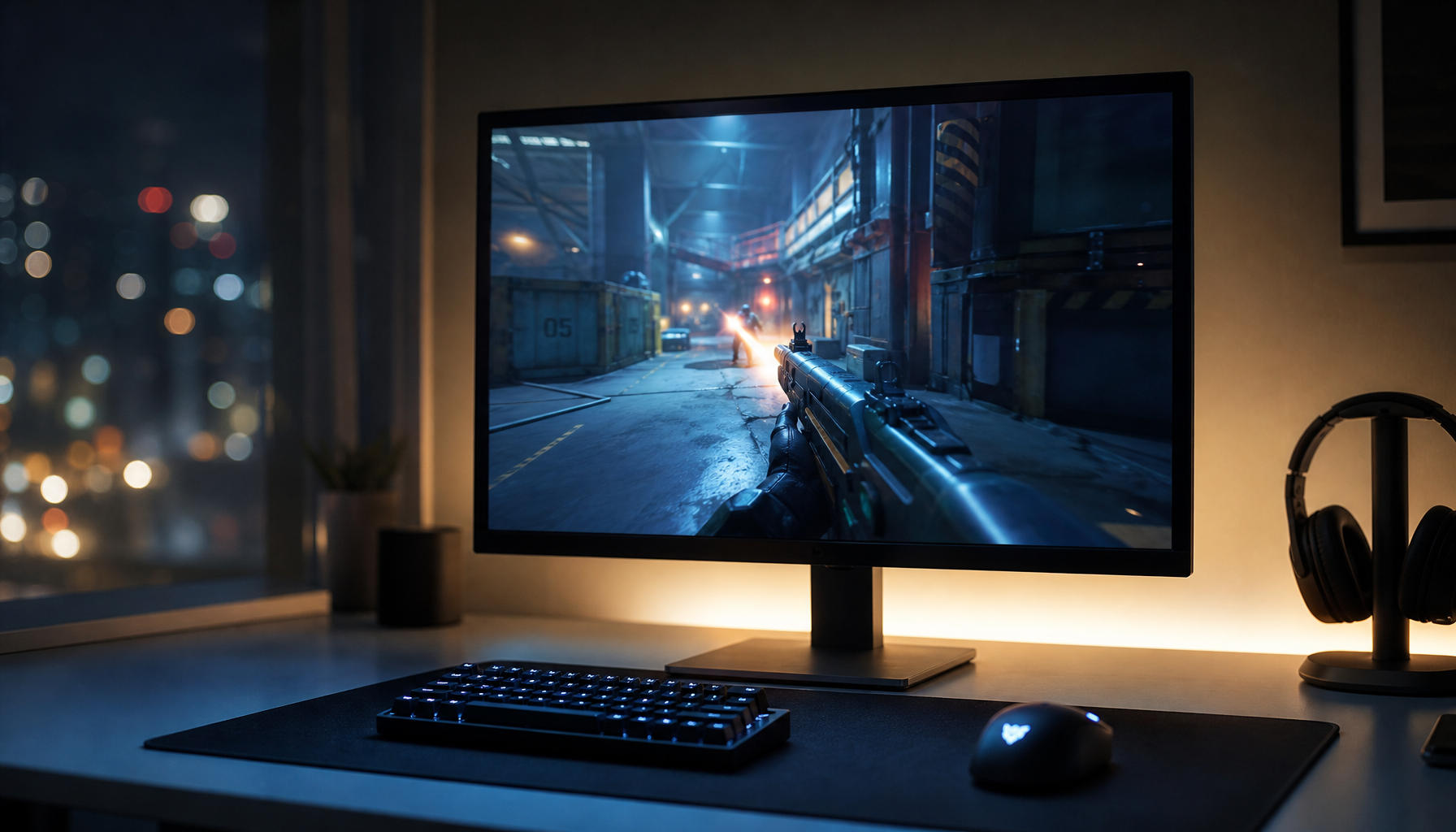
Because LCD panels use a backlight, they need a control system to keep a bright sword flash from lifting the black level of the whole screen. Local dimming is that control system: the backlight is split into separate zones that can brighten or darken independently, so contrast improves beyond what the LCD layer can do by itself. In a real game, this is the difference between a cave wall looking flat gray and that same wall staying dark while a torch or spell effect still pops.

More dimming zones generally improve contrast precision, because smaller zones light less of the screen when a bright object appears. That is why a monitor with a handful of large edge-lit zones often creates a wide glow around subtitles, a white HUD icon, or the moon in a night sky, while a mini-LED model with hundreds or thousands of zones can keep that glow tighter. Zone count is not magic; it is simply a measure of how small the backlight’s brush can be.

Where Zone Count Helps Gaming Most
Single-Player HDR and Dark Scenes
For dark-room HDR gaming, full-array local dimming is the preferred LCD approach, because that is where weak black levels stand out fastest. If you play cinematic games with night travel, neon reflections, star fields, or flashlight-heavy interiors, more zones usually mean deeper blacks, brighter highlights, and less blooming. The difference is easy to spot in a scene with a bright HUD over a dim background: low-zone screens make the HUD look like it is sitting on a faint gray cloud, while higher-zone screens keep more of the surrounding area properly dark.

Backlight approach |
What gaming contrast usually feels like |
Best fit |
Global dimming or very low-zone edge lighting |
A modest dark-scene boost, but halos and uneven patches remain obvious |
Bright-room play and casual HDR curiosity |
Full-array local dimming with hundreds of zones |
Stronger separation between highlights and shadows, with some blooming still visible |
Mixed gaming with real HDR interest |
Mini-LED with 1,000+ zones |
Better control of HUD glow, subtitles, and small highlights on dark backgrounds |
Immersive HDR-first LCD gaming |
OLED per-pixel lighting |
No zone halos and true black pixels, with different tradeoffs around burn-in and price |
Players chasing the cleanest black level |
Competitive Play and Bright Titles
For competitive gaming, monitor choice still has to balance, so zone count is not the only performance lever that matters. In a bright esports title, motion clarity and latency usually do more for your results than squeezing the last bit of shadow depth from the backlight. That is why a fast OLED or a well-tuned high-refresh IPS panel can still be the smarter pick for players who live in tactical shooters and only occasionally care about cinematic HDR.
Why the Number Alone Can Mislead You
Algorithms and Tuning Matter Too
A glowing cursor on a dark desktop is a good reminder that zone size, algorithm quality, and content type all affect the result. Even a respectable zone count can look clumsy if the bright object is much smaller than the zone controlling it. On an IPS mini-LED monitor, that often shows up as a lit rectangle following the mouse across a black loading screen or a faint halo around subtitles during cutscenes. The hardware is working, but the job itself is still coarse.

Even well-equipped mini-LED monitors need careful tuning, because aggressive dimming can hide shadow texture while aggressive halo suppression can trim highlight punch. Display setup guidance often points to the same tradeoff: the deepest-black presets can look impressive at first glance, yet more balanced settings preserve dark-scene detail better for actual play. In a dense neon city scene, for example, a setting that looks stronger in a static menu can make fine environmental texture disappear once gameplay starts.
Gaming also reveals pumping, flicker, and crushed shadow detail faster than movies do, because camera movement, HUD updates, and sudden flashes force the dimming system to react constantly. This is where cheaper implementations fall apart. A monitor may advertise a large zone count, yet if brightness shifts are obvious when you pan the camera or enter a dark doorway, the contrast gain stops feeling premium and starts feeling busy.
Panel Type Still Changes the Outcome
If OLED is growing so quickly in gaming monitors, it is because per-pixel lighting solves the exact problem that local dimming only approximates on LCD. OLED does not need zones, so bright stars, subtitles, and UI elements do not create the same halo patterns against black backgrounds. For a player who wants the cleanest possible black floor and plays mostly in a dark room, that can matter more than moving from 576 zones to 1,152 zones on an IPS LCD.
That does not make mini-LED irrelevant. A full-array local dimming LCD can still be the better fit if you want higher brightness, worry about burn-in, or need a mixed-use screen that spends long hours on desktop apps and productivity work. Zone count matters a great deal inside the LCD category, but once you cross into OLED territory, panel technology can outweigh the zone conversation entirely.
How Many Zones Are Actually Enough?
Research on mini-LED contrast shows why the answer is “it depends,” not one magic number. In the study it cites, suppressing visible blooming took about 200 zones on an LCD with roughly 5,000:1 contrast, but more than 3,000 zones on an LCD around 2,000:1. That gap matters because a stronger native-contrast panel needs less help from the backlight, while a weaker native-contrast panel needs many more zones to hide its limits.
Technical breakdowns of 1D local dimming and full-array local dimming make the buying tiers clearer. Basic edge-lit designs may use only 8 to 16 zones, which can raise simultaneous contrast compared with global dimming but still behave crudely in games. Full-array local dimming designs commonly land in the 384 to 1,152 zone range, and that is where LCD HDR usually starts looking convincingly premium instead of merely enabled. On larger 4K and ultrawide screens, the reason is straightforward: if the screen is big and the zones are still coarse, blooming becomes easier to notice around small bright objects.
The practical read is simple. If a monitor only says “local dimming” and hides the zone count, treat that as a warning. If the count is in the low double digits, expect a visible compromise. If it is in the high hundreds or low thousands, you are shopping in the range where gaming contrast can look genuinely transformed on an LCD.
How to Shop and Set It Up Without Regret
For mixed use, local dimming is often better left off in SDR desktop work and on for HDR gaming. That single habit prevents a lot of buyer disappointment. If your monitor doubles as an office display, leaving local dimming active all day can make white windows, cursors, and dark UI panels look uneven or distracting. Turn it on when a game or movie can actually use the extra contrast, and you get the benefit without living with the side effects.
A reliable buying method is to test one dark scene with the same brightness and HDR settings both ways, because that on-versus-off comparison exposes real local-dimming behavior faster than spec sheets do. As a paper comparison point, the KTC Mini LED 27” 180Hz 2K HDR1400 Gaming Monitor shows what a 27-inch 2K 180Hz mini-LED option with 1,152 zones looks like before you judge the actual dimming behavior. Watch the crosshair, subtitles, minimap, and any bright doorway in a dark room. If the on mode deepens blacks without obvious halos, brightness pulsing, or lost shadow detail, the implementation is doing real work. If the scene just trades one problem for another, the zone count may be more marketing than mastery.

The smartest overall choice still comes from matching the display to your actual play style and hardware. For story-heavy HDR games, dark-room immersion, and large 4K or ultrawide screens, higher zone counts are worth paying for. For mostly competitive play, a faster panel with better motion performance can be the more satisfying upgrade. And if you want the cleanest blacks available today, the best answer may not be more zones at all, but no zones needed.
Verdict
Yes, local dimming zone count matters for gaming contrast on LCD monitors, but only after a basic threshold is crossed. Think of more zones as a finer brush, not a guarantee: they can paint darker shadows and cleaner highlights, yet the real performance win still depends on panel choice, dimming quality, and whether your games actually reward that extra depth.