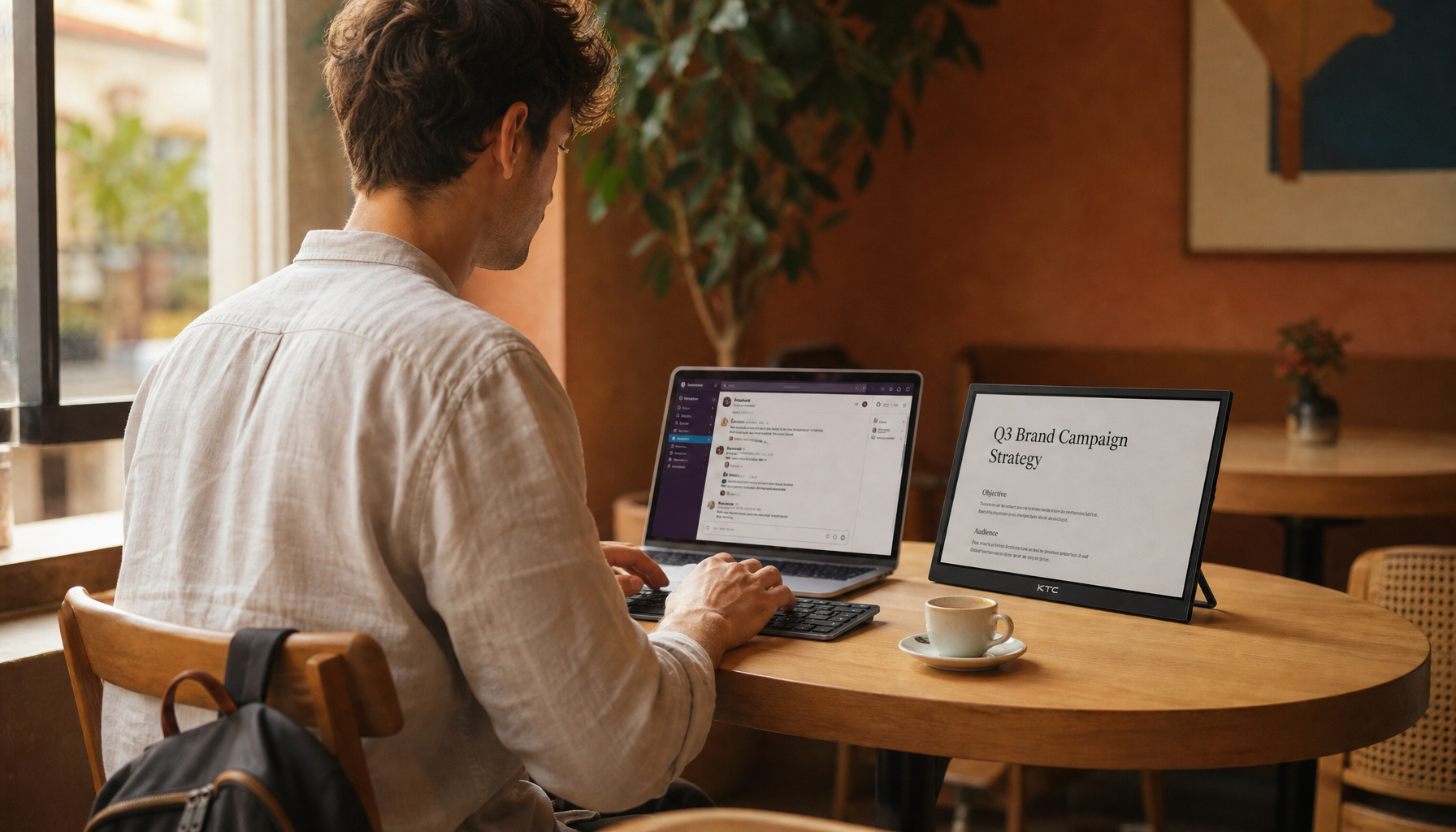
Put the primary monitor directly in front of your body, then place reference screens close beside it, angled inward, and reserved for lower-frequency information you can glance at without twisting.
Does your neck feel strained after a workday even though your desk looks well equipped? A primary-plus-reference layout can make app switching faster, keep game or creative work centered, and reduce repeated head turns when the screens are set by task priority instead of symmetry. Here is the practical way to place every display so your main work stays immersive and your reference screens support you instead of pulling you out of position.
Start With the Primary Screen, Not the Desk
The primary screen is the display that holds your highest-focus task: the game window, timeline, spreadsheet, IDE, design canvas, writing app, trading chart, or video call. It belongs directly in front of your seated position, not merely centered on the desk. Ergonomic guidance consistently puts the main monitor in front of the user because a poorly positioned monitor can push the head, neck, and trunk into awkward positions.
A simple field test works better than a tape-measure-only setup. Sit in your normal posture, place your hands where they naturally work, and look straight ahead. The centerline of your primary display should meet that line of sight. For a gamer, that means the crosshair or main play field is straight ahead. For an office user, the active document or spreadsheet should sit in the center band. For a creator, the canvas or preview should be in the central visual zone, while tools and references live off to the side.

The top of the primary screen should usually sit at eye level or slightly below it, with the center of the screen lower than your eyes. Multiple ergonomic sources point to a comfortable downward gaze rather than a perfectly flat stare. In real use, that means you should be able to read the center of the display with relaxed shoulders and no chin lift.
Place Reference Screens Where Glances Stay Cheap
A reference screen is not another main screen. It is for material that helps the primary task without demanding constant attention: chat, email, documentation, dashboards, broadcast controls, stock watchlists, source images, calendar, or notes. The more often you look at it, the closer it should be to the primary monitor.
For one primary and one reference screen, keep the primary monitor centered and place the secondary screen immediately to the left or right, angled inward. Dual-monitor ergonomic guidance recommends this pattern when one monitor is used most often. The reference display should feel like a controlled glance, not a shoulder check.
For three monitors, the best general layout is a centered primary display with two side displays angled inward. A triple setup can be powerful for streaming, development, finance, and production work, but the ergonomic benefit depends on keeping the side monitors close enough that they stay inside a comfortable field of view. The common triple-monitor layout puts one primary monitor centered, then uses inward-angled side displays for lower-priority tools and references.

Setup |
Best Use |
Positioning Rule |
Tradeoff |
Primary plus one side screen |
Office work, gaming with chat, coding with docs |
Primary centered, reference close and angled inward |
Simple and efficient, but one side can become overloaded |
Primary plus two side screens |
Streaming, finance, development, creative workflows |
Center screen straight ahead, both sides angled inward |
Excellent visibility, but desk width and neck movement need discipline |
Primary plus vertical reference |
Writing, coding, chat, long documents |
Main screen centered, portrait screen close to one side |
Great for text, less natural for wide visual content |
Stacked reference screen |
Limited desk width, broadcast previews, monitoring |
Primary at eye-friendly height, upper screen for occasional checks |
Saves width, but frequent upward viewing can fatigue the neck |
Use Distance to Control Both Comfort and Immersion
Most monitor positioning advice starts around arm’s length, but screen size changes the final answer. A compact 24-inch or 27-inch monitor can often sit around arm’s length, while a 32-inch display needs more room so you can see the full panel without scanning aggressively. Some ergonomic guidance gives a practical benchmark: a 27-inch screen may feel right around 3 to 4 ft away, while a 32-inch screen may need closer to 5 ft depending on desk depth and vision.
This is where performance setups often go wrong. A 32-inch gaming monitor pushed against a shallow desk can look impressive, but if you are moving your head to check health, minimap, chat, and inventory, the screen is effectively too close. The same problem appears in productivity layouts when a large spreadsheet fills the main panel and messaging, email, and dashboards sit far out at the edges.
For reference screens, keep the distance similar to the primary monitor when possible. If the side display sits much closer, your eyes must refocus every time you glance over. If it sits much farther away, you lean or squint. Ergonomic monitor positioning treats viewing distance as a comfort variable, not a decorative preference.
Angle Side Screens Based on Use Frequency
Side screens should curve toward you, not sit flat like a showroom wall. A shallow inward angle of roughly 10 to 30 degrees works for most desks, with the tighter angle reserved for screens you check often. If you use the reference monitor only occasionally, it can sit a little farther out. If it holds live chat, system metrics, a script, or source material, pull it closer to the primary display and angle it more directly toward your face.
The goal is to keep sustained neck rotation modest. If you must hold your head turned for more than a few seconds, that screen is no longer a reference screen; it is acting like a second primary and should be repositioned. For two equally important monitors, many ergonomic sources suggest placing both close together in a shallow concave shape. But when one screen is dominant, the better layout is asymmetric: center the main screen and let the secondary serve it.
For a streamer, the game should stay directly ahead. Chat can sit vertically on the dominant-eye side or the side you naturally glance toward, while a broadcast preview can sit on the other side or above if checked less often. For a financial analyst, the active model belongs in the center, while market news and a dashboard can sit left and right. For a writer, the draft stays centered, research sits on one side, and messaging should be farther away or minimized.
Match Heights, Brightness, and Scaling
Reference monitors should not punish your eyes for using them. Keep the top edges close in height, especially when the monitors are similar size. If one screen is vertical, align its active reading area with the primary screen’s comfortable gaze zone rather than blindly matching the outer frame.
Brightness and contrast matter too. A bright reference display beside a dim primary monitor creates a visual tug-of-war, especially in dark rooms. For office productivity, match brightness to the room and avoid glare from windows or task lights. Place monitors at a right angle to windows or adjust lighting so reflected glare does not push you into awkward reading postures.
Scaling also needs consistency. If your 4K primary monitor uses 150% scaling and a 1080p side monitor uses tiny text, every glance becomes a focus shift. Increase text size on reference screens until you can read them without leaning. This is not a weakness; it is a performance choice. A readable reference screen is faster than a dense one that forces you out of posture.
Choose Landscape, Portrait, or Ultrawide by Task
Landscape reference screens are best for visual material such as timelines, preview windows, spreadsheets, dashboards, maps, and media. Portrait screens are better for chat, documentation, source code, long articles, and scripts. A vertical monitor can be especially valuable when it prevents constant scrolling, but it should still sit close enough that your neck does not rotate repeatedly.
Ultrawide displays change the decision. A 34-inch ultrawide can replace a primary-plus-reference pair for many users because the center zone can hold active work while side zones hold supporting information. Larger 49-inch displays can work well for power users, but they require disciplined window placement. Treat the center third as the primary monitor and the outer thirds as reference screens. If your most-used app lives at the far edge, the layout is failing.
Multi-monitor setups still beat ultrawides when you need strict task separation, portrait orientation, or independent inputs. A gaming monitor plus a portable secondary screen, for example, can be cleaner than forcing chat or system tools onto the gaming panel. For travel, a portable reference display should sit beside the laptop or primary portable monitor, not below it where it encourages hunching.
Hardware: Arms Beat Guesswork
Stock stands are often the limiting factor. They may be too deep, too low, too high, or unable to rotate into portrait. Monitor arms solve the real positioning problem because they let you tune height, depth, tilt, and angle after you actually work for a while. A good arm also frees desk space and helps align mismatched monitors.

Before buying arms, check VESA compatibility, screen weight, desk thickness, and whether the arm can support your monitor’s size without sagging. Monitor arm setup material emphasizes selection and adjustment because monitor arms are only useful when they match the display and workstation. This matters more with heavy gaming displays, curved ultrawides, and stacked layouts.
Cable length is part of positioning too. If HDMI, DisplayPort, USB-C, or power cables are too short, the ergonomic position will slowly migrate back to wherever the cables allow. Leave enough slack for sit-stand movement if your desk rises, and secure cables so they do not pull against the monitor arm.
Configure the Digital Layout to Match the Physical Layout
After the screens are physically placed, the operating system must match reality. Use display settings to identify each screen, drag the display boxes into the same order as the desk, and choose “Extend” rather than “Duplicate” for a true multi-screen workspace.
This step sounds basic, but it affects speed. If the cursor exits the right edge of the primary screen and appears on the wrong reference monitor, your hand hesitates every time. Align the tops of the virtual screens if the physical screens are top-aligned, or align the active working bands if one display is vertical or smaller. The goal is a pointer path that feels invisible.
Pros and Cons of Primary-Reference Layouts
A primary-reference setup is one of the highest-value upgrades for modern desk work because it separates focus from awareness. The primary monitor stays clean and immersive, while reference screens reduce window switching and keep supporting information visible. That is useful for office productivity, competitive gaming, streaming, editing, coding, research, and financial workflows.
The main downside is physical load. More screens can mean more head rotation, more glare, more heat, more cable clutter, and more visual noise. The fix is not always fewer monitors; it is better hierarchy. If a display does not support the main task, move it farther out, lower its brightness, switch it to portrait, or remove it from the daily layout.
FAQ
Which side should the reference monitor go on?
Put it on the side you naturally check with the least body movement. If one eye is clearly dominant or one side feels more comfortable, use that side. If the screen holds communication apps that distract you, place it on the less dominant side so it remains available without hijacking attention.
Should both monitors be the same size?
Matching monitors are easier to align and scale, but they are not required. A strong setup can pair a 27-inch primary display with a smaller vertical reference screen. The key is matching the active viewing zone, not making every bezel line perfect.
Is a curved monitor better for the primary screen?
A curved primary monitor can improve comfort on wider displays by keeping edges more visually consistent with the center. It helps most when the screen is large enough that flat edges would sit far from your natural viewing arc. For smaller office displays, correct height and distance matter more than curve.
Where should a laptop screen go?
If the laptop is only a reference screen, place it on a stand beside the primary monitor and use an external keyboard and mouse. If the laptop remains low on the desk, it usually turns into a posture trap because you look down and forward too often.
Final Positioning Rule
Center what earns your attention, angle what supports it, and demote anything that makes your neck do the work. A high-performance monitor layout is not about having the most screens; it is about making every glance faster, calmer, and easier to sustain.