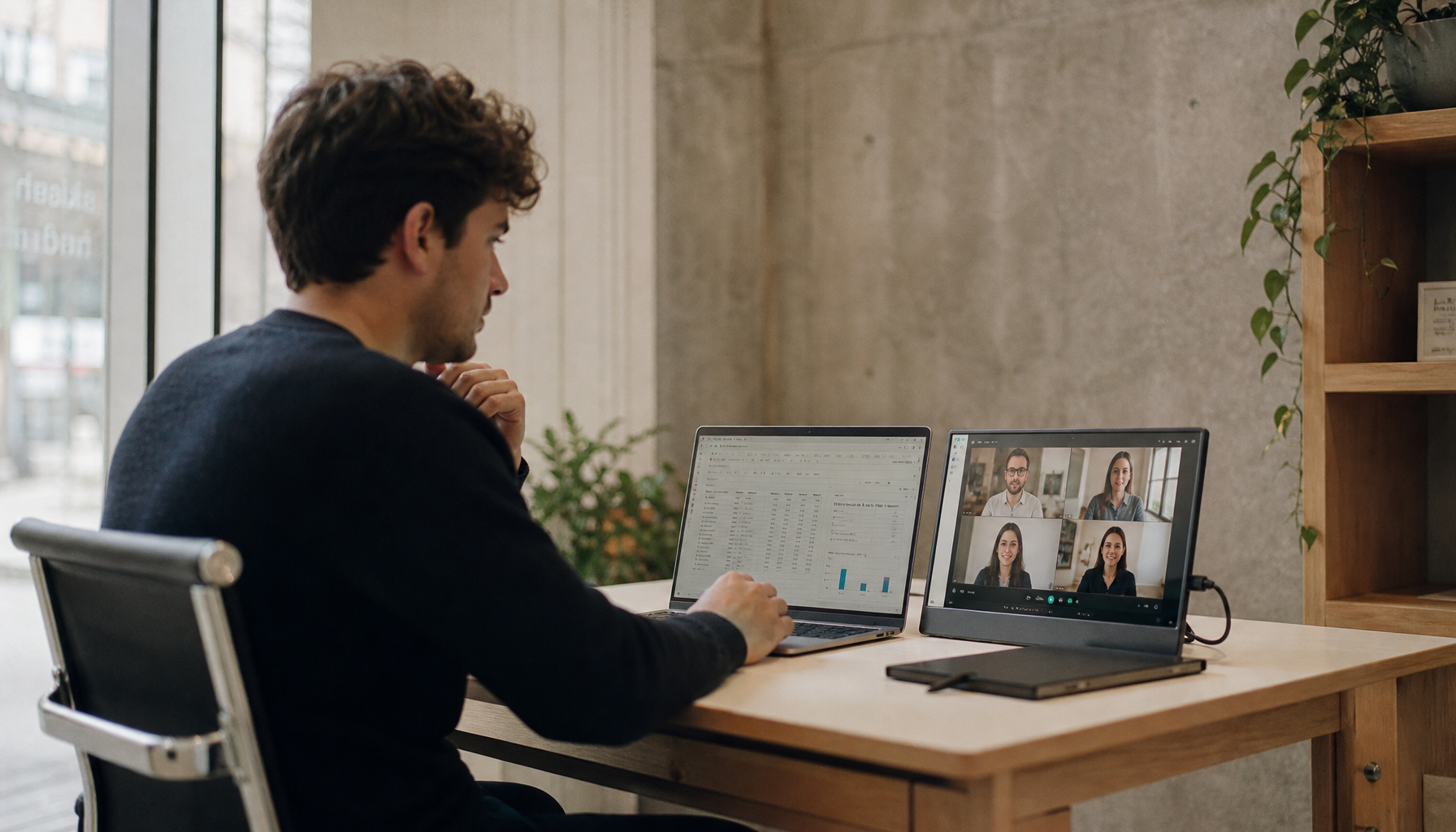
A corner desk adds surface area, but it breaks the simple straight-line geometry that makes dual and triple monitors easy to align. The result is more angle tuning, more reach management, and more chances for neck, eye, and cable clutter problems.
The Corner Changes Your True Center
On a standard rectangular desk, your main monitor usually sits directly behind the keyboard. On a corner desk, the “center” may be the desk corner, the keyboard tray, the chair position, or the deeper wing of the surface.
That matters because ergonomic viewing starts with the primary display in your natural line of sight. A screen should generally sit about an arm’s length from your face, with the top at or slightly below eye level.
If your chair faces the corner seam but your main monitor is offset to one side, your neck becomes the adjustment mechanism. That may work for quick glances, but not for six hours of spreadsheets, editing, coding, trading dashboards, or competitive gaming.

Side Monitors Need Different Angles
Multi-monitor setups work best when the main screen gets priority and side displays curve inward toward you. A corner desk complicates that because each wing may have a different depth, wall clearance, or usable mounting zone.
For a productivity-first layout, keep the primary monitor centered with your keyboard and place secondary screens at a shallow inward angle. For gaming or immersive simulation, you can use a wider wraparound angle, but only if your chair, keyboard, and mouse still stay aligned with the center screen.

As a quick positioning check, the primary display should sit directly in front of your torso, while secondary displays should angle inward instead of sitting flat against the wall. Keep the top edges aligned across screens, maintain similar viewing distances so text size feels consistent, and make sure your mouse movement matches the on-screen display order.
You should also drag display icons into the same physical order in your system’s display settings, then test by moving the cursor across screens.
Desk Depth Can Fight Screen Distance
Corner desks often feel spacious because the back corner is deep. But that depth is not always usable. A monitor pushed too far into the corner may become harder to read, while a monitor pulled forward can eat into keyboard, mouse, speaker, and notebook space.
This is where monitor arms earn their keep. They let you pull the main screen forward, raise it to eye level, and float side displays over the desk surface instead of letting stand bases dominate the work zone.

The ergonomic goal is not more screens; it is less friction. Your shoulders should stay relaxed, your wrists neutral, and your mouse close to the keyboard. Workstation guidance commonly emphasizes avoiding unnecessary reaching and twisting because thoughtful equipment placement reduces physical strain over long sessions.
Cable Paths Get Messier Fast
A corner desk creates longer cable runs because monitors may sit on separate wings while the computer, dock, power strip, and accessories live in different zones. Add a laptop, console, capture card, light bar, webcam, or USB hub, and the back corner becomes the hardest area to service.
Plan the signal path before mounting anything. Video, data, power, and dock cables all need enough slack for arm movement, but not so much slack that they sag behind the desk.
For a cleaner setup, route power down one side and data cables down the other. Use sleeves or clips under the rear edge, then leave a service loop behind each display so you can rotate or raise it without unplugging everything.

The Best Fix Is a Primary-Screen Layout
Treat the corner desk as a cockpit, not a shelf. First, decide where your body faces. Then build the monitor array around that position.
For most users, the strongest layout is simple: main monitor centered in the corner or slightly forward from it, secondary monitor on the dominant task side, and an optional third screen vertical for chat, documents, code, or reference. Keep movement breaks in the routine too; even strong ergonomics benefit from regular standing, walking, and stretching.
A corner desk can support a high-performance multi-monitor setup. It just demands more precision: center your body first, place the main display second, and let every extra screen serve the workflow instead of stealing posture from it.