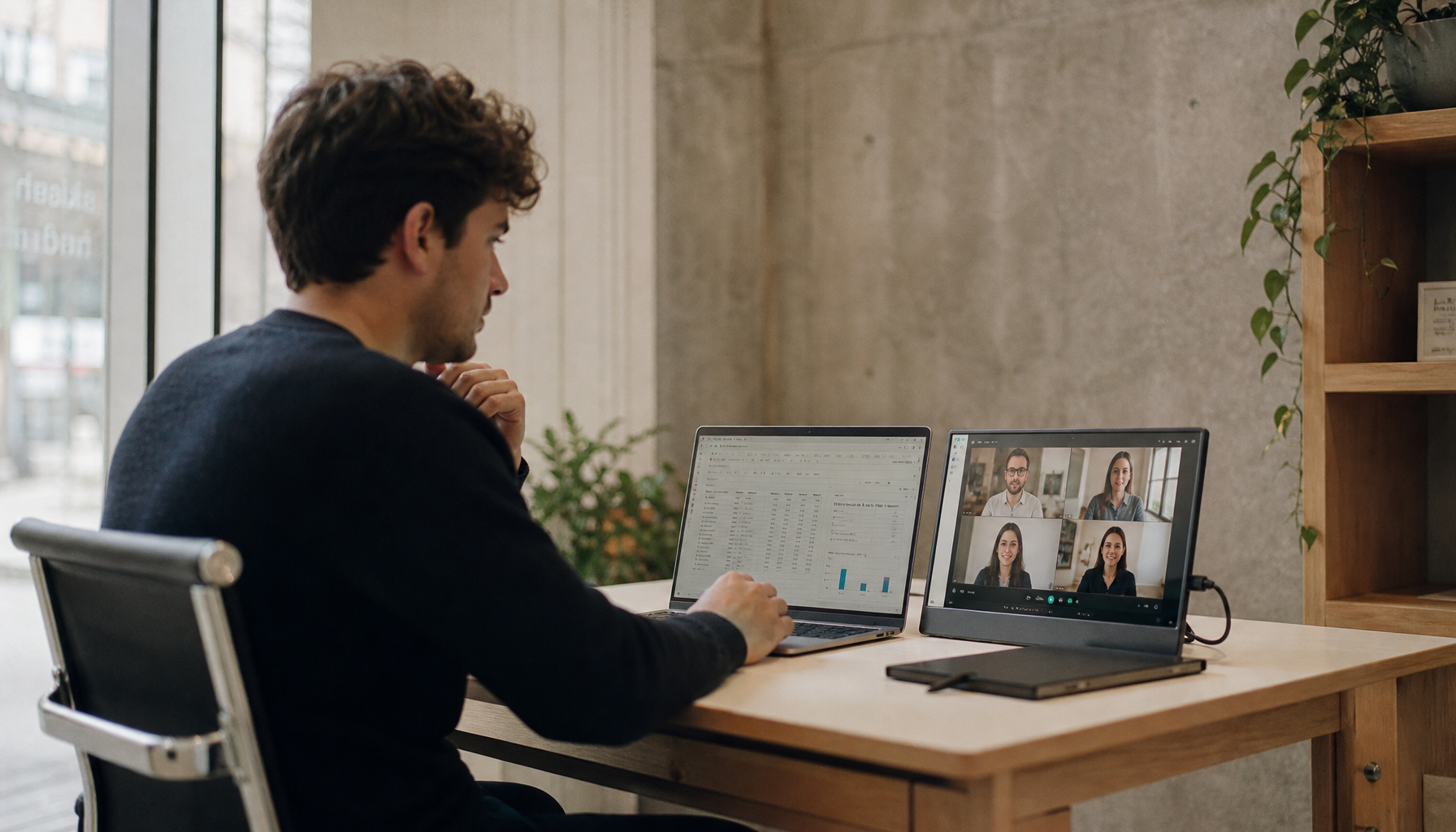
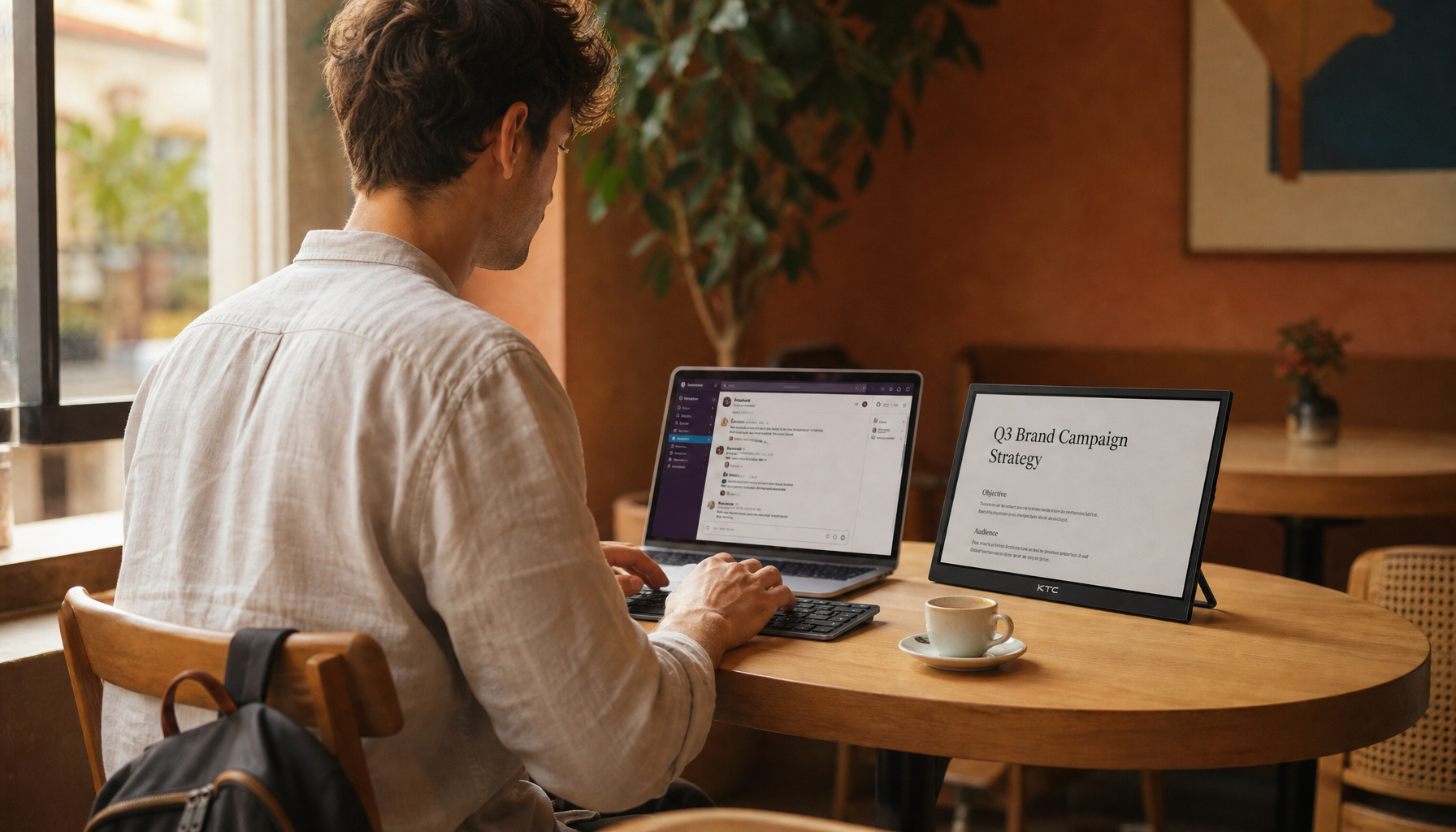
Height gets your monitor into the right range, but tilt determines whether your eyes meet the screen without your neck compensating. For most desk setups, a slight backward tilt matters more than chasing a perfect eye-level number.
If your neck feels tight after a full workday or a late-night gaming session, the problem may be the screen angle, not just the stand height. Most ergonomic guidance lands in the same zone: keep the display at least 20 inches away, place the top at or slightly below eye level, and tilt the panel back about 10° to 20°. The goal is simple: a monitor setup that lets you see the whole screen without lifting your chin, leaning forward, or twisting your shoulders.

Height Gets You Close, Tilt Finishes the Job
A monitor can be the right height and still create bad posture
In practice, a workplace safety agency’s monitor guidance treats height, viewing angle, distance, and clarity as one system. The top of the screen should sit at or slightly below eye level, the center should usually land about 15° to 20° below horizontal eye level, and the screen itself should usually tilt no more than 10° to 20° so it stays perpendicular to your line of sight.
That last point is why height alone is incomplete. You can set a gaming monitor or office display at the “correct” top-edge height, but if the panel stays too upright, your eyes hit the screen at an awkward angle. Then your body starts making small corrections: chin up, head forward, shoulders rounded, or torso slightly slumped to improve readability.
Neutral neck posture depends on the full viewing geometry
A second layer of guidance from a university’s workstation posture recommendations makes the same point from the user side: keep the monitor directly in front of you, keep the neck neutral, place the top of the screen about 2 to 3 inches below eye level, and keep the display about 20 to 30 inches away. Those numbers work because they reduce the need to bend the neck up, down, or sideways.
Research also points away from simple “eye level fixes.” In an ergonomics study indexed on a research database, muscle activity was generally greater at a low viewing angle, and users preferred a midlevel monitor placement. That is a useful reminder for display buyers: posture is driven by the full line of sight to the screen, not by stand height in isolation.
Why Tilt Changes Posture So Quickly
Tilt changes both what you see and how you hold your head
A practical ergonomic rule is that natural gaze tends to fall about 15° to 30° downward, while the monitor itself usually works best with a slight 10° to 20° backward tilt. That combination helps the screen meet your gaze instead of forcing your gaze to chase the screen.
When the panel angle is wrong, the posture change happens fast. A too-flat or too-vertical screen can create reflections, weaker contrast, or a sense that part of the image is easier to read than the rest. People respond by leaning in for the lower half of the screen, lifting the chin for the upper half, or turning the head slightly off-center if the display is not aligned with the body.
Neck load changes with viewing angle, not just with screen height
A small but useful study on viewing angle and neck load indexed on a research database found significantly different loading moments at the neck when users worked at 20° below horizontal versus 3° above horizontal. Even if you do not apply that result as a universal target, it reinforces the larger ergonomic lesson: the angle of gaze materially changes neck demand.
Clinical posture advice lands in the same place. The screen should typically be visible without moving the head up, down, or side to side, and the panel should tilt slightly backward by about 10° to 20°. For a large ultrawide or high-refresh-rate gaming display, that often matters more than a tiny riser adjustment because the larger visual field makes bad screen geometry harder to ignore.
Tilt, Height, and Distance Should Be Set Together
Use a starting position, then tune from there
For most desks, guidance from a workplace safety agency puts 20 to 40 inches in the safe starting zone. Smaller desktop monitors usually feel best in the lower half of that range, while larger ultrawide monitors often need the far end so the full screen stays visible without head movement and within a comfortable downward viewing angle.
One setup guide for monitor arms and desktop displays, a brand’s neck-pain article, gives a useful real-world example: if your seated eye height is 48 inches from the floor and the top of the monitor is 50 inches, the screen is still too high. The same source suggests about 20 to 28 inches for a 24-inch monitor and 24 to 32 inches for a 27-inch monitor, which lines up well with how many gaming and productivity setups behave in practice.
Quick comparison by monitor type
Monitor setup |
Top of screen |
Tilt back |
Starting distance |
Main posture risk if wrong |
24-inch gaming or office monitor |
At or slightly below eye level |
10° to 15° |
20 to 28 in |
Leaning in when text or HUD looks small |
27-inch high-refresh-rate monitor |
At or slightly below eye level |
10° to 20° |
24 to 32 in |
Head-forward posture during long sessions |
34-inch+ ultrawide monitor |
Near eye level at the top edge |
10° to 20° |
28 to 36 in |
Neck turning and excessive downward viewing angle |
15- to 18-inch portable monitor |
Slightly below eye level once raised |
10° to 20° |
20 to 24 in minimum |
Looking down for long periods |
Dual monitors |
Primary centered; both similar height |
Slight inward angle |
24 to 32 in |
Repeated head rotation |
A good setup should also keep the rest of the workstation from undoing your monitor adjustments. The university guidance on supported posture recommends feet supported, back in contact with the chair, and elbows opened to about 100° to 110°. If your chair is too low or your keyboard is too high, you may blame the monitor when the real issue is that your whole posture chain is off.
Different Monitor Types Need Different Tilt Priorities
Gaming monitors and high-refresh-rate displays
With desktop monitor arm guidance, the biggest trap on a 144 Hz or 240 Hz gaming monitor is not the refresh rate itself. It is the tendency to pull the screen too close or to let a drifting arm slowly change height and tilt over time. That creates the “clean desk, bad posture” problem where the screen looks centered but your body keeps making micro-corrections.
For gaming use, start with the top edge at or slightly below eye level, keep the screen directly in front of you, and only then fine-tune the backward tilt. If your chin lifts during map checks or HUD scanning, lower the display slightly or increase the backward tilt a touch. If you lean in during recoil control or target tracking, increase UI scaling or move the monitor back before you accept the posture.
Ultrawide and dual-monitor setups
For larger panels, a workplace safety agency notes that very large monitors can increase the total downward viewing angle, and the screen should still remain directly in front of you with no more than 35° of left or right offset. That matters with ultrawide monitors because their width makes it easy to turn the head instead of moving the eyes.
Dual-screen guidance recommends keeping the screens close together, angling them slightly inward, and centering the main work area based on how you actually use them. If both displays are used equally, center the gap between them. If one is primary, center that screen and let the secondary sit off to the side with only a slight angle.

Portable monitors need the most help
Portable displays are often the worst ergonomic setup by default because they sit low and flat. A general screen-angle warning is that screens below eye level can force prolonged downward viewing, which strains the back of the neck and can contribute to stiffness, headaches, and reduced neck mobility.

For portable monitors, the fix is usually not “use less tilt.” It is “raise the screen first, then tilt it.” If you use a portable display for travel or a second screen, put it on a stand, stack it closer to eye level, or use it for reference material rather than your main window. A low secondary screen is less damaging than making it your primary focus for hours.
A Five-Minute Setup Routine That Usually Works
Start with stability, not perfection
A practical lesson in monitor arm setup is that a monitor arm only helps if it holds position without wobble or drift. If the screen slowly drops, rotates, or rocks when you type, you keep correcting with your neck and eyes. Stability is an ergonomic feature, not just a desk-aesthetics feature.
Quick action checklist
- Sit back in the chair first, with feet flat and shoulders relaxed.
- Center the monitor directly in front of you; do not let it sit more than about 35° off to one side.
- Set the top of the screen at or slightly below eye level.
- Move the display to about 20 to 30 inches away for most setups, or farther for larger ultrawide panels.
- Tilt the panel back about 10° to 20° until the screen feels easy to read without chin lift or forward head posture.
- Test with 10 to 15 minutes of normal work or one full game; if you still lean in, increase text or UI size before moving the monitor closer.
A healthy monitor position also depends on basic workstation posture: supported back, neutral neck, and elbows at a slightly open angle. If discomfort shows up after 30 to 60 minutes, take a break and reassess whether the screen is too close, too low, or simply too upright for your natural gaze.
FAQ
Q: Can a monitor at eye level still cause neck pain?
A: Yes. A monitor can be at the “right” height but still be too vertical, too close, too far away, or slightly off-center. That combination often causes chin lift, forward head posture, or neck rotation even when the top edge looks correct.
Q: Does an ultrawide need more tilt than a standard monitor?
A: Usually it needs more careful distance and centering, not a dramatic tilt change. Start with the same modest 10° to 20° backward tilt, then move the screen farther back so the full panel stays visible without head movement.
Q: Are portable monitors bad for posture?
A: Not inherently, but their default position usually is. A portable monitor used flat on a desk almost always forces you to look down, so it should be raised and tilted or used as a secondary display.
Final Takeaway
Height is the rough adjustment; tilt is the finishing adjustment that often decides whether your neck stays neutral. If you are choosing between two monitors or monitor stands, prioritize enough tilt range, stable positioning, and enough desk depth to keep the screen in the 20- to 40-inch zone. That matters for standard office displays, high-refresh-rate gaming monitors, ultrawides, and portable monitors alike.