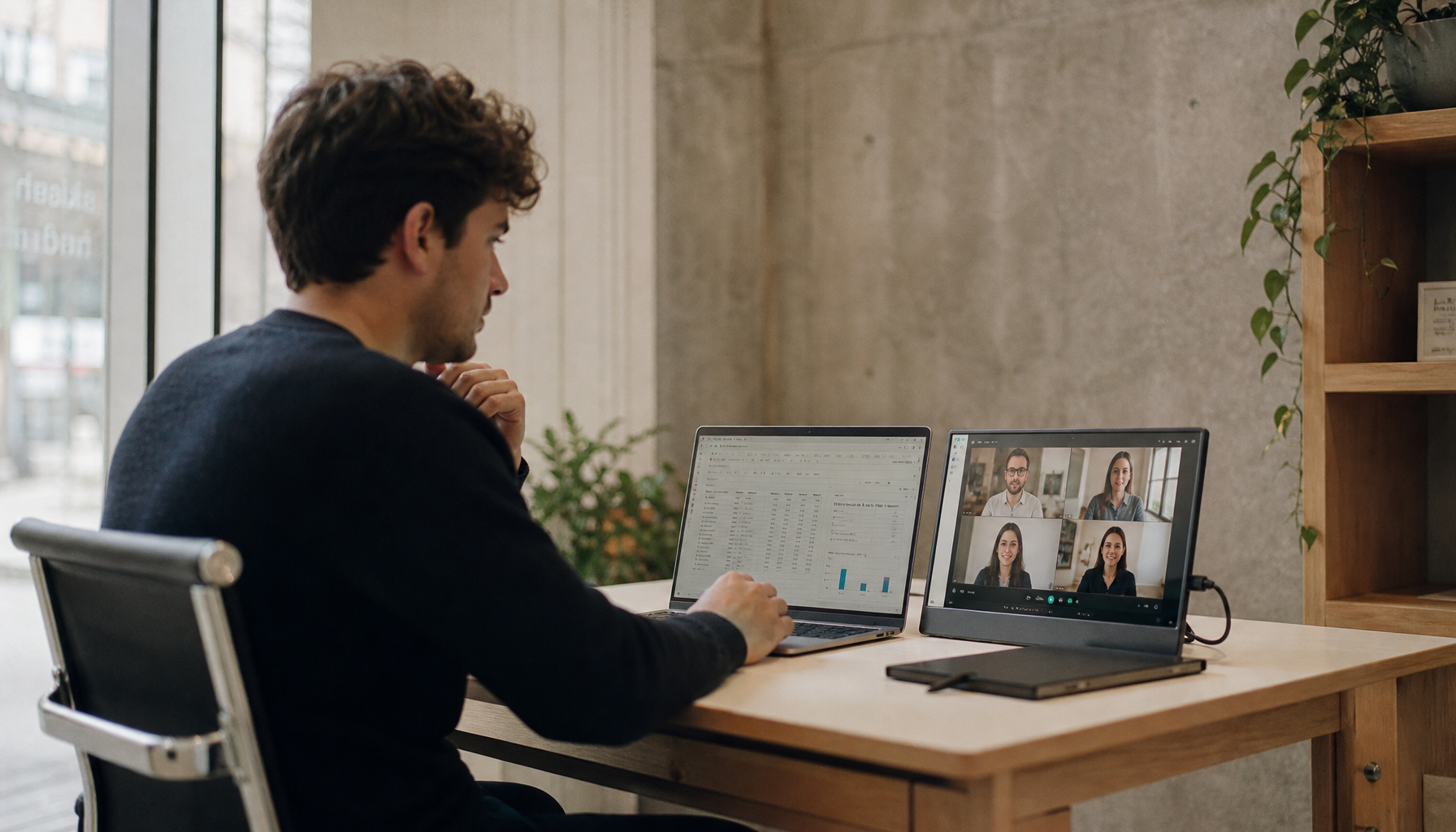
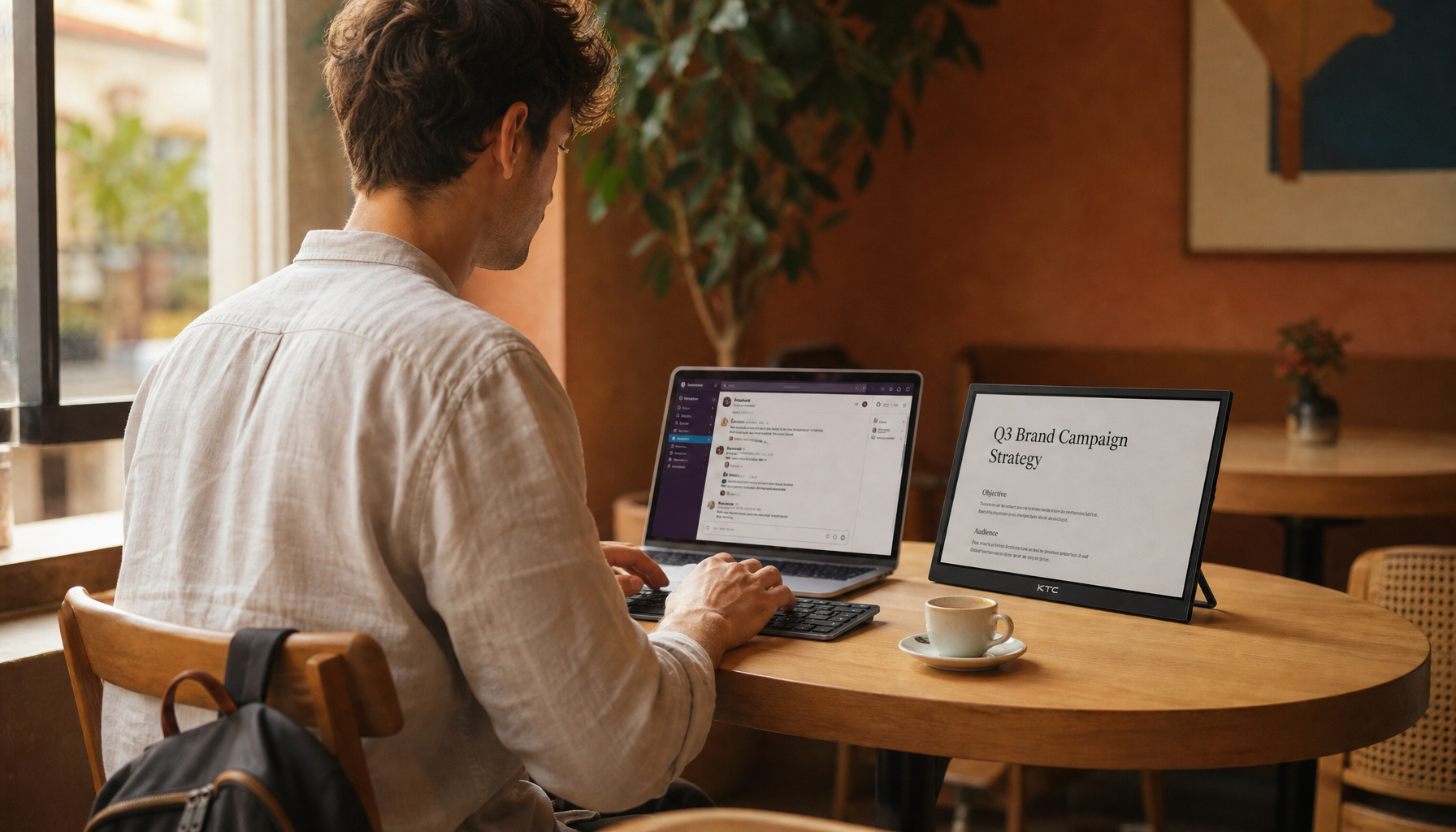
Local LLM monitoring works best when it has its own screen, especially if your main coding monitor is already handling terminals, notebooks, and model edits. A dedicated mobile AI dashboard display keeps throughput, thermals, and agent state visible without constant window switching, and that usually makes long runs easier to supervise.
Why a Dedicated Observability Screen Matters
For most researchers, the main benefit is focus. If your coding screen is also your dashboard, every alert, chart, or log line interrupts the work you were trying to do. A separate observability screen reduces that friction and makes it easier to glance at the system without losing your place.
A rolling or portable display matters most when the monitor needs to move with the session, whether that means a desk, a bench, or a nearby seating area. The Mobile Touch Screen collection is a useful browsing path if you want to compare that category against fixed displays. If your setup never leaves one spot, a standard monitor may be simpler.
One practical rule helps here: if you keep checking runtime status while coding, a dedicated screen is usually worth it; if monitoring happens only once in a while, a second desk-side window may be enough. That distinction is more important than chasing a specific size.
For readers who want a broader workstation context, the hybrid desk setup guide is a reasonable follow-up on multi-device layouts. It is not about local LLM observability specifically, but it helps with the room-planning side of a shared work area.

What to Monitor on the Live Dashboard
A useful local LLM dashboard should privilege the signals that change fastest. Tokens per second, queue depth, and response latency belong near the top because they tell you whether the system is actually keeping up or quietly slowing down. In plain terms, latency is the delay between asking for output and seeing it start; if it drifts upward, you notice the slowdown before the run feels broken.

GPU temperature and utilization should stay visible, but they do not need to dominate the screen. The point is not to stare at every number, it is to catch drift early enough to avoid surprise throttling or an overloaded card. For most stacks, that is a management signal rather than a reason to overengineer a dense control panel.
Agent state and task progress deserve their own space because human-in-the-loop monitoring is different from passive status watching. If the system is making tool calls, switching phases, or waiting on approval, the dashboard should show that clearly. Otherwise the session can look idle when it is actually doing work.
Alerts should stay sparing. Too many banners and pop-ups turn a dashboard into clutter, and clutter defeats the whole point of a separate observability screen. A simple rule is safer: show only the alerts you would genuinely act on during a long run.
The article Local LLM development workstations and 5K resolution is a good companion if you are deciding how much text density your dashboard needs. For many setups, higher resolution helps readability, but the real decision is whether your dashboard must show multiple small panels at once.
Throughput and Latency
Throughput tells you how much work the model is doing over time, while latency tells you how quickly each response starts arriving. Those two together tell a more useful story than either one alone. If throughput is acceptable but latency feels sluggish, the system may still be fine for batch work but annoying for interactive use.
For a local LLM command center, this is the first section worth making glanceable. It helps you decide whether the session is still healthy, whether a queue is building, or whether a slow prompt is just a heavy prompt.
GPU Temperature and Utilization
Thermals matter because they reveal whether the machine is staying in a stable operating zone. Utilization shows load, but temperature shows whether that load is sustainable. If temperatures rise while throughput falls, the dashboard is doing its job by warning you before the run becomes unreliable.
Do not turn this into a live engineering console unless you really need one. For most home labs, a small set of temperature and fan indicators is enough to tell you whether to keep going or pause and check airflow.
Agent State and Task Progress
Agent state is the easiest thing to overlook and one of the most useful things to show. A run can look stalled when it is actually waiting for confirmation, calling a tool, or moving to the next step. Clear task labels reduce false alarms and make the station more useful for hands-on monitoring.
This matters most if you are supervising multiple agents or long workflows. If your setup is just a single prompt loop, the dashboard can stay simpler.
Alerts and Session Notes
Keep alerts compact and add short session notes when a run is expected to be unusual. A note like “bigger context window” or “watch for long tool chain” is often more helpful than another chart. That keeps the dashboard readable and helps you remember why a session behaves differently from the last one.
If alerts are too frequent, they stop helping. A cleaner dashboard is usually the better choice for local LLM monitoring than a louder one.
Display Choices for Mobile Lab Stations
The right screen depends on whether the station is truly mobile or mostly parked beside the main desk. The table below clarifies the trade-off: a mobile touch display wins on movement and quick repositioning, a fixed 27-inch 4K monitor is usually better for dense text, and a 5K professional monitor is the sharper but less flexible option when the station stays put.
| Display Class | Mobility | Text Density | Setup Convenience | Observability Fit |
|---|---|---|---|---|
| Mobile touch display | High | Low | High | Medium |
| Fixed 27-inch 4K monitor | Low | High | Medium | High |
| 5K professional monitor | Low | High | Low | High |
A mobile touch display is the strongest fit when the observability station truly needs to roll between locations. If you mostly want to move a dashboard a few feet, it is convenient; if you need constant height changes and a large amount of static text, the extra mobility may not matter as much.
A fixed 27-inch 4K monitor is usually the simpler choice when the station stays near the same desk. It gives you more room for terminals, charts, and logs without making the setup feel temporary. For many lab desks, that is the most balanced option.
A 5K monitor is the better fit when text sharpness matters more than movement. It makes sense for dense dashboards, but it is not the natural choice if you expect to push the screen from room to room.
A useful decision sentence is this: if the monitor must move often, choose mobility first and resolution second; if it stays parked, choose text density first and movement second. That keeps the purchase grounded in how you actually work.
Build the Rolling Station Step by Step
-
Choose the location first. The display, power path, and cable runs should all fit the same physical route, not force you into improvising later.
-
Confirm the base or stand is stable before you add a load of cables or accessories. For a rolling station, stability matters more than convenience because movement can reveal weak points that were invisible on a desk.
-
Route power and data separately when possible. That reduces the chance that a single tug shifts both connections at once, and it keeps the cable bundle easier to inspect.
-
Open the dashboard layout before the session starts, then save it. If you always begin with the same panels in the same places, the station becomes useful faster and is less annoying to restore after a reboot.
-
Test the roll path before leaving the system unattended. Make sure the monitor clears corners, that the cable slack is enough, and that the path has no obvious trip hazard.
-
Do a short dry run before the long session. It is better to find a cable snag during setup than halfway through a model run.
This is also where a touch-enabled display can help. If you want a category view instead of a fixed model, the Mobile Touch Screen collection is the right place to compare portable options against standard monitors.
The general safety rule is simple: a rolling observability station should feel boring in motion. If it wobbles, pulls on cables, or needs constant readjustment, it is not ready for unattended use.
Setup Checks Before the First Long Run
Before the first long session, verify that the display stays stable when it is moved and that the stand does not drift when you stop it in place. That sounds basic, but it is the first thing that breaks confidence in a mobile station.
Check the viewing distance with the actual dashboard you plan to use. If the browser tabs, charts, or terminal text feel cramped, the problem is not the software, it is the viewing geometry. A fixed 27-inch monitor often feels easier here, while a mobile touch screen may be preferable if you value placement flexibility more than density.
Test the whole setup under a sustained run, not just an idle desktop. Watch whether temperatures stay reasonable, whether fan noise becomes distracting, and whether the cable path still behaves after a few minutes of movement.
Make sure you can pause, acknowledge, or dismiss an alert quickly. If the station is meant to supervise live inference, the response path should be obvious even when you are not sitting right at the main desk.
A direct rule of thumb helps: if the screen is hard to read, hard to reach, or hard to move safely, it is not ready for a long run. That is the point at which setup friction becomes operational friction.
The KTC MEGAPAD 25-inch portable touch monitor is a reasonable place to start if you want a compact smart touch option with battery support and Google EDLA. The product page lists Android 14, a built-in camera, and touch input, but for observability use the key question is still whether 25 inches and 1080p are enough for your dashboard density.
For a larger mobile option, the KTC MEGAPAD 32-inch 4K smart touch monitor gives you more screen space and a 4K panel, which helps when you want more panels visible at once. Its built-in battery and adjustable stand make it more natural for room-to-room use than a fixed desktop screen.
Which Setup Breaks Down First?
The mobile setup breaks down first when you stop moving it. If the screen is going to live beside the desk most of the time, mobility stops earning its keep and the extra convenience can become unnecessary complexity.
The fixed setup breaks down first when you need to relocate the dashboard often. That is when app switching, cable rerouting, and desk clutter become the real cost of staying stationary.
The 5K-style setup breaks down first when you need flexibility more than density. It can be the sharpest choice on paper, but it is not the most practical choice if the station is part of a moving lab workflow.
A clean filter is useful here: choose mobile when movement is the point, choose fixed 4K when the desk is stable, and choose 5K when text density is the main constraint. Anything else is usually a compromise.
FAQs
Q1. How Do You Choose the Right Screen Size for Local LLM Monitoring?
Start with the viewing distance and how many panels you want to see at once. A smaller mobile display can work if the dashboard is simple and the station moves often. A 27-inch or larger screen is easier when you want terminals, charts, and logs visible together without constant zooming.
Q2. What Metrics Matter Most on an AI Observability Dashboard?
Put throughput, latency, GPU temperature, and agent state first. Those tell you whether the run is healthy, slowing down, overheating, or waiting on a step. Memory pressure and logs can be useful too, but they are usually secondary unless your stack is close to its limits.
Q3. Why Use a Rolling Display Instead of a Fixed Monitor?
Use a rolling display when the dashboard has to move between a desk, a bench, or a different room. That is the main advantage. If the screen stays in one place, a fixed monitor is usually simpler, cheaper to live with, and less likely to need extra cable management.
Q4. Can a Touch Display Help With Human-In-The-Loop Monitoring?
Yes, but it is optional rather than mandatory. Touch helps when you want to acknowledge alerts, switch views, or inspect a panel quickly without reaching for another input device. If your workflow is mostly keyboard-driven, touch is a convenience, not a requirement.
Q5. How Do You Keep a Mobile Monitoring Station Safe in a Home Lab?
Keep the base stable, leave enough cable slack, separate power and data where you can, and test the full motion path before a long run. A safe mobile station is one that does not wobble, tug, or create trip hazards. If those issues show up, fix them before trusting the setup.
A Practical Closing Rule for 2026 Labs
Choose the display that matches session movement, required dashboard density, and response speed when conditions change. Test stability and cable paths under load first; a setup that feels boring in motion stays useful longer than one optimized only for size or resolution.