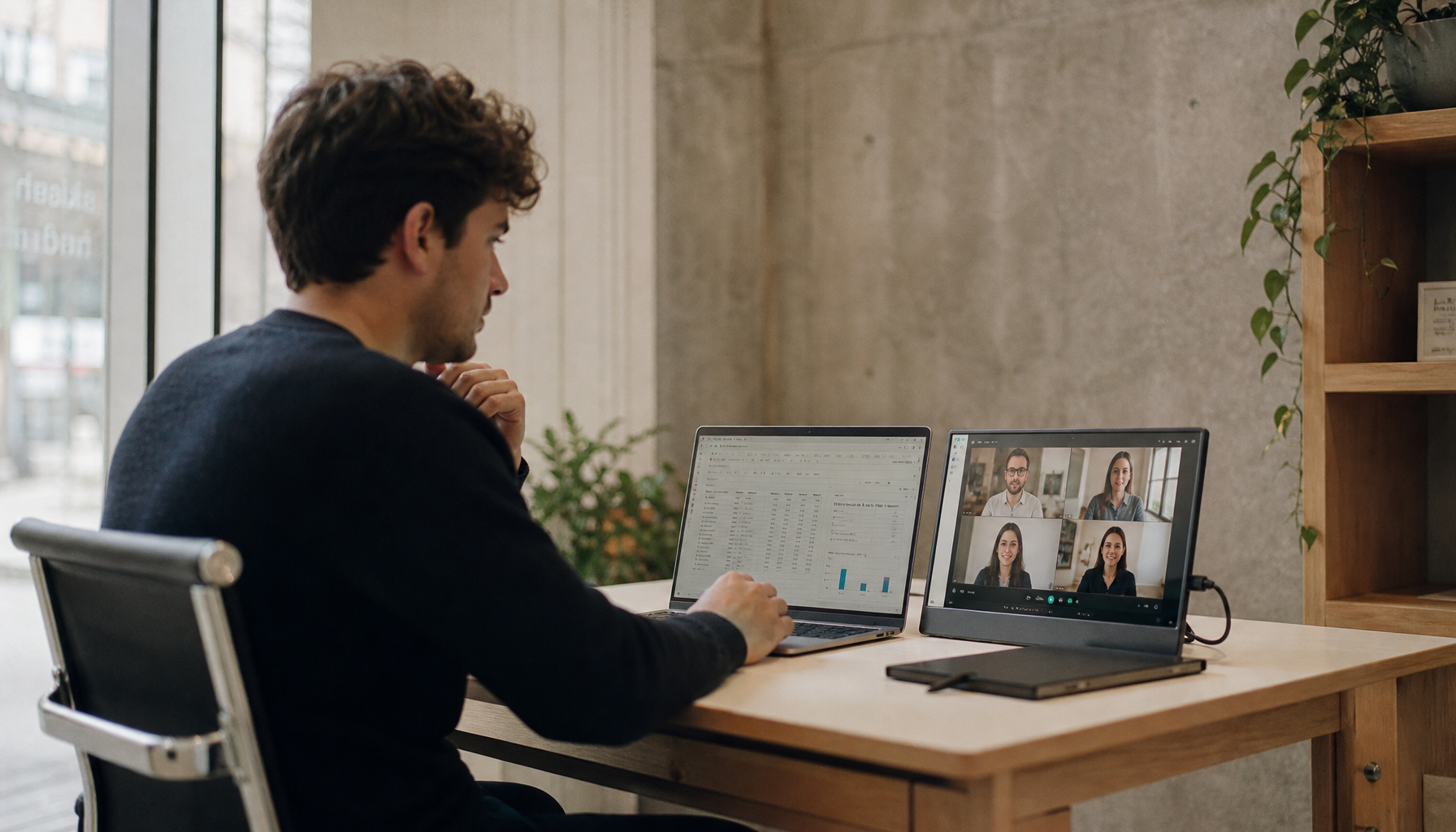
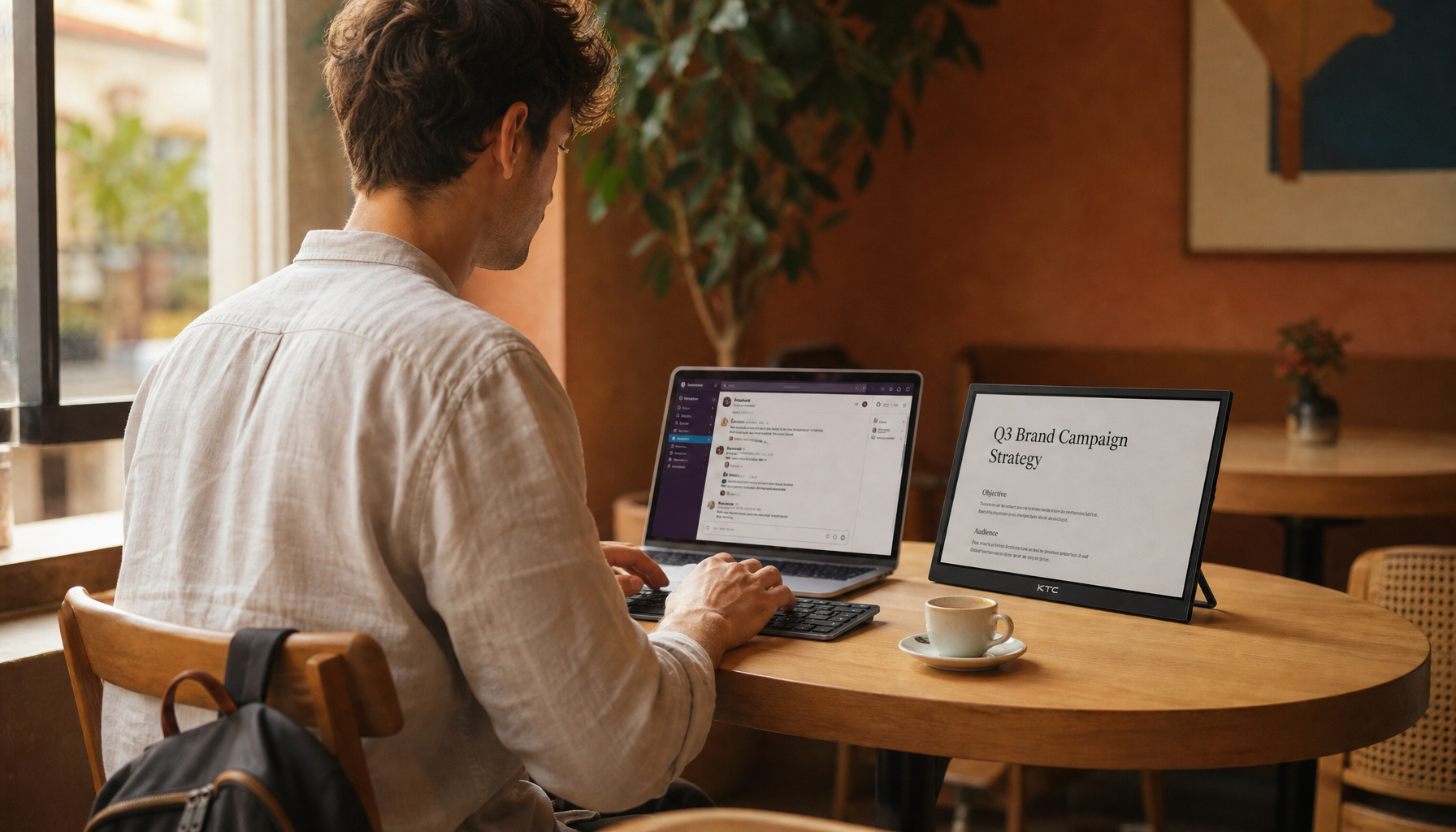
Body doubling can work as a more stable focus cue when the virtual companion and task view stay visible in one place. A rolling display does not treat ADHD, but it can reduce the hassle of rebuilding the same setup every time you change rooms, which is often the part that breaks follow-through.
Why Body Doubling Translates Well to a Rolling Screen
Body doubling is usually described as working alongside another person to make it easier to start and finish tasks. In digital form, that shared presence may be a video call or a task board, not a person sitting beside you. Background overviews from Cleveland Clinic and ADDA point to the same basic idea: visibility and accountability matter more than physical proximity.
That is why a rolling display can make sense. If the screen carries the call, checklist, or timer from a bedroom to a kitchen table to a coworking lounge, you spend less energy reconstructing the setup. For people whose attention drops when the environment changes, that consistency can be more useful than adding another app or another notebook.
A practical way to think about it is this: if your main problem is starting work once the setup is already there, a mobile screen may help; if your real problem is choosing the task, a screen will not solve that. That boundary matters, because body doubling is an observational strategy, not a replacement for professional care.
The MegPad format fits that workflow better than a fixed monitor when you want the same visible anchor to move with you. It is still a screen, not a system, but the rolling format makes the “show up and begin” step a little less brittle.
What Makes a Rolling Focus Station Work
A good rolling focus station is simple enough that you can recreate it without a long reset ritual. The goal is not to turn your desk into a command center. It is to keep one stable place for the call, the checklist, and the next action so your brain has fewer points of friction.

Visible Task Plan and Call Window
For most people, the most useful layout is a split between the companion view and the task list. That means you can glance at the call or shared room while still seeing what comes next. The portable touch screen options are the easiest place to browse that category if you want a portable display path rather than a fixed office monitor.
The point is not extra screen time. It is reducing context switching. If the task list lives on the same screen as the body-doubling session, you are less likely to close one window and forget why you opened it.
One-Tap Access to Core Tools
The best setup is usually the one that opens fast: call app, timer, notes, and checklist. If you have to hunt for five tabs or reconnect three devices, the system becomes another obstacle. That is especially true on low-energy days, when even a small setup delay can feel enough to postpone starting.
This is where the 25-inch KTC MEGAPAD 25" FHD Google EDLA Portable Touch Monitor built in Camera is a sensible reference point. Its built-in camera, touch support, Android 14, Wi-Fi, and battery make it easier to keep a simple body-doubling layout without extra peripherals. The trade-off is that you should keep the workflow compact, because the smaller format is better at portability than at holding lots of windows.
Movement Without Rebuilding the Setup
Mobility matters when your day jumps between rooms. A setup that works at home but collapses in a cafe or shared living space is not really portable, it is just movable once. The Smart Touch Monitor Setup for Boardrooms and Agile Meetings is a useful related read if you want a broader view of how touch screens are positioned for flexible work, even though the use case is different.
The friction to watch for is repeated rebuild time. When the call window, charger, and task list each need a different adjustment every time you move, the habit gets harder to maintain. A rolling screen helps most when it preserves the same visual pattern across locations.
How to Set Up a Body Doubling Screen
- Put the display where you can see both the companion view and the task list without twisting your neck or constantly shifting the stand.
- Open only the essentials first, usually the call, timer, notes, and checklist.
- Save or memorize one repeatable startup routine so the setup feels the same at home, in a coworking space, or in a quiet corner.
- Keep charging and connectivity simple, because a screen that takes too long to wake up becomes one more reason to delay work.

For a 27-inch example, the KTC MEGAPAD 27" FHD Android 14 Google EDLA Smart Touch Monitor with 9500mAh Battery is the most literal fit for this kind of setup. It includes built-in wheels, a built-in 8MP camera, Android 14, touch, and a 9500mAh battery rated for up to 6 hours. That makes it a practical middle ground when you want one screen for calls and task tracking without giving up room-to-room mobility.
A useful rule of thumb is that the more you move during the day, the more you should value a setup that turns on and reconnects quickly. If a screen only works when you have time to rebuild everything from scratch, it will usually lose to a simpler habit.
Choosing the Right MegPad for Your Workflow
For virtual body doubling, the right size depends on whether you are optimizing for portability, visual space, or a longer stay in one spot. The smaller option is easier to carry and reset. The larger option is easier to live with if you keep the same task board, call window, and notes open for long stretches. The middle size is often the most balanced choice.
| Model | Best Fit | What It Gives You | When It Breaks Down |
|---|---|---|---|
| 25-inch A25Q5 | Light, portable body doubling sessions | Built-in camera, touch, Android 14, battery, and a compact footprint | Less room for split layouts and multi-window use |
| 27-inch A27Q7 | Balanced rolling focus station | Built-in wheels, 8MP camera, battery up to 6 hours, and a larger task view | Heavier than the 25-inch model, so it is less convenient if you move constantly |
| 32-inch A32Q7S | More persistent desk setup | 4K panel, touch, Android 14, adjustable height and rotation, built-in battery | Best when you stay put more often, because the device is heavier and less casual to move |
The 25-inch option from the Mobile Touch Screen collection makes the most sense when the room changes more often than the task does. It is a better fit for quick carry, video calls, and basic task tracking. The 27-inch model is the safest middle ground if you want more visual breathing room without turning the device into a semi-permanent installation.
The 32-inch KTC MEGAPAD 32" 4K Android 14 Google EDLA Smart Touch Monitor with 8550mAh Battery shifts the decision toward a more persistent workstation. It has a 31.5-inch 4K display, touch, Android 14, Wi-Fi 6, Bluetooth 5.2, and adjustable height, tilt, and rotation. That helps if you want a richer task board or a larger split view, but it is less attractive if your main need is lightweight movement.
If you are unsure, choose by the thing you hate most: if you hate rebuilding the setup, choose the 27-inch; if you hate carrying a larger screen, choose the 25-inch; if you hate cramped multitasking, choose the 32-inch. That is usually a better filter than chasing the biggest screen available.
Keep the Setup Sustainable Over a Full Workday
- Keep the layout stable so you do not spend energy re-learning the same screen arrangement in every location.
- Match battery habits to your day. If you move around a lot, do not assume a wall outlet will always be nearby.
- Reduce visual clutter so the display stays a task anchor instead of becoming another source of stimulation.
- Treat brightness, sound, and privacy as settings you adapt to the room, not fixed values you must preserve everywhere.
- Watch for avoidance. If you are spending more time perfecting the station than doing the work, the setup has become part of the delay.
- A rolling display should make work easier to begin, not more elaborate to maintain.
The The 2026 'Floating' Workstation: Using Rolling Displays for Dynamic Hot-Desking post is a useful follow-up if you want a broader version of the same mobility problem. For days when you bounce between rooms, the key is to keep the station reproducible, not impressive.
FAQs
Q1. How Can Body Doubling Work With a Screen Instead of a Person in the Room?
The screen can hold the video call, shared task board, or timer in one visible place so you always have a point of accountability. Academic work on digital extensions of body doubling shows that remote video presence or a shared digital workspace can replicate the core cue of another person being “there.” That is enough for many people to keep the session feeling real, even when the other person is remote.
Q2. What Should I Put on a Virtual Body Doubling Station?
Keep it minimal: one call window or co-working view, one task list, one timer, and one notes area. If you add too many tools, the setup can become noisy enough to compete with the work itself. Research into neurodivergent practices emphasizes that fewer visible elements reduce the chance the station itself becomes a new source of distraction.
Q3. Why Is a Rolling Display Better Than a Fixed Monitor for ADHD Workflows?
It helps most when you move between rooms during the day. A rolling display keeps the same visual anchor available without forcing you to rebuild the desk every time, which can reduce the friction that often breaks momentum. Virtual body doubling gained visibility as a flexible approach precisely because people needed setups that travel with changing locations.
Q4. Can I Use the MegPad for Both Calls and Task Tracking?
Yes, in a practical sense. The verified camera, touch, Android, and battery features support a combined call-and-task workflow. The stronger fit is the model that matches your movement pattern, because a good setup still needs to stay easy to launch.
Q5. What If a Body Doubling Setup Becomes Another Distraction?
Simplify it. Remove extra apps, hide unused windows, and keep the screen focused on the next task rather than on endless toggling. The goal is easier task entry, not more screen activity.
A Simpler Way to Keep Showing Up
A rolling screen works best when it removes setup friction instead of trying to do the work for you. If body doubling helps you start tasks but the old setup keeps breaking down when you move, the mobile format may be the cleaner option. Pick the smallest screen that still supports your real workflow, then keep the routine boring enough to repeat.