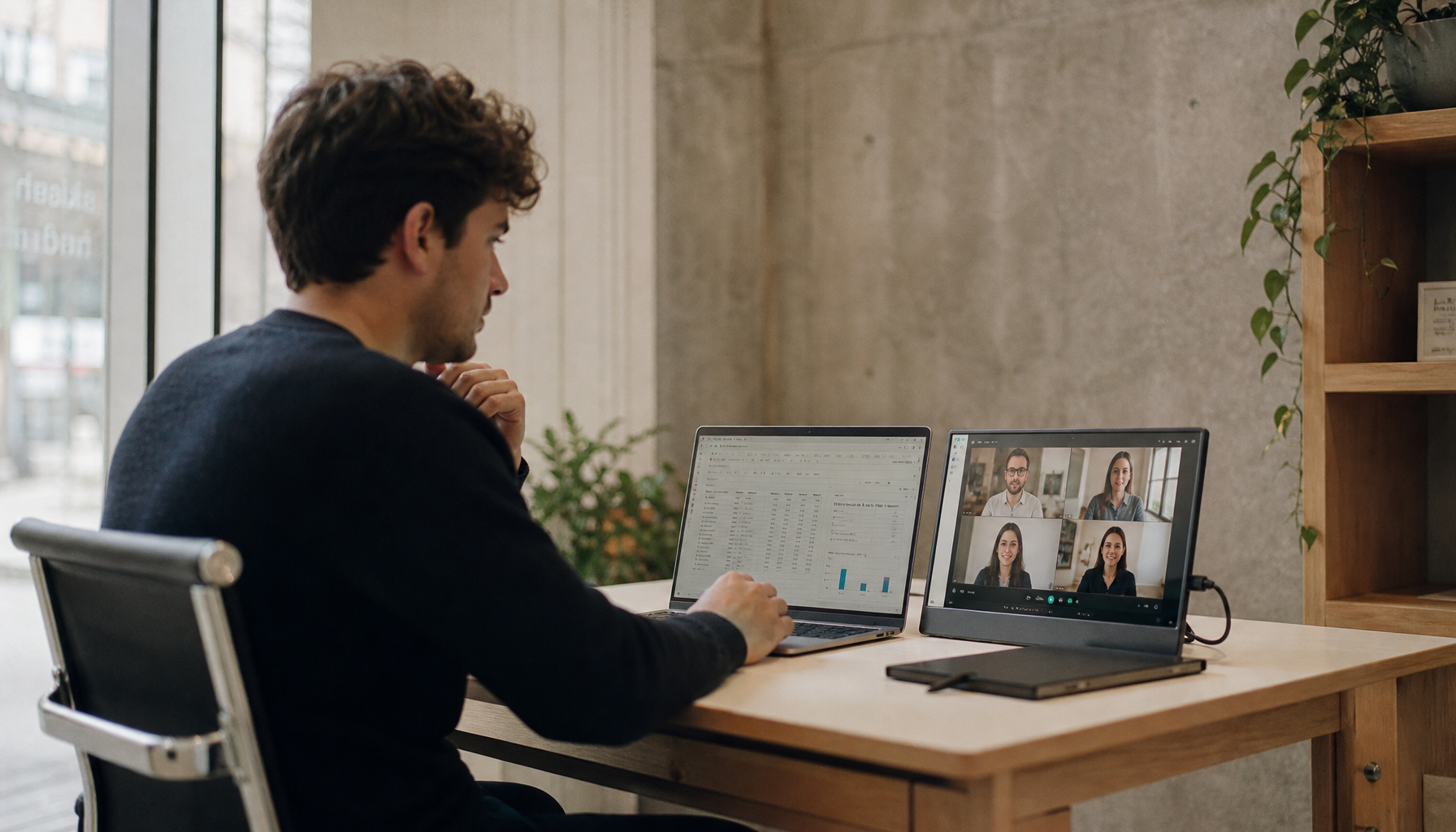
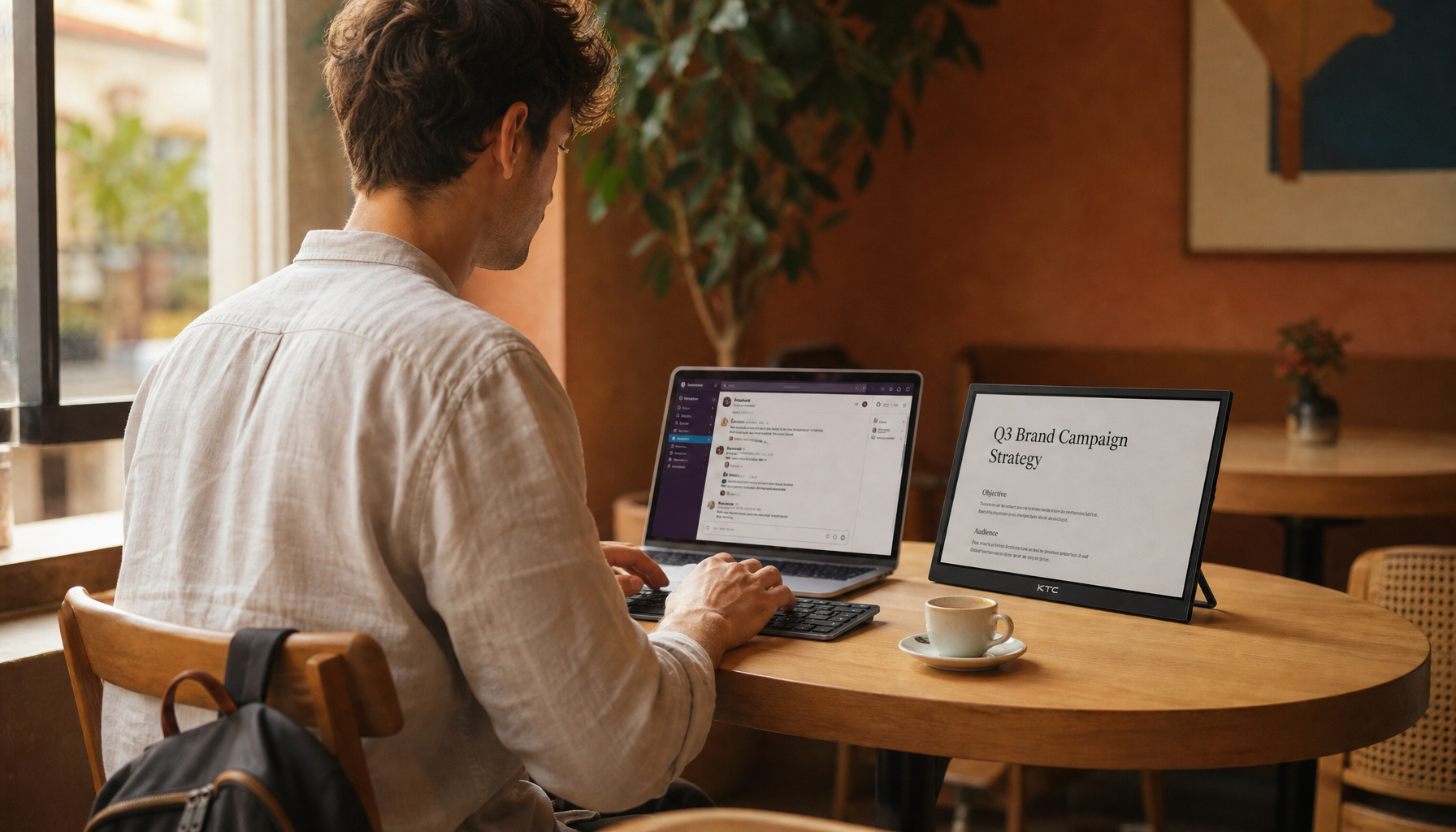
A KVM monitor with built-in switching lets you share one high-refresh display and the same keyboard and mouse between a MacBook and a gaming PC without swapping cables every time you change tasks. This setup works best for hybrid workers who finish the workday on macOS and then game on Windows, or for anyone who wants a cleaner desk while keeping full performance on both systems.

The Prosumer Setup: Why Share One Display Between Mac and PC?
Many users now split their day between macOS productivity and Windows gaming on the same desk. A single KVM monitor removes the need for duplicate peripherals and keeps the workspace minimal while preserving high refresh rates on both machines. Built-in KVM switching handles video and USB peripherals with one button press or OSD toggle, which is simpler than managing an external switch and extra cables.
The choice between a monitor with built-in KVM and an external switch often comes down to cable management versus flexibility. Built-in KVM reduces clutter but requires the monitor to support the exact ports and power delivery your devices need. External switches can sometimes offer faster input detection, yet they add another device and potential points of failure.
KVM Connectivity Map: How to Wire Your MacBook and Gaming PC
Connect the MacBook with a single high-quality USB-C cable that supports DisplayPort Alt Mode. This one cable carries video, up to 90 W charging, and data so the MacBook can stay closed in clamshell mode when an external power source is present. Apple Support confirms that closed-display mode works reliably when the notebook receives power through the cable.
The gaming PC needs two cables: a DisplayPort 1.4 or HDMI 2.1 cable for video plus a USB-B upstream cable plugged into the monitor. The USB-B link lets the monitor’s downstream USB-A ports share the keyboard, mouse, and other peripherals with the PC. As this DisplayPort over USB-C guide explains, USB-C Alt Mode is the technical foundation that makes the MacBook side so simple.
In the monitor OSD, set USB Selection to the specific host instead of Auto to reduce handshake lag during switches. Keyboard and mouse should plug directly into the monitor’s USB-A ports so they follow whichever computer is active.

Maximizing Performance: Resolution, Refresh Rates, and Cable Standards
High-refresh 4K performance remains possible on both systems when the right cables and OSD settings are used. M-series Macs support up to 4K at 240 Hz over compatible HDMI 2.1 or high-bandwidth USB-C connections, according to Apple Support documentation. This means the MacBook experience does not have to feel downgraded compared with the gaming PC.
The chart below helps visualize cable suitability for 4K high-refresh KVM use.
Cable Choice for 4K High-Refresh KVM Switching
A quick fit guide for MacBook and gaming PC users choosing a cable path for 4K 144Hz+ in a KVM setup.
View chart data
| Scenario | USB-C Thunderbolt 4 / USB4 | DP 1.4 with DSC | HDMI 2.1 |
|---|---|---|---|
| MacBook | 2.0 | 3.0 | 3.0 |
| Gaming PC | 1.0 | 3.0 | 3.0 |
Use a Thunderbolt 4 or USB4-rated cable for the MacBook to maintain 4K 144 Hz plus 90 W charging. On the PC side, confirm the monitor OSD is set to DisplayPort 1.4 rather than 1.2 compatibility mode so Display Stream Compression can enable higher refresh rates.
Reliability Checklist: Troubleshooting Common Switching and Wake Issues
Signal loss and wake failures are the most common complaints in cross-platform KVM setups. Changing Auto Source Detection to Off and selecting the input manually often stops the monitor from cycling through ports. On Windows, disabling USB selective suspend in Power Options keeps the USB-B data link active during idle periods.
Mac wake-from-sleep over USB-C can be inconsistent with Apple Silicon. Enabling “Prevent automatic sleeping when the display is off” in System Settings and using a certified high-bandwidth cable reduces the chance of a cold handshake. Some users also keep a short HDMI or DisplayPort cable on the PC as a backup video path when the Mac side needs a quick reset.
Local dimming and HDR settings may need manual toggling when moving between work and gaming. This small extra step is the trade-off for the contrast benefits Mini-LED panels provide during play.
Essential Hardware: Choosing a KTC Monitor with Built-in KVM
Several KTC models include the port layout and KVM logic needed for this workflow. The M27P6 pairs 4K 160 Hz Mini-LED with 90 W USB-C charging and full KVM switching, making it a strong choice when HDR contrast matters for both work and games. The H27P6 offers the same KVM features plus a dual-mode option that drops to 1080p 320 Hz for competitive play. Users who prefer a wider canvas can consider the H49S66 or the larger H32P22P.
Final Setup Checklist for a Seamless Dual-OS Workspace
Verify cable certifications first: Thunderbolt 4 or USB4 for the MacBook and DP 1.4 or HDMI 2.1 for the PC. Update the monitor firmware through the KTC support site before final assembly. Configure Windows USB power settings and macOS sleep options as noted earlier, then map a quick OSD shortcut for KVM switching. Test both systems with your daily apps and a high-polling mouse to confirm no lag appears after transitions.
Common Questions About KVM Monitor Setup
Does a KVM monitor reduce refresh rate on either system?
No, provided the correct certified cables and OSD settings are used. Both the MacBook and gaming PC can maintain their native high-refresh capabilities when the monitor supports the required bandwidth.
Can I keep the MacBook closed while using the monitor?
Yes. Mac notebooks support closed-display mode when connected to power through the USB-C cable, which the monitor’s Power Delivery supplies.
What happens if the keyboard or mouse stops responding after a switch?
Switch the monitor’s USB Selection from Auto to the specific host in the OSD. This prevents the hub from losing the active computer during rapid toggles.
Do I need special software for Mac and Windows switching?
No additional software is required. The monitor handles video and USB routing through its built-in KVM logic once the cables are connected correctly.
Will Mini-LED local dimming affect text clarity during work?
Local dimming can introduce blooming on desktop interfaces. Many users turn it off for productivity work and re-enable it only for HDR gaming content.