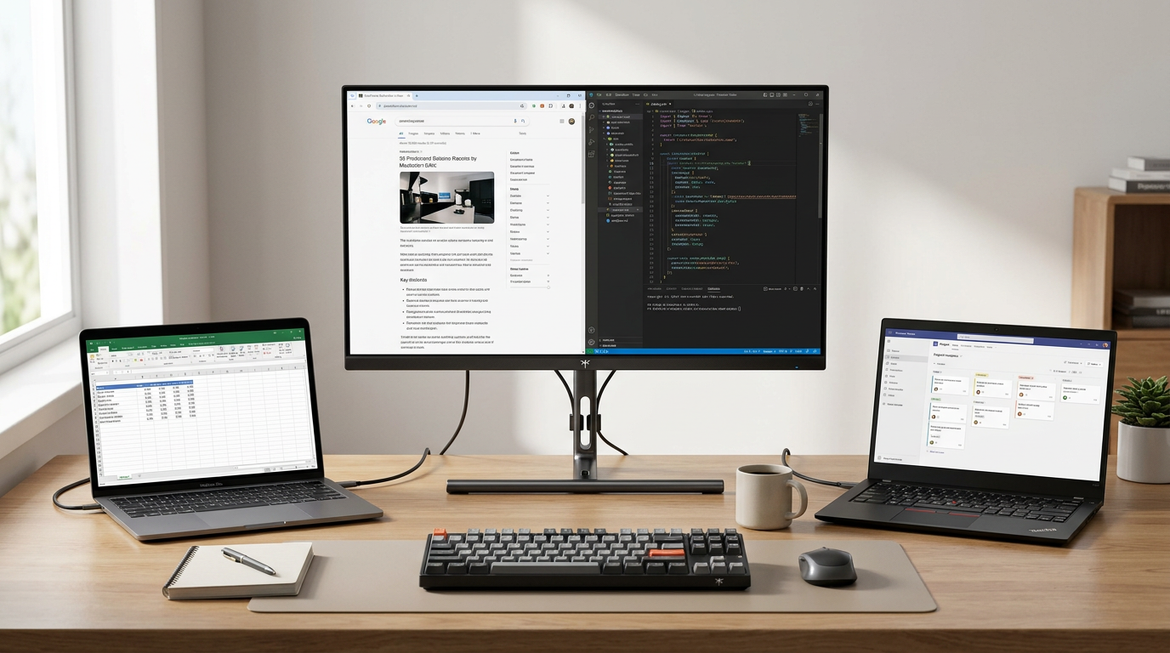
Frequent travelers should judge a USB-C KVM monitor by the whole path, not just the monitor label. If your laptop, cable, dock, and power path do not agree, the same setup can feel stable at home and flaky in a hotel or coworking space. The practical question is simple: can your exact travel kit keep video, USB handoff, and charging steady enough to be worth the switch?

Why Travel Changes USB-C KVM Behavior
One laptop across several desks is a path-compatibility problem first and a monitor-spec problem second. At home, you may use one reliable cable and one known dock. On the road, that chain can change every time you move.
That matters because a USB-C KVM monitor depends on more than a USB-C plug. Cable quality, adapter chains, dock firmware, and the laptop's own USB-C mode can all change how the setup behaves. A setup that feels fine on a clean desk can become slower to reconnect, slower to charge, or harder to troubleshoot once you add hotel or coworking gear.
A useful way to think about the category is this: compare the direct laptop-to-monitor path first, then add the rest of your accessories one layer at a time. If the simple path is unstable, adding a dock usually makes the diagnosis harder, not easier. For a broader buying overview, the section on hybrid-work USB-C monitor basics is a good companion.
What Actually Affects Compatibility
The fastest way to avoid regret is to separate compatibility into four checks: the laptop, the cable, the dock or hub, and the monitor port path. That sounds basic, but it is where most travel setups break down.
A laptop USB-C port does not always carry video. It must explicitly support DisplayPort Alt Mode to send display output, so the USB-C label alone is not enough How DisplayPort Alt Mode Actually Works Over USB-C. That single check matters most if you expect one cable to handle video and peripherals.

Cables matter too. A cable that works on your home desk may behave differently if it is longer, lower quality, or missing the needed spec for video or data. In travel use, the symptom is often not a dramatic failure. It is a smaller annoyance, like a lower resolution than expected, USB handoff that feels delayed, or a monitor that connects only after a second try.
Docks and hubs add convenience, but they also add another point where the chain can fail. A technical troubleshooting pattern that comes up often is to validate the direct path first, then reintroduce the dock or hub only after that path is stable. That is especially sensible for frequent travelers because the fewer layers you depend on, the easier it is to trust the setup when you arrive.
For readers shopping a USB-C KVM monitor for travel and home office use, the key filter is not "Does it have USB-C?" but "Which part of my actual path is doing the work?" If the answer is unclear, check whether your laptop supports display output on the port you plan to use, whether the cable is meant for that job, and whether the dock is changing the behavior before you blame the monitor.
How Power Delivery Changes on the Road
Charging is usually the most variable part of a travel setup. The monitor may support power delivery, but that does not mean every laptop will charge at the same speed through every cable and dock.
USB-C monitor power delivery for laptop docking should be treated as a range, not a promise. The monitor's PD rating tells you what it can offer, but the laptop decides how much it will accept. In practice, that means a monitor can be enough for office work on one laptop and still feel slow on another, especially if the machine is working hard or arriving with a low battery.
For power, data, and cable negotiation, the key detail is that the cable can be the bottleneck. Belkin's USB-C charging guidance notes that higher-power charging, especially above 60W, may require an E-marked cable so the devices can safely negotiate power. That does not guarantee fast charging in every setup, but it does explain why a spare travel cable can change the result.
| Priority | Best Use Case | Main Trade-Off | Safer Travel Choice |
|---|---|---|---|
| Prioritize charging headroom | You want the monitor to carry more of the laptop's power needs | The rest of the chain still has to support the path | Use the simplest direct cable path you can verify |
| Prioritize data bandwidth | You care more about USB peripherals or faster data devices | Video bandwidth can be reduced in some lane setups | Confirm the monitor's USB-C mode before you travel |
| Prioritize setup simplicity | You want the fewest moving parts at a hotel or coworking desk | You may give up some flexibility | Keep one known-good cable and test it at home first |
If your USB-C docking monitor depends on both power and data, the simple rule is to test the exact cable and dock you plan to carry. That is also why a USB-C monitor audio issue on low battery can sometimes be a power-path issue rather than a speaker issue. If the path is unstable, look at the cable and charging chain before you assume the display itself is at fault.
For deeper background on this trade-off, see power versus data speed on USB-C and the support note on audio dropouts on low battery.
Switching Behavior Travelers Actually Notice
Travelers usually notice KVM behavior in four moments: the first switch, USB handoff, waking the laptop, and reconnecting after unplugging. Those are more useful than abstract spec talk because they map to real frustration.
USB-C setups can also force a trade-off between video bandwidth and USB data speed depending on how the lanes are allocated. Newnex explains that some USB-C DP Alt Mode paths prioritize higher-speed USB data, while others preserve more video bandwidth Exploring DisplayPort Alt Mode over USB-C. In plain terms, the same port can feel different depending on which job the connection is prioritizing.
What this means for a traveler is that a "works fine" setup can still be the wrong fit if USB recovery is slow or the screen comes back clumsily after a hotel move. A small delay may be tolerable at a fixed desk. It is more annoying when you are trying to get online quickly between meetings.
Here is the practical filter:
- If you mainly want the fastest return to work, favor the path that reconnects cleanly.
- If you rely on peripherals, watch for slow USB handoff.
- If you care most about sharp text, make sure the mode you use does not force an unexpected drop in video capability.
- If you switch setups often, judge recovery after unplugging, not just the first connection.
A USB-C KVM monitor for travel and home office use is most attractive when it reduces friction, not when it adds a lot of recovery steps. If the setup gets unstable only after you add a dock, that is a sign to simplify rather than a reason to keep layering fixes.
Which Monitor Fits a Frequent Traveler
Use this as a quick filter before you buy:
- Choose a USB-C KVM monitor if you use one laptop at multiple desks and want fewer cable swaps.
- Choose it only if your laptop supports display output on the USB-C path you plan to use.
- Choose a simple direct cable path if you move between hotels, coworking spaces, and home often.
- Skip the category if you depend on a complex dock stack and do not want to troubleshoot the chain.
- Treat charging and switching as separate checks, even when the monitor claims both.
A neutral example is the KTC 27" 5K@60Hz 2K@120Hz Home&Office Monitor | H27P3. It includes a Type-C port with 65W PD and two USB 3.0 downstream ports, so it can support a straightforward USB-C desk path when the laptop and cable also support the needed modes. It also offers 5K@60Hz and 2K@120Hz modes, which may suit buyers who want sharper office text with a fallback for smoother motion. That is a fit cue, not a guarantee of travel reliability.
If you are comparing cable paths as part of the same decision, premium USB-C and display cables can help you keep the setup consistent, but the cable still needs to match the way your laptop and monitor negotiate video and power.
Final Travel Setup Checks
Before you buy, write down the exact laptop model, exact cable, exact dock, target resolution, and the charging level you actually need on the road. Then test the full path at home, unplug it, and repeat the test. If the setup is only stable in one location, it is not yet a travel setup.
If you want to keep browsing monitor options, start with all monitors and compare only the paths that match your kit.
FAQs
How Do I Tell If My Laptop Can Use a USB-C KVM Monitor?
Check whether the laptop's USB-C port supports display output, not just data or charging. If the port does not support DisplayPort Alt Mode, the monitor may charge the laptop but still fail to show video through USB-C.
What Cable Problems Are Most Likely to Break USB-C KVM Switching?
Short or well-specified cables usually behave more predictably than long, bargain, or underspecified ones. Travel setups are most likely to get weird when the cable cannot carry the same mix of video, USB data, and charging that your home desk uses.
Can a Dock Change How Fast My Laptop Charges Through the Monitor?
Yes, it can. The monitor's power-delivery rating is only one part of the chain, and a dock or hub may limit what reaches the laptop. If charging speed matters, test the exact dock and cable you plan to carry.
Why Does KVM Behavior Seem Better at Home Than in a Hotel or Coworking Space?
Home setups usually use a known-good cable path, while travel setups often add borrowed cables, hubs, or adapters. That extra variability can change video detection, USB handoff, and charging behavior even when the monitor itself is unchanged.
Can One USB-C Cable Handle Video, Charging, and Peripherals at the Same Time?
Sometimes, but only when the laptop, monitor, cable, and any dock all support the same mode. Treat it as a setup you verify, not a promise you assume. The safest approach is to test that exact travel kit before relying on it.