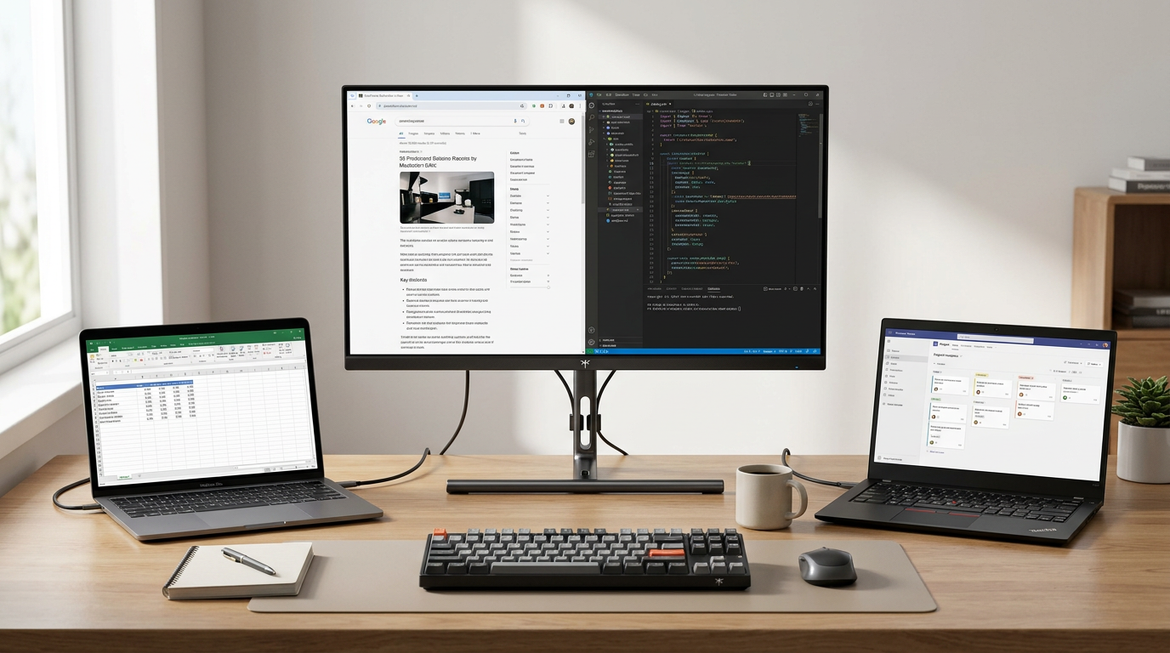
A USB-C KVM monitor dock compatibility guide should start with the weak link, not the product: power, video, USB data, EDID, and wake behavior are separate checks, and any one of them can break the chain. If you want a true one-cable desk, confirm those modes first or expect troubleshooting after setup.

What Breaks in a USB-C KVM Dock Chain
Most failures are not caused by the monitor alone. They happen when the dock, KVM, monitor, and source device do not agree on video mode, USB routing, or how to remember the display during a switch. EDID handshake problems can lead to no-signal screens, resolution resets, or a setup that works until the laptop sleeps or the input changes, which is why KVM chains often feel unstable even when each part looks fine on paper. Built-in EDID emulation is one reason reliable video is easier to maintain in a switchable chain.
The most common symptoms are simple to spot. The laptop charges, but the screen stays black. The monitor wakes, but the keyboard and mouse stay on the wrong computer. Or everything works after a cold boot, then breaks after sleep. In a USB-C KVM monitor dock compatibility setup, that usually means the path is wrong, not that the monitor is defective.
A good rule of thumb is this: if the chain fails after switching sources or waking from sleep, treat it as a handshake problem first. If the chain fails before the monitor ever shows an image, treat it as a routing or mode-support problem first.
How the Signal Path Has to Line Up
For most hybrid desks, the cleanest way to think about the setup is as three jobs sharing one connection path. Power delivery keeps the laptop charged, video output carries the picture, and USB data moves your peripherals. USB-C can support more than one of those jobs, but it does not guarantee all of them at once in every device path. The USB Power Delivery overview is a useful reminder that charging support is only one part of the story.
A practical USB-C KVM monitor setup guide starts with the source device. If the laptop or desktop port does not support display output, the monitor will not show a picture just because the cable fits. If the dock supports charging but routes video through a different path, the setup may still charge normally while failing at display or USB switching. That is why a USB-C dock and KVM detection issues often look like one problem but actually come from two separate paths.
A useful self-check is to separate the chain into the order you will troubleshoot it. First confirm the monitor can show a direct image from one source. Then add the dock. Then add the KVM. Then add peripherals. If you skip that order, it becomes much harder to tell whether the failure is in the source device, the dock, the KVM, or the cable.
A shared USB-C monitor port can also force a tradeoff between power and data, which is why one cable is not always one clean solution. If your desk depends on fast external storage, multiple USB devices, or a more demanding display path, you may need to choose which function gets priority. Power delivery vs. data speed is often the decision that determines whether the setup feels simple or frustrating.
The short version is this: if the source device supports the needed display mode and the monitor or dock supports the same path, the setup has a chance to work well. If any one device only supports part of the chain, the result may still look like a USB-C setup, but it will not behave like a reliable one-cable desk.
Where Dual-Monitor and High-Refresh Setups Usually Fail
The more display demand you add, the easier it is for the chain to fall apart. USB-C often has to trade display bandwidth against USB data speed, so a path that is fine for one monitor may become fragile when a second display is added or when refresh rate climbs. DisplayPort Alt Mode over USB-C explains the core tradeoff: higher display bandwidth and USB data do not always travel comfortably together.
Here is the practical pattern:
| Setup Type | Likely Weak Link | Check First | Safer First Test |
|---|---|---|---|
| Single-monitor USB-C dock | Port mode mismatch | Source USB-C display support | Direct cable at a basic refresh rate |
| Dual-monitor dock-to-KVM | Bandwidth or port order | Whether each display path is supported | One monitor first, then add the second |
| High-refresh hybrid desk | Adapter chain complexity | Whether the full path supports the refresh mode | Lower refresh first, then step up |
| Sleep-sensitive desk | EDID or wake-state instability | Whether the switch remembers the display | Cold boot, then sleep/wake test |
This is where a setup can seem fine in the store and fail at home. A second monitor may not detect even though the first one works, and the bottleneck is often a cable, port, adapter, driver, or hardware limit rather than the panel itself. Second monitor detection issues are common enough that it is worth checking the simplest failure points before replacing hardware.
The big decision split is easy to miss. A single-monitor desk with stable wake behavior is usually the safest path for a USB-C KVM monitor dock compatibility setup. Dual-monitor, high-refresh, and dock-to-KVM chains are more fragile because each added device increases the chance that the path will fall back to a weaker mode or lose detection after sleep.
If you are trying to run a high-refresh gaming monitor through a switch or splitter, treat the accessory path as the likely bottleneck first. HDR and refresh-rate breakage is often a sign that the chain, not the panel, is limiting the result.
USB-C KVM dock setup risk guide
Use this as a quick fit check: setups move from safer to riskier as display load, chain length, and wake sensitivity increase.
View chart data
| Scenario | Direct USB-C to monitor | USB-C dock to KVM | Dock + KVM chain |
|---|---|---|---|
| Single monitor, 60 Hz, stable wake | 1 | 1 | 2 |
| Single monitor, high refresh, stable wake | 1 | 2 | 3 |
| Dual monitor, 60 Hz, stable wake | 2 | 3 | 3 |
| Dual monitor, high refresh, stable wake | 3 | 3 | 3 |
| Sleep-sensitive wake behavior | 1 | 2 | 3 |
How to Match a Monitor to a Hybrid Desk
The easiest monitors to live with in a switchable desk are the ones that reduce the number of separate decisions you have to make. Look for a clear port mix, USB-C charging that fits your laptop, enough native resolution for your work, and a stand that does not make desk alignment annoying. A monitor with USB-C and KVM can simplify the desk, but it does not make the rest of the chain automatically compatible.
That is where the KTC OLED 27" 2K 240Hz/0.03ms USB-C Gaming Monitor | G27P6 fits naturally as a featured example. It includes 65W USB-C charging and built-in KVM support, so it can fit readers who want a cleaner laptop-to-monitor connection without turning the article into a pure spec pitch. The key boundary is still the same: the monitor can help simplify the desk, but it does not prove the dock, KVM, and source device will all negotiate correctly together.
For a hybrid desk, that matters more than marketing language. If your laptop needs charging while you work and you want the monitor to handle a portion of the switching, the G27P6 is a reasonable candidate to check. If you need guaranteed dual-monitor routing, exact wake behavior, or a specific dock chain, you still need to verify those parts separately.
You can compare it with the 4K and 5K high-refresh monitor range if your desk leans more toward mixed productivity and gaming, but the buying question should stay the same: does the whole chain support the exact signal path you want, or only part of it?
A second product reference becomes useful when you want more charging headroom. The KTC 27" 4K 160Hz/320Hz 90W Gaming Monitor | H27P6 adds 90W USB-C PD and dual-mode 4K/1080p behavior, which may suit readers who need a little more power margin and who still want to validate the rest of the chain before buying. For a compatibility-first reader, that makes it a higher-headroom candidate, not a universal fix.
If you are comparing another desk path, start with the same questions. Do you need laptop charging, display output, and USB switching all at once? Do you actually need dual monitors, or would a single display reduce failure points? Would a simpler office monitor be enough if the KVM chain is causing too much friction? Those questions usually matter more than the refresh-rate number alone.

What Should You Check Before You Buy?
Before checkout, verify the source device first. Make sure the laptop or desktop supports the display mode you want over USB-C, not just charging. Then check the dock or KVM for the exact upstream and downstream roles it expects. Finally, confirm whether you are building a single-monitor desk or a dual-monitor chain, because the second display is often where the bottleneck shows up.
A simple not-a-fit filter helps here. If you need one cable to charge, switch, and wake perfectly across multiple devices, a USB-C KVM dock chain is usually a poor fit unless the published specs and device manuals line up very closely. If your desk can accept one monitor, one upstream path, and a basic wake test, the setup is much more likely to behave the way you expect.
For readers who want the simplest path, test in this order: direct monitor connection, charging, USB peripherals, then KVM switching. If that order already feels too involved, the setup itself may be overbuilt for what you need.
Frequently Asked Questions
Why Does My Second Monitor Stop Detected After I Add a Dock or KVM?
That usually points to a path issue, not just a bad display. Check the cable type, input order, and whether the dock or KVM supports the second display at the resolution and refresh rate you want. If the first monitor works and the second does not, the bottleneck is often in the accessory chain.
Can a USB-C Monitor Charge My Laptop but Still Fail to Show Video?
Yes. Charging and video are separate checks, even when they share one connector. A monitor or dock may provide enough power for the laptop while still lacking the source-device display mode, cable support, or upstream routing needed for video. That is why charging success is not proof of full compatibility.
Why Does Wake From Sleep Break My KVM Setup?
Sleep and wake can expose EDID or handshake problems that are invisible during a cold boot. If the display comes back blank or the wrong source returns, the switch may not be preserving the monitor identity well enough. Test wake behavior separately from the first connection test, especially on mixed laptop and desktop desks.
Is a Dual-Monitor USB-C KVM Setup Harder to Make Reliable?
Usually yes, because each additional display adds another place for bandwidth, routing, or detection to fail. A setup can look fine with one screen and still fall apart with two. If you want the highest chance of stable switching, start with a single-monitor path and only expand after that works.
What Is the Safest First Test for a New Dock-And-KVM Desk?
Use one direct cable from the source device to the monitor first, and test at a basic, stable mode before adding accessories. Once the picture is stable, add charging, then USB peripherals, then the KVM. That order makes it much easier to isolate the part that is causing the problem.
Final Takeaway
The safest way to buy a USB-C KVM monitor dock compatibility setup is to treat the chain as a system, not a single product. If your desk needs charging, display, USB switching, and reliable wake behavior, verify each part separately before checkout. If you want a simpler route, start with one monitor, one direct cable, and one known-good input path, then expand only after that works.
For a cleaner hybrid desk, the KTC G27P6 is a reasonable fit example to check, and the H27P6 is worth a look if you need more charging headroom. Use the linked troubleshooting guides to compare your port layout before you buy, and avoid assuming that USB-C by itself guarantees everything will switch correctly.