A KVM monitor can make a multi-device desk feel much cleaner, but it is a convenience upgrade, not a universal fix. The best fit is a setup where your laptop, cable, and monitor all support the same USB-C path, and where you mainly want faster keyboard-and-mouse handoff with less cable clutter.

Why a KVM Monitor Simplifies Desk Switching
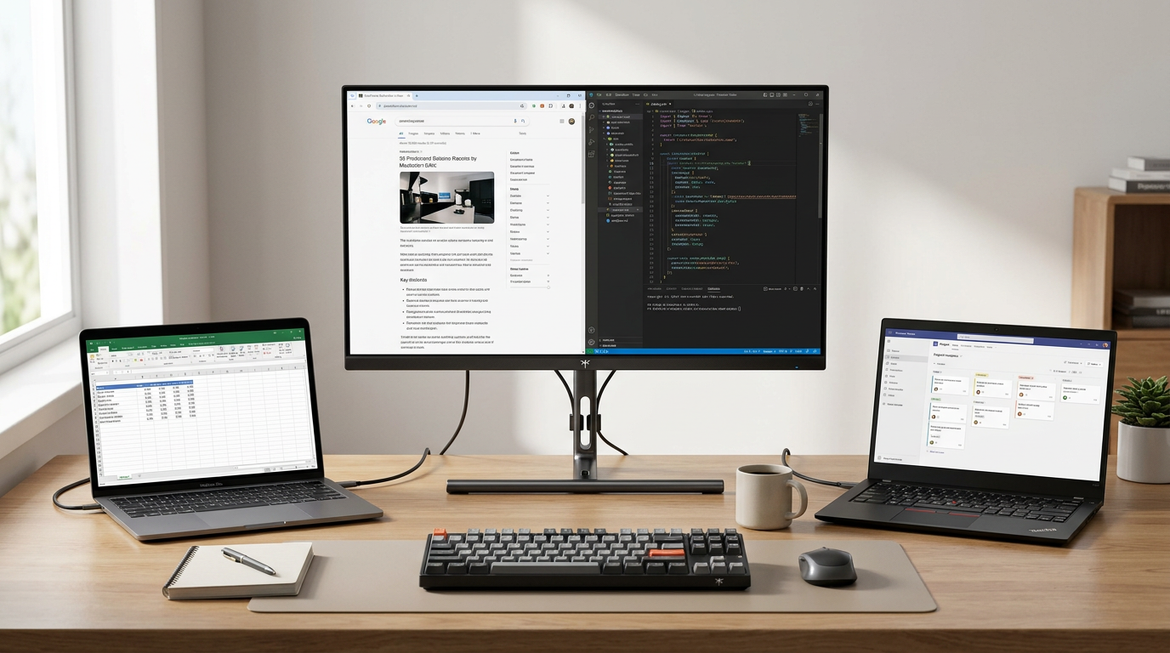
For a desk that jumps between a laptop, desktop, and sometimes a console, the main win is fewer things to replug. A KVM monitor is designed to keep your keyboard, mouse, and other USB peripherals attached to the active source, so switching feels closer to changing inputs than rebuilding the desk.
That convenience matters most when the alternative is a dock plus a separate USB switch plus extra cables. It matters less if you only switch once a day or if your monitor is really just a display first and a hub second. As RTINGS explains, the value is shared peripheral control, not magic compatibility.
If you are still comparing categories, the All Monitors collection is a practical browse path before you narrow down to a connectivity setup.
A useful rule of thumb: if the thing you hate most is the cable shuffle, a KVM monitor is worth considering. If your main issue is resolution, refresh rate, or panel quality, KVM should stay a secondary filter.
How USB-C, Power Delivery, and KVM Work Together
USB-C can carry video, data, and charging on one cable, but only when the host device, cable, and monitor all support the right features. The port label alone does not guarantee the full experience.

That is why a USB-C monitor with KVM can feel seamless on one laptop and frustrating on another. Charging may work even when video does not. Keyboard and mouse may switch correctly while audio or a webcam behaves differently. The whole path has to line up.
For most buyers, the cleanest setup is still the simplest one. A direct connection usually gives you the fewest surprises, while docks and hubs add flexibility at the cost of another compatibility layer.
Here is the practical translation: USB-C is the convenience layer, KVM is the handoff layer, and the monitor input is the compatibility layer. If any one of those is mismatched, the setup can still work, but it will not feel as clean as the marketing promise.
USB-C Video and Charging Paths
A KVM monitor with power delivery is most useful for laptop-first desks. One cable can handle display output and charging, which cuts down on the usual tangle of charger plus dock plus video cable. That said, wattage still matters. A 65W or 90W port may be enough for many thin-and-light laptops, but you should check your actual laptop's charging requirement instead of assuming the highest spec is always better.
Built-In KVM Versus External Switching
Built-in KVM is usually the simpler path because the switching logic lives in the monitor. External KVM boxes can still make sense when you need to share more peripherals or different port types, but they add one more box to troubleshoot. For many desks, the built-in option is the cleaner fit unless your device mix is unusually complex.
Peripherals, Audio, and Source Switching
Do not assume every device will behave the same way after a switch. Keyboard and mouse are the core promise, but audio devices, webcams, and special peripherals may need extra verification. That is why the setup should be tested end to end before you decide it is finished.
Choose the Right Monitor for Your Devices
The right KVM monitor depends on which device gets used most often and which friction matters most. Laptop-first users usually care about one-cable convenience and charging. Creators care more about text clarity and dependable handoff across Mac and Windows. Gamers care more about whether the monitor still feels fast enough for play when it doubles as a work screen.
The table below helps show where the fit tends to shift across those scenarios.
| Model | Laptop-first hybrid | Creator desk | Gaming desk |
|---|---|---|---|
| H27P6 | Strong | Moderate | Strong |
| A32Q8 | Moderate | Strong | Moderate |
| H49S66 | Moderate | Moderate | Moderate |
For a laptop-first desk, the KTC 27" 4K 160Hz/320Hz 90W Gaming Monitor | H27P6 is the strongest match among the supported options because it combines 90W USB-C power delivery with built-in KVM and a faster refresh ceiling. It is a better fit when you want workday convenience without giving up a more responsive gaming display.
For a creator desk, the KTC 32" 4K 60Hz Smart Monitor with Google TV in Netflix Audio Licensed makes more sense when your priority is a 4K desktop with built-in smart features and 65W USB-C hub + KVM convenience. It is not the first pick for speed-focused gaming, but it is a reasonable fit for mixed work, streaming, and casual switching.
For a wide multitasking setup, H49S66 is worth a look if your priority is horizontal workspace rather than KVM. The important boundary is simple: it is a different kind of solution because the product facts do not list KVM support, so it should not be treated as a like-for-like replacement for a KVM monitor.
A short decision sentence: if you switch every day and hate cable clutter, choose the most direct KVM path you can. If you mainly want a wide workspace, a non-KVM ultrawide can still be the better fit. If you care more about gaming speed than desk simplification, KVM should not be the deciding feature.
Laptop-First Hybrid Work
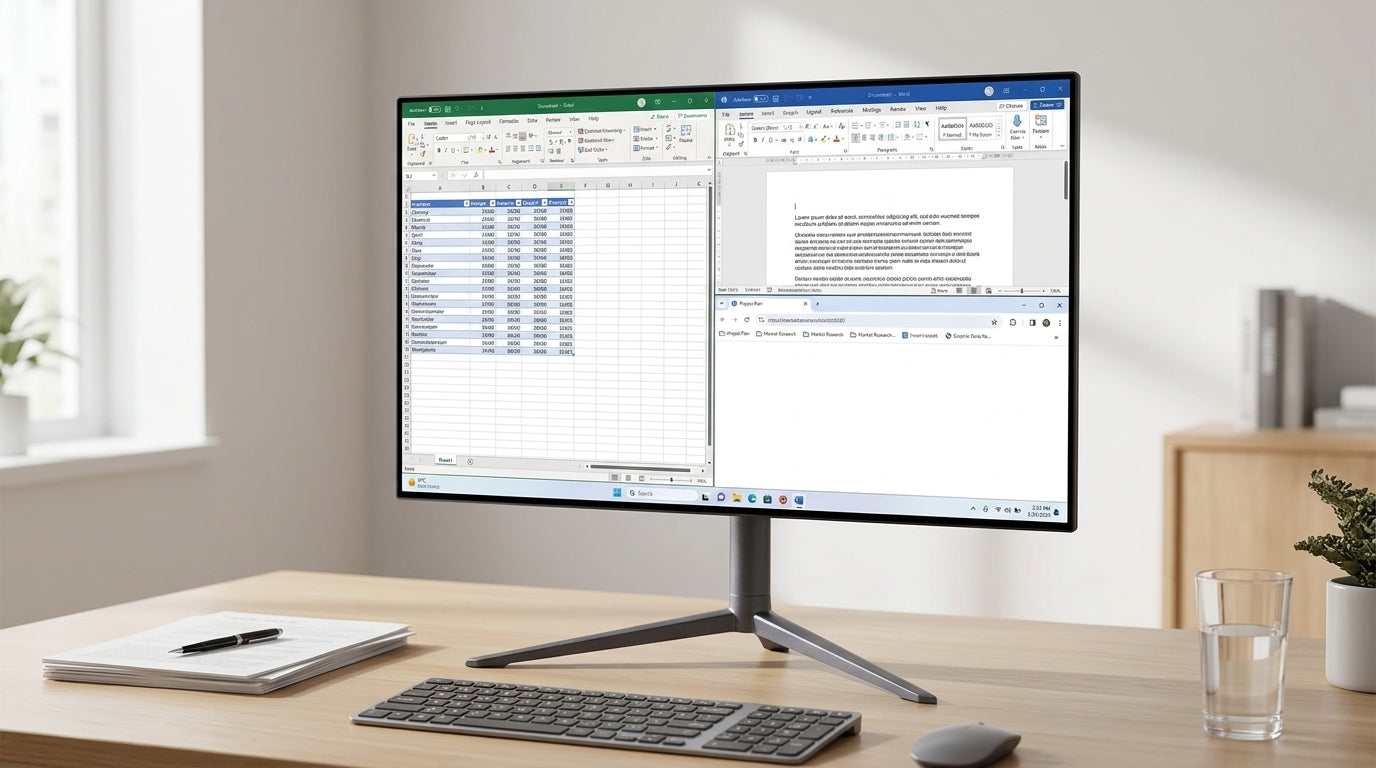
This is the best scenario for a KVM monitor when one laptop does most of the daily work and a desktop or docked machine is secondary. The real benefit is not just fewer cables. It is the ability to move from work to play without changing the whole peripheral stack.
The USB-C monitor with KVM path makes the most sense when your laptop supports video over USB-C and the monitor can charge it at a useful wattage. If your laptop uses a higher power brick or your USB-C port only handles charging, the convenience drops quickly.
Creator Desk With Mac and Windows Devices
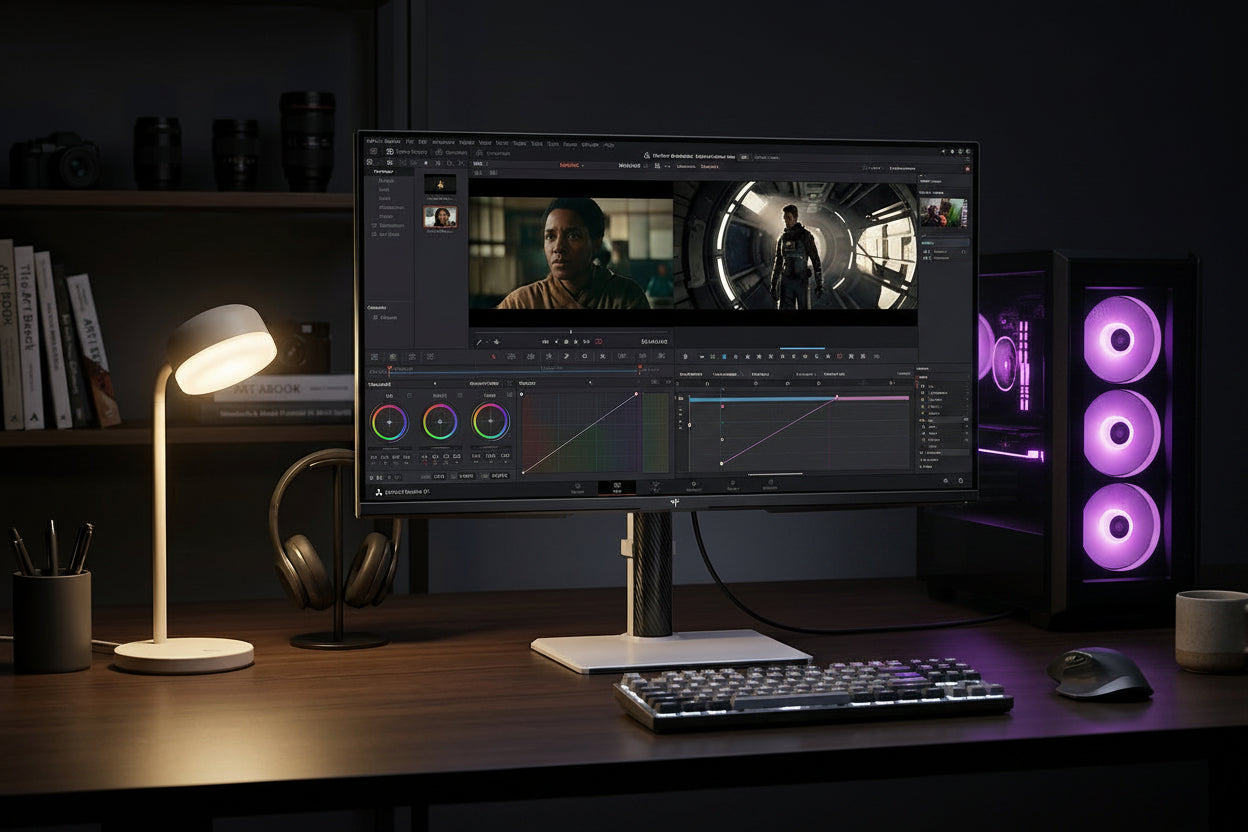
Creators often care more about predictable handoff than raw speed. The useful question is whether the monitor keeps text clear, cables sane, and switching reliable across devices. That is where a KVM monitor can help, especially if your desk moves between editing, calls, and admin work.
Still, creator desks are also where compatibility problems show up fastest. If you use a MacBook, check the exact USB-C display support before buying. If you work with a Windows workstation and a laptop, verify that both sources can use the monitor inputs you plan to rely on.
Gaming Desk That Also Handles Work
Gaming desks are the trickiest case because the best work monitor and the best gaming monitor do not always point to the same spec sheet. A KVM monitor can be a strong compromise when you want one screen for both, but the decision flips if your playtime depends on the highest refresh rate or a very specific console input path.
If gaming is the priority, look first at the source you use most. A console-first desk may care more about HDMI support. A PC-first desk may care more about refresh rate and input flexibility. A KVM feature is useful, but it should not distract you from the signal path.
Setup Checks That Prevent Switching Problems
The fastest way to avoid regret is to test the simplest path first. Start with one direct source, then add KVM, charging, and peripherals only after the base connection is stable. That order matters because it separates a device problem from a cable problem and keeps you from guessing.
- Confirm the source device supports USB-C video if you plan to use a one-cable setup.
- Use a full-function USB-C cable, not a charge-only cable.
- Match the monitor input to the source you actually connected.
- Attach keyboard and mouse through the intended KVM or upstream path.
- Test switching at a safe baseline before pushing higher resolution or refresh rate.
If charging works but the screen stays blank, stop and check the host port first. If the monitor behaves unpredictably after adding a dock or hub, remove the extra layer and retest. Those two checks solve a lot of the usual frustration.
The KVM monitor setup guide is a useful follow-up if you want a more desk-specific example of how the switching flow should feel when it is working.
A Practical Way to Decide What Matters Most
The easiest way to pick a KVM monitor is to rank your daily pain points before you rank your specs. If cable clutter bothers you most, prioritize built-in KVM and USB-C power delivery. If text clarity matters more, prioritize resolution first. If gaming matters most, let the input path and refresh rate lead the decision.
- Prioritize the input that matches your main device.
- Choose charging wattage for your actual laptop, not the biggest number on the page.
- Treat KVM as a convenience feature and verify it with your own keyboard and mouse.
- If you split time between work and play, decide whether text clarity, charging, or refresh rate matters most.
- Check stand adjustability and desk footprint so the monitor fits your real setup.
A simple decision sentence: if your desk is laptop-first, choose the monitor that reduces daily friction. If your desk is console-first or wide-workspace-first, another class of display may fit better even if it lacks KVM.
For a browsing shortcut, the 4K Monitor collection and the 2K Monitor collection are helpful when you want to compare workspace sizes before locking in a connectivity feature set.
FAQs
Q1. How Does a KVM Monitor Differ From a Regular USB-C Monitor?
A regular USB-C monitor may only handle video and power, while a KVM monitor is designed to share keyboard, mouse, and other USB peripherals across sources. The difference shows up when you switch devices without replugging, but exact behavior still depends on the model and how it is wired.
Q2. What Should I Check If My Laptop Charges but No Video Appears?
Check host USB-C video support first, then the cable, then the monitor input. Charging alone does not prove the full USB-C path works. A direct connection is the fastest way to separate a port compatibility issue from a dock or hub issue.
Q3. Can a KVM Monitor Switch Keyboard and Mouse Without Replugging?
Yes, that is the main job of built-in KVM, but only when the keyboard and mouse are connected through the correct path. If the monitor supports KVM but the peripherals are plugged into the wrong port or upstream path, the handoff will feel inconsistent.
Q4. Why Does a Dock or Hub Sometimes Reduce Refresh Rate?
Because video, data, and power can share bandwidth on USB-C chains, higher refresh rates may require a simpler path. If you want the best motion performance, test the direct connection first and use the dock only if the result still meets your needs.
Q5. Can One KVM Monitor Handle Both Work and Gaming?
Often yes, but the right choice depends on what you value most. If you want text clarity, charging, and decent gaming performance in one place, a KVM monitor can work well. If you care most about competitive refresh or a very specific console setup, the trade-off may not be worth it.
The Cleanest Setup Is the One You Will Actually Use
A KVM USB-C monitor is best when it removes friction you deal with every day. It is less useful when it adds a compatibility puzzle you have to solve every time you change devices. If you check the host port, cable, and charging needs first, you can usually tell quickly whether the feature will feel genuinely helpful or just sound convenient. Compare options in the gaming monitor collection or the Single Monitor Setup for Work and Gaming Balance for more context.