In 2026, a smart home hub monitor transforms from a passive screen into a mobile control center that supports local automation through Matter and Thread protocols. The key distinction is whether the display merely shows status updates or actively participates in local logic, cross-platform synchronization, and physical device control while maintaining connectivity during room-to-room movement. Battery persistence of roughly 75–95 Wh becomes essential for rolling setups, as power cycling disrupts the local network that true infrastructure depends on.

Why a Smart Monitor Belongs in Your 2026 Home Ecosystem
Smart displays are shifting from simple app interfaces to proactive hubs that manage lighting, security, and ambiance using local protocols rather than constant cloud calls. This matters because local control keeps essential automations running during internet outages, turning the monitor from a temporary accessory into reliable home infrastructure.
As explained in this Matter & Thread guide, prioritizing local protocols like Matter and Thread differentiates a true smart home hub monitor from standard TVs or cloud-dependent panels. For hybrid workers or apartment dwellers, this reliability reduces the need for multiple fixed devices and simplifies daily routines across rooms.
Many early adopters initially expect any smart screen to serve as a central nervous system. The practical boundary appears when the device must stay continuously connected: without persistent local control, routines break during power interruptions or room transitions. Check your network setup and primary automations first—if you rely on always-available local execution, a standard tablet-style display often falls short.
See You at CES 2026 – A Look at What We’ll Be Showcasing highlights emerging AI-driven features that further support this infrastructure role. How a USB-C Monitor Can Streamline Your Workspace also shows how single-cable connectivity aids tidy multi-purpose setups.
Beyond the App: How Matter 2.0 Changes Monitor Integration
Most monitors with smart apps function only as passive dashboards that display status from a separate hub. They cannot execute local logic when the primary controller goes offline. Matter 1.3 and later versions change this by adding Media Player device types that let the ecosystem automate the monitor’s volume, input switching, and power state as part of broader scenes.
According to the official Matter specification, these updates enable smart displays to participate more deeply in the fabric rather than simply mirroring an app. A monitor acting as a Matter endpoint can also bridge nearby sensors (occupancy or light level) directly to the local network, reducing latency for desk-specific adjustments.
The practical test is whether the device can be controlled by the home system or only displays information. If your routines involve automating the screen itself—such as dimming lights and switching inputs when you start work—the monitor needs explicit Matter 1.3+ Media Player certification. Entry-level models may only support basic dashboard apps, so verify the exact role before purchase.
This distinction prevents the common regret of expecting full hub behavior from a device that only runs cloud-dependent software. For deeper troubleshooting of related device control, see our guide to HDMI CEC Device Control on Monitors: Why Some Commands Work and Others Don’t.
Monitor Use Cases: Dashboard, Matter Endpoint, or True Hub
A quick boundary check for 2026 smart-home use: many monitors are only passive dashboards, some act as Matter endpoints, and only a smaller set can support true multi-admin control. Battery-backed mobility matters when the display must move around the home.
View chart data
| Scenario | Passive Dashboard | Matter Endpoint | True Multi-Admin Hub |
|---|---|---|---|
| Local Logic Execution | 0.0 | 1.0 | 2.0 |
| Cross-Platform Sync | 0.0 | 1.0 | 2.0 |
| Physical State Automation | 0.0 | 1.0 | 2.0 |
The Multi-Platform Reality: Managing Apple and Google on One Screen
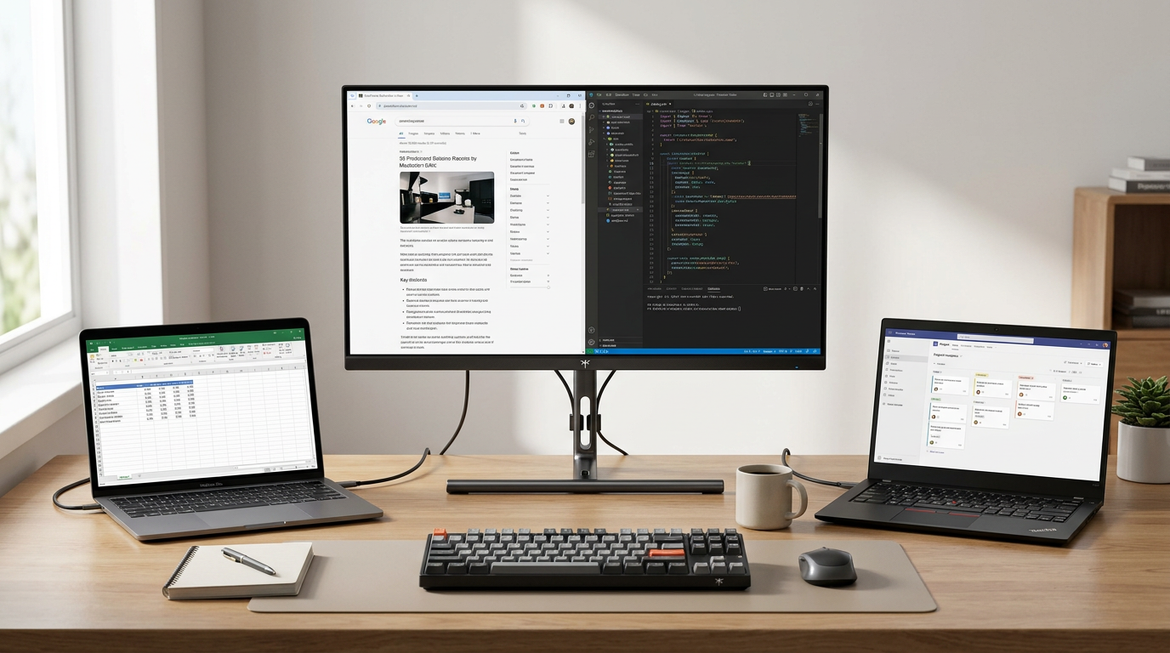
Hybrid workspaces often mix a Mac for productivity with an Android-based monitor for home control. Without proper integration, one ecosystem can interfere with the other, creating sync delays or outright lockouts during work hours.
Matter’s Multi-Admin feature addresses this by allowing simultaneous control from different platforms, such as Apple Home and Google Home, without losing state. As detailed in the Matter Multi-Admin FAQ, this capability prevents the “work” platform from overriding home automation routines.
The friction becomes obvious when you try to adjust desk lighting or temperature while the monitor is in productivity mode. If Multi-Admin is absent, you may need to choose one primary ecosystem or accept occasional manual overrides. Premium models in early 2026 are more likely to offer full Multi-Admin support, so verify compatibility with your specific devices before relying on seamless blending.
This requirement is especially relevant for remote workers who want one screen to handle both professional inputs and home scenes without constant reconfiguration.
The Battery Requirement for Rolling Smart Displays
Adding wheels to a standard monitor might seem like an easy way to gain mobility, but most conventional displays lose all connectivity the moment they are unplugged. This power cycling resets the Matter and Thread radios, breaking automations and requiring a full network rejoin each time you move rooms.
True rolling smart display integration needs an internal battery—typically in the 75–95 Wh range—to maintain the local network “heartbeat” during transitions. Without this buffer, the device cannot serve as reliable infrastructure because every move triggers a protective shutdown or reboot.
Manufacturers of mobile smart screens emphasize this threshold because the combination of display backlight, processors, and radios draws significant power. A lower-capacity battery often lasts only minutes under load, defeating the purpose of multi-room use. This is the core “don’t buy if” filter: if your intended monitor lacks integrated battery persistence, treat it as a fixed-position dashboard rather than a mobile hub.
One Screen for the Whole House: Why MegPad Is the Perfect Christmas Gift explores practical examples of battery-backed mobility in daily life.

Living Room to Home Office: Real-World Setup Scenarios
In a dedicated home office, the rolling monitor can coordinate micro-zones by dimming lights and adjusting temperature when you switch inputs for focused work. The local Matter connection keeps these changes immediate and independent of cloud services.
In living rooms or smaller apartments, the same device replaces multiple fixed screens by serving as a media center that also controls ambiance lighting and audio. Rolling it to a workout corner or kitchen lets you maintain continuous access to timers, music, or security feeds without dropping the network.
Multi-room households benefit most when the display moves freely yet stays part of the fabric. Battery-backed models allow seamless transitions from morning productivity to evening entertainment without reconfiguration. The experience feels like infrastructure rather than a gadget you must babysit.
For related mobility ideas in different contexts, review How to Build a Mobile Dual-Screen Gaming Setup with a Portable Monitor.
Building Your 2026 Smart Office Hub: A Buyer's Checklist
Start by confirming your primary use: fixed dashboard, occasional mobility, or full multi-room infrastructure. This choice determines whether basic app support suffices or whether you need Matter 1.3+ Media Player certification, Thread border router capability, and Multi-Admin support.
Next, verify internal battery capacity if rolling between rooms is planned—aim for at least 75 Wh to avoid network drops. Check that the built-in OS (Google TV, Android, or equivalent) can run automation dashboards alongside productivity tools without performance lag.
For users combining Apple and Google ecosystems, Multi-Admin is non-negotiable to prevent platform conflicts. Entry-level monitors may limit this feature to higher “Pro” or “Hub” editions in early 2026, so read the exact certification details.
Models such as the KTC MEGAPAD 32" 4K Android 13 Google EDLA Smart Touch Monitor with 9500mAh Battery offer a practical combination of large 4K touchscreen, rolling stand with height and portrait adjustment, and sufficient battery for extended unplugged operation. Its Google EDLA certification helps with dashboard integration, though real-world Matter controller behavior still depends on firmware and your broader ecosystem. Always confirm current certification status and test in your specific network before committing to it as the sole hub.
Smaller options like the KTC MEGAPAD 27" FHD Android 14 Google EDLA Smart Touch Monitor with 9500mAh Battery suit tighter spaces or lighter mobility needs while retaining similar smart features. Consider the Smart Monitor collection or Mobile Touch Screen range to compare specifications against your room size and automation complexity.
The final decision layer is simple: if your setup demands constant local control and room-to-room mobility, prioritize battery persistence and verified Matter roles. Devices without these traits work well for media consumption or static dashboards but will disappoint as primary home infrastructure.
Can Any Smart Monitor Act as a Full Matter Controller?
No. Most run dashboard apps but function only as endpoints or passive displays. True controller behavior that executes local logic without a separate hub is limited to specific certified models and often appears first in premium editions.
Does a Rolling Stand Alone Turn a Monitor Into a Mobile Hub?
No. Without an integrated high-capacity battery, the device power cycles during moves, dropping the Thread network and interrupting automations. A proper rolling smart display needs built-in power persistence.
How Important Is Multi-Admin Support for Mixed Ecosystems?
It is critical if you use Apple devices alongside a Google or Android-based monitor. Without it, one platform can interfere with the other, causing automation delays or lost states during work sessions.
What Battery Capacity Is Needed for Reliable Room-to-Room Mobility?
Aim for 75–95 Wh or higher. Lower capacities typically cannot sustain both the screen and radios long enough for practical transitions without triggering shutdowns or network resets.
Should I Choose a 4K or Lower-Resolution Smart Monitor for Home Automation?
It depends on viewing distance and primary tasks. 4K models like the 32-inch options provide sharper dashboards and media playback from farther away, while 1080p or 1440p versions remain sufficient for closer desk use and reduce cost and power draw.