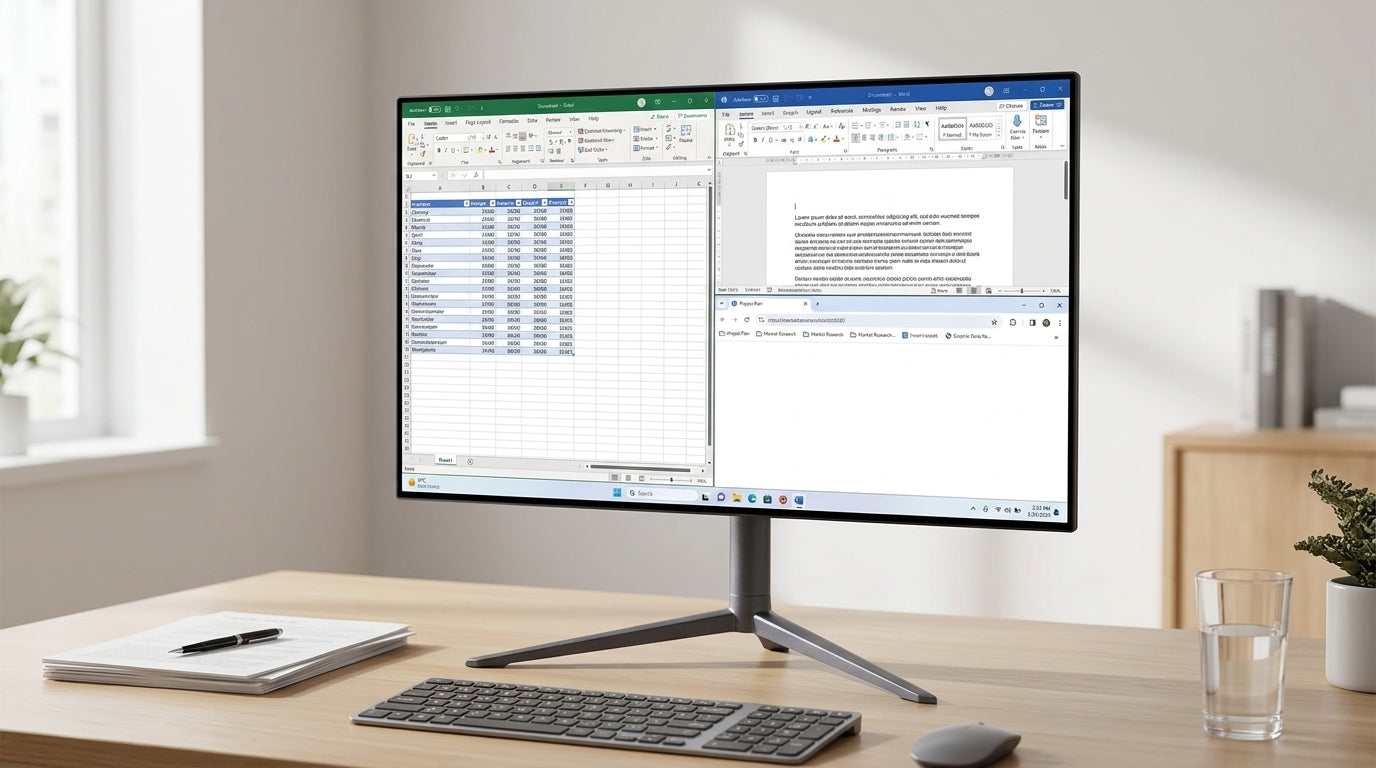
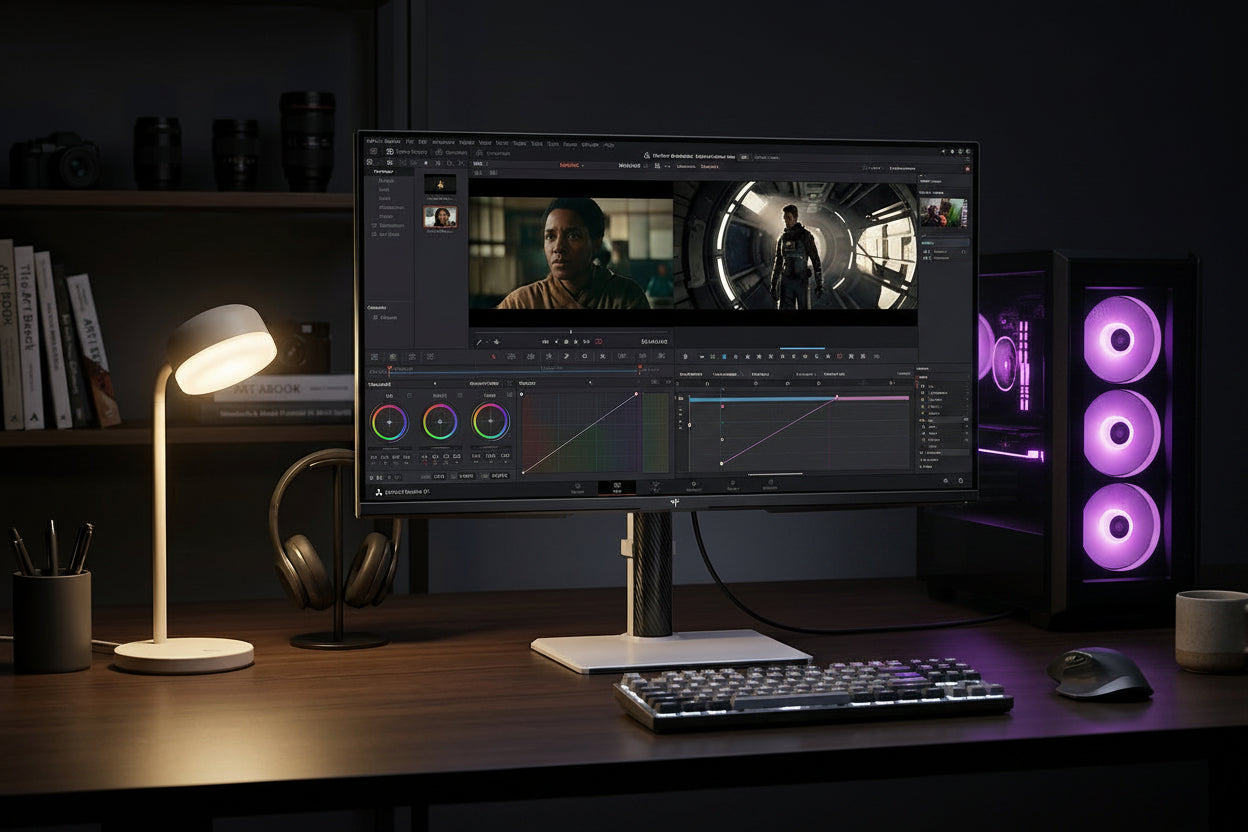
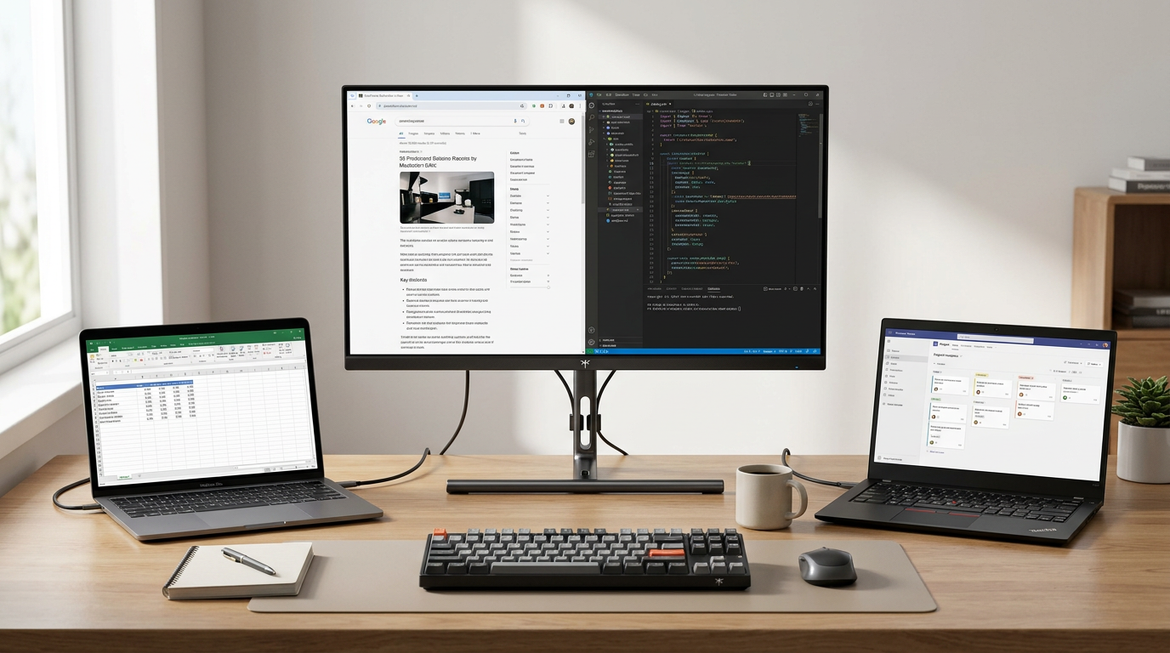
Competitive esports in 2026 rewards players who treat their monitor as a precision instrument rather than a marketing checklist. The difference between a good setup and a pro-grade one lies less in chasing the highest refresh-rate number and more in balancing measurable motion clarity, zero-added-latency signal delivery, and ergonomic consistency that protects aiming repeatability.

2026 Esports Monitor Specs That Actually Matter
Higher refresh rates have become the baseline for serious play, but raw Hz numbers alone no longer tell the full story. By 2026, professional standards have shifted toward 480 Hz and 500 Hz panels—especially OLED and Fast IPS—primarily to reduce frame persistence, the time a pixel holds its image before the next frame arrives. This CES 2026 coverage shows how the industry is moving beyond marketing GtG claims.
Motion clarity is now better judged by VESA ClearMR ratings, which measure the ratio of clear pixels to blurry ones during movement rather than relying on a single best-case GtG transition time. ClearMR 9000 or higher is the practical target for competitive tracking; many panels still advertise “1 ms GtG” while delivering noticeable overshoot or persistence that hurts target acquisition. This shift explains why some 360 Hz monitors can feel clearer than poorly tuned 500 Hz ones.
Which Monitor Specs Translate to Competitive Advantage?
A tiered view of when higher refresh rates begin to matter, and when motion clarity and display link support become the real bottlenecks.
View chart data
| Category | Refresh Rate Tier | Motion Clarity Tier | DisplayPort Tier |
|---|---|---|---|
| Entry | 2.0 | 2.0 | 1.0 |
| Competitive | 3.0 | 3.0 | 2.0 |
| Pro | 4.0 | 4.0 | 3.0 |
DisplayPort 2.1 (UHBR20) delivers the bandwidth needed for uncompressed 4K at high refresh rates. This removes the small latency tax that Display Stream Compression (DSC) can introduce in the most extreme competitive scenarios, though the penalty is measured in microseconds and only matters for the top fraction of a percent of players. As the VESA announcement explains, native DP 2.1 support acts as latency insurance when pushing very high frame rates without artifacts.
Dual-mode panels add genuine flexibility by letting players switch between high-fidelity 4K at 160 Hz for casual or story-driven titles and 1080p at 320 Hz or higher for ranked matches, all without scaling artifacts when the panel properly bypasses the internal scaler. This capability is now a legitimate pro-grade feature rather than a gimmick.
For readers comparing refresh-rate impact, see our guide on Which Refresh Rate Is Best for Gaming: 60Hz, 144Hz, or 240Hz?.
Optimal Monitor Height and Distance for Flick Shots
Ergonomics is not a comfort afterthought; it directly affects aiming consistency. Poor posture introduces small, variable neck movements that break muscle memory during flicks and tracking. The 5-degree rule provides a reliable starting point: position the top of the monitor at or slightly below eye level so your neck stays neutral. This encourages eye movement over head pivoting, which is both faster and more repeatable. The Esports Healthcare posture guide supports this neutral-neck approach for competitive players.
Viewing distance should fall between 20 and 30 inches—roughly arm’s length—for 24- to 27-inch monitors. This range maximizes your foveal vision zone while minimizing excessive eye saccades that cause overshoot on large flicks. The ViewSonic positioning recommendations confirm this distance reduces eye strain without sacrificing field of view.
When the monitor sits too high, players unconsciously “turtle” their necks, which physically limits shoulder and arm reach during vertical tracking. The result is inconsistent flick endings and increased fatigue over long sessions. A monitor arm or fully adjustable stand is often required to hit these thresholds precisely, especially if your desk or chair height varies from standard assumptions.
Individual torso length and desk height can shift these numbers slightly, so treat them as practical starting points rather than rigid rules. For broader ergonomic advice, our Home Office Setup Guide: How to Choose the Right Ergonomic Monitor offers additional context.

Reducing Perceived Motion Blur and Input Lag
Once the physical setup is dialed in, monitor tuning determines whether the panel’s hardware potential actually reaches your eyes. The most common mistake is defaulting to the highest overdrive setting because it matches the box’s “1 ms GtG” claim. Extreme overdrive frequently produces inverse ghosting—bright halos around fast-moving objects—that distracts more than moderate ghosting would. Medium or Fast settings usually deliver cleaner motion for competitive tracking.
Backlight strobing (MPRT or ELMB) can deliver CRT-like clarity by inserting black frames, but it typically disables variable refresh rate and reduces perceived brightness. Use strobing only when you can lock your frame rate exactly to the refresh rate and play in a controlled lighting environment. In most ranked sessions with fluctuating frame rates, VRR (G-Sync or FreeSync) remains the safer choice to avoid tearing and stuttering.
VA panels introduce another variable: slower black-to-gray transitions create visible smearing in dark scenes. Raising the Black Equalizer or Shadow Boost slightly can lift those pixels out of the slowest part of their transition curve without washing out the image. Our detailed guide on What Is Pixel Overdrive, and When Does It Create Inverse Ghosting? walks through visual testing methods using the UFO Test.
Sample-and-hold blur remains a physical limit even at 500 Hz. Higher refresh rates shrink the time each frame is held, but only if pixel response is fast enough to complete the transition before the next frame begins. This is why ClearMR ratings and pursuit-camera testing matter more than headline refresh numbers. See also What Is Sample-and-Hold Blur and Why Higher Refresh Rates Don’t Eliminate It?.
Choosing the Right 2026 Display for Your Setup
The decision framework is straightforward: match ClearMR rating, DisplayPort version, and ergonomic adjustability to your system’s stable frame-rate capability and your primary game resolution. A monitor that forces heavy DSC or inconsistent overdrive will undermine the very speed you paid for.
For pure speed in 1080p competitive titles, the KTC H25X7 (360 Hz native, 400 Hz overclock) offers a compact Fast IPS panel with full tilt adjustment suitable for fixed-height desks. Players needing 1440p clarity with extreme refresh headroom should consider the KTC H27E6, which reaches 300 Hz native (320 Hz overclock) and includes full ergonomic adjustment including height, swivel, and pivot—critical for maintaining the neutral-neck posture discussed earlier.
Dual-mode versatility shines in the KTC H27P6. It toggles cleanly between 4K at 160 Hz for console or story play and 1080p at 320 Hz for ranked FPS without scaling artifacts, while its full ergonomic stand helps lock in consistent posture across session types. If your system can maintain stable high frame rates and you prefer 1440p esports balance, the KTC H27E6 or KTC M27T6S (200 Hz Mini-LED with strong color volume) are strong fits.
Avoid buying purely on headline Hz if the panel lacks sufficient motion-clarity certification or forces heavy compression. A lower-tier but well-tuned display with proper ergonomics and DP 2.1 support will usually outperform a higher-spec panel that cannot deliver clean frames. Our collection of 240Hz-400Hz Monitors groups the current high-speed options for easier comparison.
Esports Monitor Setup Checklist
Use this checklist to validate your 2026 competitive setup before your next ranked session:
- Confirm the monitor’s ClearMR rating (or equivalent pursuit-camera results) meets or exceeds 9000 for your chosen refresh rate.
- Verify your GPU output uses native DP 2.1 bandwidth when running uncompressed high refresh; check for DSC warnings in your driver overlay.
- Set monitor top edge at or slightly below eye level; measure 20–30 inches from eyes to screen center and adjust stand or arm accordingly.
- Run the UFO Test at your target refresh rate; tune overdrive until moving objects show minimal ghosting without bright halos—Medium or Fast is usually optimal.
- Decide between strobing and VRR based on whether you can lock frame rate exactly to refresh rate and whether your room lighting allows reduced brightness.
- For VA panels, test dark scenes and raise Black Equalizer only enough to eliminate smearing without crushing shadow detail.
- Record a short gameplay clip at your tuned settings and review slow-motion playback for consistency in flick endings and tracking smoothness.
Follow these steps in order. Revisit ergonomics first if you notice inconsistent aim; revisit tuning first if motion looks clean but targets feel “floaty.” This sequence prevents chasing refresh-rate upgrades when the real limiter is posture or overshoot artifacts.
Do ClearMR Ratings Matter More Than GtG Response Time?
Yes, for competitive tracking. GtG measures a single transition under ideal conditions, while ClearMR evaluates the actual ratio of clear to blurred pixels across full motion. A panel with strong ClearMR will deliver more usable clarity even if its headline GtG number looks slower on paper.
Is 500 Hz Necessary for Most Players?
No. 360–480 Hz on a well-tuned Fast IPS or OLED panel with ClearMR 9000+ and proper ergonomics already provides the majority of motion-clarity gains for most ranked and scrim play. 500 Hz becomes relevant mainly for players chasing the final fractional improvements in the highest-tier tournaments.
Should I Use Backlight Strobing or VRR for Esports?
It depends on frame-rate stability. Lock your FPS to the refresh rate in a dark room and strobing usually wins for CRT-like clarity. With variable frame rates common in online play, VRR avoids tearing and is the safer default. Test both; the difference is visible within minutes.
Does Monitor Height Really Affect Aim Consistency?
It does. A monitor positioned too high forces repeated micro neck movements that introduce variability into your arm-eye loop. Keeping the top edge at or below eye level locks the neck and shifts tracking to faster eye movements, improving flick repeatability over long sessions.
Can Dual-Mode Monitors Replace Two Separate Displays?
In many cases yes, provided the panel supports clean integer scaling or scaler bypass in high-speed mode. The ability to switch between 4K 160 Hz for general use and 1080p 320 Hz for competitive titles removes the need for constant cable swapping while maintaining low added latency.