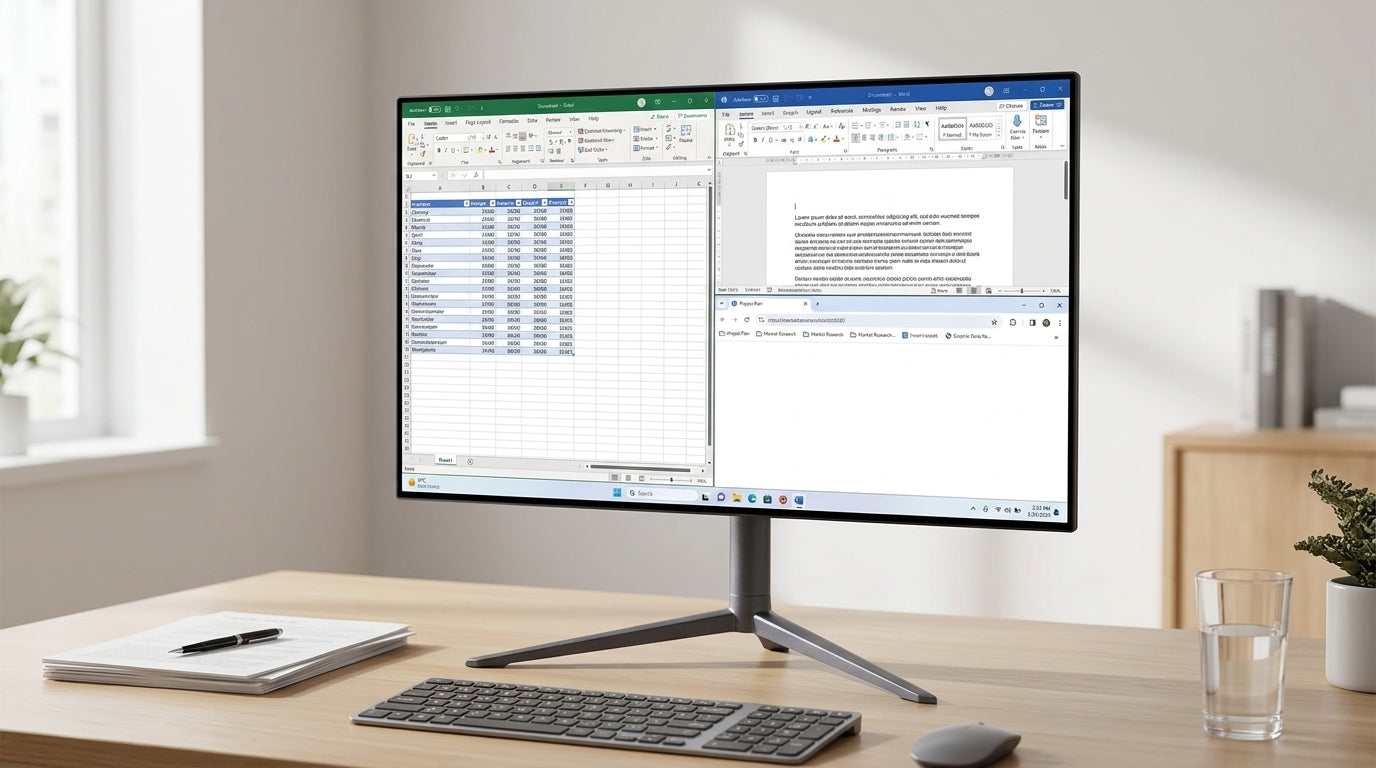
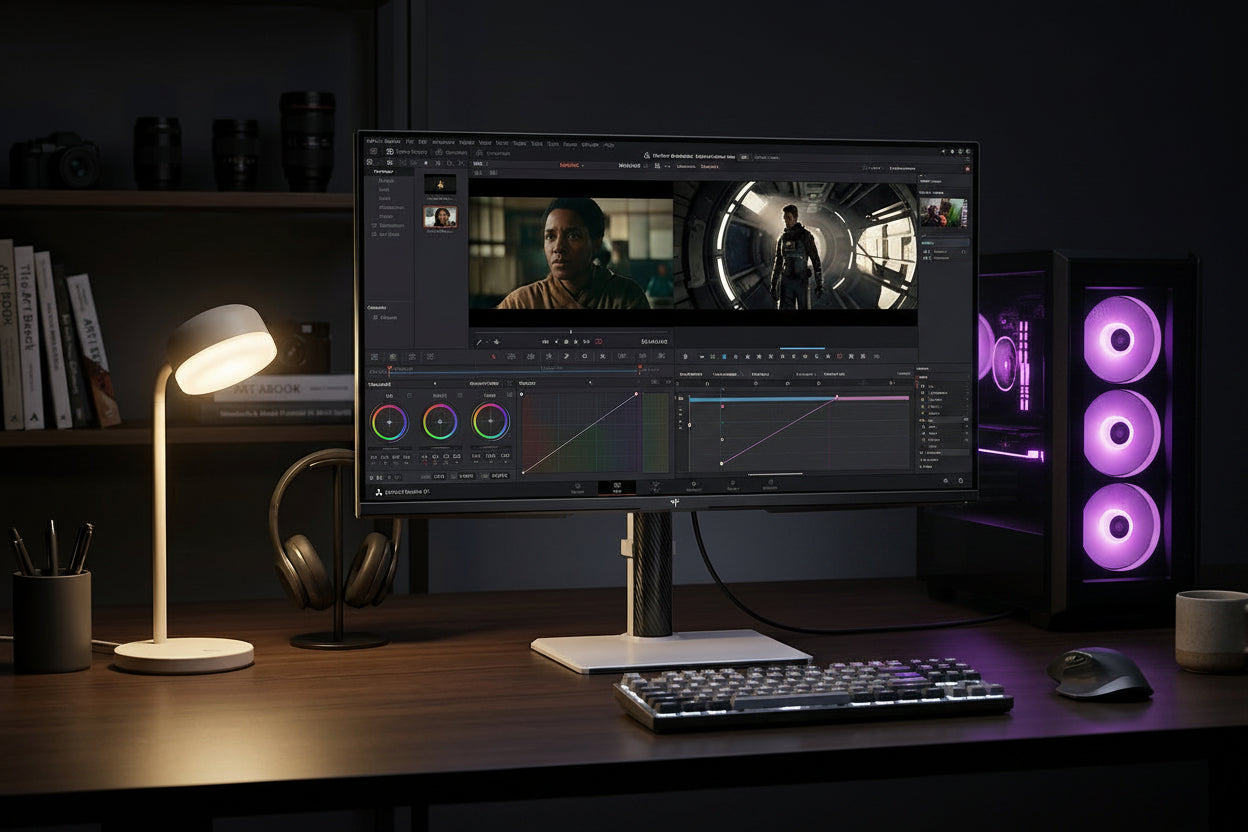
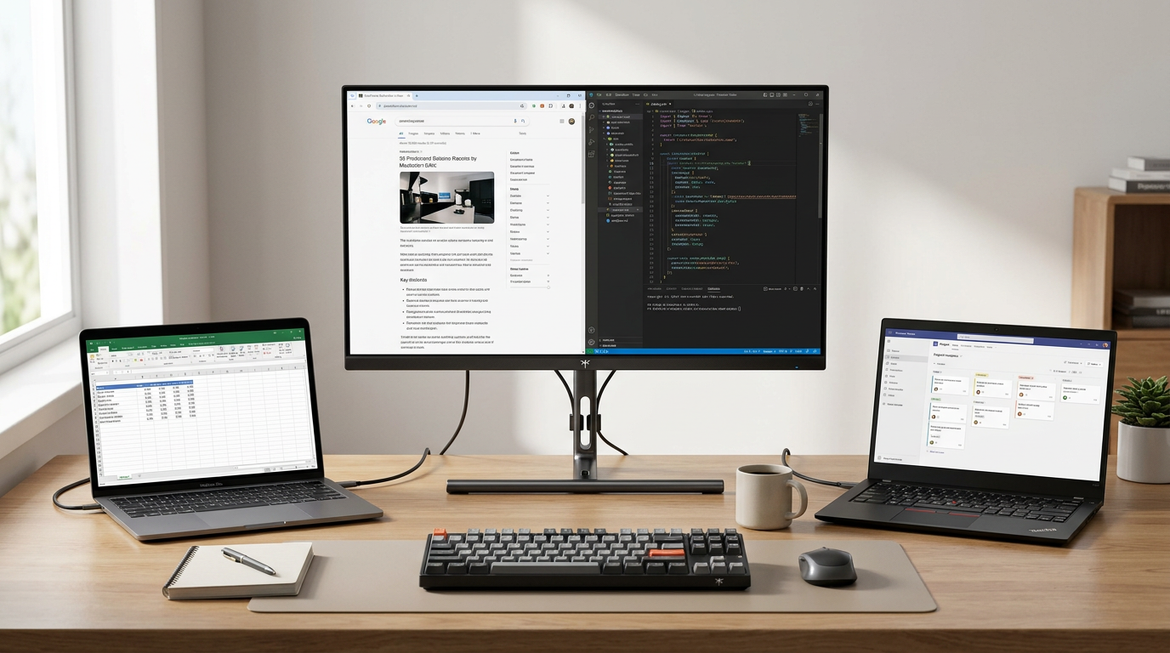
27 inch vs 32 inch monitor is mostly a desk-fit decision first and a sharpness decision second. If your desk is shallow or you sit close, 27 inches is usually the safer default. If you have more depth and want a larger canvas, 32 inches can feel better, especially for split-screen work or entertainment.

Start With Desk Depth and Viewing Distance
Before you compare specs, check how far your eyes sit from the screen. OSHA's computer workstation monitor guidance puts monitor distance in the 20 to 40 inch range, and the American Optometric Association's computer vision syndrome advice suggests 20 to 28 inches as an ideal viewing distance. That does not create one universal rule, but it does show why desk geometry matters.
For most shoppers, a 27-inch monitor is easier to place on a shallower desk because it leaves more room behind the keyboard and does not push the panel as far into your field of view. A 32-inch monitor becomes more comfortable when the desk is deeper or when an arm lets you move the screen back.
A monitor arm can change the answer as much as the panel size itself. If the included stand is deep, fixed, or hard to position, the bigger screen may feel crowded even if the diagonal size looks attractive on paper.
Decision sentence: If your desk is tight and you cannot move the screen back, 27 inches is usually the safer choice; if you can sit a bit farther back or mount the display on an arm, 32 inches becomes much more workable.
Desk Depth That Fits a 27-Inch Screen
A 27-inch screen usually fits better on compact desks because it preserves more usable space in front of you. That matters for laptops, notebooks, docks, and a full-size keyboard.
The real check is not just whether the monitor fits on the tabletop. It is whether the stand leaves enough room for your normal posture without making you lean forward. If the screen feels too close after you place the keyboard where it belongs, the desk is probably telling you to stay smaller.
How Monitor Arms Change the Decision
A monitor arm can reclaim desk space and make either size easier to place at the right distance. That matters most when the included stand is deep or fixed.
If you plan to use an arm, check VESA support, cable length, and whether the arm can hold the screen where you actually want it. A bigger panel does not solve a crowded desk if the arm cannot move it far enough back.

Text Sharpness Changes With Size and Resolution
Size and sharpness are related, but they are not the same thing. RTINGS' 27-inch vs 32-inch comparison puts 27-inch 1440p at about 109 PPI and 32-inch 4K at about 140 PPI. PPI means pixels per inch, or how tightly the image is packed together. Higher PPI usually looks finer at normal desk distance.
That is why a smaller panel can still look cleaner than a larger one if the resolution does not keep up. A 32-inch screen is not automatically sharper just because it is bigger. The resolution has to match the size.
In practice, 32-inch 4K often feels roomier for windows, spreadsheets, and text scaling, while 27-inch 1440p often feels more compact and easier to scan. The better choice depends on whether you want a larger workspace or a tighter reading area.
Decision sentence: If you care most about crisp text and you are choosing between 27-inch 1440p and 32-inch 4K, the 32-inch 4K panel usually has the clarity edge; if you are comparing 27-inch 1440p to 32-inch 1440p, the smaller screen is typically the sharper-feeling option.
| Setup | What it feels like | What usually matters most |
|---|---|---|
| 27-inch 1440p | Compact and easy to scan | Focus, desk efficiency, simpler scaling |
| 32-inch 4K | Roomier and cleaner at normal distance | Text clarity, larger workspace, scaling comfort |
| 32-inch 1440p | Bigger, but not a clarity upgrade | Canvas size, not pixel density |
If you want a deeper explanation of why 4K looks sharper on some monitors than others, that article is a useful follow-up. For Windows users trying to match higher PPI with comfortable scaling, Retina-level clarity on PC is the more relevant next step.
Which Size Fits Work, Gaming, or Both
For productivity, 27 inches tends to work well when you want a focused desktop and faster eye movement between windows. It is often the easier choice on smaller desks, and it stays comfortable for long sessions when you are mostly reading, writing, or coding.
For gaming, 32 inches can feel more immersive, especially in slower-paced or cinematic games, but the payoff depends on having enough viewing distance. On a shallow desk, the extra size can start to feel busy instead of immersive.
For mixed work and gaming, the best size is usually the one that matches your most common session. If you spend more time in docs, browsers, and spreadsheets, 27 inches often feels efficient. If you split windows a lot and want a larger game view after work, 32 inches starts to make more sense.
A useful rule is this: choose compact focus if your desk is the limiting factor, and choose larger canvas if the desk can support it without forcing you to sit uncomfortably close.
Decision sentence: If your day is mostly work with occasional games, 27 inches is the more conservative pick; if your day is split between multitasking and entertainment and your desk is deep enough, 32 inches is the more satisfying fit.
For readers who care about quick visual scanning in strategy games, screen size for RTS visibility gives a useful game-specific angle. If you are worried about oversizing a competitive setup, when a monitor is too big is the better sanity check.
Product Examples That Match Different Buyer Conditions
If you want a 27-inch product that leans toward sharper everyday work, the KTC 27" 4K IPS Home & Office Monitor is a neutral match for buyers who value text clarity, 4K resolution, and a simple office setup. It makes the most sense when your desk supports a smaller screen and you care more about crisp reading than high refresh rate gaming.
If you want a 32-inch option that stays in the 4K camp, the KTC MEGAPAD 32" 4K Smart Touch Monitor is better thought of as a desk-to-entertainment screen than a pure monitor pick. Its size and built-in features matter most when you want a larger display for media, touch use, or room-to-room flexibility.
If you want a larger 32-inch workspace without moving to 4K, the KTC 32" 2K IPS Home & Office Monitor fits buyers who want a bigger canvas, 1440p resolution, and a more relaxed office or casual-gaming setup. It is a good reminder that 32 inches changes the feel of the desk even when the resolution stays moderate.
If you want a 27-inch gaming-first pick, the KTC 27" 2K curved gaming monitor is the most natural fit for players who want a tighter field of view, a curved shape, and faster motion handling. It suits compact gaming desks better than large mixed-use setups.
For shoppers comparing the broader categories, the 27 inch Monitors and 32 inch / 49 inch monitors collections are useful starting points if you want to browse by size before narrowing by resolution or refresh rate. If your setup needs different tuning at home than at work, home office monitor settings is a practical follow-up.
Use a Simple Final Fit Checklist
- Measure the space from where your eyes sit to where the screen will live, not just the empty desktop.
- Decide whether you want a compact focus area or a larger canvas for side-by-side work.
- Check whether your stand, arm, or dock changes the real viewing distance.
- Match size to resolution, because 32 inches does not automatically mean sharper text.
- Choose the screen size that fits your most common session, not the one that sounds better in a spec list.
If you are still undecided on the 27 inch vs 32 inch monitor question, start with desk depth, then ask whether sharper text or larger workspace matters more. That order usually prevents the most common regret: buying a size that looks good online but feels too close, too large, or too cramped at home.
FAQs
How Much Desk Depth Do I Need for a 27-Inch vs 32-Inch Monitor?
There is no single universal number, but desk depth should support a comfortable viewing distance before anything else. If your desk is shallow, 27 inches is usually easier to fit. If you can sit farther back or use an arm, 32 inches becomes more realistic.
Is 27-Inch 1440P Better Than 32-Inch 4K for Text Sharpness?
Usually, 32-inch 4K has the sharper text because the pixel density is higher. The tradeoff is that scaling and viewing distance matter more on the larger screen. If you sit close or dislike UI scaling changes, the smaller screen may still feel easier to live with.
Which Size Is Better for a Mix of Work and Gaming?
For mixed use, the better pick is the one that matches your daily posture. If you spend more time working at a tight desk, 27 inches is usually the safer choice. If you want more immersion and more room for windows, 32 inches is often better when the desk supports it.
Can a 32-Inch Monitor Be Too Large for Competitive Gaming?
It can be, depending on the game and desk setup. A larger screen may require more eye movement, which some fast-paced players do not want. If your desk is shallow or your games reward quick central focus, 27 inches is usually the easier competitive fit.
What Should I Check Besides Screen Size Before Buying?
Check resolution, refresh rate, scaling comfort, stand adjustability, and whether you need a monitor arm. Those factors often matter as much as the diagonal size, especially if you are choosing between a sharper 27-inch setup and a larger 32-inch one.
Wrap-Up
If you want the safest default in the 27 inch vs 32 inch monitor choice, start with desk depth, then match size to your daily use. A 27-inch screen is easier to place and scan, while 32 inches gives you more room when your setup can support it.