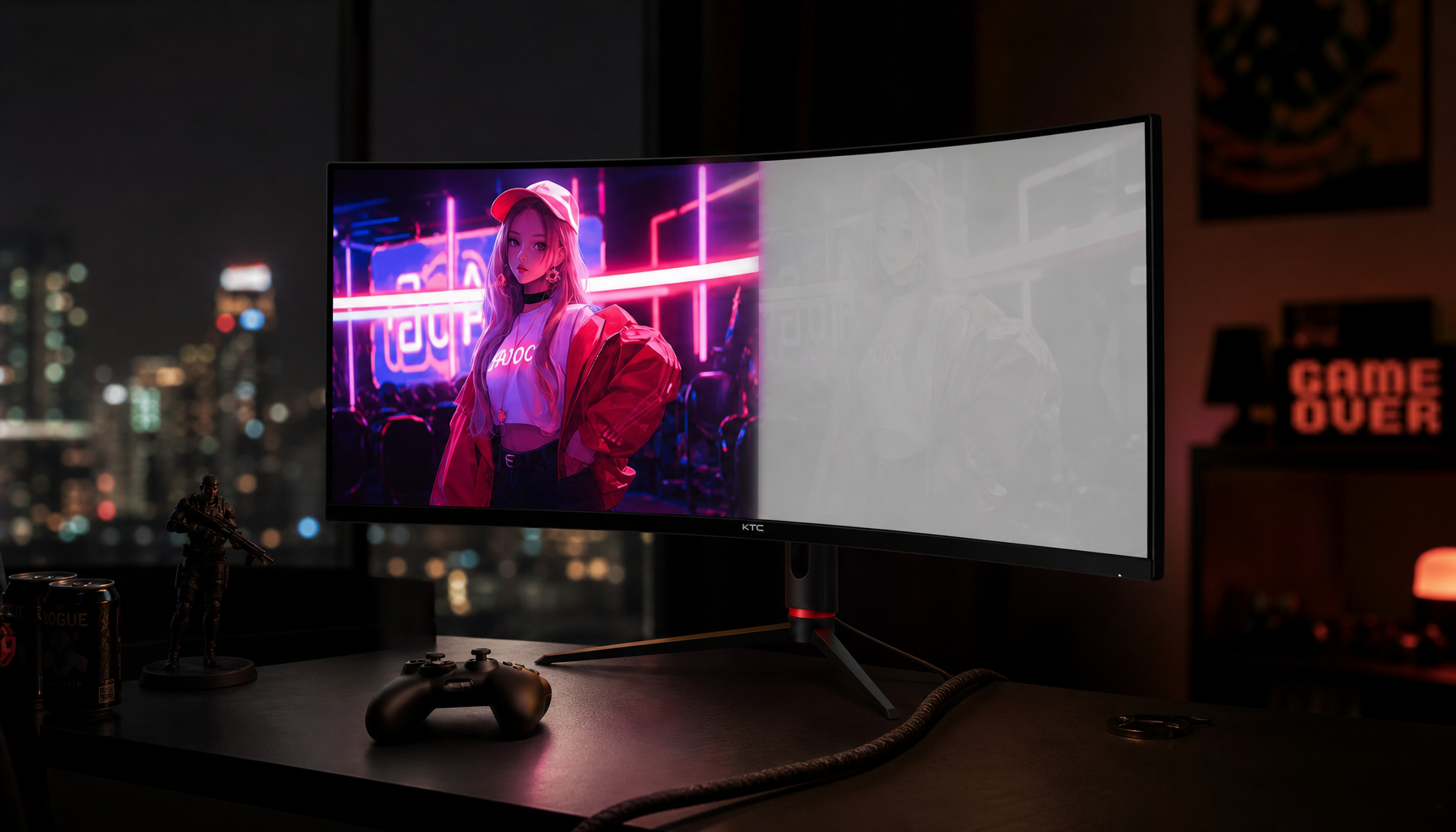
Some OLED panels use polarizers because peak brightness is not the only performance target. A polarizer can trade some light output for deeper blacks, less ambient-light washout, and cleaner HDR contrast in real rooms.
The Tradeoff: Brightness vs. Black-Level Control
OLED’s core strength is pixel-level light control: each pixel can emit its own light or turn off for true black, which is why OLED displays can look so deep and precise in dark scenes.
A polarizer helps protect that advantage when room light hits the screen. Without it, ambient light can bounce inside the panel structure and lift blacks, making dark areas look gray or hazy.

The cost is efficiency. A polarizer blocks part of the panel’s own emitted light, so the screen may need more power to hit the same luminance, or it may top out at a lower peak brightness.
Why Manufacturers Accept the Brightness Hit
For gaming monitors and productivity displays, perceived contrast often matters more than a spec-sheet brightness spike. A 1,000-nit highlight loses impact if the black floor rises beside it.
That matters in common setups: desk lamps, daylight from a side window, color lighting, or overhead office lighting. A polarizer can help dark UI themes, space games, horror scenes, and shadow detail hold together better.

It also helps consistency. OLED monitors already face brightness limits because large bright areas can trigger dimming behavior, and OLED gaming monitors are often judged by the balance between full-screen brightness, highlight punch, text clarity, and burn-in management.
Why Some QD-OLED Panels Skip It
Some QD-OLED designs avoid a traditional polarizer to improve light efficiency and color volume. That can help the panel look more vivid, especially in controlled lighting.
The drawback is that room light can raise perceived blacks. In a dark room, this may be hard to notice. In a bright office or sunlit gaming space, the same screen can lose some of OLED’s signature ink-black look.

This is why two OLEDs with similar peak-brightness numbers can feel different. One may win in dark-room HDR punch; another may look more stable and contrasty during daytime use.
Panel type, coating, tone mapping, and firmware all matter, so whether a display has a polarizer is useful context, not a full buying verdict.
What It Means for Gamers and Desk Users
For competitive gaming, a brighter polarizer-free panel can look vivid in HDR highlights, neon effects, and saturated game worlds. If you play mostly at night or in controlled lighting, that design can be a strong fit.
For office productivity, mixed use, and bright rooms, a polarizer can be worth the peak-brightness loss. Text, dark app panels, and high-contrast windows tend to look more stable when ambient light is controlled.

OLED brightness behavior is already tied to content size and protection logic. Discussions around HDR setup often separate general brightness from peak brightness, because peak brightness mainly governs how far highlights are allowed to rise.
How to Choose
Pick based on your room first, then your spec sheet.
- Bright room or office: favor stronger ambient-light control.
- Dark gaming room: prioritize HDR peak brightness and color volume.
- Mixed productivity: value stable brightness and burn-in protections.
- Movie-first setup: protect black depth and shadow detail.
- Esports-first setup: prioritize refresh rate, response time, and clarity.
The best OLED is not always the brightest one. It is the one that keeps contrast, highlights, and usability aligned with how you actually play, work, and watch.