Matte coatings usually reduce distracting glare in bright rooms, while glossy coatings usually preserve sharper contrast and richer image depth in controlled lighting. The healthier choice is the one that keeps you from squinting, leaning forward, over-brightening the screen, or fighting reflections for hours.
Is your monitor forcing you to dodge window glare at 2:00 PM, then tempting you with perfect OLED blacks after dark? After comparing matte office panels with glossy and semi-gloss OLED displays, the practical win is clear: you can reduce daily eye fatigue by matching the coating to your room instead of chasing the most premium finish. Here is how to choose the coating that protects comfort without giving up the performance you bought the screen for.
The Core Difference: Scattered Light vs. Mirror-Like Light

A matte display coating is an anti-glare surface that diffuses incoming light, spreading reflections across the panel so a lamp or window does not appear as a sharp mirror image. A glossy coating is smoother, so it reflects light more directly while letting the panel’s native contrast, color saturation, and perceived sharpness come through with less haze.
That trade-off matters because eye strain is often driven by visual conditions around the display, not only by the screen itself. Long periods of close focus, glare, bright lighting, dirty screens, poor prescriptions, and reduced blinking during screen use are all common contributors to eye strain. In practice, the coating is one part of a larger comfort system: room lighting, brightness, distance, refresh behavior, text clarity, and your own sensitivity to reflections all stack together.
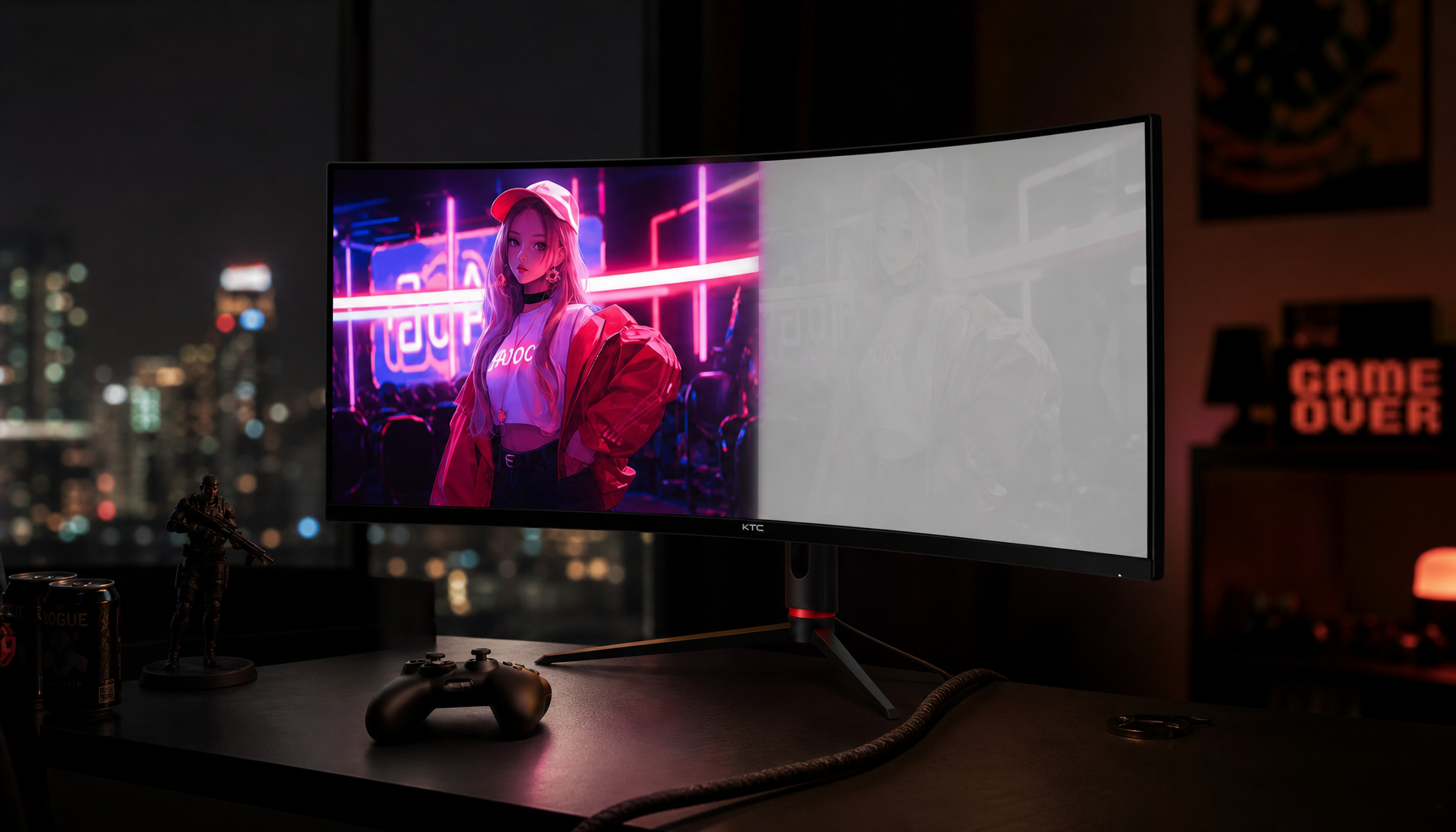
The coating difference shows up fastest in two moments. In a bright office, a glossy panel can make your face, window, or ceiling light compete with the text. In a dim gaming room, a heavy matte layer can make a premium panel look slightly veiled, with blacks and highlights feeling less direct.
Matte Displays: Better Glare Control, With a Clarity Cost

Matte coatings are usually the safer default for office productivity, shared workspaces, classrooms, trading desks, and daytime home offices. Their strength is predictability. If you have overhead lights, a window behind you, or changing daylight across the workday, matte reduces the chance that one bright object becomes a hard reflection in the middle of your document or game HUD.
The eye-health advantage is behavioral. When glare is controlled, you are less likely to squint, raise brightness too high, lean closer, or tilt your neck to dodge reflections. Practical eye-comfort guidance often includes keeping screens clean, reducing workspace glare, using a matte screen filter when needed, and placing screens about 20 to 26 inches from the face, slightly below eye level. A real-world check is simple: open a white document at your normal brightness at noon. If you can read comfortably without seeing a lamp shape or window frame, the coating and lighting are working together.
The cost is image purity. An OLED coating comparison found that matte anti-glare finishes generally handled reflections better, while glossy and semi-gloss coatings tended to preserve clearer image depth and stronger perceived clarity in controlled lighting. On high-end OLED and high-PPI productivity screens, a strong matte layer can introduce visible grain or haze, especially on white backgrounds, small text, and fine UI lines.
Glossy Displays: Sharper Perceived Image, Higher Reflection Risk

Glossy coatings are compelling because they make a good panel look more vivid. Blacks can feel deeper, colors can look more saturated, and fine edges can appear cleaner because the coating is not scattering as much panel light before it reaches your eyes. For HDR gaming, photo review, video playback, and immersive single-player titles in a controlled room, glossy can make the screen feel more transparent and dimensional.
The eye-health trade-off appears the moment the room pushes back. A glossy screen can reflect a window, desk lamp, white shirt, or your own face with enough sharpness to compete with the content. That does not mean glossy is automatically unhealthy, but it can become fatiguing if your eyes constantly jump between screen content and reflected objects. Eye discomfort from poor visual conditions can be uncomfortable, even though computer vision syndrome and screen-related discomfort are generally not considered causes of permanent vision damage.
For a gaming monitor, the practical test is strict but useful. Turn the screen off during the time of day you use it most. If you can clearly see a window, lamp, or your face in the panel, glossy will probably require room changes. If the room becomes visually quiet with curtains, side lighting, or a repositioned desk, glossy can reward you with the most immersive image.
Anti-Reflective Is Not the Same as Matte
This is where many buyers get trapped. “Anti-glare,” “anti-reflective,” “matte,” “semi-gloss,” and “glossy with AR glass” are not interchangeable terms. Matte usually reduces reflections by scattering them. Anti-reflective treatments aim to reduce reflected light without necessarily creating the same grainy diffusion. Semi-gloss coatings sit between the two, often preserving more contrast than matte while avoiding some mirror behavior.
Eyeglass lens coatings make the distinction easier to understand. Anti-reflective lens coatings are sold in tiers, and higher tiers may add easier cleaning, durability, UV protection, dust resistance, and sometimes blue-light filtering, while blue-light filtering may also be a separate lens option in some plans. The monitor lesson is similar: do not assume one marketing phrase tells you the whole optical behavior. A light matte coating can look cleaner than a rough matte coating, and a glossy panel with advanced anti-reflective coatings can behave differently from bare glass.
Eyeglass-coating buying advice also applies to displays: judge coating upgrades by use case, price, and warranty instead of treating them as automatic improvements. For monitors, that means checking real reviews for coating upgrades, reflection handling, text clarity, brightness behavior, and coating grain instead of buying only by the matte-or-glossy label.
Which Coating Is Better for Eye Comfort?
The better coating is the one that reduces visual effort in your actual room. For a bright office, matte usually wins because reflection control matters more than maximum contrast. For a dark or light-controlled gaming space, glossy or semi-gloss often wins because the screen can deliver sharper perceived contrast without fighting ambient light. For mixed-use desks, semi-gloss or a lighter matte finish is often the premium compromise.
Use Case |
Better Starting Point |
Eye Health Trade-Off |
Bright office with windows or overhead lights |
Matte |
Less sharp reflection, but possible haze on text |
Controlled gaming room |
Glossy or semi-gloss |
Stronger contrast, but reflections must be managed |
Portable screen used in changing locations |
Matte |
More reliable visibility, less image pop |
OLED HDR gaming |
Glossy or semi-gloss if lighting is controlled |
Better depth, higher reflection sensitivity |
Long document work |
Light matte or high-quality anti-reflective |
Comfort depends heavily on text clarity and brightness |
A simple calculation helps. If you use a monitor eight hours a day and only game in a dark room two hours at night, your coating should serve the eight-hour environment first. If your screen is mainly for competitive gaming after work in a controlled room, image clarity and contrast may matter more than daytime reflection control.
Brightness, Distance, and Breaks Matter More Than Coating Alone

A matte screen with bad brightness settings can still exhaust your eyes. A glossy screen in a well-controlled room can be comfortable for long sessions. The coating reduces or intensifies certain problems, but it does not replace ergonomic setup.
Eye-comfort monitor guidance often highlights reduced blue light, flicker-conscious design, higher refresh rates up to 120Hz on some models, and ambient light sensors that adjust brightness and color temperature on supported displays. Those features matter because a screen that is too bright at night or too dim at noon makes your eyes keep adapting. For a fast practical check, compare a blank white document to a sheet of white printer paper under your room lighting. If the screen looks like a light source instead of paper, reduce brightness. If it looks gray and dull, raise it slightly.
Break behavior still counts. The 20-20-20 rule means that every 20 minutes, you look about 20 feet away for 20 seconds, which helps interrupt the close-focus load of screen work. For gamers, that can happen between rounds. For office users, it can be tied to saving a file, sending a message, or switching documents.
Buying Advice for Gaming, Office, and Portable Screens

For a pro gaming monitor, choose glossy or semi-gloss if you can control light with curtains, side lamps, and desk placement. This is especially attractive for OLED, where perceived black depth and HDR punch are part of the premium experience. If your setup includes daylight, ceiling lights, streaming lights, or a bright wall behind you, a high-quality matte or semi-gloss panel will likely feel better over a long session.
For office productivity displays, favor matte or light anti-glare coatings, then prioritize high pixel density, ergonomic adjustment, flicker control, and brightness range. Text fatigue often comes from a combination of glare, small fonts, poor contrast, and bad posture. A 27-inch 4K office display with a refined matte coating can be easier to live with than a punchier glossy panel that reflects every ceiling fixture.
For portable smart screens, matte is usually more reliable because the environment changes constantly. Airports, hotel desks, coffee shops, client rooms, and kitchen counters all introduce unpredictable light. Glossy portable screens can look excellent for video, but they demand more positioning effort. If you cannot control where the light comes from, glare control has more real value than perfect contrast.
FAQ
Does Matte Automatically Mean Better for Your Eyes?
No. Matte reduces sharp reflections, which can lower visual stress in bright rooms, but a poor matte coating can add haze that makes text less crisp. Comfort comes from the combination of coating, brightness, panel quality, viewing distance, and lighting.
Does Glossy Damage Your Eyes?
Glossy does not damage your eyes by itself. The risk is practical fatigue from reflections, squinting, and over-brightening the screen to overpower glare. If the room is controlled, glossy can be comfortable and visually superior.
Should Blue-Light Filtering Decide the Coating Choice?
No. Blue-light filtering and surface coating solve different problems. Strong evidence is lacking that digital-device blue light causes eye strain, so focus first on glare, brightness, breaks, and text clarity.
Final Verdict
Choose matte when your room is bright, shared, or unpredictable. Choose glossy or semi-gloss when you can control lighting and want maximum immersion, contrast, and image clarity. The performance-driven choice is not the shinier or flatter finish; it is the coating that lets your eyes stay relaxed while the display does its best work.