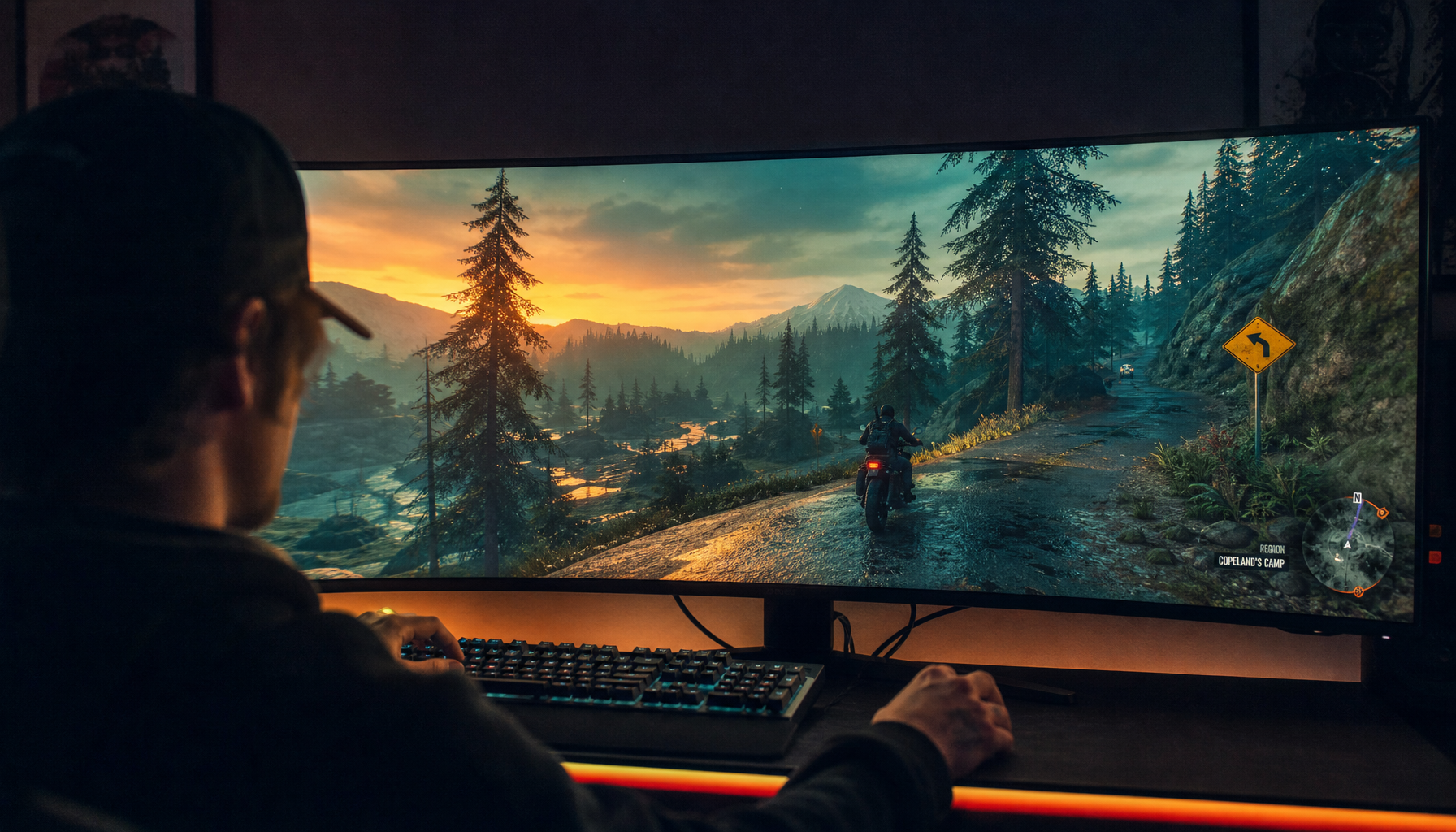
A 34-inch ultrawide is wide enough that edge UI can fall outside your comfortable eye-only viewing zone, especially if the monitor is too close or your main window is off-center.
Do you keep turning your nose toward the minimap, tool panel, chat window, or spreadsheet columns at the far edge of your screen? A five-minute setup check can usually show whether the problem is distance, height, curvature, or window placement, and the fix is often as simple as moving the monitor back and centering the task you use most. You can make a 34-inch ultrawide feel immersive without making your neck do the work.
The Real Reason: Width Changes the Ergonomics

A 34-inch ultrawide is not just a bigger monitor. It is a wider canvas, commonly using a 21:9 aspect ratio, so it pushes more pixels into your side vision than a standard 16:9 display. That extra horizontal room is why ultrawides work so well for timelines, spreadsheets, coding, trading dashboards, and immersive games, but it also means your eyes and neck have to manage a wider scan path.
The key distinction is eye movement versus head movement. In normal use, your eyes can glance around the center of the screen quickly. When UI elements sit too far left or right, though, you start rotating your head so your eyes can land on them clearly. Ergonomic ultrawide guidance often treats the central work area as the priority because ultrawide monitors can cause neck and shoulder strain when high-use apps live at the edges.
In hands-on desk tuning, the most common mistake is centering the physical panel while letting the active task drift left or right. The monitor looks symmetrical; the workflow is not. If your browser, game HUD, code editor, or timeline controls are off to one side, your body follows the workload, not the bezel.
How Wide Is a 34-Inch Ultrawide in Practice?
A typical 34-inch ultrawide is roughly 31 inches wide and about 13 inches tall. That is close to the height of a 27-inch 16:9 monitor, but with much more side-to-side room. In this category, a 34-inch 21:9 panel is roughly as tall as a 27-inch screen, while ultrawide formats add about 30% more width than comparable 16:9 displays, which is why 34-inch 21:9 is roughly as tall as a familiar 27-inch monitor but feels much broader.
That extra width changes your viewing angles. If your eyes are about 28 inches from the screen, each edge of a 31-inch-wide panel sits at a noticeable angle from center. Move closer and the edges feel even farther away. Move back and the same screen becomes easier to scan with smaller head turns.
Setup Factor |
What It Feels Like |
Better Starting Point |
Screen too close |
Edges feel like separate zones |
Try 31 to 39 inches away |
Main app off-center |
Neck turns repeatedly |
Center the primary task |
Top edge too high |
Chin lifts and shoulders tense |
Put top third at or below eye level |
UI text too small |
You lean forward |
Increase scaling before moving closer |
Far edges overused |
Constant scanning fatigue |
Reserve edges for passive content |
The Comfort Zone: Center the Work, Not the Monitor

For a 34-inch ultrawide, the most valuable rule is simple: your main task belongs directly in front of your body. That could be your crosshair and HUD in a game, your editor in a coding setup, your active spreadsheet region, or the document you are editing. The physical screen can stay centered, but the hot zone of work should be centered even more carefully.
Ultrawide setup guidance often recommends using the center 40% to 50% of the screen for active work, with secondary apps farther out and static information at the edges, because content beyond roughly 30 degrees usually requires more meaningful head rotation. In real terms, your active writing window might sit in the center, with messaging or music off to one side and a calendar or system monitor on the other.
For gaming, this matters in a different way. Many 34-inch 3440 x 1440 OLED and VA models can deliver strong immersion and high refresh rates, but even a fast panel does not fix bad HUD placement. A racing sim or open-world game can feel fantastic on a 21:9 display, while a competitive title with tiny edge UI may make you swivel your head if the interface is not scalable or movable.
Distance: The Cheapest Fix Is Often Moving the Screen Back

If you feel forced to turn your head, check distance before blaming the monitor. Many 34-inch ultrawides are placed like 24-inch monitors, too close to the keyboard and too close to the eyes. That makes the panel feel larger than your visual system wants for all-day work.
A practical range for many 34-inch and larger ultrawide setups is about 31 to 39 inches from your eyes, and that usually requires a desk with enough depth to avoid crowding. KTC’s ultrawide positioning advice suggests starting around 24 to 31 inches for many large curved displays, while other guidance pushes many 34-inch-plus setups farther back. The difference is not necessarily a contradiction; tighter gaming desks, eyesight, text size, and curvature all change what feels comfortable.
The reliable test is behavioral. Sit normally, put your keyboard and mouse where your hands naturally land, then open the apps you actually use. If checking a toolbar, minimap, timeline bin, or chat pane makes your chin point away from center again and again, the window is too far out, the screen is too close, or both.
Height and Tilt Still Matter on Ultrawides

Horizontal width gets most of the blame, but vertical placement can quietly make the problem worse. If the monitor is too high, you lift your chin while also rotating your neck, which compounds fatigue. If it is too low, you may lean forward and shorten the viewing distance, making the edges feel wider.
A strong starting point is to place the top third of the usable screen at or slightly below eye level. General monitor-height guidance uses the familiar ergonomic baseline that the top edge of the screen should sit at or just below eye level, while ultrawide-specific setup refines that idea by focusing on where your most-used content actually lives.
A small backward tilt can also help. For many desks, a 5- to 10-degree upward-facing tilt improves visibility across the lower part of the panel without pushing the top edge into an awkward line of sight. If glare appears, fix lighting first where possible; do not keep tilting until posture suffers.
Curved vs. Flat: Helpful, Not Magical

A curved 34-inch ultrawide can make edge viewing feel more natural because the sides sit slightly closer to you than they would on a flat panel. That can reduce the far-corner feeling and improve immersion, especially in racing games, flight sims, first-person games, and wide productivity layouts.
But curvature is not a posture cure. Curved ultrawides can be useful for productivity and immersion, yet the biggest advantage remains the extra horizontal workspace, not a guarantee that every pixel becomes equally comfortable. A curved display can help the edges feel less distant, but extra horizontal screen space still needs smart placement.
The curve number also needs context. A 1500R curve feels more noticeable on a 34-inch 21:9 panel than on a narrower 27-inch display because more screen wraps into your peripheral vision. If you do mostly text, spreadsheets, and document editing, a gentle curve may feel cleaner. If you play immersive games or run side-by-side tools, a stronger curve can feel more enveloping.
Pros and Cons of a 34-Inch Ultrawide
A 34-inch ultrawide shines when you treat it like a command surface. You can keep a document beside a browser, a timeline beside preview tools, or a game world across a wider field of view. You lose the bezel gap of dual monitors, and many modern ultrawides add USB-C, KVM, higher refresh rates, and better docking features for hybrid workstations.
The tradeoff is that the screen rewards discipline. If every app is treated as equally important and every edge is used for constant reading, the display becomes physically demanding. If the center is reserved for active work and the edges are used for lower-frequency information, the same monitor feels calmer, faster, and more useful.
For office productivity, a 34-inch 3440 x 1440 ultrawide is often the ergonomic sweet spot because it adds meaningful width without reaching the more demanding span of 40-inch, 45-inch, or 49-inch displays. For gaming, it delivers stronger immersion than 16:9 while staying easier to drive than some higher-resolution super-ultrawides.
A Practical Setup That Works
Start by sitting in your normal working posture, not an idealized one. Place the monitor so the center of your main task lines up with your nose, sternum, keyboard, and mouse. Then move the display back until the left and right edges can be checked with modest eye movement and only occasional head movement.
Next, set the height so your eyes land near the upper third of the active screen area. Increase font size, browser zoom, game HUD scale, or operating system scaling before pulling the monitor closer. This is especially important on 3440 x 1440 panels, where sharp text can tempt users into running UI too small.
Finally, zone your screen with intent. Put the active document, game focus, spreadsheet cells, code editor, or creative canvas in the center. Put reference pages, chat, music, file browsers, and monitoring panels to the sides. Put rarely checked widgets at the far edges. The result is not less screen; it is better screen economy.
FAQ
Is it normal to move my head on a 34-inch ultrawide?
Some head movement is normal. The warning sign is repeated or sustained turning for common tasks. If you are constantly rotating toward the same UI element, that element belongs closer to the center or the screen needs more distance.
Should I buy a smaller monitor if this bothers me?
Not immediately. Try moving the monitor back, increasing scaling, and recentering your main app first. If your desk is shallow or your work requires constant reading at both far edges, a 27-inch or dual-monitor setup with a clearly centered primary display may fit better.
Is a 49-inch super-ultrawide worse for this?
It can be more demanding. A 49-inch 32:9 display gives tremendous workspace, but it requires more distance, stricter zoning, and more desk depth. For many all-day productivity users, 34 inches is easier to live with.
Final Word
You need to move your head because the UI is outside your comfortable viewing zone, not because ultrawides are flawed. Set the 34-inch panel farther back, center the work that matters, keep the top third near eye level, and use the edges as support space. That is how an ultrawide becomes a performance upgrade instead of a neck workout.