AI picture modes can overcorrect skin tones when they mistake lighting, makeup, camera white balance, or underrepresented complexion data for a “problem” to fix, then push warmth, saturation, smoothing, or contrast too far.
Does a person on your screen suddenly look too orange in a video call, too gray in a movie, or strangely glossy in a creator’s portrait? A practical display check can usually separate a bad panel setting from an AI enhancement mistake in under five minutes: compare Standard, Creator/sRGB, and AI modes on the same paused face. You’ll know why it happens, when AI helps, and how to tune your screen without flattening real skin detail.
AI Is Guessing What “Healthy” Skin Should Look Like
AI-powered picture modes work by analyzing visual patterns and applying automated corrections. In a monitor, TV, phone, or editing app, that often means the system tries to identify faces, estimate the scene, then adjust color temperature, tint, contrast, saturation, sharpness, local brightness, and sometimes skin smoothing.
The problem is that skin tone is not a single target. It is a mix of hue, undertone, brightness, saturation, lighting, camera response, makeup, compression, and the display’s own color profile. A tool built to “improve” skin may decide that a face under warm desk lighting needs cooling, that darker skin needs lifting, or that visible texture needs smoothing. Those choices can make a person look less real, even when the image looks more polished at first glance.
For display buyers and power users, the key distinction is simple: AI picture modes are optimized for pleasing output, not always faithful output. That is useful for casual streaming and quick social content, but risky for photo review, color-sensitive office work, telehealth, ecommerce, beauty content, and any professional workflow where human appearance matters.
What Overcorrection Looks Like on a Monitor
Overcorrection usually shows up in four repeatable ways. Skin becomes too orange or red, especially in warm scenes. Darker complexions lose depth because the display lifts shadows and midtones too aggressively. Faces become waxy because noise reduction and smoothing remove pores and natural texture. Mixed lighting turns uneven, with the face, neck, and hands drifting into different color families.
A common real-world example is a laptop connected to a wide-gamut external monitor with an “AI vivid” or “smart HDR” mode enabled. A video call may look punchier, but the same person’s forehead becomes red, the cheeks look airbrushed, and the neck stays cooler. That is not necessarily a camera failure. It can be a chain reaction: webcam auto white balance, app compression, display enhancement, and AI skin correction all making small decisions on top of each other.

Editing tools expose the same logic more transparently. One portrait workflow separates manual skin tone controls from AI unification, including temperature, tint, radiance, rosy complexion, and local masking; those controls show how many different variables a “skin tone” correction can actually touch skin tone controls. When a display hides those decisions behind one picture mode, the user gets speed but loses precision.
Why AI Gets Skin Tone Wrong
Training Data Can Be Uneven
AI models learn from examples. If the examples underrepresent certain skin tones, lighting conditions, or undertones, the system may become better at correcting some faces than others. This is not a minor academic concern. A methodological study of AI-generated medical imagery found that standard image-generation outputs significantly overrepresented lighter skin tones, with only one dark-skin image across 200 standard generated images overrepresented lighter skin tones.

The display implication is practical. If an enhancement engine has seen more fair skin under studio lighting than deep skin under mixed indoor lighting, it may treat natural variation as an error. On screen, that can mean darker skin gets brightened until it looks flat, undertones shift toward red or yellow, and contrast around facial features becomes less believable.
Dermatology AI research reaches a similar warning from a higher-stakes angle: biased training data can reduce model performance for darker skin and reinforce inequity when systems are deployed broadly biased training data. A gaming monitor picture mode is not diagnosing melanoma, but the technical lesson carries over: a model that is not validated across the full range of human skin will not correct all people equally well.
Skin Tone Is More Than Light or Dark
Many systems still treat skin as a brightness problem. That is too crude. Skin has hue, undertone, luminance, saturation, texture, and surrounding color context. A person with a warm golden undertone under cool LED light needs a different correction than a person with a neutral undertone under sunset light.
The Monk Skin Tone Scale was introduced as a 10-point alternative to older, coarser scales, and it also reinforces an important point for image systems: skin tone should be handled separately from race because broad identity labels hide huge color variation. For display tuning, that means a mode labeled “portrait,” “AI face,” or “skin enhance” may still be operating from simplified assumptions.
This is why two people in the same frame can break an AI mode. A monitor may warm the entire image to make one face look lively, while the other face becomes too saturated. Or it may lower red and orange globally, fixing a flushed forehead while making lips, hands, and wood furniture look dull.
Lighting Confuses the Correction
Bad lighting often creates the symptom that AI modes are trying to solve. Harsh fluorescent lighting can make skin look uneven, dim indoor light can flatten complexion, and mixed light from a window plus a lamp can split the face into two different color temperatures. Consumer skin tone editors frame complexion correction around exactly these lighting problems, including washed-out or distorted skin under poor light.

The trouble starts when AI cannot tell whether the color cast is intentional. A movie scene lit by neon, a game character under firelight, or a streamer using magenta accent lights should not be forced back into neutral office lighting. If the picture mode “fixes” the face, it may destroy the scene’s mood.
For gaming, this can be especially visible in HDR. AI contrast enhancement may lift faces in dark cutscenes, then add saturation so characters stand out. That looks impressive in a store demo, but during actual play it can make cinematic skin look sunburned or synthetic.
Texture Smoothing Can Hide Real Detail
Skin does not look real because it is perfectly smooth. It looks real because it has pores, fine lines, subtle color variation, and uneven reflection. When AI picture modes combine face detection with noise reduction, sharpening, and smoothing, the result can be a glossy “plastic” look.
This matters more on high-refresh gaming monitors and 4K productivity displays because sharp panels reveal processing artifacts quickly. A 27-inch 4K screen at desk distance can make waxy skin obvious in a way a small cell phone screen may hide. If you review creator assets, product portraits, or team headshots, over-smoothing can make you approve edits that look fake on another screen.
When AI Picture Modes Help
AI modes are not the enemy. They can be valuable when the source is weak, the room is bright, or the user wants a fast, pleasing image without manual tuning. A portable smart screen used in a hotel room, for example, may benefit from smart brightness and face-aware tone mapping during a video call. A casual viewer watching compressed streaming video may prefer a cleaner, warmer image over strict accuracy.

A skin tone changer emphasizes fast correction for mismatches between face, neck, and body, which is a valid use case when lighting or camera conditions create visible inconsistency visible mismatches. The same idea applies to display processing: quick correction can make a flawed source easier to watch.
The tradeoff is control. AI helps most when the goal is “make this look better quickly.” It helps least when the goal is “show me what is actually in the file.”
Use Case |
AI Picture Mode Value |
Better Choice When Accuracy Matters |
Casual streaming |
High |
Standard or Cinema if skin looks exaggerated |
Competitive gaming |
Medium |
Game mode with color enhancements reduced |
Photo editing |
Low |
sRGB, Creator, or calibrated custom mode |
Video calls |
Medium |
Neutral picture mode plus camera white balance |
Portable screen in changing rooms |
Medium to high |
Save one neutral preset and one vivid preset |
How to Stop Skin Tone Overcorrection
Start by turning off the strongest processing layer. On many displays, that means disabling AI picture, dynamic contrast, vivid color, skin enhancement, noise reduction, and automatic HDR tone expansion one at a time. Do not change everything at once. Pause on a face with forehead, cheek, neck, and hand visible, then toggle one setting and watch whether those areas move together or drift apart.
Next, choose a color-accurate baseline. For office productivity displays, sRGB or Creator mode is usually the better starting point than Vivid. For gaming monitors, use the least aggressive Game preset that still gives you the response features you bought the panel for. For portable smart screens, save a neutral preset for work and a punchier preset for entertainment.
Then adjust warmth before saturation. If skin looks orange, lowering saturation alone may make it dull instead of accurate. Post-production skin tone workflows often treat hue, saturation, and luminance separately, with red, orange, and yellow channels needing careful handling red, yellow, and orange saturation. On a monitor, the simpler version is to reduce color temperature warmth first, then back down color saturation only if faces still look too intense.
Finally, test with more than one person. A single fair-skinned headshot under studio light is not enough. Use a short video call clip, a movie scene with mixed lighting, a sports broadcast, and a portrait with darker skin. If one setting makes every face converge toward the same peach, bronze, or gray tone, the processing is too heavy.
Pros and Cons for Display Buyers
AI picture modes are attractive because they reduce effort. They can rescue dull webcam feeds, add punch to compressed video, and help portable screens adapt to inconsistent rooms. For users who do not calibrate displays, that convenience has real value.
The downside is that AI can make invisible decisions about identity, complexion, and realism. Coverage of AI dermatology image research reported that only 10.2% of generated dermatology images depicted dark skin, while nearly 90% depicted light skin, showing how skewed image systems can become when representation is weak dark skin. In consumer displays, the risk is not medical diagnosis, but the visual bias can still affect trust, taste, and professional output.
For a serious monitor setup, the strongest buying strategy is to treat AI as a preset, not a foundation. You want a panel with solid native color coverage, reliable sRGB behavior, good grayscale tracking, and manual controls. AI should be optional, easy to disable, and preferably adjustable by intensity.
A Practical Five-Minute Test
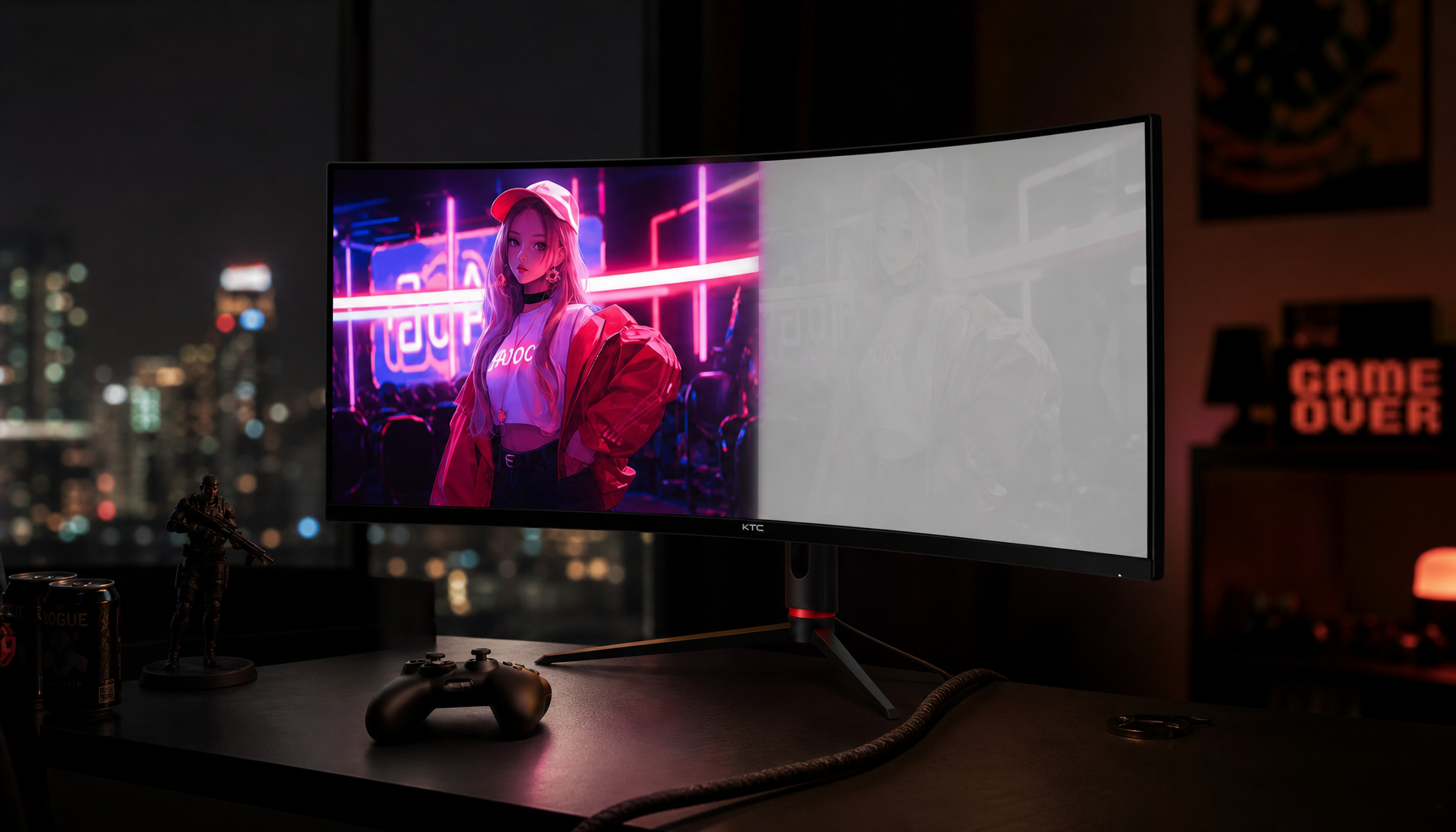
Open the same portrait or paused video across three modes: Standard, sRGB or Creator, and the AI-enhanced mode. Keep brightness constant if possible. Look first at the neck and hands, because faces often include makeup, filters, or app beautification. If the AI mode makes the face warmer but leaves the neck cool, it is not correcting skin globally; it is selectively beautifying.

Now check shadowed skin. If darker areas lose shape and become gray or lifted, the mode is overusing local brightness. If cheeks become glossy or pores disappear, smoothing is too strong. If lips, wood desks, orange clothing, and skin all become more saturated together, the display is applying broad color enhancement rather than intelligent skin correction.
For creative work, finish by returning to the neutral mode before making edit decisions. AI display processing can trick you into under-correcting or over-correcting the actual file. That mistake travels: the image may look fine on your enhanced monitor and wrong everywhere else.
FAQ
Should I leave AI picture mode on all the time?
No. Leave it on when you prefer a punchier entertainment image, but turn it off for photo editing, design review, ecommerce images, medical visuals, and any work where skin accuracy affects decisions.
Is overcorrected skin a monitor problem or a content problem?
It can be either, but it is often the stack. Camera auto white balance, app filters, compression, HDR conversion, and display AI can all push the same face in different directions. Testing the same content in a neutral mode is the fastest way to isolate the display’s role.
Do darker skin tones need different display settings?
They do not need a separate “special” setting. They need a display mode that preserves real luminance, undertone, and texture without forcing all complexions into one preferred look. A discussion of skin tone bias in AI dermatology highlights how underrepresentation can reduce reliability for darker Fitzpatrick types, which is a reminder to test displays with diverse faces before trusting an automated mode skin tone bias.
The Bottom Line
AI-powered picture modes overcorrect skin tones because they optimize for a guessed ideal, not always for the person, scene, or file in front of you. Use them as a convenience layer, keep a neutral preset ready, and judge any display by how well it preserves human variation when the enhancement switch is off.