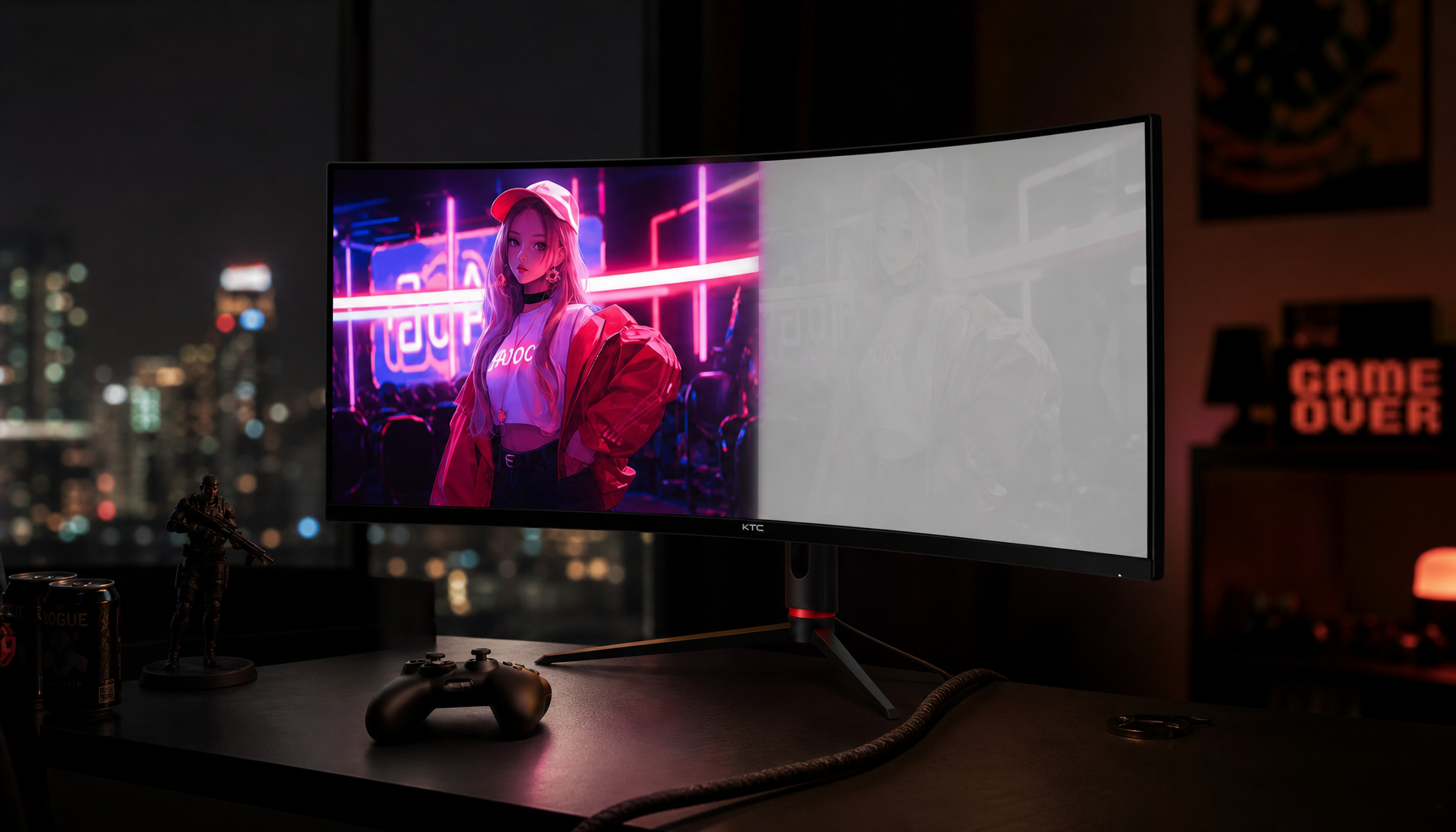
Black levels change on camera because the display, camera sensor, exposure, processing, and playback screen all interpret “dark” differently. What looks like deep black to your eyes can become gray, crushed, noisy, or haloed once it passes through a viewfinder or recording pipeline.
Ever aimed a camera at an OLED gaming monitor and wondered why perfect blacks suddenly look lifted, blotchy, or surrounded by glow? With a few controlled checks, you can separate a real display issue from a camera-created artifact before blaming the panel, returning the monitor, or changing your calibration. You will learn why this happens and how to capture screen footage that represents black levels more honestly.
The Core Reason: You Are Viewing a Display Through Another Display
When you look at a monitor directly, your eyes adapt to the room, the screen brightness, and the surrounding black level in real time. When you view it through a camera, the image is translated by a sensor, processed by camera software, compressed into a recording, and then shown again on an electronic viewfinder, cell phone, laptop, or editing monitor.
That chain matters. A mirrorless camera or cinema camera viewfinder is not a window; it is a small display fed by a sensor. The same is true for many modern capture workflows where a camera signal is passed into video-assist software, monitoring tools, or external recorders. Professional video-assist systems are built around live video capture, playback, metadata, on-set processing, and color workflows, which shows how many steps can sit between the original image and what the crew sees on a monitor.

For display testing, that means your camera is not simply “showing the monitor.” It is making a new image of the monitor.
Black Level, Contrast, and Dynamic Range in Plain English
Black level is the darkest tone a display can produce. Contrast is the difference between that darkest tone and the brightest white. Dynamic range is the usable span between shadow and highlight detail.
OLED panels are known for excellent black levels because each pixel can emit its own light, while LCD-based monitors depend on a backlight. VA panels generally produce deeper blacks than many IPS panels, while IPS often wins on viewing angles, speed, and broad usability. Mini-LED improves LCD contrast by dimming zones of the backlight, but bright objects near dark areas can still create blooming. Display-focused sites organize buying advice around exactly these tradeoffs, including resolution, refresh rate, adaptive sync, and panel behavior.
A camera complicates this because it must decide where to place exposure. If the camera exposes for a bright white desktop window, the black wallpaper may crush into featureless darkness. If it exposes for a dim game scene, blacks may lift into dark gray because the camera is trying to reveal shadow detail. Neither result proves the monitor is wrong.

Why OLED Blacks Can Look Gray on Camera
OLED black should look convincingly black in a dark room, but camera recordings often make it look raised. The usual reason is automatic exposure. A cell phone or mirrorless camera sees a mostly dark frame and brightens the whole image to create a usable picture. That makes the display’s black pixels, reflections, and room light more visible.
There is also processing. Smartphones rely heavily on computational photography, which automates capture, processing, backup, editing, and sharing. That convenience is powerful, but it means the cell phone may brighten shadows, reduce noise, sharpen edges, or apply tone mapping without making those choices obvious.
A simple example makes this clear. Put a black full-screen image on an OLED monitor in a dark room. To your eyes, the screen may appear almost off. Aim a cell phone at it in auto mode, and the preview may brighten until the “black” screen looks like charcoal fabric. The camera is not discovering hidden panel glow; it is amplifying whatever signal and ambient reflection it can capture.
Why LCD and Mini-LED Bloom Can Look Worse in Recordings
LCD monitors, including Mini-LED models, can show haloing around bright objects on dark backgrounds. Your eyes may tolerate or barely notice it during normal use, especially at a desk with moderate ambient light. A camera can exaggerate it because it clips the bright object, lifts the shadows, and compresses the transition around the local dimming zone.
This is most visible with white subtitles, a mouse cursor, a loading icon, or a crosshair on a black screen. If the camera exposure rises to show the dark background, the blooming grows. If the exposure drops to preserve the white object, the bloom shrinks, but the rest of the image may look too dark.
That does not mean Mini-LED is bad. It means local dimming is scene-dependent, camera-dependent, and exposure-dependent. In person, Mini-LED can deliver a stronger HDR experience than a basic edge-lit LCD. On camera, it can look less controlled than it feels while gaming or watching content.
Viewfinders Add Their Own Black Level
A camera viewfinder or headset display has its own panel technology, brightness curve, optics, and processing. One photographer described a high-end mixed-reality headset as familiar because looking through it resembled using a modern mirrorless camera’s electronic viewfinder rather than directly viewing the world. That comparison is useful because it reminds us that an EVF is already a mediated image.
If the viewfinder cannot reproduce deep blacks, the monitor being filmed may appear worse than it is. If the viewfinder has high contrast but crushes near-black tones, the monitor may look more dramatic than it is. If the camera feed is viewed on a portable display, smart glasses, or laptop panel, you are judging one screen through another screen with a different black level.
Portable display glasses make this even more obvious. Some compact external displays use Micro-OLED screens, vivid color, strong contrast, and a 50-degree field of view, but they still have optical reflections, fit limitations, and daylight-blocking issues. The playback device can change your opinion of the recorded blacks before you even inspect the original file.
SDR, HDR, and Tone Mapping Can Shift the Look
HDR content carries more brightness and shadow information than SDR, but only when the whole chain supports it. The display, GPU, cable, camera settings, recording format, editing app, and playback screen all need to handle the signal correctly. If one part treats HDR like SDR, blacks and highlights can look wrong.
A common gaming example is recording an HDR monitor with a cell phone while the game runs in a dark scene. The monitor may be rendering bright neon highlights and very low shadow detail at the same time. The camera compresses that range into its own preview, and then the recording app may compress it again for sharing. The final clip can show lifted blacks, blown highlights, or both.
This is why direct screen capture and camera capture often disagree. Direct capture records the image signal before room reflections and camera exposure. Camera capture records the physical display, which is useful for showing blooming, coating reflections, or real-world brightness, but it is less reliable for judging exact black level.
Camera Type Matters, But Settings Matter More
A DSLR, mirrorless camera, point-and-shoot, and cell phone can all show different black levels from the same monitor. Older camera buying advice often framed DSLRs as stronger for image quality and point-and-shoot models as better for convenience, while recommending the choice based on shooting needs rather than assuming one replaces the other. That logic still applies here.
A larger camera with manual exposure, manual white balance, and a flatter picture profile usually gives you more control. A cell phone is faster and more convenient, but it may keep correcting the scene. For a monitor review, product listing, desk setup video, or support ticket, manual control is more valuable than raw resolution.
Capture Choice |
Main Advantage |
Main Risk for Black Levels |
Cell phone auto video |
Fast and easy |
Lifts shadows and applies hidden processing |
Cell phone manual app |
Better exposure control |
Still may process tone and noise |
Mirrorless camera |
Strong control and lens choice |
EVF and picture profile can mislead |
External recorder |
More consistent monitoring |
Requires proper signal and color setup |
Direct capture |
Cleanest source signal |
Does not show real panel behavior |
How to Record a Display More Accurately
Start by locking exposure. Point the camera at the display, set the brightness so white areas are not blown out, and then stop the camera from changing exposure mid-shot. If the blacks rise after you move the camera, auto exposure is still active.
Next, lock white balance. A display filmed in a warm room can look yellow; a display filmed near daylight can look blue. White balance shifts do not only affect color. They also change the perceived neutrality of dark gray and near-black tones.
Set the monitor to a known mode before filming. Use SDR for SDR content and HDR for HDR content. Avoid switching between game presets, movie presets, and creator presets during a comparison unless that is the test. Monitor color work depends on stable settings; changing display controls after profiling can invalidate the profile, so consistency matters when evaluating tonality.
Control the room. Turn off bright lights behind you, remove direct reflections, and avoid glossy objects near the screen. A black OLED pixel can still reflect a lamp, a window, or a white shirt. The camera will capture that reflection and make it look like poor black level.
Finally, judge the footage on a trustworthy display. If you record a premium OLED monitor and then review the clip on a low-contrast laptop, the blacks may look weak because of the playback screen. That is not a monitor fault; it is a review-chain fault.
When the Camera Is Revealing a Real Problem
Camera artifacts are common, but the camera is not always wrong. If blooming appears in person and grows around subtitles, that is a real local dimming limitation. If an IPS monitor looks gray in a dark room, that may be normal IPS contrast behavior. If an OLED shows uneven near-black patches in both direct viewing and locked-exposure footage, the panel or content handling may deserve closer inspection.
The key is repeatability. A real display behavior will appear under controlled settings, across more than one camera or viewing condition, and often with predictable test patterns. A camera artifact will change dramatically when exposure, angle, room lighting, or playback device changes.
The display industry has spent years pushing toward deeper blacks, thinner panels, flexible OLED structures, and better contrast control; one industry awards archive highlights OLED developments, curved display work, and component advances aimed at improving deep black reproduction. But even an excellent display can look wrong when the capture chain is unmanaged.
FAQ
Why do black bars look gray in my camera preview?
The camera is likely raising exposure because much of the frame is dark. Reflections from the room can also become visible when the preview brightens.
Why do OLED monitors flicker or band on video?
The recording frame rate, shutter speed, and display refresh behavior may be out of sync. Try matching common video settings such as 60 FPS with a 1/60 or 1/120 shutter, then test again.
Should I trust a camera recording when buying a monitor?
Use it for obvious traits like blooming, reflections, layout, and motion impression, but do not use it as the final judge of black level. Direct viewing under controlled lighting is more reliable.
Final Word
Black levels look different through cameras because the image is reinterpreted at every step: panel, sensor, exposure, processing, recording, and playback. Lock the camera, control the room, match SDR or HDR correctly, and judge the result on a capable display; that is how you turn a misleading clip into a useful screen test.