Console-first games often skip true ultrawide support on PC because the original design, testing, cinematics, HUD, and performance targets were built around 16:9. A wider monitor can still be excellent, but the PC release has to earn that extra view instead of merely stretching the image.
Is your 34-inch or 49-inch display showing black bars, warped menus, or cutscenes that snap back to 16:9 after flawless gameplay? A quick settings audit can usually tell you whether the game has real ultrawide support, safe pillarboxing, or fake scaling that hurts image geometry. You’ll learn why this happens, how to judge each port, and when an ultrawide monitor is still the smarter buy.
The Core Problem: Console Games Are Built Around 16:9 First

Most console pipelines begin with a simple assumption: the player is using a standard 16:9 TV or monitor. That assumption affects camera framing, field of view, menu layout, subtitles, minimaps, pre-rendered cinematics, QA checklists, and performance budgets. When the same game ships on PC, ultrawide support is not just a resolution toggle; it is a second presentation format that needs design and testing.
That matters because an ultrawide display is wider, not taller. A common 34-inch 3440 x 1440 screen gives you much more horizontal view than a 2560 x 1440 16:9 monitor, while a 32:9 panel behaves more like two wide displays joined together. Ultrawide monitors are commonly described around 21:9 and 32:9 aspect ratios, which immediately puts them outside the default console target.
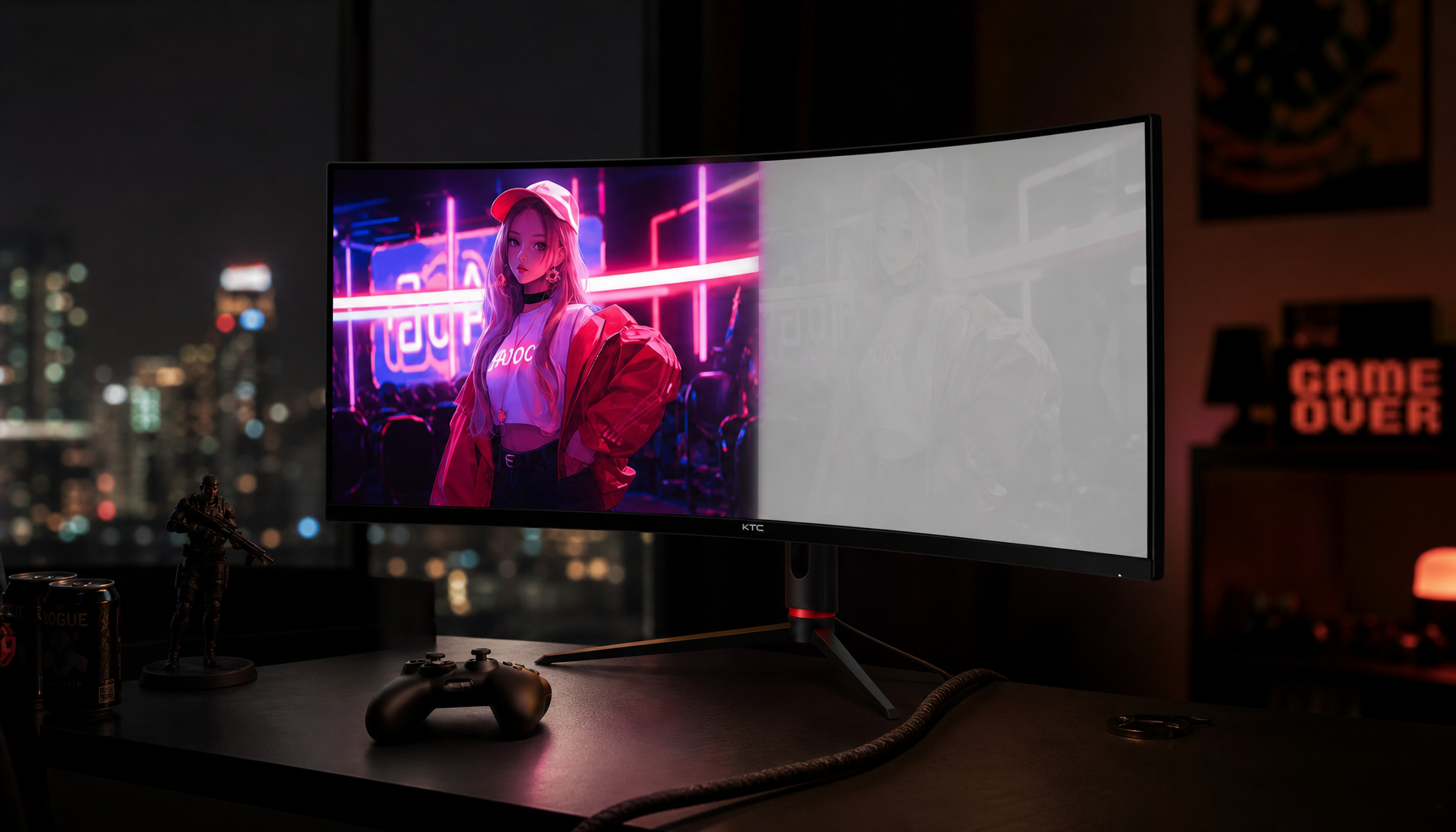
The first practical check is simple. If a port only accepts 16:9 output, you should see black bars on the left and right rather than a stretched image. Pillarboxing is not glamorous, but it preserves circles as circles, faces as faces, and aim references where your muscle memory expects them.
Why a PC Port May Still Behave Like a Console Game
A “PC release” does not always mean a PC-native display strategy. Many ports inherit console camera constraints, console UI placement, and console video assets. If the game was approved, balanced, and performance-tested at 16:9, widening the camera can expose objects that were never meant to be visible, reveal animation shortcuts, break scripted scenes, or make interface elements sit too far from the player’s focal area.
Cutscenes are the obvious giveaway. A game may support 21:9 during live gameplay but fall back to 16:9 during cinematics because those scenes were authored, captured, or framed for a fixed rectangle. Reports on ultrawide gameplay highlight this mixed reality: some titles look excellent during play while menus or cutscenes still use bars, blurred side fills, or narrower framing.
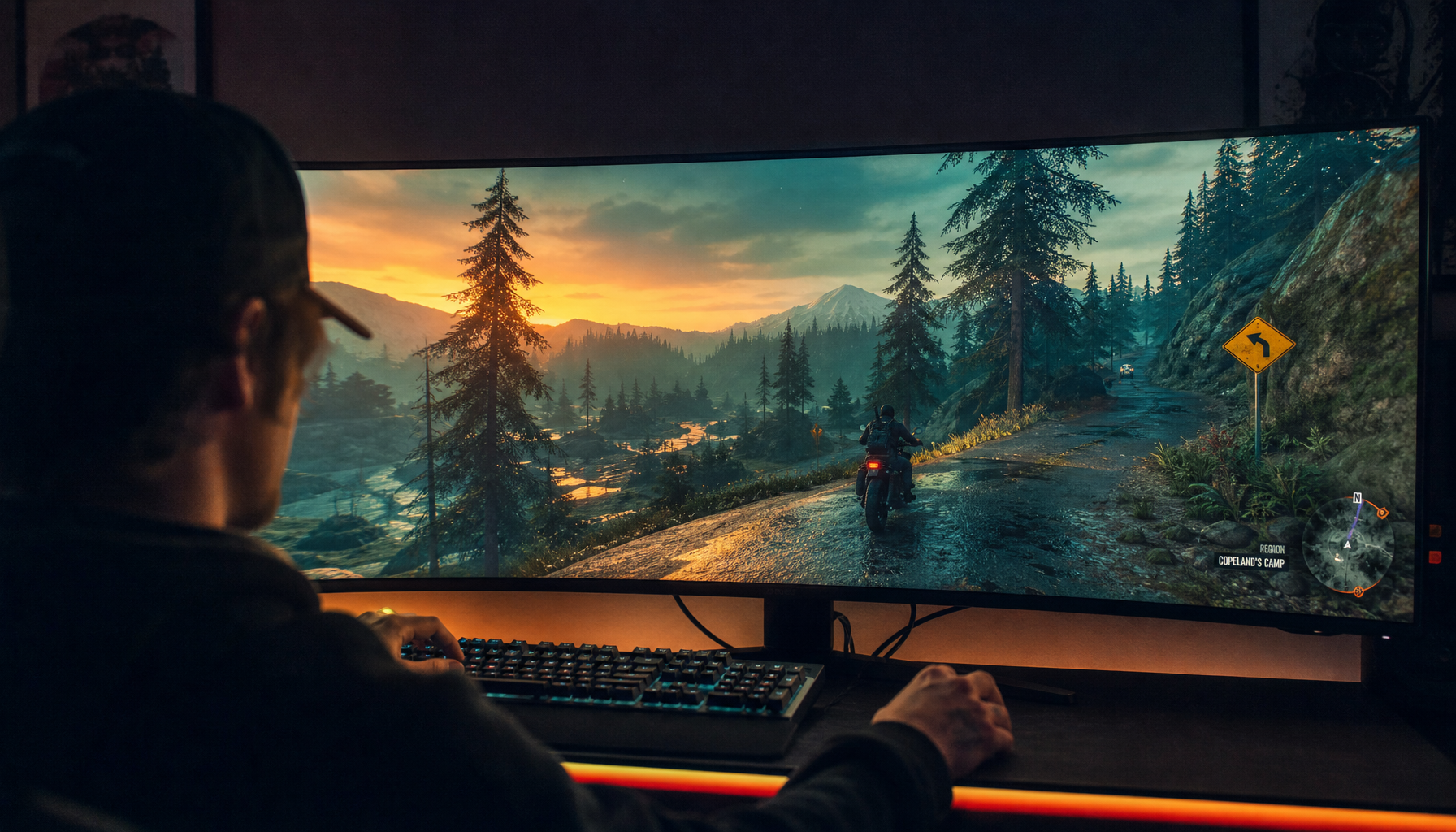
HUD placement is another common failure point. On a 32:9 display, a minimap in the far corner may be physically several inches farther from your center vision than it would be on a 27-inch 16:9 monitor. That extra width can be powerful in racing, flight, open-world, and simulation games, but it can make health bars, ammo counters, party status, and subtitles harder to scan if the port does not let you move the interface inward.
True Ultrawide vs. Stretching vs. Cropping

The difference between good and bad ultrawide support comes down to whether the game renders more useful horizontal space or merely manipulates the final image. True ultrawide support expands the rendered scene and keeps the user interface readable. Stretching fills the screen by deforming the 16:9 image. Cropping or zooming preserves proportions but cuts away useful information near the edges.
Display behavior |
What you see |
Practical result |
True ultrawide rendering |
Wider field of view with correct geometry |
Best outcome for immersion and awareness |
Pillarboxed 16:9 |
Centered image with black side bars |
Correct geometry, no added field of view |
Horizontal stretch |
Full screen but wider-looking characters and UI |
Distorted image, no real gameplay benefit |
Crop or zoom |
Full screen with missing top, bottom, or side detail |
Can hide subtitles, HUD, tutorials, or menus |
The most reliable monitor-side choices are usually Aspect, Original, Auto, or 16:9 modes. If a display offers Full, Wide, or Stretch, treat those as last-resort modes for casual play, not accuracy modes. For competitive shooters, racing lines, strategy grids, and UI-heavy RPGs, distorted geometry is not a harmless cosmetic issue; it changes what your eyes use to judge space.
The Business Reason: Ultrawide Is Valuable, But Still Niche
Ultrawide gaming is no longer exotic, but it is still a smaller target than 16:9. A studio making a console-led game has to prioritize what affects the largest share of players. That usually means stable frame rates, HDR behavior, controller tuning, 60 Hz or 120 Hz modes, and predictable TV compatibility before 21:9 and 32:9 validation.
The PC monitor market also has many ultrawide formats. Current ultrawide monitor options range from 34-inch 3440 x 1440 OLED panels to 49-inch 5120 x 1440 super-ultrawides with 240 Hz refresh rates. Supporting one ultrawide mode cleanly does not guarantee that menus, FOV, subtitles, performance, and cutscenes will behave perfectly across the whole range.
That is why some ports ship with partial support. Gameplay may be 21:9, menus may be 16:9, pre-rendered scenes may be fixed, and 32:9 may need community fixes. From a player’s point of view, that feels inconsistent. From a production point of view, it is often a compromise between budget, deadline, and risk.
Performance Is Part of the Decision
A 3440 x 1440 ultrawide screen pushes about 4.95 million pixels per frame, while 2560 x 1440 pushes about 3.69 million. That is roughly a third more pixels before effects, upscaling, ray tracing, or high-refresh targets enter the conversation. For a console port already tuned near the edge, widening the render can expose performance drops that were never part of the original certification target.

This is why ultrawide support should be judged alongside refresh rate, GPU headroom, and image quality settings. A 34-inch 3440 x 1440 monitor at 144 Hz or 165 Hz is a high-value sweet spot for many PC players because it adds immersion without the extreme demand of larger 32:9 formats. A 49-inch 5120 x 1440 panel is spectacular when supported, but it asks much more from the game and graphics card.
For real use, test a port in three passes. First, check whether the resolution appears natively in the game menu. Then compare a circular object, character model, or map grid at 16:9 and ultrawide to spot stretching. Finally, run a demanding scene for several minutes and watch frame pacing, not just the average FPS number.
Console Habits Still Shape PC Settings
Console-first display design also affects latency choices. Many players focus on resolution first, but display processing can matter just as much. Console gaming input lag can be made worse by motion smoothing, noise reduction, dynamic contrast, overscan, and other smart display features, which is why Game Mode or Low Latency Mode is usually the first setting to verify.
That advice carries over to PC ports played on smart monitors or TV-like displays. If the game already lacks proper ultrawide support, adding stretch processing or extra enhancement layers can make the result worse. A clean 16:9 image with low latency is usually better than a full-screen image that is stretched, delayed, and sharpened into artifacts.
On a 34-inch 3440 x 1440 monitor, a 2560 x 1440 16:9 image can sit centered with full vertical detail and unused side pixels. That is a valid fallback for a console-style port. It may not show off the entire panel, but it protects motion clarity, HUD placement, and geometry.
When Ultrawide Is Still the Right Choice

An ultrawide monitor makes the most sense when your screen has to do more than console gaming. For PC work, timelines, spreadsheets, side-by-side documents, browser research, streaming controls, and creative tools, the extra horizontal room can be genuinely efficient. One university BYOD station pilot used ultrawide monitors for flexible study and multitasking, which reflects the same practical value many home office users get every day.
For gaming, ultrawide is strongest in open-world, racing, flight, simulation, exploration, and cinematic single-player titles. It is weaker when a port is locked to 16:9, when competitive rules limit wider views, or when the UI cannot be repositioned. If your library is mostly console ports and esports titles, a fast 27-inch or 32-inch 16:9 display may deliver more consistent results.
The decision is not “ultrawide good” or “ultrawide bad.” It is workload math. If most of your time is PC productivity, ultrawide-supported PC gaming, editing, or multitasking, a 34-inch ultrawide can be a strong long-term buy. If most of your time is console play from a couch or 16:9-only ports, a high-refresh 4K or QHD 16:9 monitor is often cleaner.
How to Evaluate a Port Before You Commit
Start with the game’s own display menu. A trustworthy ultrawide implementation should list your native resolution, preserve correct proportions, and let you adjust field of view or HUD placement where needed. If the game offers only 1920 x 1080, 2560 x 1440, or 3840 x 2160 on an ultrawide panel, expect pillarboxing or scaling behavior.
Next, check gameplay and cutscenes separately. A port can pass one and fail the other. If gameplay is ultrawide but every cinematic snaps to 16:9, that may still be acceptable for action games. If menus, subtitles, inventory screens, or maps become awkward, the day-to-day experience will feel less polished.
Finally, test the monitor’s scaling mode. Use aspect-preserving modes first, disable overscan-style processing, and keep Game Mode enabled if it reduces latency. If the game looks wrong only after you change monitor scaling, the port may be doing its job and the display is the problem.
FAQ
Does black bar support mean the PC port is broken?
No. Black bars can mean the game is preserving a 16:9 image correctly. It is less immersive than true ultrawide rendering, but it is usually better than stretching.
Should I use community ultrawide fixes?
They can help, especially with older games, but they may break after patches, affect online anti-cheat behavior, or create UI issues. Use them carefully and avoid them in competitive multiplayer unless the developer clearly permits it.
Is 32:9 worth it for console ports?
Usually not as the main reason to buy. A 32:9 display is excellent for PC multitasking and supported sims or racing games, but console-style ports often expose the limits of fixed cinematics, edge-heavy HUDs, and inconsistent aspect ratio support.
Bottom Line
Console ports often ignore ultrawide support because 16:9 is still the production baseline, and real ultrawide support requires camera, UI, cutscene, QA, and performance work. Buy ultrawide for the games and workflows that truly use it, set unsupported ports to preserve aspect ratio, and treat stretched full-screen output as a compromise, not an upgrade.