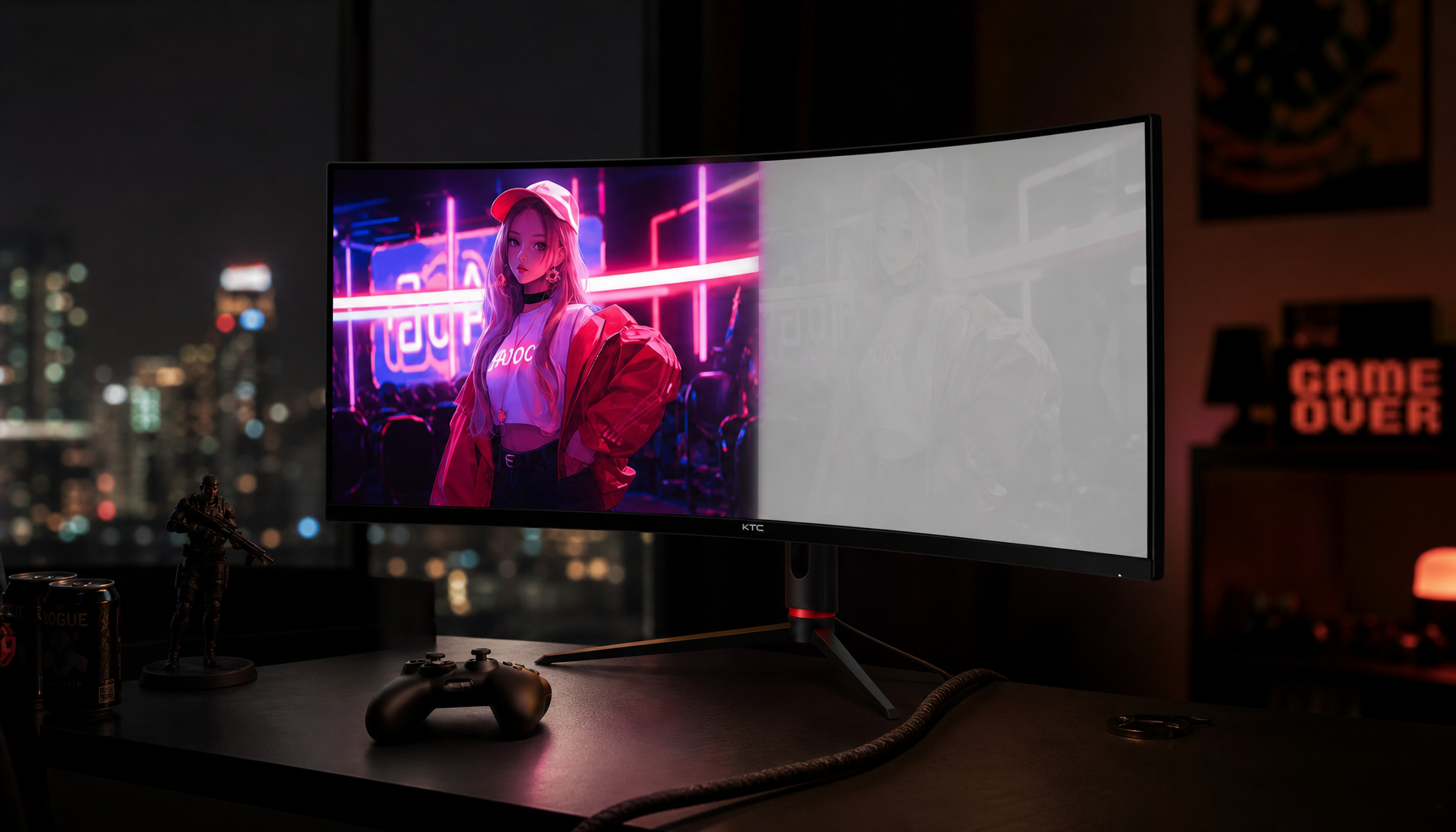
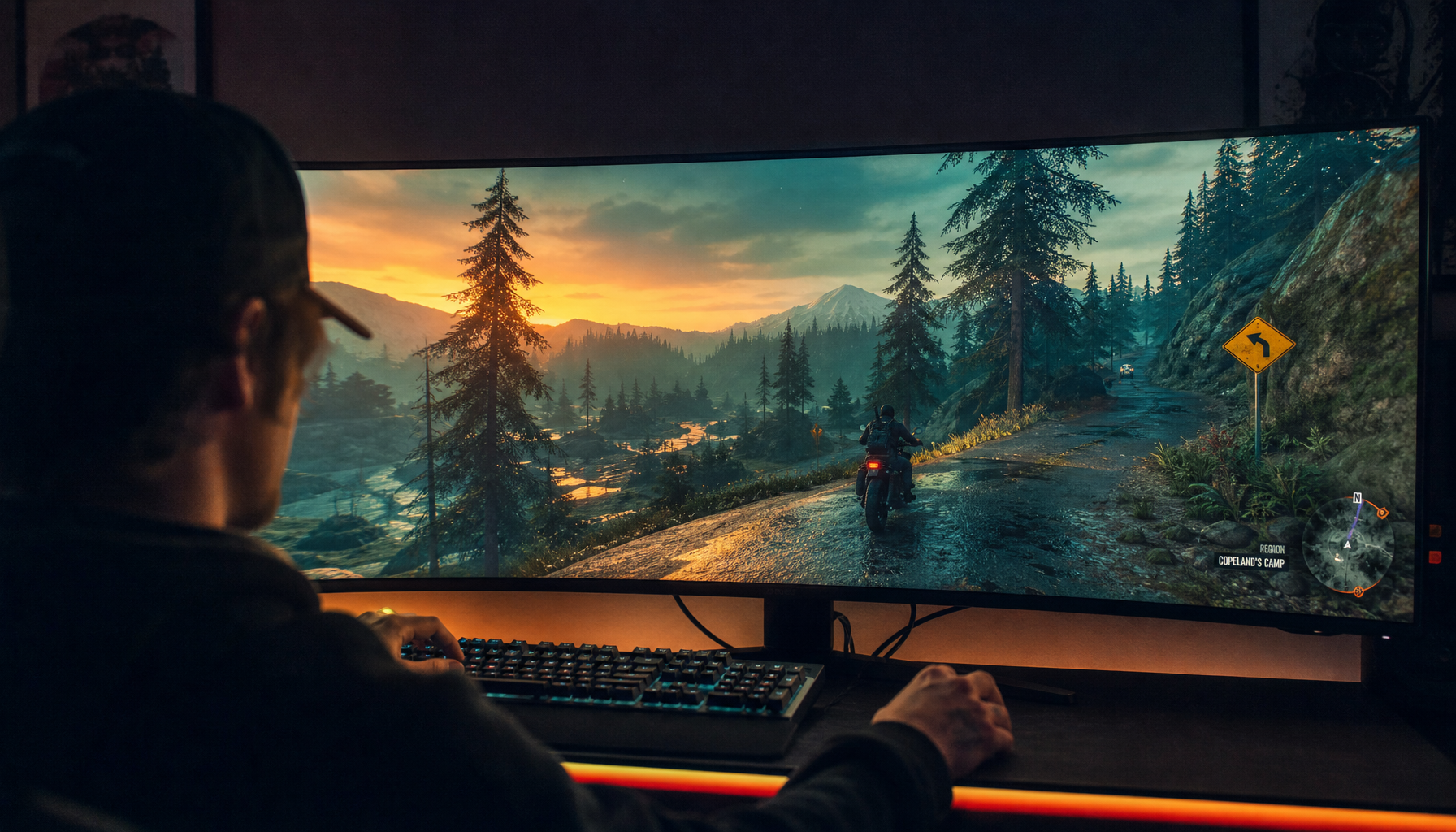
Curved displays can make first-person adventure games feel more immersive by bringing screen edges closer to your peripheral vision and making wide environments easier to absorb.
Ever step into a misty ruin, dense forest, or neon alley and feel as if the edges of your monitor are still reminding you it is just a rectangle on a desk? A properly sized curved display can make side details easier to notice and keep the image more visually consistent from center to edge. This article explains when curvature genuinely helps, which specs matter, and when a flat screen is still the smarter buy.
Why Peripheral Immersion Matters in First-Person Adventure Games
First-person adventure games depend on atmosphere as much as aim. You are not only tracking enemies; you are reading environmental clues, scanning doorways, following light, noticing motion at the edge of a cave, and building a mental map as you move. A curved monitor supports that style because it keeps more of the image angled toward your eyes instead of leaving the far left and right edges feeling visually distant.
A curved monitor is a display with an inward-bending screen designed to wrap slightly around the viewer’s field of vision. That shape does not increase resolution or make textures sharper, but it can make the same scene feel more continuous, especially when the game supports ultrawide aspect ratios. In practical play, this is most obvious in slow-to-medium-paced exploration, where your eyes naturally roam across the screen instead of locking to a crosshair every second.
For first-person adventure titles, immersion is not just spectacle. It is useful information. If a torch flickers near the edge of the frame, a path branches off in your peripheral view, or a shadow moves beside a doorway, a curved display can make those cues feel less detached from the center of action.
The Display Physics Behind the Wraparound Effect

The core advantage is viewing-distance consistency. On a large flat screen, the center is closest to you, while the left and right edges sit farther away and at a sharper angle. On a curved panel, those edges bend inward, so the screen’s outer zones are presented more directly to your eyes.
Curved gaming monitor guidance explains that curvature ratings such as 1000R, 1800R, or 1900R describe the radius of the curve, measured in millimeters. A lower number means a stronger curve. A 1000R display is more aggressive than a 1800R display, while 3000R is much gentler and closer to flat.

That matters because first-person adventure games often use horizontal awareness to create presence. On a 34-inch ultrawide display, a 1500R or 1800R curve can pull cave walls, cockpit edges, corridors, forests, and city streets into a more natural arc. The effect is not that the monitor becomes larger in actual screen area. It is that the outer image feels less remote, which helps your brain treat the scene as a space around you rather than a panel in front of you.
Curvature |
Feel at a Desk |
Best Fit |
1000R |
Strong wraparound, very noticeable |
Deep immersion, large gaming screens, centered solo play |
1500R |
Balanced gaming curve |
27-inch to 34-inch gaming setups |
1800R |
Gentler but still immersive |
34-inch ultrawide, mixed gaming and work |
3000R |
Subtle curve |
Large productivity displays, less aggressive desk setups |
Why Ultrawide Curved Screens Work Especially Well
Curvature becomes more valuable as screen width increases. A small 24-inch curved screen may look stylish, but the peripheral benefit is limited because the edges are not very far from the center. On a 34-inch 21:9 ultrawide or a 49-inch 32:9 super-ultrawide, the curve does more practical work.
A monitor roundup notes that curved monitors often feel more immersive because they create a broader field of view and reduce perceived edge distortion, especially on ultrawide displays. That aligns with real desk setup experience: the wider the panel, the more you notice whether the edges are comfortably visible or sitting at an awkward angle.
For a first-person adventure game, 21:9 is usually the sweet spot. It gives you a wider scene without becoming as demanding or compatibility-sensitive as 32:9. A 34-inch 3440 x 1440 curved ultrawide can show more of a shoreline, hallway, mountain pass, or abandoned station than a standard 16:9 display, assuming the game supports the format well. The result is not just a wider picture; it is a stronger sense of being placed inside the environment.

Curved monitor recommendations also highlight that models such as 34-inch ultrawides and 32-inch 4K curved OLED displays are chosen primarily for immersive gaming, not because curvature alone improves frame rate or input latency. That distinction is important. Curvature improves perception and comfort; performance still comes from refresh rate, response time, panel quality, and GPU power.
The Specs That Decide Whether Curvature Feels Good
A curved screen can enhance immersion only if the rest of the display keeps up. For first-person adventure games, resolution should be sharp enough that distant objects, text, and environmental details remain clean. At 27 inches, 1440p is a strong value target. At 32 inches, 4K becomes more attractive. At 34 inches ultrawide, 3440 x 1440 is a practical balance between sharpness and GPU demand.
Refresh rate also matters because camera motion is constant in first-person games. Gaming monitor testing defines refresh rate as how many times per second the display updates, and higher values such as 165Hz, 240Hz, and beyond can improve smoother competitive gaming. For adventure-first players, 144Hz or 165Hz is already a strong baseline; it keeps panning, walking, and turning fluid without forcing you into the cost and GPU demands of extreme esports displays.
Response time affects motion clarity. If pixels transition slowly, dark scenes can smear as you turn through a cave or forest at night. Gaming monitor guidance repeatedly treats response time, refresh rate, adaptive sync, panel type, and resolution as core display factors, which is the right way to shop: curvature should be part of a complete performance package, not a substitute for one.
Adaptive sync is worth prioritizing. Compatible adaptive sync support helps reduce tearing and stutter when frame rates fluctuate, which is common in visually rich adventure games. The practical buying rule is simple: match the monitor’s adaptive sync support to your graphics card and confirm the monitor can run your preferred resolution at your target refresh rate over HDMI or DisplayPort.
Setup: The Difference Between Immersive and Awkward

A curved monitor works best when you sit centered. If you play from an angle, share the screen often, or push the monitor too far to one side of the desk, the curve can work against you. The center seat is where the geometry makes sense.
KTC’s mounting guidance points out that curved monitors can shift their center of gravity forward, increasing tilt stress and making mount strength more important for curved gaming monitors. That is not just a wall-mount issue. On a desk arm, a heavy ultrawide can sag if the arm is rated only by weight and not by real tilt stability.
For most players, the best starting point is to place the top of the screen at or slightly below seated eye level, then set the display at a comfortable arm’s-length distance. If the curve feels too aggressive, move the screen slightly farther back. If the edges still feel detached, bring it closer within comfort. In first-person adventure games, also check the in-game field-of-view setting. A curved monitor can make a good FOV feel more natural, but it cannot fix a badly tuned FOV that stretches the image or makes movement feel distorted.
Pros and Cons for First-Person Adventure Players
The biggest advantage is presence. Curved displays make wide scenes feel more enveloping, especially in supported 21:9 games. They can also reduce the sense that the edges of a large screen are angled away from you, which helps with long sessions where your eyes scan constantly across the environment.
A gaming monitor overview frames curved screens as strongest for immersive genres such as open-world games, racing games, RPGs, and cinematic single-player titles, while noting they are not universally better for every player or genre when immersion and comfort matter. That is a useful distinction for first-person adventure games, because these games usually reward atmosphere, exploration, and environmental awareness more than pixel-perfect competitive aiming.
The drawbacks are real. Curved monitors often cost more than comparable flat models, need more desk depth, and are less ideal for shared viewing. Some games do not support ultrawide properly, which can lead to cropped cutscenes, stretched HUD elements, or black bars. Flat monitors also remain better for tasks where straight-line geometry is mission-critical, such as CAD-style work, layout proofing, or precision image editing.
Glare can be another issue. A curved glossy screen may catch light from more angles, so room lighting matters. If your desk faces a bright window, a matte panel or better light control may do more for image quality than buying a more aggressive curve.
How to Choose the Right Curved Display
Start with the game experience you want. If you mainly play first-person adventure, RPG, exploration, horror, survival, and cinematic single-player games, a 34-inch 21:9 curved ultrawide at 3440 x 1440 is one of the most balanced choices. It adds meaningful horizontal vision without becoming as extreme as a 49-inch super-ultrawide.
If you want sharper image detail and console-friendly support, a 32-inch 4K curved display can be excellent, especially with OLED or a high-quality VA/IPS panel. If you have a smaller desk or a modest GPU, a 27-inch 1440p curved monitor can still work, but the immersion gain will be subtler.
A major electronics retailer’s curved monitor category shows how mainstream curved screens have become in the US retail market, but the useful filter is not simply curved screen. Check size, resolution, refresh rate, adaptive sync, ports, stand adjustment, and return policy. A monitor that fits your desk and GPU will feel better than a premium panel you cannot position correctly or drive smoothly.
For value, prioritize 1440p or ultrawide 1440p, 144Hz or higher, adaptive sync, and a curve between 1500R and 1800R. For maximum immersion, consider OLED contrast, stronger curvature, and ultrawide formats, but budget for the GPU power and desk space those choices demand.
FAQ
Does a curved display improve aim in first-person games?
Not directly. A curved display can improve comfort and peripheral awareness, but aim depends more on input latency, refresh rate, response time, frame rate, mouse control, and your in-game settings.
Is 1000R too curved for adventure games?
It can be excellent for centered solo play, especially on larger displays, but it may feel intense for mixed office work or shared viewing. If you want one monitor for gaming and productivity, 1500R or 1800R is often easier to live with.
Is ultrawide support required?
No, but it matters. Curvature still helps on some 16:9 displays, yet first-person adventure games benefit most when the game supports a wider aspect ratio cleanly. Check recent player reports for HUD behavior, cutscenes, and FOV options before buying around one favorite title.
Final Word
Curved displays enhance peripheral immersion because they make wide game worlds feel more continuous, readable, and physically present at the desk. For first-person adventure games, the best value is not the most extreme curve; it is the right blend of size, aspect ratio, resolution, refresh rate, and setup discipline. A well-positioned curved ultrawide turns exploration from screen-watching into spatial awareness.