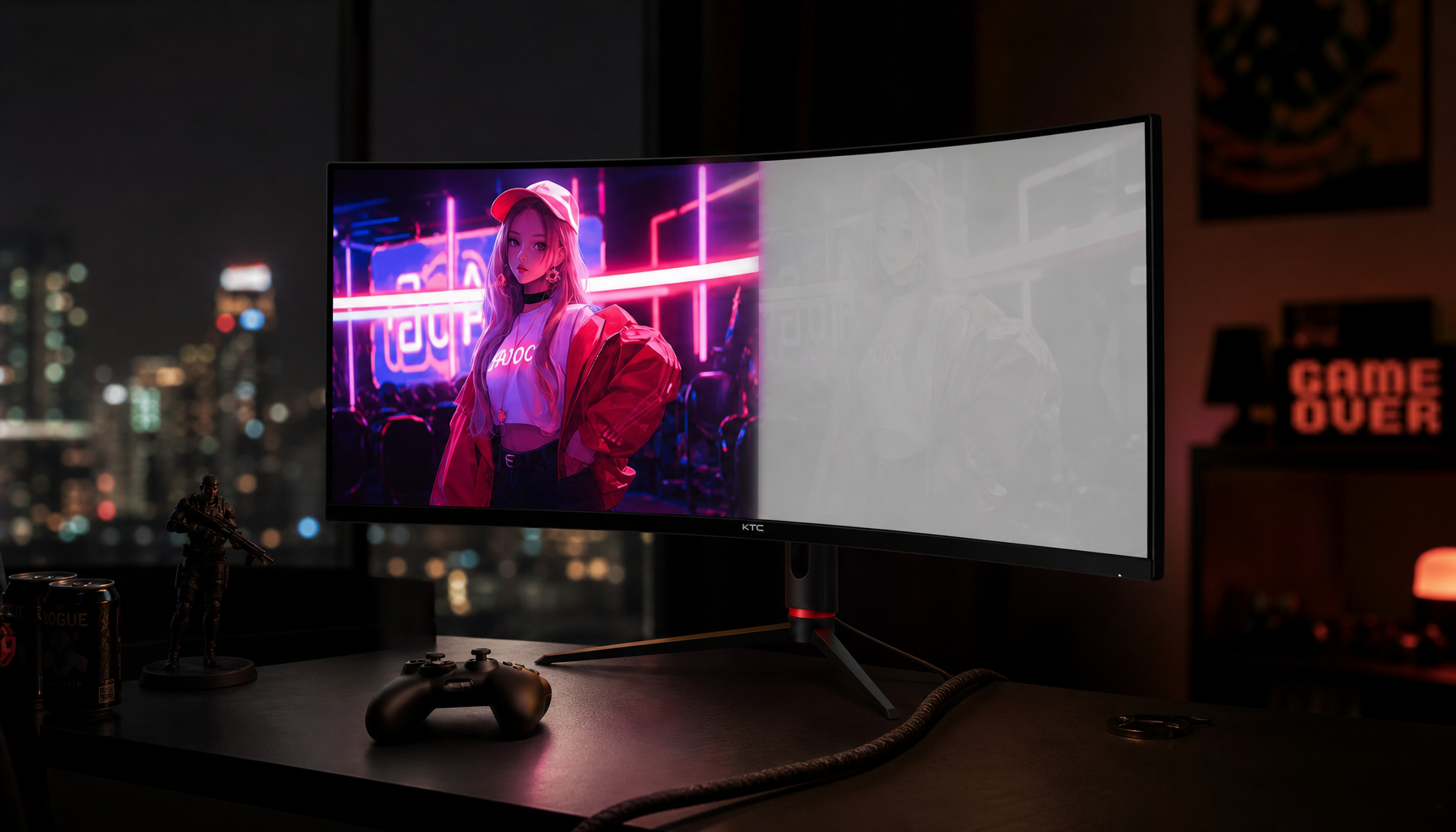
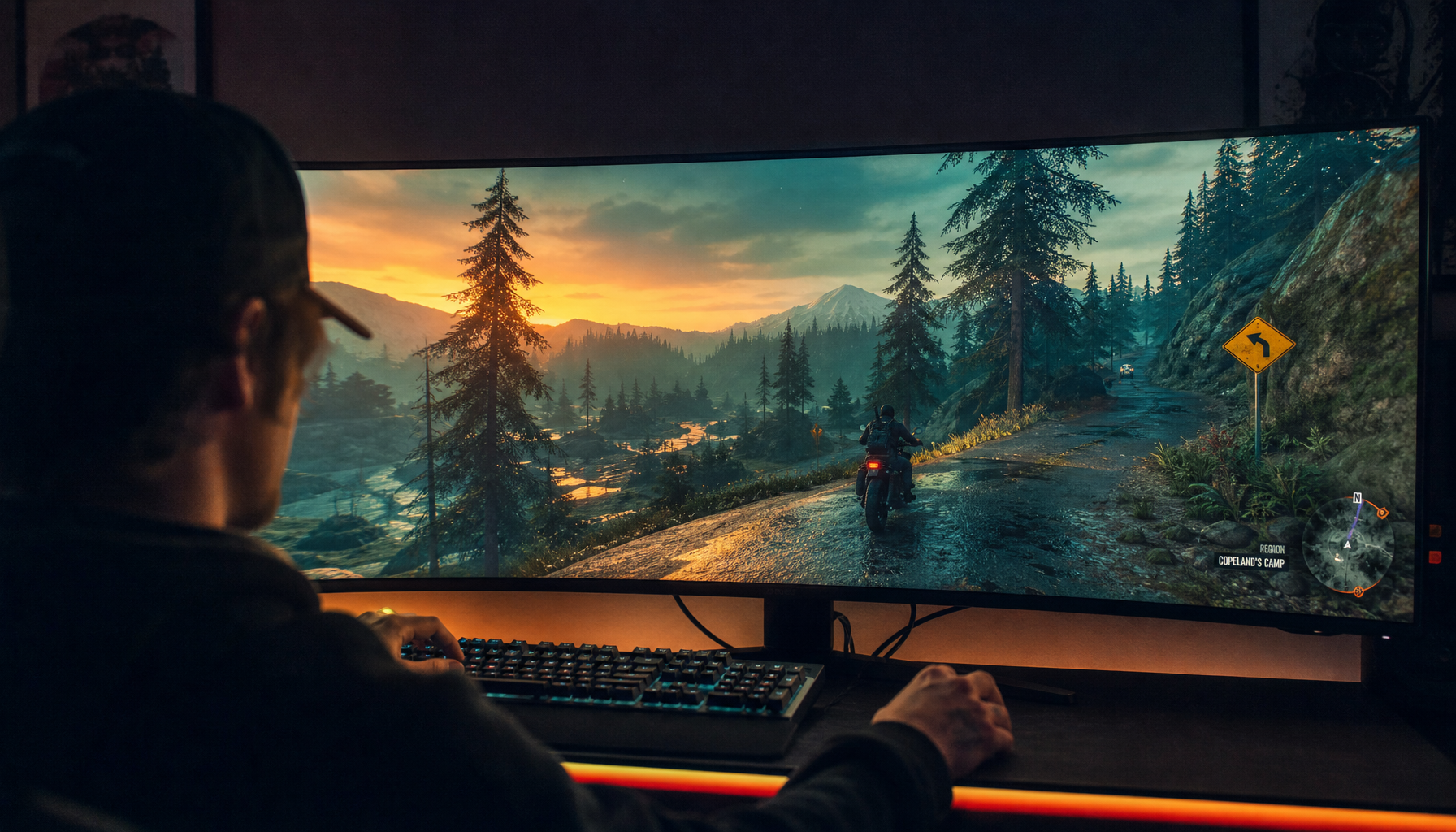
Black levels look gray in bright rooms because room light reflects off the screen and raises the visible “black floor.” Display contrast, panel type, gamma, HDR mode, and dynamic processing determine how much depth remains.
Does your dark game scene look smoky at noon, or does a black spreadsheet sidebar turn charcoal under office lights? A quick check of room reflections, brightness, gamma, and HDR state can separate a lighting problem from a monitor limitation. These adjustments can improve depth without hurting accuracy, visibility, or long-term comfort.
The Real Reason Black Turns Gray
A display does not create black in isolation. You see the panel, the light coming from it, and the light bouncing off it. In a bright room, sunlight, ceiling lights, white walls, and even a light shirt can reflect from the screen surface. That reflected light adds a haze over dark pixels, so black no longer looks black to your eyes.

This is why a monitor can measure well in a lab but look flat at a desk beside a window. A matte coating scatters reflections broadly, which usually makes work easier under office lighting. A glossy coating can preserve sharpness and perceived contrast in controlled light, but it can also mirror bright objects behind you. The practical lesson is direct: light sources behind or around the viewer are often the enemy of perceived black.
Black level is the darkest tone a display can show, but what matters visually is contrast: the distance between that black and the brighter parts of the image. One monitor-testing explanation defines contrast as the difference between the whitest white and blackest black a monitor can produce, which is why a bright office can make a technically capable panel feel weaker than expected.
Panel Technology Sets the Starting Point
IPS, VA, OLED, and mini-LED LCD panels do not handle black the same way. IPS monitors use a backlight that stays on while liquid crystals modulate light, so some glow is normal. OLED pixels emit their own light and can switch off individually, which gives them a major advantage in dark scenes. Mini-LED LCDs improve contrast by dividing the backlight into dimming zones, but their performance depends on scene content and zone behavior.
Panel type |
Why black may look gray |
Best fit |
IPS LCD |
Always-on backlight, IPS glow, possible edge bleed |
Office work, static dashboards, color-stable productivity |
VA LCD |
Better native contrast than many IPS panels, but slower dark transitions on some models |
Mixed media, budget contrast-focused setups |
Mini-LED LCD |
Local dimming helps, but halos or muted highlights can appear |
Bright-room HDR, premium productivity and gaming |
OLED |
Excellent black depth, but room reflections can still lift perceived black |
Dark-room gaming, HDR movies, immersive content |

An IPS panel can still be a strong professional choice. IPS remains valuable for color stability, high full-screen brightness, and reliable long work sessions, while OLED can turn pixels off for true black. That distinction explains why a 27-inch IPS office monitor may stay readable in daylight, while an OLED looks more cinematic at night.
For a real desk example, imagine a 32-inch display near a window. A bright IPS panel may keep documents and dashboards legible, but a dark game loading screen may show gray corners or glow. An OLED may deliver deeper night scenes after sunset, yet still look less impressive if the window reflects across the screen.
Brightness Helps Readability, But It Cannot Fix Black
Raising brightness can improve text clarity and daytime visibility, but it also raises the whole light output of many LCD monitors. If the room is bright, you need enough luminance to compete with ambient light. If the screen is too bright at night, black glow, clouding, and fatigue become more obvious.
Eye-fatigue guidance commonly recommends matching display brightness to the environment, with typical office lighting around 300 to 500 lux pairing well with roughly 100 to 150 nits of screen brightness. A simple practical check is to put a sheet of white paper beside the monitor under the same light. If a blank white document is dramatically brighter than the paper, your display is likely too bright for the room. If it looks dull and gray, the monitor may be too dim for that space.

For gaming, the balance changes. A competitive player may accept slightly raised shadow visibility to spot movement in dark corners. A cinematic player should reduce room light first, then tune brightness, because lifting shadows in software can flatten the entire scene.
Gamma, HDR, and Dynamic Contrast Can Make Gray Worse
Gamma controls how tones move from black to white, especially in shadows and midtones. A common desktop target is gamma 2.2 because it keeps web pages, office apps, SDR games, and UI elements predictable. Higher gamma can deepen midtones in a dim room, but in a bright room it may hide shadow detail. Lower gamma can reveal enemies or dark UI panels, but it can also make the image look washed out.
HDR adds another complication. HDR can improve brightness range and color when the content, operating system, graphics driver, cable, and monitor handshake correctly. When that chain initializes badly, the image can look gray or too bright. Stronger HDR performance usually requires higher peak brightness, with OLED and mini-LED panels often performing better than basic LCD HDR.
Dynamic Contrast Ratio, or DCR, changes brightness and contrast in real time based on the image. It can make movies and casual gaming punchier, especially on portable monitors, but it can also pump brightness, shift color, or crush detail. For portable displays, Dynamic Contrast Ratio can help with media and changing light conditions, but it is less trustworthy for photo editing, product color, or spreadsheet work where stable tones matter.
Reflections Can Beat Specs
A monitor with excellent lab contrast can still lose to a mediocre room. Direct sunlight is the worst case because it adds strong reflected light and forces your eyes to adapt to the bright surroundings. Overhead lighting can be almost as disruptive if it lands on the panel. White desks, glossy speakers, glass frames, and bright walls can all raise perceived black.
The fix is physical before digital. Move the display so windows are beside the screen rather than behind you. Angle the monitor slightly away from ceiling-light reflections. Use blinds, curtains, or a desk lamp aimed at the wall behind the monitor instead of at the panel. A monitor hood can help for editing, but even a darker wall behind the display can make black feel deeper because your eyes are not constantly comparing the screen against a bright surround.
This is also where matte versus glossy becomes a preference with consequences. Matte is usually the reliable choice for office productivity because it reduces sharp reflections. Glossy can look more saturated and deep in controlled light, but it demands discipline from the room.
How to Diagnose Gray Blacks at Your Desk
Start with the room before blaming the panel. Open a full-screen black image during the day and again at night. If black improves dramatically at night, the main problem is ambient light or reflection. If it stays cloudy in the same corners, you may be seeing backlight bleed, IPS glow, or poor uniformity.
Uniformity issues are easiest to spot on full-screen black, gray, and white backgrounds. KTC’s monitor uniformity notes explain that large flat areas reveal brightness drift, cloudy patches, edge glow, and tint more clearly than busy content. If the problem only appears on test screens, it may be acceptable. If it distracts you in code editors, maps, dark games, or photo work, the display is not matching your use case.
Next, reset the monitor to a standard, sRGB, creator, or custom mode. Disable HDR for normal SDR desktop work, turn off dynamic contrast, and set gamma near 2.2. Then adjust brightness for the room and leave contrast near default unless you see clipped whites or crushed dark grays. For a gaming monitor, adjust the game’s own brightness only after the monitor baseline is stable.
Buying Advice for Bright Rooms
For a bright office, prioritize high usable brightness, matte anti-glare handling, stable gamma, good ergonomics, and reliable panel uniformity. A premium IPS or IPS Black monitor can be a better daily tool than an OLED if your day is mostly documents, browser tabs, dashboards, and static UI. One tested IPS Black 4K productivity monitor reached 415 nits maximum brightness and remained usable in bright indoor rooms, though direct sunlight could still wash it out.
For immersive gaming and HDR media, OLED or mini-LED becomes more compelling. OLED gives the cleanest black in controlled light. Mini-LED can push stronger brightness in brighter rooms, though local dimming may create halos or change small highlight behavior. Gaming monitor guidance also reinforces that size, resolution, and aspect ratio matter for immersion, with 1440p recommended across many 27- to 35-inch gaming setups.

Portable smart screens need a slightly different priority stack. Choose enough brightness for travel, an anti-glare surface if you work in cafes or airports, and a DCR toggle you can disable. For color work, a stable IPS or calibrated mode matters more than a huge advertised dynamic contrast number.
FAQ
Is Gray Black Always a Defect?
No. In a bright room, gray-looking black is often normal because ambient light raises the perceived black floor. It becomes a defect concern when clouding, edge bleed, or glow is visible in normal work or gameplay after you reduce reflections and use reasonable brightness.
Should I Use HDR All the Time on My Desktop?
Usually no. For daily productivity, SDR is often cleaner and more predictable. Switch HDR on for HDR games, movies, or grading work, then verify that black, white, and midtones look correct after the mode change.
Does OLED Solve Gray Blacks in Bright Rooms?
OLED solves backlight-related black glow, but it cannot stop room reflections from landing on the screen. In controlled light, OLED looks dramatically deeper. In direct daylight, even OLED black can appear lifted because you are seeing reflected room light.
Deep blacks are not just a spec-sheet trophy. They come from the right panel, sensible settings, and a room that lets the display do its job. Control reflections first, tune brightness and gamma second, and choose OLED, mini-LED, IPS, or VA based on the space where the screen will actually live.