VA response time is not one fixed number; it changes depending on which gray shade a pixel starts from and where it needs to land. VA panels are usually strongest in bright and mid-tone transitions, while slower dark transitions can create black smearing in games, movies, and fast scrolling.
Why Gray-to-Gray Is Not One Speed
Gray-to-gray, or GtG, measures how quickly a pixel moves between two gray levels, not just black to white. That matters because real content is full of partial shade changes: a shadowed hallway, a dark HUD, a gray office window, or a fast-moving object against a dim background.
Independent response-time testing often checks multiple shade pairs rather than trusting one advertised number. Testers commonly measure GtG across a range of gray transitions because pixel transition speed can vary widely from one shade pair to another.
For VA, this variation is the whole story. A monitor may hit a quick best-case transition and still feel slower when darker shades are involved.
Why Dark VA Transitions Are Slower
VA panels are known for deep blacks and high contrast. Their liquid crystals block more backlight than typical IPS panels, which is why VA can look punchy in dark rooms and cinematic games.
The tradeoff is movement near black. Dark-to-dark, dark-to-mid, and mid-to-dark transitions often take longer, causing the familiar dark trail behind moving objects. This is usually called black smearing, and it is one reason VA motion can look different from IPS or TN even when the spec sheet claims 1 ms.
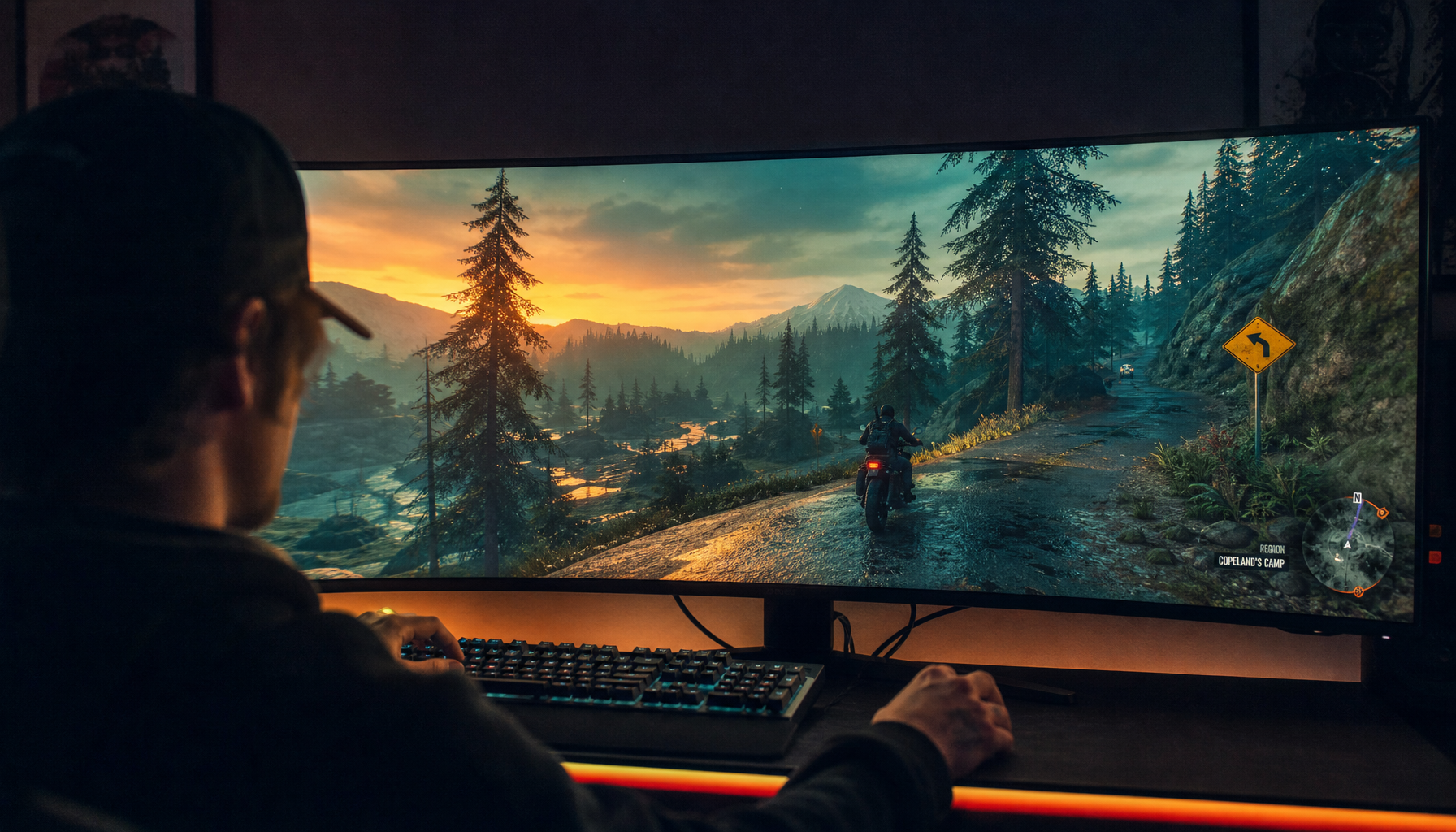
Black smearing is most visible when a black weapon model moves across a gray wall, white text scrolls over a dark background, a racing game runs at night, or a shadowed enemy crosses a bright doorway. For productivity, this may be minor. For competitive play, it can affect tracking clarity.

The Refresh Rate Math Gamers Should Know
Response time has to fit inside the refresh window. At 144 Hz, each frame lasts about 6.94 ms. At 240 Hz, each frame lasts about 4.17 ms.
So if a VA panel has some transitions near 3 ms but darker transitions closer to 12 ms, the average number does not tell you enough. Some pixels may still be changing after the next frame arrives, which creates trailing.

That is why a high-refresh VA monitor can feel sharp in bright scenes but smeary in dark ones. A fast refresh rate improves smoothness, but slow pixel transitions can still reduce motion clarity.
MPRT and GtG describe different parts of motion performance, so a low MPRT mode does not automatically mean every VA gray transition is fast.
Overdrive Helps, But It Has Limits
Overdrive pushes pixels harder to reach the target shade faster. On VA monitors, it can reduce ghosting, especially in mid-tone transitions.
But aggressive overdrive can overshoot the target shade, creating bright halos or inverse ghosting. This is why the fastest overdrive mode is not always the best one. A balanced mode often gives cleaner real-world motion than the maximum setting.
For tuning, use a simple process:

- Start with the monitor’s middle overdrive mode.
- Test bright and dark motion separately.
- Watch for dark trails and bright halos.
- Drop one level if halos appear.
- Re-test at lower frame rates if using VRR.
KTC’s testing advice highlights that VA panels need dark-background testing because their weakest transitions often appear there.
What to Buy for the Best VA Experience
Choose VA when contrast, deep blacks, curved immersion, and value matter as much as raw esports speed. A well-tuned VA panel can be excellent for RPGs, racing, strategy, office work, streaming, and cinematic single-player games.
For competitive shooters, prioritize measured response charts, not just “1 ms” branding. Look for reviews that show average response, slowest transitions, overshoot, and performance at your target refresh rate.
Modern Rapid VA designs aim to close the speed gap while keeping VA contrast. Newer approaches may use improved materials and higher driving voltage to reduce liquid crystal flipping time, but real testing still matters.
The best VA monitor is not the one with the lowest printed GtG claim. It is the one whose dark transitions, overdrive tuning, and refresh behavior stay clean in the content you actually play and work in.