USB-C DP 1.4 is the practical mainstream choice for 4K productivity, gaming, docks, and portable displays today, while USB-C DP 2.0 is the higher-bandwidth path for 8K, extreme refresh rates, multi-display workstations, and future high-end USB-C setups.
Does your laptop advertise USB-C video, yet your monitor refuses the refresh rate you paid for or drops a second screen to a lower resolution? The bandwidth jump from DP 1.4 to DP 2.0 is concrete: DP 1.4 tops out at 32.4 Gbps raw bandwidth, while DP 2.0-class links reach up to 80 Gbps, giving demanding displays far more room to breathe. This guide gives you a clear buying rule for gaming monitors, office docking displays, and portable smart screens.
USB-C Is the Connector; DisplayPort Is the Video Engine

USB-C is the small reversible port on your laptop, tablet, dock, or monitor. DisplayPort is the display protocol that may run through that port. That distinction matters because USB-C video output is not guaranteed, even when the port can charge a laptop or transfer files.
When USB-C carries DisplayPort, the feature is called DisplayPort Alternate Mode, often shortened to DP Alt Mode. In practice, this is what lets a single USB-C cable send video to a monitor while also handling power, audio, USB data, and peripherals on supported hardware. DisplayPort material frames DisplayPort over USB-C as a way to combine the DisplayPort video standard with the USB-C physical connector.
For a desk setup, one cable can replace a charger, display cable, and basic USB hub. For a portable smart screen, one USB-C cable can carry both power and video from a laptop. For a gaming monitor, USB-C can clean up cable routing without giving up high-refresh performance, assuming the port, cable, and monitor all support the required mode.
DP 1.4 vs DP 2.0: The Core Technical Difference

The defining difference is bandwidth. DisplayPort 1.4 uses HBR3 signaling and reaches 32.4 Gbps raw bandwidth, with 25.92 Gbps of usable data throughput. DisplayPort 2.0 raises the ceiling dramatically, reaching up to 80 Gbps raw bandwidth and about 77.37 Gbps of usable data throughput with more efficient encoding.
Feature |
USB-C DP 1.4 |
USB-C DP 2.0 |
Raw bandwidth |
32.4 Gbps |
Up to 80 Gbps |
Effective payload |
25.92 Gbps |
About 77.37 Gbps |
Compression support |
DSC 1.2 / 1.2a, depending on implementation |
DSC support continues |
Typical strength |
4K high refresh, 1440p multi-monitor setups, USB-C docks |
8K, multi-8K, extreme refresh, future display headroom |
Market reality |
Common in current laptops, docks, and monitors |
More future-facing and hardware-dependent |
DP 1.4 is not weak. It added Display Stream Compression, HDR10 metadata, Forward Error Correction, and expanded audio support. With DSC, DP 1.4 can support demanding modes such as 4K at very high refresh rates or 8K-class output in certain configurations, but it leans on compression much sooner.
DP 2.0 is the headroom upgrade. DisplayPort 2.0 is positioned for beyond-8K displays, higher refresh rates, HDR at higher resolutions, multi-display setups, and AR/VR use. That does not mean every user needs it today. It means the connection is less likely to become the bottleneck when the monitor, graphics hardware, dock, and cable are all high-end.
What This Means for Gaming Monitors

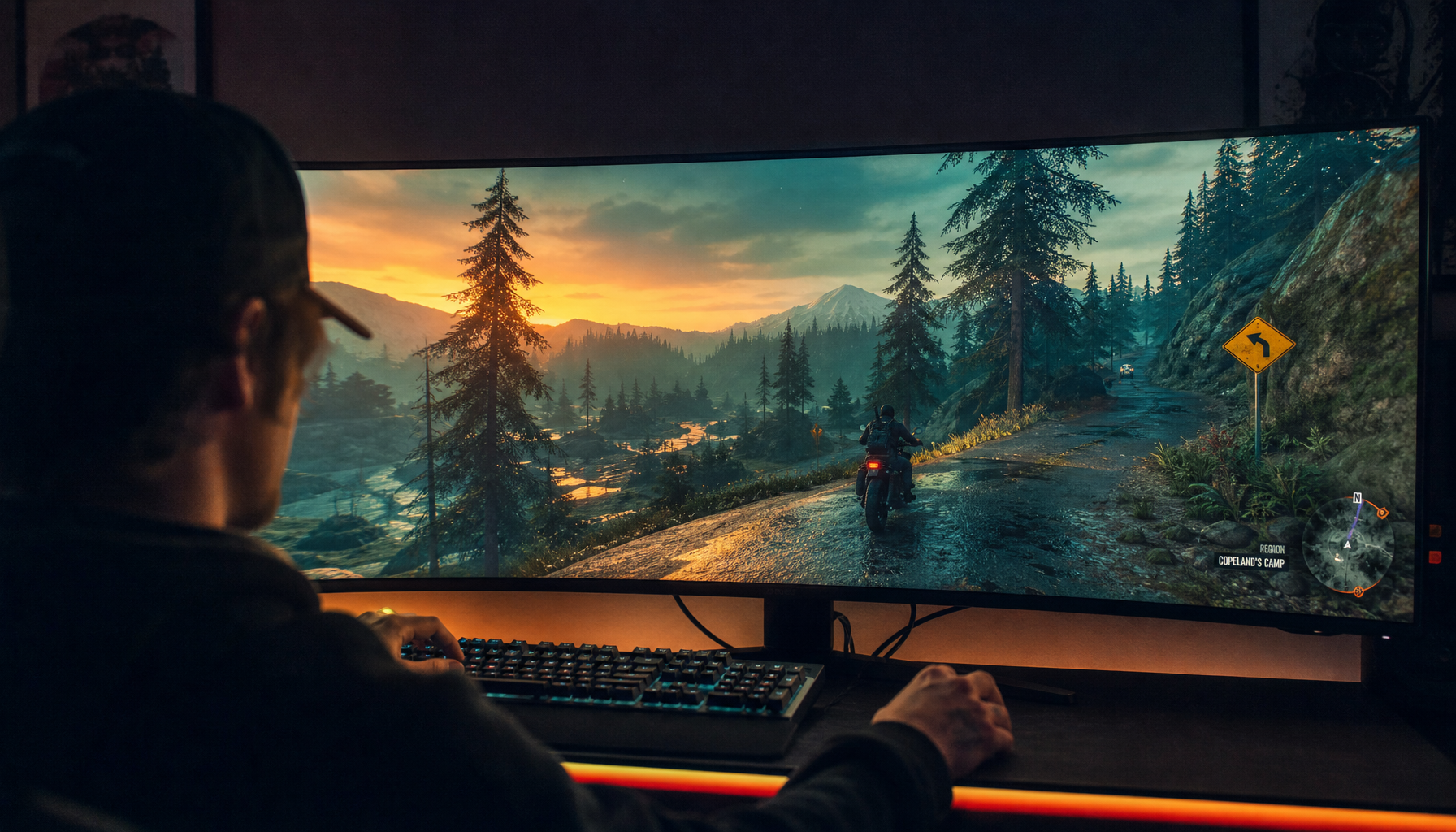
For competitive gaming, the deciding factor is not the logo on the cable; it is whether your complete setup can carry the monitor’s native resolution, refresh rate, color depth, HDR mode, and variable refresh feature at the same time. DisplayPort for PC gaming is commonly favored because it offers strong bandwidth, MST support, and broad support for high-refresh monitor features such as adaptive refresh operation.
A 1440p 165Hz or 240Hz monitor is typically well within the practical territory of DP 1.4 if the laptop or graphics hardware supports the right DisplayPort mode. A 4K 144Hz gaming display is also a strong DP 1.4 use case, often with DSC involved. DP 2.0 starts to matter for 4K at extreme refresh rates, high-bit-depth HDR without compromise, 8K gaming displays, or future OLED and mini-LED panels that aggressively combine resolution, refresh, and color depth.
The value-oriented buying move is simple: do not pay extra for DP 2.0 only because it sounds newer. Pay for it when your monitor’s spec sheet actually demands it, or when you are building around high-end graphics hardware and expect to keep the display for several upgrade cycles.
What This Means for Office Productivity Displays
For office productivity, USB-C DP 1.4 is often the sweet spot. A 27-inch 1440p USB-C monitor, a 4K 60Hz productivity display, or a dual-QHD docked setup can work very well over DP 1.4 when the laptop, monitor, and dock negotiate correctly. USB-C monitors are especially useful because they can combine video, laptop charging, and peripherals through one cable.
The catch is that dual-monitor behavior can expose weak links quickly. A laptop USB-C port with DP Alt Mode may technically support external displays, but a specific adapter or dock can still limit one screen to a lower resolution. Real-world support notes show this pattern clearly: one adapter may drive one 1440p screen and one 1080p screen, while a better-matched dock drives two 1440p screens from the same laptop class.
For office buyers, the better question is not “DP 1.4 or DP 2.0?” It is “Can this exact laptop, dock, cable, and monitor combination run my target layout?” If the answer is two 1440p displays at 60Hz, DP 1.4 is usually enough. If the answer is multiple 4K displays, HDR work, or very high refresh on top of productivity docking, DP 2.0 or higher-end USB-C hardware becomes more attractive.
What This Means for Portable Smart Screens
Portable monitors benefit from USB-C more than almost any display category. A single cable can deliver video and power, which matters when you are working from a hotel desk, client office, classroom, or compact apartment setup. But portable screens are also where vague USB-C labeling causes the most frustration.
A USB-C cable that charges your cell phone may not carry display video. A laptop USB-C port may support charging but not DP Alt Mode. A portable display may need more power than the connected device provides. USB-C to DisplayPort buying guidance consistently comes back to the same practical checks: confirm DP Alt Mode, confirm the desired resolution and refresh rate, and use a cable rated for video.
For most portable smart screens, DP 1.4 over USB-C is already strong. A 1080p or 1440p portable display does not need DP 2.0. A premium portable OLED, high-refresh travel gaming screen, or compact 4K creative display may benefit from the extra margin, but only if both the connected device and cable support it.
The Compatibility Chain Matters More Than the Label

DisplayPort connections negotiate down to the lowest-capability part of the chain. That chain includes the computer’s USB-C port, the graphics hardware, the dock or adapter, the USB-C cable, the monitor input, and sometimes firmware. DisplayPort bandwidth has increased sharply across generations, but the label alone does not guarantee the highest display mode.
This is where many monitor purchases go sideways. A product page might say “USB-C” but not mention DisplayPort Alt Mode. A cable might say “fast charging” but not list video capability. A dock might support dual monitors, but only at a reduced resolution when USB data lanes are also active. A monitor might support DP 1.4 through its full-size DisplayPort input but offer different capability through USB-C.
The practical test is to read specifications as a complete path. For example, if you want a 4K 144Hz gaming monitor over USB-C, check that the laptop USB-C port supports DP 1.4 Alt Mode or better, the cable supports the required bandwidth, the monitor’s USB-C input supports that refresh rate, and the graphics hardware can drive it. If one part falls short, the setup will run at the lower mode.
Pros and Cons of USB-C DP 1.4
USB-C DP 1.4’s biggest advantage is availability. It is common across modern laptops, docks, USB-C monitors, and adapters, and it is powerful enough for mainstream high-performance setups. It handles 4K productivity displays well, supports high-refresh gaming in many configurations, enables HDR and DSC, and works with one-cable docking monitors.
Its limitation is headroom. When you stack 4K resolution, high refresh, HDR, 10-bit color, multiple displays, and USB data through a dock, DP 1.4 can become tight. Depending on the hardware, it may rely on DSC, reduce refresh rate, lower color format, or limit a second display.
Pros and Cons of USB-C DP 2.0
USB-C DP 2.0’s advantage is bandwidth freedom. It is built for high-resolution, high-refresh, HDR-heavy, multi-display use cases where DP 1.4 starts making compromises. For premium gaming rigs, workstation displays, AR/VR, and future 8K-class workflows, it is the stronger foundation.
The downside is ecosystem maturity. A DP 2.0-capable monitor does not help if the laptop, graphics hardware, dock, or cable cannot provide DP 2.0-class output. DP 2.0 also should not be confused with ordinary USB-C. The connector can look identical while the underlying video capability is completely different.
How to Choose the Right One

Choose USB-C DP 1.4 when you are buying a practical, reliable setup for 1440p productivity, 4K 60Hz office work, many 4K creative displays, or high-refresh 1440p and 4K gaming where the monitor’s own specs confirm support. It is the best value tier for most people today.
Choose USB-C DP 2.0 when you are buying for a top-end monitor, multi-display workstation, 8K workflow, extreme refresh rate, or long-term upgrade path. It makes the most sense when the whole chain is premium: graphics hardware, laptop port, dock, cable, and monitor.
For a clean desk, prioritize a USB-C monitor with enough Power Delivery for your laptop, a built-in hub if you use peripherals, and a clearly stated DP Alt Mode video spec. For a gaming station, prioritize the monitor’s maximum refresh rate over USB-C, not just over full-size DisplayPort. For a portable screen, prioritize verified USB-C video and power behavior over headline bandwidth.
FAQ
Is USB-C DP 2.0 the Same as a High-Speed USB-C Port?
No. Some high-speed USB-C ports can carry DisplayPort video, but USB-C DP Alt Mode and high-speed USB-C data support are not the same thing. Premium USB-C ports usually offer stronger display flexibility, but you still need to check the exact laptop and dock specifications.
Do I Need DP 2.0 for a 4K Monitor?
Usually not for 4K 60Hz. For 4K 144Hz, DP 1.4 is often enough with the right hardware and DSC support. DP 2.0 becomes more compelling for extreme refresh rates, higher color depth, multi-monitor 4K setups, or longer upgrade cycles.
Will Any USB-C Cable Work for Monitor Video?
No. Some USB-C cables are charge-only or data-only for practical display purposes. Use a cable that explicitly supports video output and the resolution and refresh rate you want.
The smartest monitor connection is not the newest label; it is the connection that lets your display run at its native resolution, refresh rate, color depth, and charging behavior without hidden compromises. USB-C DP 1.4 is the value champion today, while USB-C DP 2.0 is the performance runway for the next wave of immersive screens.