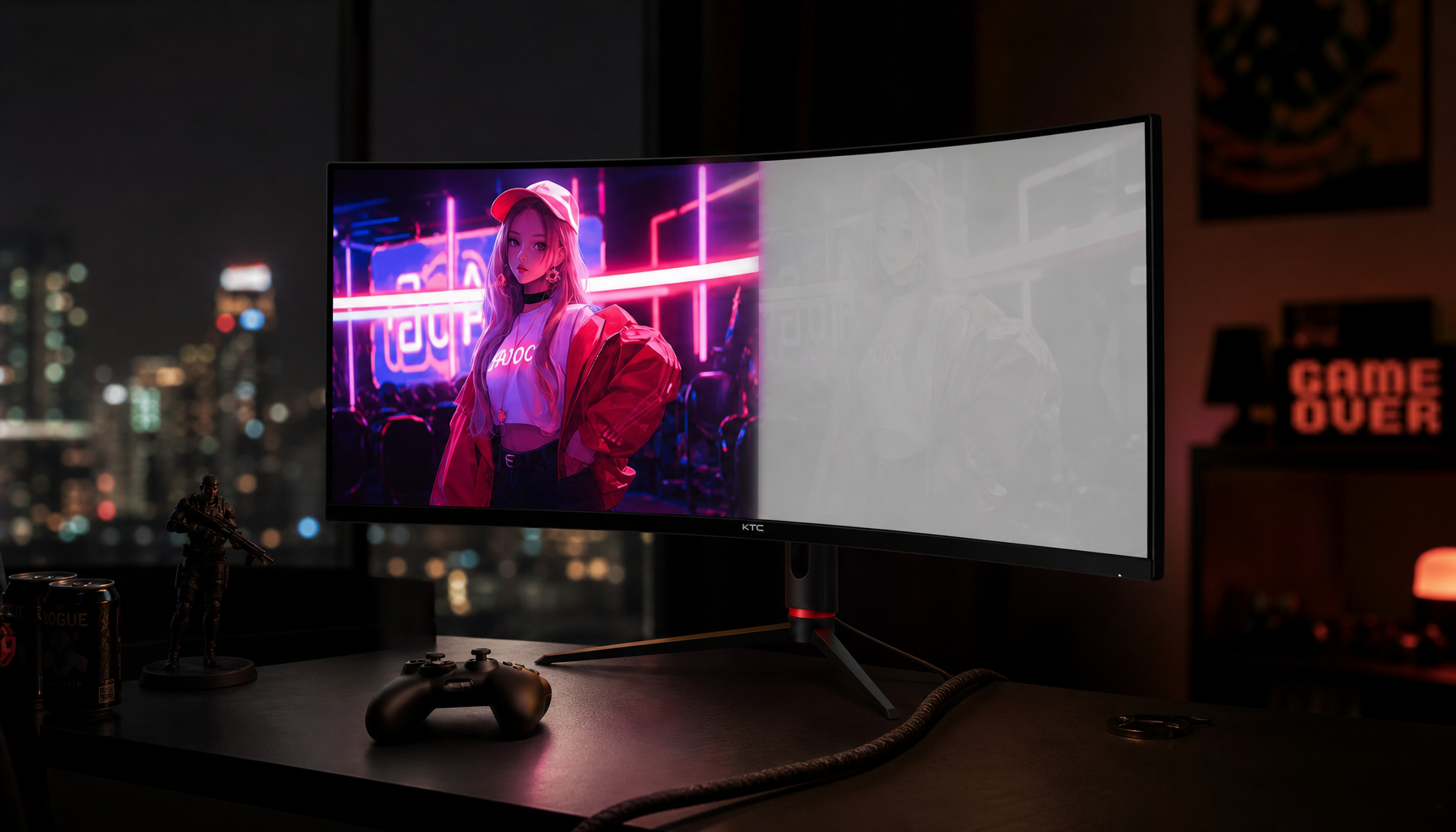
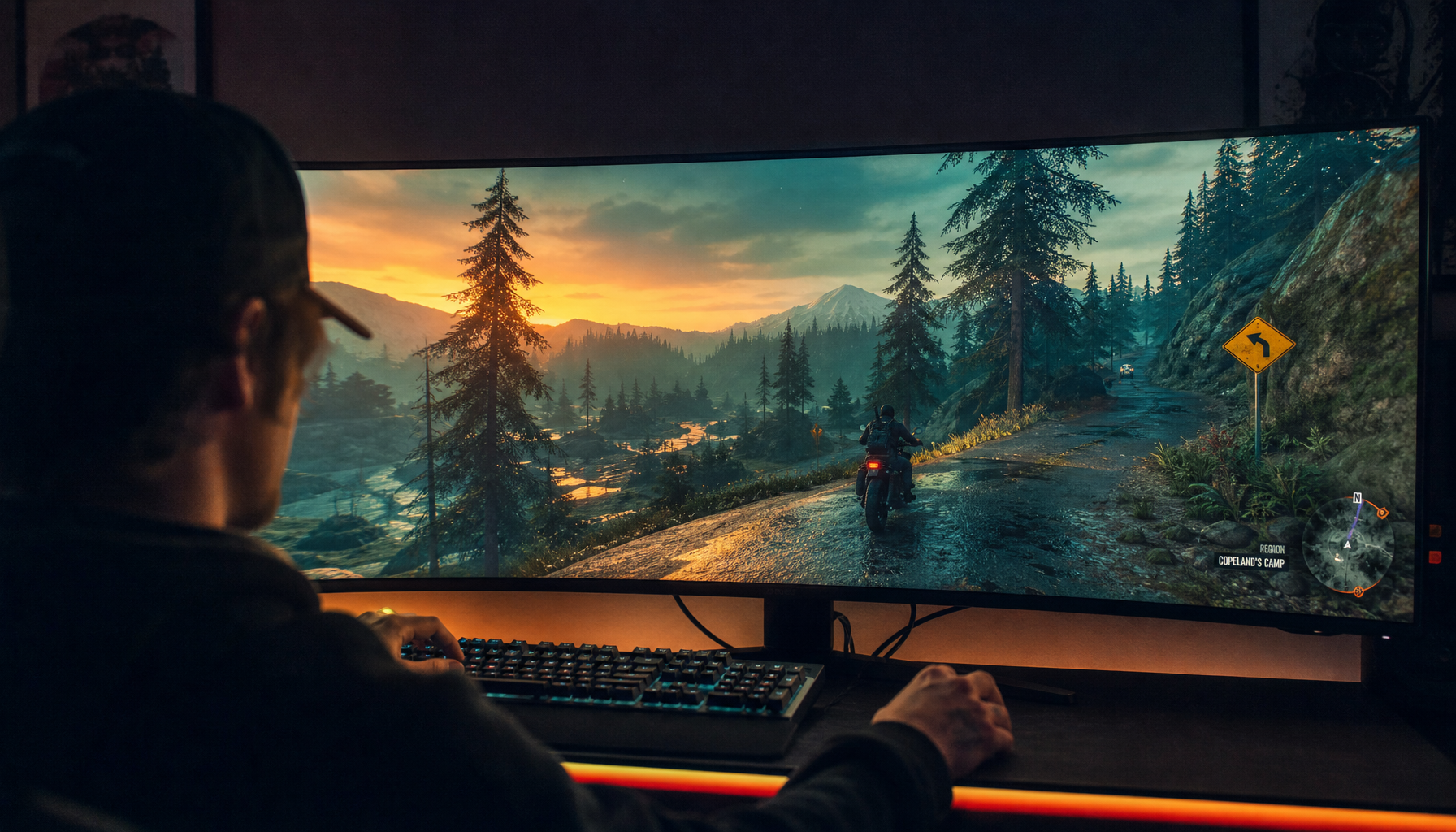
At the same refresh rate, higher pixel density does not remove motion blur, but it can make blur, ghosting, and soft edges easier to notice because still images are sharper and moving details are more finely resolved.
Does your 27-inch 4K monitor look razor-sharp on the desktop, then reveal smeared crosshairs, fuzzy text while scrolling, or trailing enemies at the same 144 Hz as your older 1080p screen? A practical side-by-side check can show whether the blur comes from pixel response, game settings, overdrive, frame pacing, or simply from a sharper panel making flaws more visible. The goal is to judge PPI, refresh rate, response time, and settings clearly, so you do not overbuy the wrong monitor.
Pixel Density Changes What Your Eye Can Resolve
Pixel density, usually expressed as pixels per inch, describes how tightly the pixel grid is packed into the physical screen area. A 27-inch 4K monitor has far more pixels in the same space than a 27-inch 1080p monitor, so edges, text strokes, UI lines, and distant game objects can look cleaner when still. The basic distinction matters: pixel density is not the same as resolution, because resolution counts the pixel grid while density relates that grid to physical size.
That distinction is why the same refresh rate does not always mean the same perceived motion. If two monitors both run at 144 Hz, they update 144 times per second, but the sharper screen gives your eyes more fine detail to compare from frame to frame. When that detail moves, any smearing from sample-and-hold blur, slow pixel transitions, poor overdrive, or in-game motion blur becomes easier to detect.
A simple example makes the point. A 27-inch 1440p monitor is roughly 109 PPI, while a 27-inch 4K monitor is roughly 163 PPI. At identical refresh rates, the 4K screen does not refresh faster, but a moving white window edge, thin map line, or distant player silhouette has more spatial precision. If the panel response is weak, the blur can look more obvious because the expected sharpness is higher.

Refresh Rate Sets the Time Window
Refresh rate is how many times per second the display refreshes the image. A higher value usually makes motion smoother, and gaming advice commonly treats high refresh as foundational because it can reduce perceived blur, tearing, and input lag. Still, higher refresh rates deliver their full value only when the GPU, cable, port, game engine, and monitor can sustain the mode cleanly.
At identical refresh rates, motion blur visibility depends heavily on response behavior. A 144 Hz panel refreshes in short intervals, but the pixels still need to transition from one color to another quickly enough. If they lag behind, you see ghosting: a faint trail or delayed copy behind moving objects. If overdrive is pushed too hard, you may see inverse ghosting, where bright or dark halos follow motion.
This is where high pixel density cuts both ways. On a lower-PPI monitor, a moving object may already have chunky edges, so mild blur gets masked by pixel structure. On a high-PPI monitor, the still image is clean enough that the motion artifact stands out. The monitor did not necessarily become worse; it raised your visual reference point.
Same refresh rate scenario |
What higher PPI changes |
What it does not change |
Fast shooter at 144 Hz |
Distant targets and edges look finer, so smear can be easier to spot |
Pixel response time, frame pacing, and input lag |
Office scrolling at 100 Hz or 144 Hz |
Text strokes look cleaner when still, but blur during scroll is more apparent |
Hold-type blur from continuous sample display |
Racing or flight game at 120 Hz |
Track details, signs, and cockpit UI can stay more defined |
Stutter from uneven FPS or mismatched settings |
Portable screen at 60 Hz |
Small UI and text can look sharper at close distance |
The lower refresh ceiling and motion smoothness limit |
Why Motion Blur Can Look Worse on a Sharper Monitor
A high-density display can make motion blur more visible for the same reason a high-resolution photo makes lens softness easier to judge. There is more fine information available. When motion interrupts that detail, the loss is obvious.

In competitive games, this often appears as smeared outlines during flicks, fuzzy nameplates, or a target that seems to soften as soon as you strafe. Visibility-focused gaming advice often recommends reducing in-game blur and bloom because motion blur can make fast targets harder to track. Higher resolution and density can improve edge definition, but they cannot undo a slow panel or a cinematic post-processing effect.
In productivity work, the same issue appears as text clarity changing between still and moving states. A 27-inch 4K office monitor can look excellent for reading, spreadsheets, and coding, yet scrolling may reveal blur more clearly than a lower-density display. That does not mean high PPI is bad for work. It means motion clarity and static clarity are separate buying criteria.
Viewing distance also matters. If you sit farther away, the fine pixels blend together, so blur differences may be less visible. If you sit close to a 27-inch 4K monitor or use a high-PPI portable display near a laptop, you are more likely to notice both the benefit of sharpness and the weakness of motion handling.
Pixel Density Versus Response Time
The best motion experience usually comes from a balanced panel, not from chasing one spec. A lower-resolution esports monitor can feel cleaner in motion if it has very fast response, high refresh, and well-tuned overdrive. A higher-density monitor can look more immersive and precise but may expose more artifacting if response tuning is mediocre.
Gaming monitor recommendations often split along that line. Buyers who value visual detail may prefer QHD or 4K when their hardware can support it, while players who value speed may prefer lower resolution with higher frame rates. Gaming monitor resolution is best matched to hardware, budget, and whether smooth performance or maximum detail matters more.
The same tradeoff appears in real buying choices. A 27-inch 4K monitor is excellent for text clarity and visual precision, while a 27-inch 1440p high-refresh model often gives smoother gaming for the same GPU budget. Office-focused display discussions often frame text clarity as the reason to choose 4K, while noncompetitive gamers may accept 60 Hz or moderate refresh if reading comfort is the priority.
For a pro display setup, the best choice depends on your main task. If you edit images, write all day, code, analyze charts, or inspect fine UI, high PPI pays off every hour. If you play ranked shooters and track fast targets, response time, overdrive quality, refresh rate, and frame stability matter as much as density, and sometimes more.
Settings Matter More as PPI Gets Higher
A high-PPI monitor rewards careful tuning. Start by confirming that the display is actually running at its intended refresh rate and native resolution. Mixed-monitor setups can hide simple configuration mistakes, especially when one screen is 4K and another is 1080p. Independent refresh rates are normal, but the gaming display should be selected directly before changing advanced display settings.
Next, tune overdrive. The safest starting point is usually the monitor’s Normal or Fast mode, not the most aggressive mode. Extreme overdrive can replace blur with overshoot, which may look like glowing or dark trails around moving objects. If a UFO test, scrolling text, or in-game pan shows halos, step the setting down.
Disable in-game motion blur for competitive play and productivity-sensitive visual work. Cinematic blur may look natural in a single-player scene, but it reduces the clean edge information that high PPI is supposed to provide. Bloom and heavy post-processing can also hide small details, especially in bright scenes.
Backlight strobing can reduce perceived LCD hold-type blur, but it brings tradeoffs. Blur-reduction modes often reduce brightness and may require fixed refresh-rate conditions. In one display-forum discussion, a blur-reduction mode depended on specific refresh rates, cable and port behavior, adaptive sync state, and HDR settings, which shows why this feature should be tested rather than assumed to be an automatic upgrade.
Pros and Cons of Higher PPI at the Same Refresh Rate
Higher PPI gives you sharper still images, cleaner text, finer game details, smoother-looking edges, and better visual inspection for creative or productivity work. It also makes portable smart screens more usable at close range because small interface elements and documents can remain crisp without looking blocky.
The downside is that high PPI can expose motion flaws more clearly. It can also demand more GPU power at native resolution, especially in 4K gaming. Very high density may require operating system scaling, and scaling behavior can be uneven across older apps or mixed-monitor layouts. A common interface-scaling system illustrates the broader principle that screen densities require software to scale interface elements properly, even though desktop operating systems handle this differently.
There is also a value question. A 1080p high-refresh monitor can be the better buy for pure esports. A 1440p high-refresh display often lands in the best performance-per-dollar zone. A 4K high-refresh monitor is the premium immersion and productivity choice, but only if your GPU can keep frame rates high enough to justify it.
How to Choose for Gaming, Office Work, and Portable Screens
For competitive gaming, prioritize stable FPS, low response time, clean overdrive, low input lag, and a refresh rate your system can sustain. Choose higher PPI when you also need better target definition, sharper maps, or a premium desktop experience, but do not expect density alone to fix blur.

For office productivity, choose the density that makes text comfortable at your viewing distance. A 27-inch 4K display is a strong clarity-first option, while 27-inch 1440p remains easier to drive and often needs less scaling. If you scroll large spreadsheets or code for hours, a moderate-to-high refresh rate can make the workspace feel calmer, but static readability still comes from density, contrast, scaling, and font rendering.

For portable smart screens, high PPI matters because the display sits close and often shares space with a laptop. A compact 1080p portable panel can look impressively sharp because the screen is small, but 60 Hz or 75 Hz motion will still feel limited compared with a desktop gaming monitor. That is acceptable for dashboards, documents, travel work, and media controls; it is less ideal for fast competitive play.
FAQ
Does higher PPI reduce motion blur?
No. Higher PPI improves spatial sharpness, not temporal performance. It can make moving edges look more detailed when the rest of the monitor performs well, but blur is mainly controlled by refresh rate, pixel response, frame pacing, strobing behavior, and software effects.
Why does my 4K monitor look blurrier in motion than my 1080p monitor?
It may not be objectively blurrier. The 4K monitor may simply reveal blur more clearly because the still image is sharper. It may also have slower pixel response, poor overdrive tuning, higher GPU load, or unstable frame rates at native resolution.
Is 1440p better than 4K for motion clarity?
Not automatically. At the same refresh rate and response quality, 4K can look sharper. In practice, 1440p often lets more GPUs sustain higher FPS, which can improve perceived motion. The right answer depends on whether your priority is speed, detail, or a balanced desktop-and-gaming setup.
High pixel density is an amplifier: it amplifies detail when the display system is strong, and it exposes blur when response, settings, or frame delivery fall short. For the cleanest experience, buy density for sharpness, refresh for smoothness, and panel tuning for motion discipline.