JRPGs are famous for their vibrant, stylized art that can look disappointingly flat on everyday monitors. High-saturation Quantum Dot panels help close that gap by delivering purer reds, greens, and a wider color range that makes character designs, spell effects, and fantasy environments pop with the artistic intent developers intended, provided you also consider color volume, contrast pairing, and proper SDR handling.

Why Do Standard Monitors Mute JRPG Art?
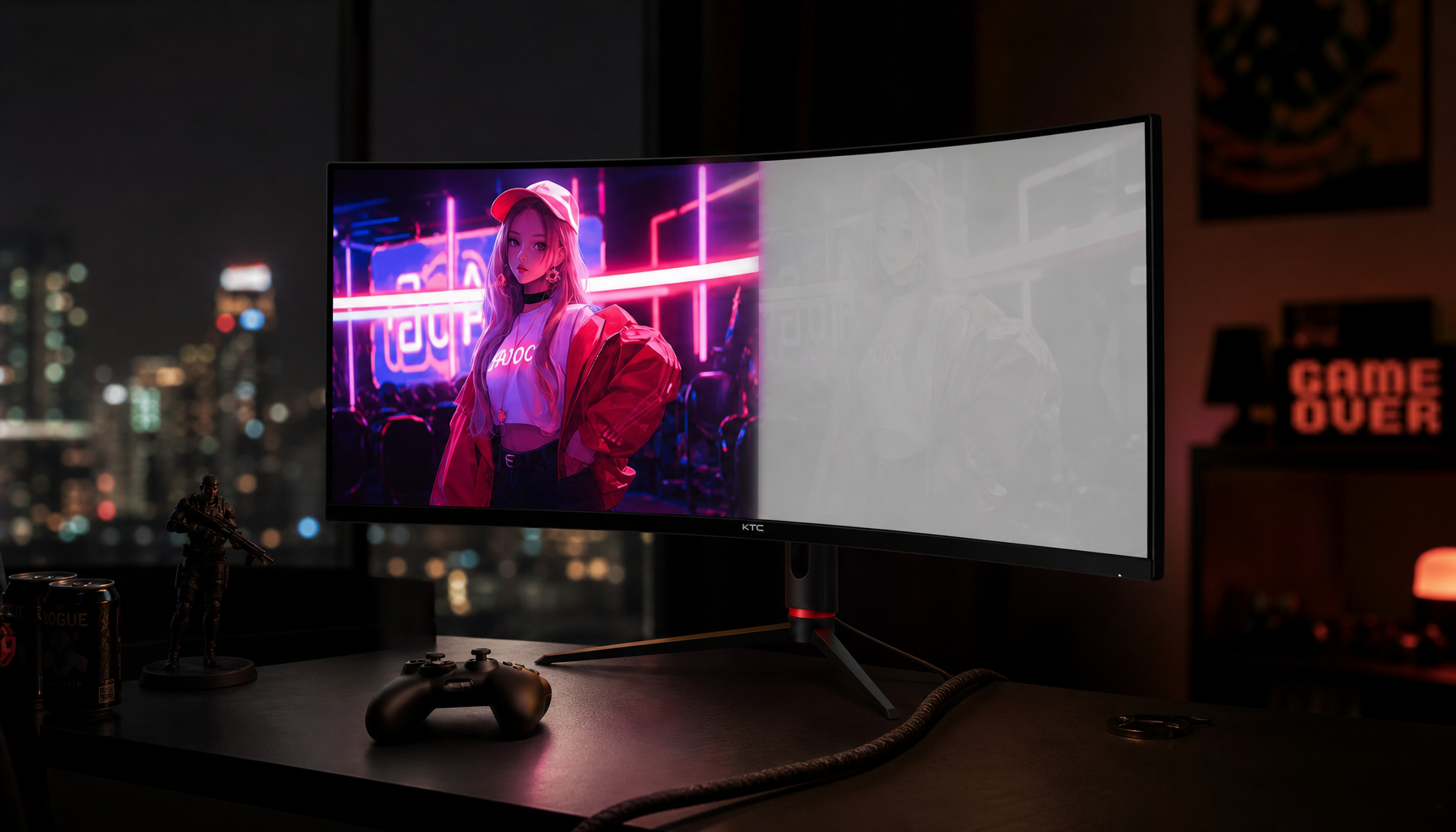
Standard sRGB monitors often compress the rich, non-realistic palettes that define JRPGs. These games draw on color theory traditions from the 1990s that favor saturated hues to establish mood, identity, and magic. When a display is limited to roughly 70% of the DCI-P3 space, deep crimsons in fire spells or emerald forests lose their punch, turning lush backgrounds into flatter, less distinctive scenes.
The result is the classic "muted hero" problem: protagonists and key environments lose the bold artistic identity that makes JRPGs memorable. In dark-room cinematic play, this compression is especially noticeable because there is no ambient light to mask the shortfall. For story-driven single-player fans who value immersion over competitive frame rates, this is usually the first signal that a monitor upgrade could meaningfully improve the experience.
How Quantum Dot Technology Restores Stylized Color Palettes
Quantum Dot technology uses semiconductor nanocrystals that, when excited by a blue LED backlight, emit highly pure red and green light. This approach bypasses the broader, muddier emission of traditional phosphors, enabling significantly wider color gamuts and better efficiency. As explained in technical literature on the mechanism, the precise tuning of these nanocrystals is what allows modern panels to reach up to 98% DCI-P3 coverage on models like the KTC Mini LED 27" 4K 160Hz HDR1400 Gaming Monitor | M27P6.

That expanded gamut translates directly to JRPG visuals. Anime-style sky gradients and particle-heavy spell effects benefit from the smoother 10-bit color support, which prevents banding in subtle transitions. For most players, the practical takeaway is that a Quantum Dot panel can restore the vivid, painterly look that standard monitors compress, but only when the rest of the display stack (backlight, color management) supports it.
This is also where an sRGB clamp becomes relevant for older or remastered titles mastered strictly in the sRGB space. Without it, the extra saturation can push skin tones into unnatural neon territory. Checking for this feature is a quick self-check before purchase if your library includes many classic or SDR-focused JRPGs.
For deeper background on why wide gamut changes the gaming experience overall, see our guide on Why a Wide Color Gamut Matters for Gamers?. The same principles apply here, but JRPGs emphasize artistic fidelity over competitive speed.
Color Volume vs. Gamut: Which Matters More for Spell Effects?
Gamut describes the two-dimensional range of hues a monitor can produce. Color volume adds the third dimension of brightness: it measures how saturated those hues remain when the screen is putting out high nits. In HDR-enabled JRPGs, bright magical particles, sunbeams through forest canopies, or glowing runes often hit peak luminance. Without sufficient color volume, those effects desaturate into pale or grayish blobs.
Official VESA DisplayHDR standards recognize this by requiring high DCI-P3 coverage (typically 95% or better for the 1400 tier) alongside strong brightness and local dimming performance. A panel that scores well on gamut alone but lacks volume will still disappoint in the very moments JRPGs use to create wonder.
Mini-LED backlighting pairs naturally with Quantum Dot because the high number of dimming zones preserves deep blacks in dungeons while letting highlights stay colorful. This combination prevents the "washed-out" look common in atmospheric scenes. Our earlier article on Mini-LED IPS vs. Standard IPS: Is the Advanced Backlight Worth the Upgrade? explores the contrast side of this equation in more detail.
JRPG Panel Trade-Offs by Tier
A tiered comparison of how panel type changes HDR color volume, SDR gamut coverage, peak brightness impact, and JRPG fit. The chart emphasizes buying trade-offs: HDR spell effects and atmospheric scenes benefit most from higher color volume and brightness, while SDR use can still be limited by sRGB clamping.
View chart data
| Scenario | Color Volume (HDR) | Gamut Coverage (SDR) | Peak Brightness Impact | JRPG Suitability |
|---|---|---|---|---|
| Standard IPS | 1.0 | 2.0 | 1.0 | 2.0 |
| QD-IPS | 2.0 | 3.0 | 2.0 | 3.0 |
| QD-Mini-LED | 3.0 | 3.0 | 3.0 | 3.0 |
The heatmap above summarizes the practical trade-offs using safe, relative tiers. Standard IPS sits at the baseline, QD-IPS improves color significantly, and QD-Mini-LED delivers the strongest combination for modern HDR JRPGs. The pattern holds most clearly in dark-room play of titles heavy with particle effects or high-contrast fantasy environments.
Taming the Neon: When to Use an sRGB Clamp for SDR JRPGs
Many wide-gamut monitors stretch SDR content beyond its original mastering, producing the familiar "neon skin" effect where character complexions look unnaturally orange or oversaturated. This happens because classic and remastered JRPGs were created for the smaller sRGB color space. An sRGB clamp or emulation mode restricts the panel output to match that intent, preserving the intended painterly look instead of pushing every hue to its technical maximum.
The decision is not universal. Some players prefer the extra vibrancy of native mode for certain stylized titles, accepting a slight departure from accuracy. For most JRPG enthusiasts, however, the clamp is the safer default for legacy libraries. Our calibration guide walks through how to check and adjust these modes in five practical steps.
Is Quantum Dot Enough? Choosing Between IPS and Mini-LED Panels
Quantum Dot improves color purity and volume, but it does not address motion clarity, input lag, or native contrast on its own. If your playtime leans heavily toward competitive multiplayer rather than story-driven RPGs, higher refresh rate and faster response times may deliver more noticeable gains than color alone.
For JRPG-focused buyers, the pairing with Mini-LED backlighting is usually the decisive upgrade. A standard QD-IPS panel (such as the H27E6) can deliver strong saturation at a lower price, yet it often struggles with black levels in atmospheric dungeons or during night-time sequences. Models like the KTC Mini LED 27" 180Hz 2K HDR1400 Gaming Monitor | M27T6 or the M27P6 add hundreds of local dimming zones that keep shadows deep while letting colorful highlights remain vivid.
A useful decision filter is your preferred sub-genre. Bright, colorful anime-style games tolerate standard QD-IPS well. Dark fantasy or open-world titles with heavy contrast (think Xenoblade-style vistas or Persona night scenes) benefit more from the Mini-LED version. Our comparison of monitor types by game genre provides additional context on matching a display to your favorite titles.
If you are weighing self-emissive versus backlight technologies, the MiniLED vs. OLED monitor comparison clarifies the remaining trade-offs around burn-in risk, brightness, and text clarity.
Optimizing Your Setup: Calibration for Vibrant JRPG Art
Once the hardware is in place, a few targeted adjustments unlock the full aesthetic potential. Start by enabling 10-bit color output in your graphics driver and setting the monitor to an HDR mode that matches your game’s capabilities. For the M27P6 or M27T6S, the “Cinema” or “HDR Movie” preset often provides a balanced starting point before fine-tuning.
Use the built-in sRGB clamp for any non-HDR JRPG. Then run Windows HDR Calibration or a similar tool to set the tone-mapping curve so bright spell effects retain saturation instead of clipping. Slight reductions in saturation slider (around 5-10%) can further tame any remaining neon while keeping the overall vibrancy that makes these games special.
For bit-depth background, our article on 8-bit vs 10-bit displays explains why the extra colors matter most for gradient-heavy anime skies and magic effects.
The final practical step is to revisit settings after a week of play. Room lighting, game updates, and personal taste all influence the ideal balance. The goal is not maximum saturation but faithful reproduction of the developer’s artistic intent.
FAQs
Do Quantum Dot monitors automatically make all JRPGs look better?
Not automatically. They improve color volume and saturation for HDR titles, but SDR games still require an sRGB clamp to avoid unnatural oversaturation. Without proper color management or sufficient contrast from Mini-LED or OLED, the extra gamut can sometimes look worse than a well-calibrated standard panel. Check your specific game library and monitor features before assuming an upgrade will be universally positive.
Is an sRGB clamp necessary for modern JRPGs?
It depends on whether the title uses HDR. Newer releases that output in wide gamut benefit from native mode. Older remasters or strictly SDR engines often look more accurate with the clamp engaged. Most high-end Quantum Dot monitors now include this option; test both modes with your favorite characters to decide which respects the original art direction.
Does higher DCI-P3 coverage guarantee better spell effects?
Coverage is only part of the picture. Color volume, which measures saturation at high brightness, matters more for bright particle effects that can otherwise wash out. Look for DisplayHDR 1000 or 1400 certification alongside high DCI-P3 numbers if vibrant magic and environmental highlights are priorities.
Should I choose a QD-IPS or QD-Mini-LED monitor for JRPGs?
Choose QD-Mini-LED when you play in dark rooms or value deep blacks alongside colorful highlights. QD-IPS offers excellent color at a lower price and is often sufficient for brighter, anime-heavy games. The Mini-LED version is the stronger long-term fit for atmospheric or high-contrast JRPGs.
Can I use a Quantum Dot monitor for competitive games too?
Yes, but the color advantages will be less noticeable than high refresh rate, low input lag, and fast pixel response. If you split time between story-driven JRPGs and fast-paced multiplayer, a Mini-LED QD model with 160 Hz or higher can serve both purposes without major compromise.
How do I calibrate a new Quantum Dot monitor for JRPGs?
Begin with the manufacturer’s HDR or Cinema preset, enable the sRGB clamp for non-HDR titles, and run the Windows HDR Calibration tool. Fine-tune saturation, gamma, and white balance while displaying reference scenes from your most-played game. Revisit the settings after a few sessions as your eyes adjust.
Is Quantum Dot technology enough by itself for great JRPG visuals?
It is a strong foundation for color but not a complete solution. Pairing with adequate local dimming (Mini-LED) and correct color management is necessary to avoid washed-out blacks or inaccurate SDR tones. For many dedicated JRPG players, the combination of Quantum Dot plus Mini-LED currently offers the best balance of vibrant art and atmospheric depth.